

Search.searchiforms.com is a search engine that is not giving positive value to the machine
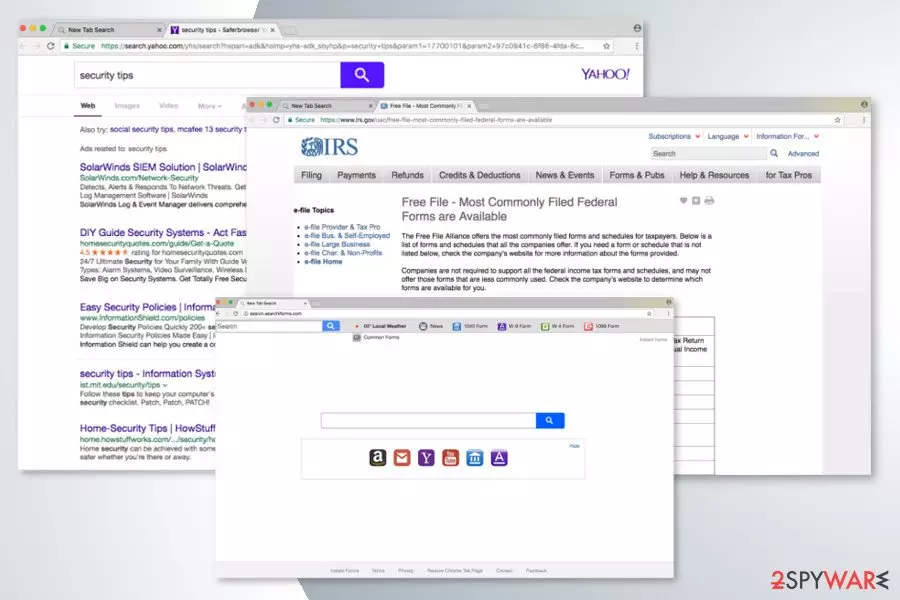
Search.searchiforms.com or Instant Forms extension is an unreliable search tool developed by Polarity Technologies Ltd. The company is known for creating numerous bogus search tools and promoting them as legitimate and helpful software. Actually, this particular browser hijacker is very similar to Search.renewitnow.co. Both of them promote quick links to various forms provided by the US Internal Revenue Service (IRS).[1]
So-called Search.searchiforms.com virus spreads in software bundles and might enter the system unnoticed. After the hijack, it might alter browser settings, make modifications in Windows Registry and install helper objects in order to prevent users from taking back control over their browsers. This potentially unwanted program (PUP) might set its domain as the start page, default search engine, and new tab address without asking the user’s permission.
| Name | Search.searchiforms.com |
|---|---|
| Type | Browser hijacker, PUP |
| Danger | The PUP is related to data tracking and third-party companies. Redirects can lead to possibly dangerous content online |
| Distribution | Freeware installations, PUPs, deceptive pages |
| Symptoms | Homepage, default search engine, new tab settings get changed, all searches get filled with ads |
| Elimination | You need help from anti-malware tools, so the system gets fully cleaned. The guide below also helps to deal with a PUP |
| Tips | Do not forget about issues that this PUP can trigger and rely on the browser guide below and tools like FortectIntego |
It might also start tracking browsing-related, personally and non-personally identifiable information for marketing purposes. As a result, you will find numerous commercial content while browsing the web. In order to avoid such inconveniences and possible threats, you need to remove Search.searchiforms.com from the computer.
The easier way to get rid of it is to use anti-malware tools like SpyHunterCombo Cleaner, MalwarebytesMalwarebytes, or another reputable security program. However, if you prefer the manual removal option, at the end of the article you will find illustrated guidelines.
The browser hijacker usually affects Chrome, Firefox, IE, and Edge web browsers. However, other browsers might suffer from the hijack as well. Nevertheless, this search engine delivers results from the Yahoo database; you should not rely on it. This program is used as a marketing tool that displays intrusive advertisements and redirects to promotional sites. Sadly, some of the redirect tendencies are concerning.
For instance, it might display misleading ads that offer fake discount coupons or warns about detected cyber infections on the computer and suggest installing removal software. However, such ads might lead to infected or potentially dangerous websites where you can get involved in an online scam. Thus, you should take care of the computer’s security and perform Search.searchiforms.com removal as soon as you spot the first pop-up or find this search toolset as your default homepage.

If you are still thinking about keeping Search.searchiforms.com as your default search engine, you should read the Terms of Use and Privacy Policy provided on the main page. These long and quite boring documents include crucial information related to your privacy and security.
When using this search tool, you agree that it collects information related to your browsing history and habits, some personal information (e.g. your name, email, etc.), geographic information, technical details about the operating system and browser, etc.
Besides, this program may also allow the installation of third-party tracking technologies. Aggregated details are used for advertising purposes or might be sold to other businesses or advertising networks. Thus, if you do not want to be bombarded with ads and want to protect your online privacy,[2] you should not get rid of Search.searchiforms.com immediately.
The hijacker spreads in software bundles
You can find Instant Forms extensions promoted in software packages together with other Polarity Technologies or Safer Browser products. Just like the majority of PUPs, this one is distributed using a bundling technique that allows adding and hiding this app under Quick/Standard installation settings. Developers of PUPs are aware that users always rely on this installation wizard that rarely discloses third-party software.
Thus, if you install freeware using these settings, you are risking encountering the hijack and allow downloading other useless apps. In order to avoid it, you need to opt for an Advanced/Custom setup and carefully follow each step. Make sure you untick pre-selected statements where you agree to make the suspicious site your default search engine.
Terminate Search.searchiforms.com quickly
If you are looking for a quick Search.searchiforms.com removal solution, you should install a reputable anti-malware program and scan the system with the help of it. If you have some security program installed on your device, you should update it and then run the system scan.
However, if the automatic elimination option doesn’t suit your needs and you are willing to get rid of the hijacker manually, you should check our prepared instructions. Follow them carefully in order to remove Search.searchiforms.com from the computer and all web browsers.
Uninstall from Windows
Uninstall from Windows 10/8:
- Type Control Panel into the Windows search box and open the result.
- Under Programs, select Uninstall a program.


Uninstall from Windows 7/XP:
- Click on Windows Start > Control Panel (Windows XP users should click on Add/Remove Programs).
- In Control Panel, select Programs > Uninstall a program.


Remove the unwanted program:
- In the Programs and Features window, look for any recently installed suspicious entries, select them, and click Uninstall.
- If User Account Control appears, click Yes to confirm, then complete the removal.


Delete from macOS
Remove the unwanted application:
- From the menu bar, select Go > Applications.
- In the Applications folder, look for any suspicious entries, then drag them to Trash (or right-click and pick Move to Trash).


Delete leftover files and folders:
- Select Go > Go to Folder.
- Enter /Library/Application Support and remove any suspicious folders related to the unwanted program.
- Repeat the same check in the /Library/LaunchAgents and /Library/LaunchDaemons folders, deleting any suspicious entries.

- Finally, empty the Trash to permanently remove the leftovers.

Remove from Microsoft Edge
Delete unwanted extensions from MS Edge:
- Select Menu (three horizontal dots at the top-right of the browser window) and pick Extensions.
- From the list, pick the extension and click on the Gear icon.
- Click Remove.


Clear cookies and other browser data:
- Click on the Menu (three horizontal dots at the top-right of the browser window) and select Settings > Privacy, search, and services..
- Under Clear browsing data, pick Choose what to clear.
- Select Cookies and other site data and Cached images and files. (apart from passwords, although you might want to include Media licenses as well, if applicable) and click on Clear.


Restore new tab and homepage settings:
- Click the menu icon and choose Settings.
- Then find On startup section.
- Click Remove next to any suspicious startup page.
Reset MS Edge if the above steps did not work:
- Press on Ctrl + Shift + Esc to open Task Manager.
- Click on More details arrow at the bottom of the window.
- Select Details tab.
- Now scroll down and locate every entry with Microsoft Edge name in it. Right-click on each of them and select End Task to stop MS Edge from running.


Instructions for Chromium-based Edge
Delete extensions from MS Edge (Chromium):
- Open Edge and click select Settings > Extensions.
- Delete unwanted extensions by clicking Remove.


Clear cache and site data:
- Click on Menu and go to Settings.
- Select Privacy, search and services.
- Under Clear browsing data, pick Choose what to clear.
- Under Time range, pick All time.
- Select Clear now.


Reset Chromium-based MS Edge:
- Click on Menu and select Settings.
- On the left side, pick Reset settings.
- Select Restore settings to their default values.
- Confirm with Reset.
- This will disable extensions and reset startup pages but will not delete bookmarks, saved passwords, or browsing history.


Remove from Mozilla Firefox (FF)
Remove dangerous extensions:
- Open Mozilla Firefox browser and click on the Menu (three horizontal lines at the top-right of the window).
- Select Add-ons.
- In here, select the unwanted extension and click Remove.


Reset the homepage:
- Click three horizontal lines at the top right corner to open the menu.
- Choose Settings.
- Under Home, set your preferred homepage and new tab settings.
Clear cookies and site data:
- Click Menu and pick Settings.
- Go to Privacy & Security section.
- Scroll down to locate Cookies and Site Data.
- Click on Clear Data...
- Select Cookies and Site Data and Temporary cached files and pages, then click Clear.


Reset Mozilla Firefox
If clearing the browser as explained above did not help, reset Mozilla Firefox:
- Open Mozilla Firefox browser and click the Menu.
- Go to Help and then choose Troubleshooting Information.

- Under Give Firefox a tune up section, click on Refresh Firefox...
- Once the pop-up shows up, confirm the action by pressing on Refresh Firefox.



Remove from Google Chrome
Delete malicious extensions from Google Chrome:
- Open Google Chrome, click on the Menu (three vertical dots at the top-right corner) and select More tools > Extensions.
- In the newly opened window, you will see all the installed extensions. Uninstall all suspicious extensions related to the unwanted program by clicking Remove.


Clear cache and web data from Chrome:
- Click on Menu and pick Settings.
- Under Privacy and security, select Clear browsing data.
- Select Browsing history, Cookies and other site data, as well as Cached images and files.
- Click Clear data.


Change your homepage:
- Click menu and choose Settings.
- Look for a suspicious site in the On startup section.
- Click on Open a specific or set of pages and click on three dots to find the Remove option.
Reset Google Chrome:
If the previous methods did not help you, reset Google Chrome to eliminate all the unwanted components:
- Click on Menu and select Settings.
- In the Settings, scroll down and click Advanced.
- Scroll down and locate Reset and clean up section.
- Now click Restore settings to their original defaults.
- Confirm with Reset settings.


Delete from Safari
Remove dangerous extensions:
- Open Safari, click Safari in the menu at the top-left of the screen, and select Preferences.
- Go to the Extensions tab, look for any suspicious entries, and click Uninstall to remove them.


Clear history and website data:
- Click Safari in the menu and pick Clear History.
- Set Clear to all history and confirm with Clear History.


Reset Safari:
- Click Safari in the menu and select Preferences > Advanced.
- Enable Show Develop menu in menu bar.
- From the menu bar, click Develop and select Empty Caches.


Did this guide help?
Be the first to comment