

Error Virus – trojan backdoor hijack scam scares netizens with DDV.YahLover trojan and Zeus virus
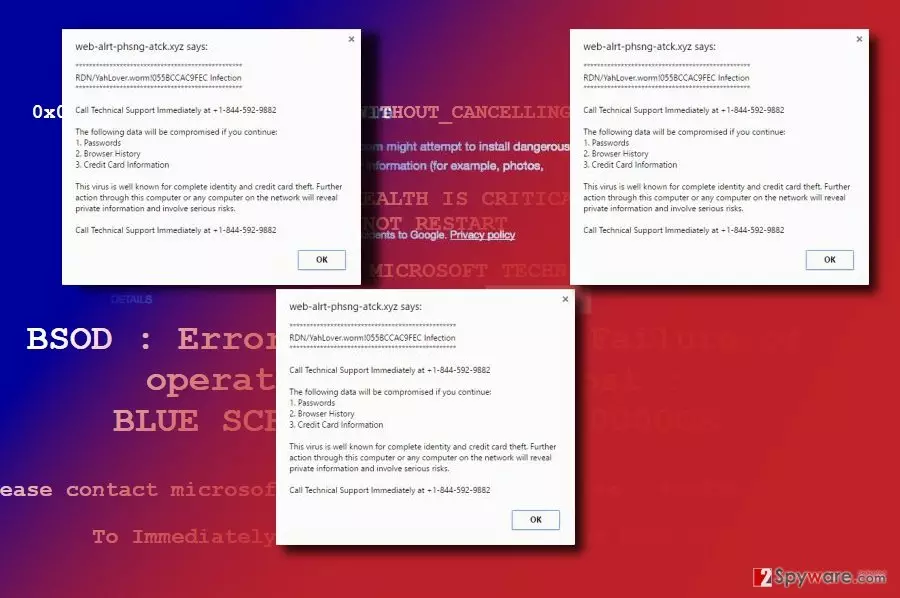
Error Virus – Trojan Backdoor Hijack Scam operates as the browser-based tech support scam.[1] It alarms users that their computers have been infected with the notorious Zeus trojan and YahLover trojan.
In order to protect your computer from these threats, the message indicates the number of (877) 416-1456. If you contact the supposed technician, he or she will help to eliminate the infection and lower the risk of the virus.
Fraudsters often employ psychological pressure to force users to behave according to their scenario. This threat is merely a browser-based scam, so no serious malware has infected the PC. Instead of complying with their demands, focus on Error Virus – trojan backdoor scam removal. FortectIntego or MalwarebytesMalwarebytes will be or service in such procedure.
Browser-based scams top the overall scam rates
Tech support scams comprise a significant share in the overall computer virus rates along with ransomware, adware and browser hijackers. There are such support scams which imitate Microsoft alerts and paralyze the activity of the device.
Browser-based scam are less troublesome as they can be terminated by exiting the respective page simply by clicking Prevent this page from creating additional dialogs.
Furthermore, the key essence of such scams is psychological terror rather than actual technical capabilities.
Error Virus – trojan backdoor hijack is no different as well. Indeed, the very threats, Zeus[2] and RDn/YahLover, wreaked global havoc. In comparison, this scam is far less destructive that the mentioned malware.
While it functions via web scripts, this scam is not capable of stealing your information. It only functions on users’ fears.
Let us warn you not to dial any provided numbers as you can simply make matters worse. The supposed technician will cram you with unnecessary technical information to earn your trust.
You may waste hundreds of dollars only to find out that the crook removed the adware or the fake alert. Thus, remove Error Virus – trojan backdoor hijack scam right away.
Ways to block the scam
Even if you are very cautious while browsing the Web, you may still experience the annoying effects of Error Virus – trojan backdoor redirect.
The script of this scam is usually placed on gaming or web pages crowded with ads or links to adult content web sites. Clicking on such ad might direct you to the website and then the supposed “Error Virus – trojan backdoor hijack” takes place.
While cautiousness and attention, indeed play an important role, in order to prevent more troublesome effects, you should install an anti-spyware tool to raise the overall protection of the computer and block the cyber attack of such browser-based scams.
Error Virus – trojan backdoor hijack termination guide
As we mentioned, do not waste time on playing according to felons‘ scenario, but instead initiate Error Virus – trojan backdoor hijack removal. Let malware elimination utility to deal with the infection. The software takes only a couple of minutes to remove Error Virus – trojan backdoor hijack scripts.
You may also make use of the below instructions and eliminate the cookies or other tracking tools associated with this scam. Even if you ever encounter a PC-based scam, do not follow its instructions and look for alternative solutions.
Uninstall from Windows
Uninstall from Windows 10/8:
- Type Control Panel into the Windows search box and open the result.
- Under Programs, select Uninstall a program.


Uninstall from Windows 7/XP:
- Click on Windows Start > Control Panel (Windows XP users should click on Add/Remove Programs).
- In Control Panel, select Programs > Uninstall a program.


Remove the unwanted program:
- In the Programs and Features window, look for any recently installed suspicious entries, select them, and click Uninstall.
- If User Account Control appears, click Yes to confirm, then complete the removal.


Delete from macOS
Remove the unwanted application:
- From the menu bar, select Go > Applications.
- In the Applications folder, look for any suspicious entries, then drag them to Trash (or right-click and pick Move to Trash).


Delete leftover files and folders:
- Select Go > Go to Folder.
- Enter /Library/Application Support and remove any suspicious folders related to the unwanted program.
- Repeat the same check in the /Library/LaunchAgents and /Library/LaunchDaemons folders, deleting any suspicious entries.

- Finally, empty the Trash to permanently remove the leftovers.

Reset Internet Explorer
Remove dangerous add-ons:
- Open Internet Explorer, click on the Gear icon (IE menu) on the top-right corner of the browser
- Pick Manage Add-ons.
- You will see a Manage Add-ons window. Here, look for suspicious plugins. Click on these entries and select Disable.


Change your homepage if it was altered:
- Open IE and click on the Gear icon.
- Select Internet Options.
- In the General tab, delete the Home page address and replace it by your preferred one (for example, Google.com).
- Click Apply and then select OK.


Delete temporary files:
- Press on the Gear icon and select Internet Options.
- Under Browsing history, click Delete...
- Select relevant fields and press Delete.


Reset Internet Explorer:
- Click on Gear icon > Internet options and select Advanced tab.
- Select Reset.
- In the new window, check Delete personal settings and select Reset.


Remove from Microsoft Edge
Delete unwanted extensions from MS Edge:
- Select Menu (three horizontal dots at the top-right of the browser window) and pick Extensions.
- From the list, pick the extension and click on the Gear icon.
- Click Remove.


Clear cookies and other browser data:
- Click on the Menu (three horizontal dots at the top-right of the browser window) and select Settings > Privacy, search, and services..
- Under Clear browsing data, pick Choose what to clear.
- Select Cookies and other site data and Cached images and files. (apart from passwords, although you might want to include Media licenses as well, if applicable) and click on Clear.


Restore new tab and homepage settings:
- Click the menu icon and choose Settings.
- Then find On startup section.
- Click Remove next to any suspicious startup page.
Reset MS Edge if the above steps did not work:
- Press on Ctrl + Shift + Esc to open Task Manager.
- Click on More details arrow at the bottom of the window.
- Select Details tab.
- Now scroll down and locate every entry with Microsoft Edge name in it. Right-click on each of them and select End Task to stop MS Edge from running.


Instructions for Chromium-based Edge
Delete extensions from MS Edge (Chromium):
- Open Edge and click select Settings > Extensions.
- Delete unwanted extensions by clicking Remove.


Clear cache and site data:
- Click on Menu and go to Settings.
- Select Privacy, search and services.
- Under Clear browsing data, pick Choose what to clear.
- Under Time range, pick All time.
- Select Clear now.


Reset Chromium-based MS Edge:
- Click on Menu and select Settings.
- On the left side, pick Reset settings.
- Select Restore settings to their default values.
- Confirm with Reset.
- This will disable extensions and reset startup pages but will not delete bookmarks, saved passwords, or browsing history.


Remove from Mozilla Firefox (FF)
Remove dangerous extensions:
- Open Mozilla Firefox browser and click on the Menu (three horizontal lines at the top-right of the window).
- Select Add-ons.
- In here, select the unwanted extension and click Remove.


Reset the homepage:
- Click three horizontal lines at the top right corner to open the menu.
- Choose Settings.
- Under Home, set your preferred homepage and new tab settings.
Clear cookies and site data:
- Click Menu and pick Settings.
- Go to Privacy & Security section.
- Scroll down to locate Cookies and Site Data.
- Click on Clear Data...
- Select Cookies and Site Data and Temporary cached files and pages, then click Clear.


Reset Mozilla Firefox
If clearing the browser as explained above did not help, reset Mozilla Firefox:
- Open Mozilla Firefox browser and click the Menu.
- Go to Help and then choose Troubleshooting Information.

- Under Give Firefox a tune up section, click on Refresh Firefox...
- Once the pop-up shows up, confirm the action by pressing on Refresh Firefox.



Remove from Google Chrome
Delete malicious extensions from Google Chrome:
- Open Google Chrome, click on the Menu (three vertical dots at the top-right corner) and select More tools > Extensions.
- In the newly opened window, you will see all the installed extensions. Uninstall all suspicious extensions related to the unwanted program by clicking Remove.


Clear cache and web data from Chrome:
- Click on Menu and pick Settings.
- Under Privacy and security, select Clear browsing data.
- Select Browsing history, Cookies and other site data, as well as Cached images and files.
- Click Clear data.


Change your homepage:
- Click menu and choose Settings.
- Look for a suspicious site in the On startup section.
- Click on Open a specific or set of pages and click on three dots to find the Remove option.
Reset Google Chrome:
If the previous methods did not help you, reset Google Chrome to eliminate all the unwanted components:
- Click on Menu and select Settings.
- In the Settings, scroll down and click Advanced.
- Scroll down and locate Reset and clean up section.
- Now click Restore settings to their original defaults.
- Confirm with Reset settings.


Delete from Safari
Remove dangerous extensions:
- Open Safari, click Safari in the menu at the top-left of the screen, and select Preferences.
- Go to the Extensions tab, look for any suspicious entries, and click Uninstall to remove them.


Clear history and website data:
- Click Safari in the menu and pick Clear History.
- Set Clear to all history and confirm with Clear History.


Reset Safari:
- Click Safari in the menu and select Preferences > Advanced.
- Enable Show Develop menu in menu bar.
- From the menu bar, click Develop and select Empty Caches.


Did this guide help?
Be the first to comment