

Searchitnow.info virus is a browser hijacker that typically targets Mac users

Searchitnow.info is an unreliable search engine and a browser hijacker that changes the new tab address, homepage and search engine of Safari, Google Chrome and Mozilla Firefox on host computers. This potentially unwanted program is spread with the help of bogus Flash Player updates as a SearchItNow application or via insecure websites. When searches are performed, users are instantaneously redirected to goto-searchitnow.global.ssl.fastly.net and then to a different search engine, such as baysearch.co or alphashoppers.co, or others. The main purpose of Searchitnow.info virus is to generate revenue for its developers and their partners by littering the search results with sponsored links, redirecting users to questionable sites and tracking various anonymous or personal information. The browser hijacker usually targets Mac users, although Windows devices might be affected as well.
| SUMMARY | |
| Name | Searchitnow.info |
| Type | Browser hijacker |
| Redirects searches to | AlphaShoppers, Bay Search, etc. |
| Distribution | Software bundling |
| Symptoms | Altered search engine, homepage and new tab address; intrusive ads; modified search results |
| Elimination | Use our instructions below and then scan your computer with FortectIntego for optimal results |
Searchitnow.info is categorized as a browser hijacker due to the following reasons[1]:
- Ability to stealthily assign hxxps://searchitnow.info as a default search engine, new tab URL, and
- homepage;
- Ability to reassign the browser settings mentioned above to the fake search engine every time user attempts to change it;
- “Bundling” distribution method used to secretly infiltrate the hijacker on the computer;
- Impersonation of AlphaShoppers to generate revenue.
The Searchitnow.info removal might get complicated because once the user installs the potentially unwanted program (PUP), he or she is not able to get rid of it — the browser hijacker is designed to insist on using its services daily and prevent the elimination of it. People are annoyed by this arbitrary behavior and recognize it as a virus.
At this point we want to inform you that Searchitnow.info is not a malicious program, but it collects browsing-related data. If you submit personal details in the search bar, you risk your privacy since developers have full access to this information and might sell it to third-party companies.

Moreover, Search It Now is created to display sponsored ads which generate revenue[2]. They look attractive and lure people into clicking on them. This leads to increase in profits for Searchitnow.info developers. It may seem completely legit, but those ads might redirect you to vague pages used to distribute malware and other high-risk computer infections.
Finally, we checked the Privacy Policy of the program, and found the following information about data collection:[3]
In addition, we may share your information with a parent company, subsidiaries, joint ventures, or other companies under common control solely if and when applicable or necessary for the purposes described in this Privacy Policy. We may share information, in the event of a corporate transaction (e.g. sale of a substantial part of our business, merger, consolidation or asset sale), provided however, that our affiliated companies or acquiring company will assume the rights and obligations as described in this Privacy Policy;
Therefore, by using Searchitnow.info services, you allow your private data to be transferred under certain circumstances. Please beware that such behavior might result in identity theft or stolen money.
Thus, we strongly recommend you to remove Searchitnow.info browser hijacker and protect your computer as well as yourself. You can do that by using a professional security software — FortectIntego — would be our top pick.

Browser hijacker comes in one download/installation package together with free software
Researchers from Virusi.hr[4] warn that potentially unwanted programs (PUPs) such as Searchitnow are bundled with third-party applications. Therefore, people unconsciously install it on their computer. You shouldn’t rush through the process and carefully monitor it.
Opt for Custom/Advanced settings since then you will be able to detect the hijacker and remove all pre-selected optional components. If you would select Recommended/Quick settings, this step would be automatically skipped. Also, you should avoid clicking on ads because even accidental clicks might lead to the automatic installation of other malware.
Learn to uninstall Searchitnow.info virus from your PC
Do not try to eliminate the potentially unwanted program (PUP) by yourself. Our IT professionals have prepared detailed instructions which you can find at the end of this article. Use them to remove Searchitnow.info virus – they are easy and quick to use. Make sure to carefully follow them in order to avoid disrupting your computer’s performance.
However, we would recommend you to employ a reputable anti-malware system to save your time and possible problems. It is not easy to start a Searchitnow.info removal if you do not have necessary IT knowledge. Thus, download a security software and let it do the job for you.
Uninstall from Windows
Uninstall from Windows 10/8:
- Type Control Panel into the Windows search box and open the result.
- Under Programs, select Uninstall a program.


Uninstall from Windows 7/XP:
- Click on Windows Start > Control Panel (Windows XP users should click on Add/Remove Programs).
- In Control Panel, select Programs > Uninstall a program.


Remove the unwanted program:
- In the Programs and Features window, look for any recently installed suspicious entries, select them, and click Uninstall.
- If User Account Control appears, click Yes to confirm, then complete the removal.


Delete from macOS
Remove the unwanted application:
- From the menu bar, select Go > Applications.
- In the Applications folder, look for any suspicious entries, then drag them to Trash (or right-click and pick Move to Trash).


Delete leftover files and folders:
- Select Go > Go to Folder.
- Enter /Library/Application Support and remove any suspicious folders related to the unwanted program.
- Repeat the same check in the /Library/LaunchAgents and /Library/LaunchDaemons folders, deleting any suspicious entries.

- Finally, empty the Trash to permanently remove the leftovers.

Reset Internet Explorer
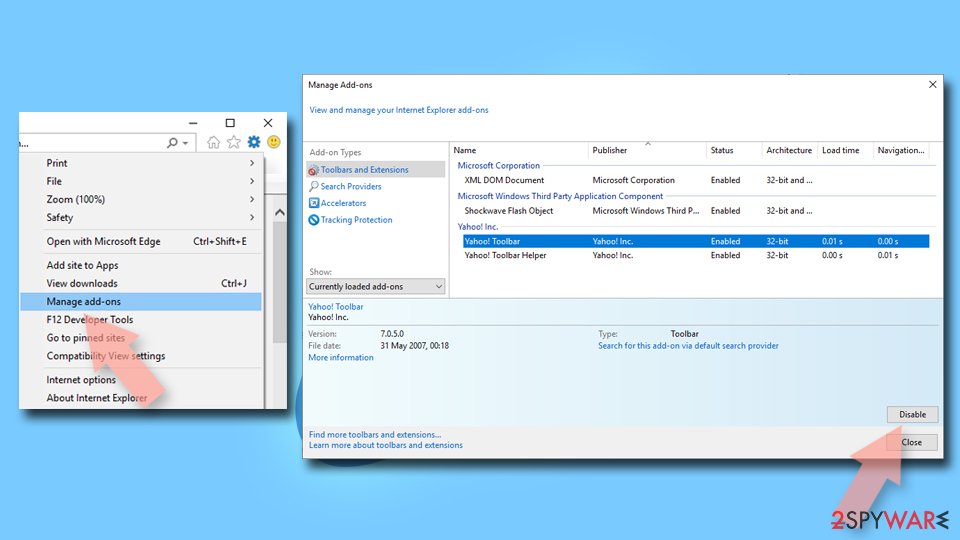
Remove dangerous add-ons:
- Open Internet Explorer, click on the Gear icon (IE menu) on the top-right corner of the browser
- Pick Manage Add-ons.
- You will see a Manage Add-ons window. Here, look for suspicious plugins. Click on these entries and select Disable.

Change your homepage if it was altered:
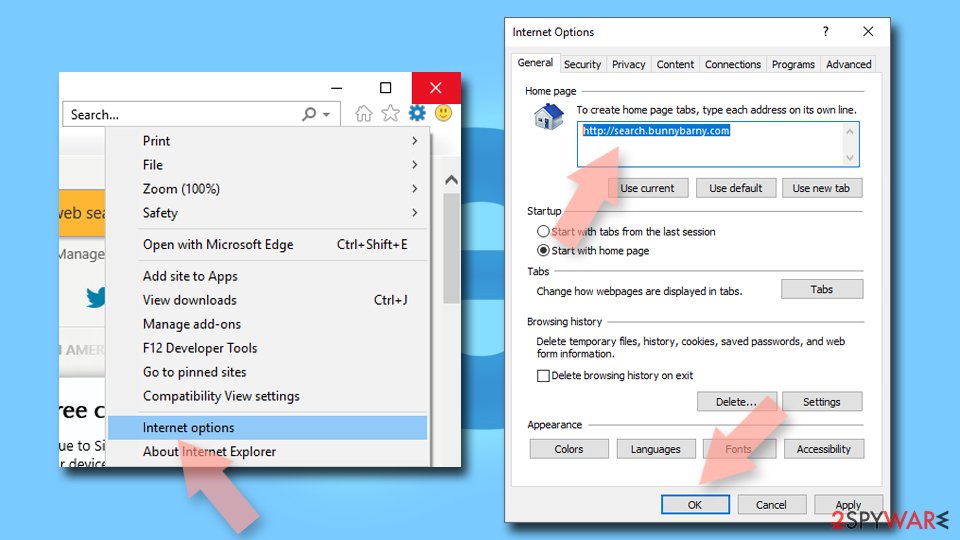
- Open IE and click on the Gear icon.
- Select Internet Options.
- In the General tab, delete the Home page address and replace it by your preferred one (for example, Google.com).
- Click Apply and then select OK.

Delete temporary files:
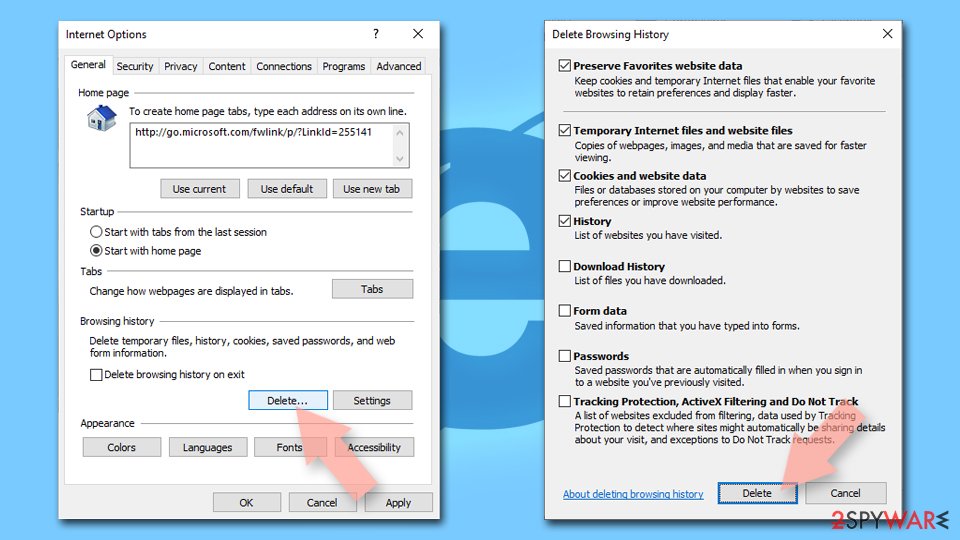
- Press on the Gear icon and select Internet Options.
- Under Browsing history, click Delete...
- Select relevant fields and press Delete.

Reset Internet Explorer:
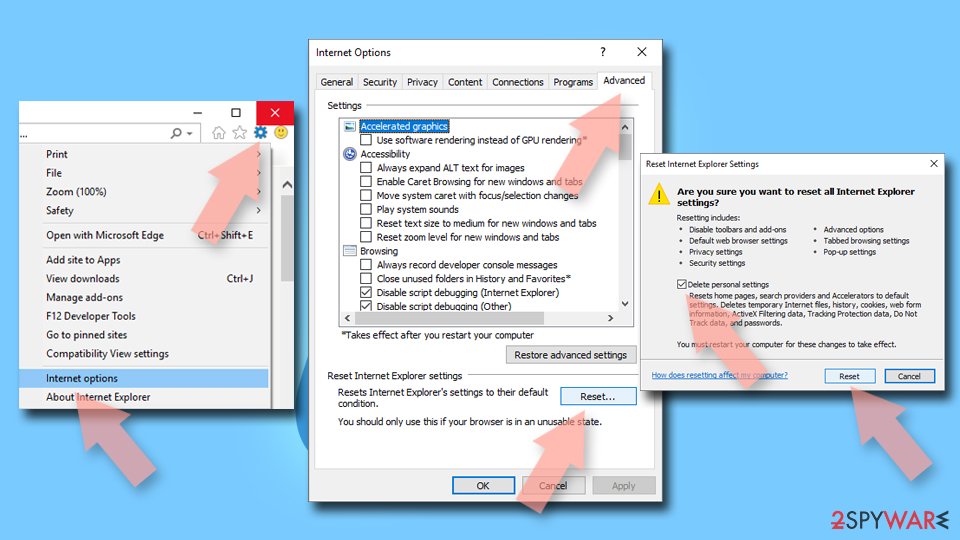
- Click on Gear icon > Internet options and select Advanced tab.
- Select Reset.
- In the new window, check Delete personal settings and select Reset.

Remove from Microsoft Edge
Delete unwanted extensions from MS Edge:
- Select Menu (three horizontal dots at the top-right of the browser window) and pick Extensions.
- From the list, pick the extension and click on the Gear icon.
- Click Remove.


Clear cookies and other browser data:
- Click on the Menu (three horizontal dots at the top-right of the browser window) and select Settings > Privacy, search, and services..
- Under Clear browsing data, pick Choose what to clear.
- Select Cookies and other site data and Cached images and files. (apart from passwords, although you might want to include Media licenses as well, if applicable) and click on Clear.


Restore new tab and homepage settings:
- Click the menu icon and choose Settings.
- Then find On startup section.
- Click Remove next to any suspicious startup page.
Reset MS Edge if the above steps did not work:
- Press on Ctrl + Shift + Esc to open Task Manager.
- Click on More details arrow at the bottom of the window.
- Select Details tab.
- Now scroll down and locate every entry with Microsoft Edge name in it. Right-click on each of them and select End Task to stop MS Edge from running.


Instructions for Chromium-based Edge
Delete extensions from MS Edge (Chromium):
- Open Edge and click select Settings > Extensions.
- Delete unwanted extensions by clicking Remove.


Clear cache and site data:
- Click on Menu and go to Settings.
- Select Privacy, search and services.
- Under Clear browsing data, pick Choose what to clear.
- Under Time range, pick All time.
- Select Clear now.


Reset Chromium-based MS Edge:
- Click on Menu and select Settings.
- On the left side, pick Reset settings.
- Select Restore settings to their default values.
- Confirm with Reset.
- This will disable extensions and reset startup pages but will not delete bookmarks, saved passwords, or browsing history.


Remove from Mozilla Firefox (FF)
Remove dangerous extensions:
- Open Mozilla Firefox browser and click on the Menu (three horizontal lines at the top-right of the window).
- Select Add-ons.
- In here, select the unwanted extension and click Remove.


Reset the homepage:
- Click three horizontal lines at the top right corner to open the menu.
- Choose Settings.
- Under Home, set your preferred homepage and new tab settings.
Clear cookies and site data:
- Click Menu and pick Settings.
- Go to Privacy & Security section.
- Scroll down to locate Cookies and Site Data.
- Click on Clear Data...
- Select Cookies and Site Data and Temporary cached files and pages, then click Clear.


Reset Mozilla Firefox
If clearing the browser as explained above did not help, reset Mozilla Firefox:
- Open Mozilla Firefox browser and click the Menu.
- Go to Help and then choose Troubleshooting Information.

- Under Give Firefox a tune up section, click on Refresh Firefox...
- Once the pop-up shows up, confirm the action by pressing on Refresh Firefox.



Remove from Google Chrome
Delete malicious extensions from Google Chrome:
- Open Google Chrome, click on the Menu (three vertical dots at the top-right corner) and select More tools > Extensions.
- In the newly opened window, you will see all the installed extensions. Uninstall all suspicious extensions related to the unwanted program by clicking Remove.


Clear cache and web data from Chrome:
- Click on Menu and pick Settings.
- Under Privacy and security, select Clear browsing data.
- Select Browsing history, Cookies and other site data, as well as Cached images and files.
- Click Clear data.


Change your homepage:
- Click menu and choose Settings.
- Look for a suspicious site in the On startup section.
- Click on Open a specific or set of pages and click on three dots to find the Remove option.
Reset Google Chrome:
If the previous methods did not help you, reset Google Chrome to eliminate all the unwanted components:
- Click on Menu and select Settings.
- In the Settings, scroll down and click Advanced.
- Scroll down and locate Reset and clean up section.
- Now click Restore settings to their original defaults.
- Confirm with Reset settings.


Delete from Safari
Remove dangerous extensions:
- Open Safari, click Safari in the menu at the top-left of the screen, and select Preferences.
- Go to the Extensions tab, look for any suspicious entries, and click Uninstall to remove them.


Clear history and website data:
- Click Safari in the menu and pick Clear History.
- Set Clear to all history and confirm with Clear History.


Reset Safari:
- Click Safari in the menu and select Preferences > Advanced.
- Enable Show Develop menu in menu bar.
- From the menu bar, click Develop and select Empty Caches.


Did this guide help?
Be the first to comment