

Search.searchddn.com is a browser hijacker that may steal people's browsing history
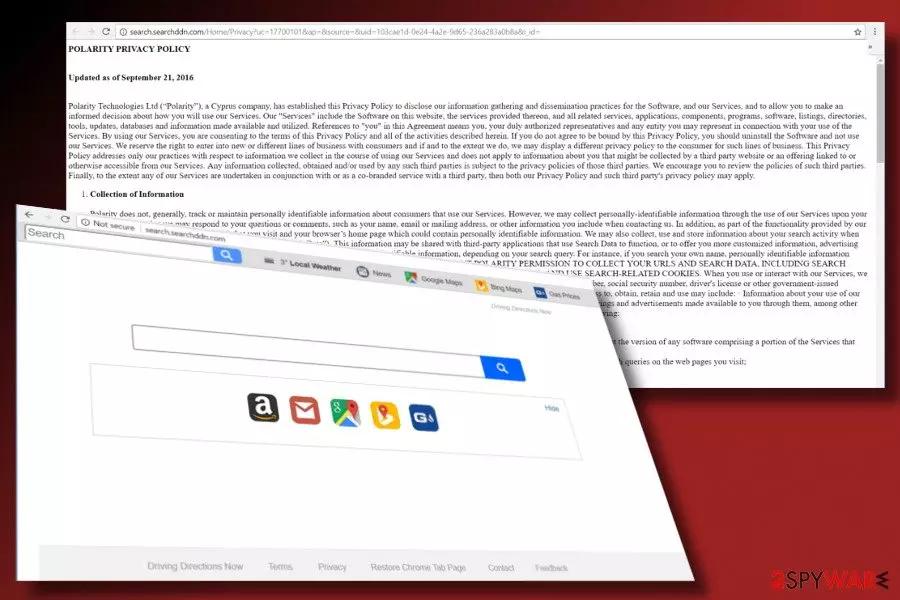
Search.searchddn.com is a misleading search engine that pretends to be a useful tool for searching the web. Its start page includes quick links to Local Weather, Google Maps, Bing Maps, Gas Prices, Amazon, Gmail, and more. Besides, it delivers Yahoo-based search results. While initially, these traits might seem useful and reliable, using Search.searchddn.com virus is not a good idea as it may be involved in affiliate marketing[1] and seek to increase traffic to suspicious third-party domains or track web browsing activities to steal browsing-related information.
Search.searchddn.com domain has been developed by Polarity Technologies Ltd. This fact makes it clear that this search site is not reliable as this company is infamous for development and distribution of potentially unwanted programs (PUPs) and browser hijackers. Search.searchgmfs.com, Search.searchcfpdf.com, Search.tz-cmf.com, Search.yourspeedtesthub.com are just a few examples of the Polarity Technologies browser hijackers' group.
The Search.searchddn.com virus injects itself into Google Chrome,[2] Mozilla Firefox or IE web browser's once the PC's owner installs it via freeware package. Right after that, the default start page and search provider is replaced by http://search.searchddn.com/. Those who don't mind such unauthorized web browser's changes might experience the following inconveniences:
- Continuous browser's redirects to unknown websites;
- A flood of irritating commercial advertisements;
- Random pop-up ads offering fake software updates;[3]
- Browser's slowdowns;
- The leak of personally non-identifiable information.
While the search site is not malicious, the content that it may expose you to is highly questionable. Doubtful parties employ such and similar search engines for promoting their websites, products or services. Unfortunately, some of the offers may be fake and trick you into purchasing expensive products, install useless software or even download malware. Therefore, security experts recommend people to remove Search.searchddn.com from the system asap.

The security of Search data and other personally non-identifiable information is yet another factor that should foster Search.searchddn.com removal. As pointed out in the Privacy Policy of this tool, it may:
collect personally-identifiable information through the use of our Services upon your contacting us so that we may respond to your questions or comments, such as your name, email or mailing address, or other information you include when contacting us.
[…] We may also collect, use and store information about your search activity when you use web search services (such as search queries) (“Search Data”).
Therefore, if your web browser's settings have been modified without your consent, the best you can do is to employ FortectIntego or another reputable anti-malware tool and eliminate all suspicious programs from the system. Those who prefer manual Search.searchddn.com removal can use a free removal guide that is included at the end of this article.
The success of PUP dissemination depends on people's carefulness
PUPs can hardly be installed on the system without PC user's approval. However, their developers found a way to trick inexperienced users into installing unwanted programs by disguising them under freeware installers.
The so-called “bundling” is a method allows PUP developers to disguise their products under Quick of Basic freeware installation methods. Therefore, it's vital to opt for Advanced or Custom installation techniques and verify each installation step carefully. Unwanted programs, such as adware or browser hijackers are typically introduced as useful free components and marked by default. The only way to reject their installation is to unmark ticks marked next to claims like: “By clicking Next I agree to install XXX” or “By clicking Next I agree to use XXX as a default search engine,” etc.
Get rid of Search.searchddn.com search engine
Do not accept Search.searchddn.com hijack as a natural thing. Replacing a search engine and start page without your consent is not only abnormal but also poses a risk of malware infection and data leakage.
There are two different approaches to remove Search.searchddn.com virus from the system. The one requires the installation of a reputable anti-malware program, while the other requires some free time and carefulness to eliminate all potentially dangerous components. Indeed, automatic removal is more reliable than manual as you can never know how many PUPs might have been injected into the system along with Driving Directions Now app.
Uninstall from Windows
Uninstall from Windows 10/8:
- Type Control Panel into the Windows search box and open the result.
- Under Programs, select Uninstall a program.


Uninstall from Windows 7/XP:
- Click on Windows Start > Control Panel (Windows XP users should click on Add/Remove Programs).
- In Control Panel, select Programs > Uninstall a program.


Remove the unwanted program:
- In the Programs and Features window, look for any recently installed suspicious entries, select them, and click Uninstall.
- If User Account Control appears, click Yes to confirm, then complete the removal.


Delete from macOS
Remove the unwanted application:
- From the menu bar, select Go > Applications.
- In the Applications folder, look for any suspicious entries, then drag them to Trash (or right-click and pick Move to Trash).


Delete leftover files and folders:
- Select Go > Go to Folder.
- Enter /Library/Application Support and remove any suspicious folders related to the unwanted program.
- Repeat the same check in the /Library/LaunchAgents and /Library/LaunchDaemons folders, deleting any suspicious entries.

- Finally, empty the Trash to permanently remove the leftovers.

Reset Internet Explorer
Remove dangerous add-ons:
- Open Internet Explorer, click on the Gear icon (IE menu) on the top-right corner of the browser
- Pick Manage Add-ons.
- You will see a Manage Add-ons window. Here, look for suspicious plugins. Click on these entries and select Disable.


Change your homepage if it was altered:
- Open IE and click on the Gear icon.
- Select Internet Options.
- In the General tab, delete the Home page address and replace it by your preferred one (for example, Google.com).
- Click Apply and then select OK.


Delete temporary files:
- Press on the Gear icon and select Internet Options.
- Under Browsing history, click Delete...
- Select relevant fields and press Delete.


Reset Internet Explorer:
- Click on Gear icon > Internet options and select Advanced tab.
- Select Reset.
- In the new window, check Delete personal settings and select Reset.


Remove from Microsoft Edge
Delete unwanted extensions from MS Edge:
- Select Menu (three horizontal dots at the top-right of the browser window) and pick Extensions.
- From the list, pick the extension and click on the Gear icon.
- Click Remove.


Clear cookies and other browser data:
- Click on the Menu (three horizontal dots at the top-right of the browser window) and select Settings > Privacy, search, and services..
- Under Clear browsing data, pick Choose what to clear.
- Select Cookies and other site data and Cached images and files. (apart from passwords, although you might want to include Media licenses as well, if applicable) and click on Clear.


Restore new tab and homepage settings:
- Click the menu icon and choose Settings.
- Then find On startup section.
- Click Remove next to any suspicious startup page.
Reset MS Edge if the above steps did not work:
- Press on Ctrl + Shift + Esc to open Task Manager.
- Click on More details arrow at the bottom of the window.
- Select Details tab.
- Now scroll down and locate every entry with Microsoft Edge name in it. Right-click on each of them and select End Task to stop MS Edge from running.


Instructions for Chromium-based Edge
Delete extensions from MS Edge (Chromium):
- Open Edge and click select Settings > Extensions.
- Delete unwanted extensions by clicking Remove.


Clear cache and site data:
- Click on Menu and go to Settings.
- Select Privacy, search and services.
- Under Clear browsing data, pick Choose what to clear.
- Under Time range, pick All time.
- Select Clear now.


Reset Chromium-based MS Edge:
- Click on Menu and select Settings.
- On the left side, pick Reset settings.
- Select Restore settings to their default values.
- Confirm with Reset.
- This will disable extensions and reset startup pages but will not delete bookmarks, saved passwords, or browsing history.


Remove from Mozilla Firefox (FF)
Remove dangerous extensions:
- Open Mozilla Firefox browser and click on the Menu (three horizontal lines at the top-right of the window).
- Select Add-ons.
- In here, select the unwanted extension and click Remove.


Reset the homepage:
- Click three horizontal lines at the top right corner to open the menu.
- Choose Settings.
- Under Home, set your preferred homepage and new tab settings.
Clear cookies and site data:
- Click Menu and pick Settings.
- Go to Privacy & Security section.
- Scroll down to locate Cookies and Site Data.
- Click on Clear Data...
- Select Cookies and Site Data and Temporary cached files and pages, then click Clear.


Reset Mozilla Firefox
If clearing the browser as explained above did not help, reset Mozilla Firefox:
- Open Mozilla Firefox browser and click the Menu.
- Go to Help and then choose Troubleshooting Information.

- Under Give Firefox a tune up section, click on Refresh Firefox...
- Once the pop-up shows up, confirm the action by pressing on Refresh Firefox.



Remove from Google Chrome
Delete malicious extensions from Google Chrome:
- Open Google Chrome, click on the Menu (three vertical dots at the top-right corner) and select More tools > Extensions.
- In the newly opened window, you will see all the installed extensions. Uninstall all suspicious extensions related to the unwanted program by clicking Remove.


Clear cache and web data from Chrome:
- Click on Menu and pick Settings.
- Under Privacy and security, select Clear browsing data.
- Select Browsing history, Cookies and other site data, as well as Cached images and files.
- Click Clear data.


Change your homepage:
- Click menu and choose Settings.
- Look for a suspicious site in the On startup section.
- Click on Open a specific or set of pages and click on three dots to find the Remove option.
Reset Google Chrome:
If the previous methods did not help you, reset Google Chrome to eliminate all the unwanted components:
- Click on Menu and select Settings.
- In the Settings, scroll down and click Advanced.
- Scroll down and locate Reset and clean up section.
- Now click Restore settings to their original defaults.
- Confirm with Reset settings.


Delete from Safari
Remove dangerous extensions:
- Open Safari, click Safari in the menu at the top-left of the screen, and select Preferences.
- Go to the Extensions tab, look for any suspicious entries, and click Uninstall to remove them.


Clear history and website data:
- Click Safari in the menu and pick Clear History.
- Set Clear to all history and confirm with Clear History.


Reset Safari:
- Click Safari in the menu and select Preferences > Advanced.
- Enable Show Develop menu in menu bar.
- From the menu bar, click Develop and select Empty Caches.


Did this guide help?
Be the first to comment