

GamesZone Search – a browser hijacker which attracts users by giving a quick access to online games
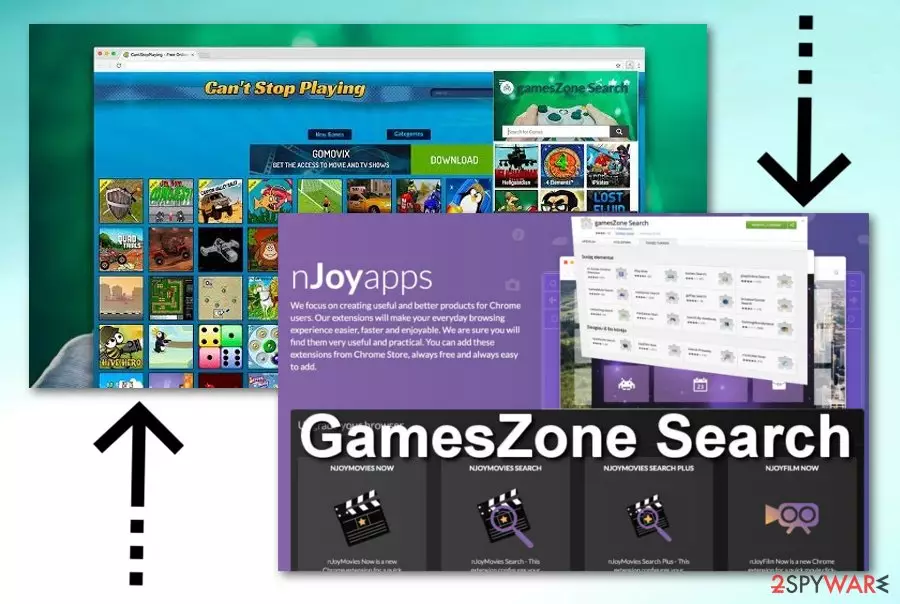
GamesZone Search is a questionable browser extension which provides fast access to various online games. It belongs to the browser hijacker category[1] because it affects only web browsers' settings. Notice that this program is designed to affect Google Chrome only, but there is no guarantee that this redirect virus won't be updated in the nearest future, so be prepared. When GamesZone virus is installed onto your browser, it modifies specific settings, including:
- Default search engine is set to Searchalgo. Every time you type in a search request or browse via the URL bar, you will be redirected to this site;
- This PUP adds a new feature to your browser – a GamesZone toolbar which is set to let you play online games faster.
| Name | GamesZone Search |
|---|---|
| Type | Browser hijacker |
| Danger level | Medium as it harms only web browsers. All other computer files and systems remain untouched. |
| Familiar to | Search.playnsearch.net, BitcoinPriceSearch, Frompus.club. |
| Distribution | Comes within bundled software, by clicking on suspicious ads or can be downloaded from Chrome webstore, its official site. |
| Prevention techniques | Antivirus installation is the best option if wanting to avoid such PUPs. Also, do not use third-party installers and look carefully through all incoming downloads/installations. |
| Elimination | You can delete this browser hijacker successfully by using FortectIntego. |
Nevertheless, this suspicious looking browser extension often provides misleading results each time you type something into the search section. The main reason for doing so – its aim to redirect its victims to required sites in order to generate some income. That's why your sear results can be filled with in-text links, banner ads, and similar content.
Also, by saying that the app is trying to enhance browsing activity, GamesZone virus starts collecting specific information behind your back. Typically, it collects such details:
- Bookmarks;
- Computer's IP address;
- Location;
- User's IP address;
- Links you have clicked;
- Pictures and videos you have viewed;
- Sites you visited;
- etc.
All this information is gathered for only one reason – developers are trying to pre-select content that would attract your attention. However, in this case, your personal data might be at risk.
If you happen to see this browser hijacker on your web browser, there is a big chance that it infiltrated your system thru its backdoors. In this case, your web browser is infected by the PUP that requires elimination. We strongly recommend deleting the harmful content that belongs to this extension. To remove GamesZone Search virus without leaving its leftover files, you can use FortectIntego. This anti-malware tool will give you a chance to recover your system with only one click. If you are willing to perform manual GamesZone Search removal, jump to the end of this post.

GamesZone spread slightly from downloaded software
Bundled software like GamesZone is one of the main sources which is used by browser hijackers for distribution[2]. If you like downloading software from secondary websites, then it might be the case why such program is on your web browser. According to IT experts[3], fake updates and illegal software might also include a browser hijacker hidden within it. It might not have been noticed while rushing thru installation steps. Last but not least, such PUPs have their own official downloading sites and links. You can easily get tricked by their good-looking pages and start the downloading process without thinking.
In order to avoid such harmful activities, you have to remind yourself to be cautious while you are visiting various pages that look too good to be true. Do not click on links that look suspicious to you – a GamesZone browser hijacker or even a more serious type of virus might hide in it. Furthermore, when downloading freeware, go to the “Custom” or “Advanced” section and opt-out all incoming downloads that you don't want to add to your system. It will help you avoid harmful content.
Another important thing everybody should do in order to avoid browser infections – downloading and installing an antivirus. If you regularly update it, various alerts will pop-out if any infections are active. If there are some – the anti-malware program will help you get rid of it by providing simple guiding steps.
Anti-malware – best help in removing GamesZone Search
To remove GamesZone Search from your browser you have to eliminate all browser extensions and malicious plug-ins that were installed in a bundle with this PUP. This removal method is called manual, as you need to remove this PUP from your Task Manager and each of web browsers yourself.
You can also take care of this procedure automatically. In order to perform GamesZone Search removal in a faster way, you need to download one of anti-malware tools that are provided below and run a scan. This type of program will let you get rid of the virus just by a few clicks. We strongly advise refreshing your browsers after the cyberthreat is eliminated – just to make sure that no harmful components are left.
Uninstall from Windows
Uninstall from Windows 10/8:
- Type Control Panel into the Windows search box and open the result.
- Under Programs, select Uninstall a program.


Uninstall from Windows 7/XP:
- Click on Windows Start > Control Panel (Windows XP users should click on Add/Remove Programs).
- In Control Panel, select Programs > Uninstall a program.


Remove the unwanted program:
- In the Programs and Features window, look for any recently installed suspicious entries, select them, and click Uninstall.
- If User Account Control appears, click Yes to confirm, then complete the removal.


Delete from macOS
Remove the unwanted application:
- From the menu bar, select Go > Applications.
- In the Applications folder, look for any suspicious entries, then drag them to Trash (or right-click and pick Move to Trash).


Delete leftover files and folders:
- Select Go > Go to Folder.
- Enter /Library/Application Support and remove any suspicious folders related to the unwanted program.
- Repeat the same check in the /Library/LaunchAgents and /Library/LaunchDaemons folders, deleting any suspicious entries.

- Finally, empty the Trash to permanently remove the leftovers.

Reset Internet Explorer
Remove dangerous add-ons:
- Open Internet Explorer, click on the Gear icon (IE menu) on the top-right corner of the browser
- Pick Manage Add-ons.
- You will see a Manage Add-ons window. Here, look for suspicious plugins. Click on these entries and select Disable.


Change your homepage if it was altered:
- Open IE and click on the Gear icon.
- Select Internet Options.
- In the General tab, delete the Home page address and replace it by your preferred one (for example, Google.com).
- Click Apply and then select OK.


Delete temporary files:
- Press on the Gear icon and select Internet Options.
- Under Browsing history, click Delete...
- Select relevant fields and press Delete.


Reset Internet Explorer:
- Click on Gear icon > Internet options and select Advanced tab.
- Select Reset.
- In the new window, check Delete personal settings and select Reset.


Remove from Microsoft Edge
Delete unwanted extensions from MS Edge:
- Select Menu (three horizontal dots at the top-right of the browser window) and pick Extensions.
- From the list, pick the extension and click on the Gear icon.
- Click Remove.


Clear cookies and other browser data:
- Click on the Menu (three horizontal dots at the top-right of the browser window) and select Settings > Privacy, search, and services..
- Under Clear browsing data, pick Choose what to clear.
- Select Cookies and other site data and Cached images and files. (apart from passwords, although you might want to include Media licenses as well, if applicable) and click on Clear.


Restore new tab and homepage settings:
- Click the menu icon and choose Settings.
- Then find On startup section.
- Click Remove next to any suspicious startup page.
Reset MS Edge if the above steps did not work:
- Press on Ctrl + Shift + Esc to open Task Manager.
- Click on More details arrow at the bottom of the window.
- Select Details tab.
- Now scroll down and locate every entry with Microsoft Edge name in it. Right-click on each of them and select End Task to stop MS Edge from running.


Instructions for Chromium-based Edge
Delete extensions from MS Edge (Chromium):
- Open Edge and click select Settings > Extensions.
- Delete unwanted extensions by clicking Remove.


Clear cache and site data:
- Click on Menu and go to Settings.
- Select Privacy, search and services.
- Under Clear browsing data, pick Choose what to clear.
- Under Time range, pick All time.
- Select Clear now.


Reset Chromium-based MS Edge:
- Click on Menu and select Settings.
- On the left side, pick Reset settings.
- Select Restore settings to their default values.
- Confirm with Reset.
- This will disable extensions and reset startup pages but will not delete bookmarks, saved passwords, or browsing history.


Remove from Mozilla Firefox (FF)
Remove dangerous extensions:
- Open Mozilla Firefox browser and click on the Menu (three horizontal lines at the top-right of the window).
- Select Add-ons.
- In here, select the unwanted extension and click Remove.


Reset the homepage:
- Click three horizontal lines at the top right corner to open the menu.
- Choose Settings.
- Under Home, set your preferred homepage and new tab settings.
Clear cookies and site data:
- Click Menu and pick Settings.
- Go to Privacy & Security section.
- Scroll down to locate Cookies and Site Data.
- Click on Clear Data...
- Select Cookies and Site Data and Temporary cached files and pages, then click Clear.


Reset Mozilla Firefox
If clearing the browser as explained above did not help, reset Mozilla Firefox:
- Open Mozilla Firefox browser and click the Menu.
- Go to Help and then choose Troubleshooting Information.

- Under Give Firefox a tune up section, click on Refresh Firefox...
- Once the pop-up shows up, confirm the action by pressing on Refresh Firefox.



Remove from Google Chrome
Delete malicious extensions from Google Chrome:
- Open Google Chrome, click on the Menu (three vertical dots at the top-right corner) and select More tools > Extensions.
- In the newly opened window, you will see all the installed extensions. Uninstall all suspicious extensions related to the unwanted program by clicking Remove.


Clear cache and web data from Chrome:
- Click on Menu and pick Settings.
- Under Privacy and security, select Clear browsing data.
- Select Browsing history, Cookies and other site data, as well as Cached images and files.
- Click Clear data.


Change your homepage:
- Click menu and choose Settings.
- Look for a suspicious site in the On startup section.
- Click on Open a specific or set of pages and click on three dots to find the Remove option.
Reset Google Chrome:
If the previous methods did not help you, reset Google Chrome to eliminate all the unwanted components:
- Click on Menu and select Settings.
- In the Settings, scroll down and click Advanced.
- Scroll down and locate Reset and clean up section.
- Now click Restore settings to their original defaults.
- Confirm with Reset settings.


Delete from Safari
Remove dangerous extensions:
- Open Safari, click Safari in the menu at the top-left of the screen, and select Preferences.
- Go to the Extensions tab, look for any suspicious entries, and click Uninstall to remove them.


Clear history and website data:
- Click Safari in the menu and pick Clear History.
- Set Clear to all history and confirm with Clear History.


Reset Safari:
- Click Safari in the menu and select Preferences > Advanced.
- Enable Show Develop menu in menu bar.
- From the menu bar, click Develop and select Empty Caches.


Did this guide help?
Be the first to comment