

Cryptor2.0 ransomware is the newest version of Ryuk virus that originally targeted high-profile organizations
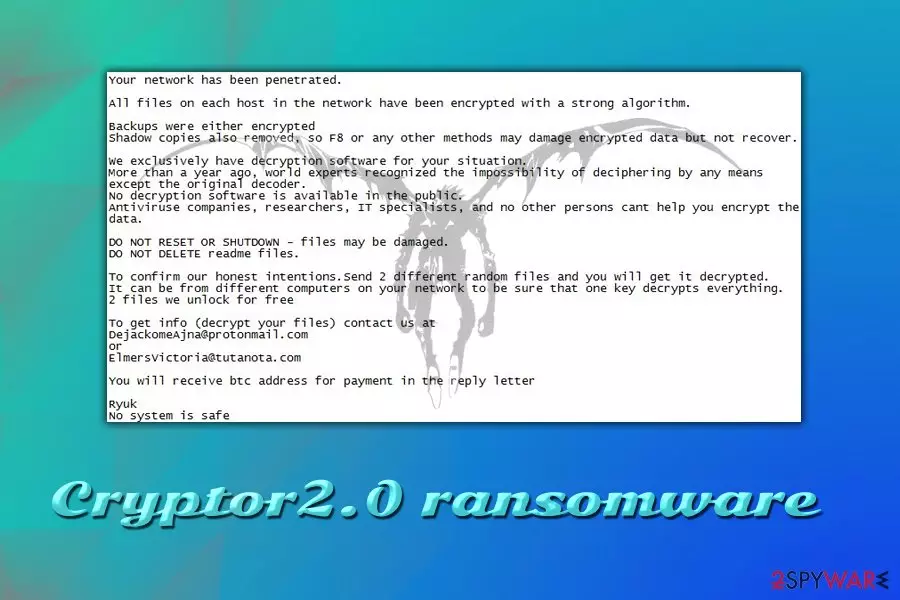
Cryptor2.0 ransomware is a file locking virus that was spotted at the end of January 2019. Malware stems from the infamous Ryuk ransomware, which is speculated to be connected to the North-Korean Lazarus hacking group. This variant uses Microsoft Enhanced RSA and AES encryption algorithms to lock up data and then adds .RYK file extension to pictures, videos, databases, documents, etc. Next, Cryptor2.0 ransomware contacts a remote server that is controlled by hackers and drops a ransom note ReadMe.txt into each of the folders. Victims are informed that their personal files have been encoded and only a unique key can unlock them. They are asked to contact crooks via DejackomeAjna@protonmail.com or ElmersVictoria@tutanota.com for Bitcoin wallet information that the ransom should be transferred to, as well as the ransom size.
| Name | Cryptor2.0 |
| Type | Ransomware |
| Family | Ryuk |
| Ciphers | RSA and AES |
| File extension | .RYK |
| Ransom note | ReadMe.txt |
| Contact | DejackomeAjna@protonmail.com or ElmersVictoria@tutanota.com |
| Decryptable? | No |
| Elimination | Use security software like FortectIntego that can detect[1] the virus |
Ryuk ransomware created real chaos among users and organizations when it started to infiltrate systems all over the world back in summer 2018. It later devastated various newspapers in the US, preventing Tribune Publishing and Los Angeles Times delivering new issues on time.[2] It asked between 15 to 20 BTC for the decryptor, and managed to earn a fortune during its reign. As evident, malware authors are not backing away and continuing their campaign with the release of Cryptor2.0 ransomware.
For Cryptor2.0 ransomware removal, users need to choose software that can recognize the threat. Currently, 47 AV engines detect the malicious dropper file as:[1]
- Dropped:Trojan.GenericKD.31536019
- TR/FileCoder.yiilk
- TrojanRansom.Agent
- a variant of Win32/Filecoder.NTB
- Ransom:Win32/Ryuk.S!MTB
- W32.Ransom.Gen, etc.
As soon as Cryptor2.0 virus modifies the system files and encrypts data, it drops the ransom note which reads as follows:
Your network has been penetrated.
All files on each host in the network have been encrypted with a strong algorithm.
Backups were either encrypted
Shadow copies also removed, so F8 or any other methods may damage encrypted data but not recover.
We exclusively have decryption software for your situation.
<…>
To get info (decrypt your files) contact us at
DejackomeAjna@protonmail.com or ElmersVictoria@tutanota.com
You will receive btc address for payment in the reply letterRyuk
No system is safe
Cryptor2.0 ransomware authors also offer to send two files for test decryption. This action is done to raise a false feeling of trust in victims, which would make them more likely to pay the ransom. However, even with test decryption being successful, there is no guarantee that users will receive full decryptor for .RYK encoded files.
Security researchers also vote against paying the ransom, as such action would simple encourage cybercriminals to improve the code and produce more sophisticated viruses. Thus, victims should remove Cryptor2.0 ransomware with the help of reputable security software like FortectIntego – it can detect all the malicious elements of malware and eliminate them.

Common ransomware distribution methods
Ransomware is a dangerous cyber infection, as it leaves files locked even after its removal. Therefore, it is vital to use maximum protection measures when it comes to computer security.
Ransomware authors usually employ a variety of distribution techniques, most prominent of them being the spam emails. Phishing emails are often sent to thousands of victims and include attachments or malicious links. As soon as users click on those – malware is executed on the system and files encrypted.
Another technique which recently grew in popularity due to “on the spot response” functionality[3] is the brute-forcing. This allows hackers to scan the internet for vulnerable RDP connections and use a preset list of most commonly used passwords. Consequently, bad actors can manually install ransomware into the computer. This is extremely common in targeted attacks against various businesses and organizations.
Additionally, malware authors use exploit kits, fake updates, malicious JavaScripts, and other techniques to infect as many users as possible. To protect yourself from ransomware attacks, use comprehensive security software, patch your system, prepare backups of your files, do not open spam emails casually, use strong passwords, and generally be more careful when browsing the web.
Cryptor2.0 ransomware removal instructions
To remove Cryptor2.0 virus, you should choose appropriate anti-malware software. There are plenty available on the market, so choose the one that suits you best, although we recommend using FortectIntego. In case Cryptor2.0 ransomware prevents security software from working normally, enter Safe Mode with Networking as explained below.
Unfortunately, but the malware is not currently decryptable. Therefore, regaining access to files without paying crooks might be quite tricky. Nevertheless, users can wait till cybersecurity researchers create an official decryptor or can try third-party recovery software as an immediate remedy. Remember, you should only try to recover your files after Cryptor2.0 ransomware removal, as your data would be encrypted again.
Did this guide help?
Be the first to comment