

Tomachopan.com – a website that deceives people into subscribing to ads
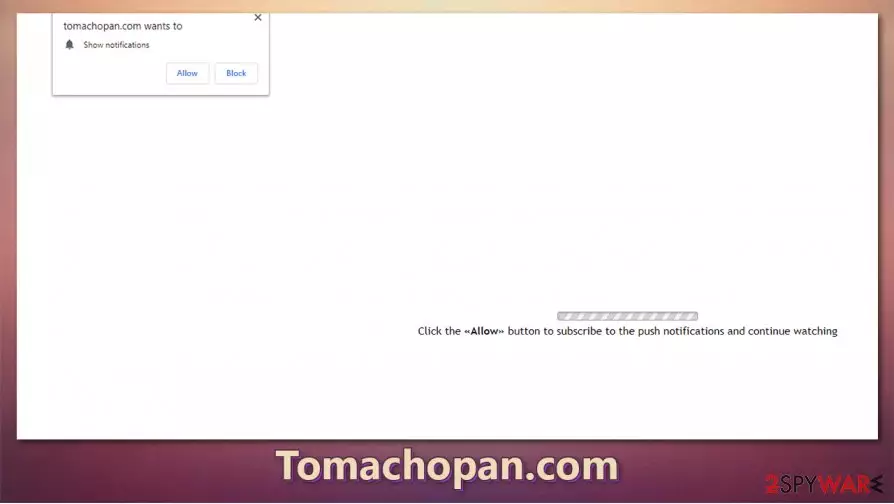
Tomachopan.com is a website that people wouldn't visit on purpose. Usually, they are redirected to these types of sites. As soon as it's opened, it urges its visitors to click the Allow button, which would subscribe users to push notifications and allow them to continue watching some imaginary content. When the Allow button is pressed, this push notification virus will start displaying various ads, from banners to pop-ups, sometimes covering the device's whole screen.
Some ads might even be shown when the browser windows are closed, thus popping up directly on your desktop. Tomachopan.com redirects usually promote online gambling and other high-risk sites, which might lead to the installation of potentially unwanted programs (PUPs) or even worse. If you've allowed notifications or clicked on any of the ads, then we will help you resolve the annoying situation easily, as long as you follow guidelines provided in this article. We clarify the dangers of such ads and explain how to eliminate them from all types of devices and browsers.
| name | Tomachopan.com |
|---|---|
| Type | Adware, redirect, push notification virus |
| Symptoms | An excessive amount of ads appear out of nowhere, covering frequently visited sites. Some ads popping up when browsers are closed. Slower device performance. Redirects to questionable sites. |
| Risks | Deceptive ads and redirects might lead to PUPs installations, malware infections. |
| Distribution | Deceptive ads, software bundles, p2p services |
| Removal | This adware can be removed manually, but for peace of mind, anti-malware tools should be used to ensure no malicious content is present |
| System repair | To keep your device in good shape – system repair tools like the FortectIntego app should be used regularly |
Tomachopan.com ads might redirect to websites that have nothing to do with the advertised content. These deceptive ads show various content that tries to lure the unaware user into clicking them. The ads might include:
- online gaming,
- adult websites,
- online gambling,
- software download promotions,
- fake updates, etc.
Users can get their devices infected with various PUPs and malware. That's why it could be called Tomachopan.com virus. Additionally, it can be categorized as a potentially unwanted program[1] (PUP) because of its nature and posed dangers.
It's needless to say this website shouldn't be visited, and none of its displayed ads should be trusted and clicked on. If you're redirected to this page, then you might have adware installed on your device. We recommend performing a full system scan with SpyHunterCombo Cleaner or MalwarebytesMalwarebytes or any other reliable anti-malware software to remove Tomachopan.com and any other suspicious entries, like adware, PUPs, or malware.
As great as anti-malware software is – it can't do everything. Users will have to intervene. Our cybersecurity team is sharing step-by-step Tomachopan.com removal instructions from the most popular browsers and devices. They are posted at the bottom of this article.

Adware and other PUPs can damage system files and settings, which might lead to abnormal system behavior. That's why experts[2] recommend using the FortectIntego system repair app or similar tools to fix any system irregularities and get the top performance from your device.
Dangers of push notifications viruses and how to identify them
Push notification viruses are delivered using social engineering tricks. These deceptive techniques urge people to subscribe to notifications in order to display an enormous amount of ads of affiliated third-party sites, which contents might be harmful.
Some websites might ask users to prove that they're not robots by doing a captcha test or similar techniques. In comparison, phony portals might ask to press the Allow button to do that, which immediately infect computers with adware. Other websites might ask to subscribe to their notifications to view some imaginary breaking news or hidden content.
Please remember that legitimate sites would never ask their visitors to allow their notifications in order to see some content. That's done only by websites with bad intentions such as installing adware, browser hijackers,[3] or other PUPs.
Remove Tomachopan.com virus from Chrome, Safari, and other browsers
If you see an abnormal amount of ads covering your frequently visited pages or some of them appear out of nowhere on your desktop, that means that your device is infected with Tomachopan.com virus. You came to the right place to find out how to eliminate it and get your device back in shape.
Manual Tomachopan.com removal is necessary to remove it from browsers themselves. Below you'll find step-by-step instructions on eliminating this adware from Safari, Firefox, and other browsers. Afterward, run a full system scan with anti-malware tools to remove any additional pieces, PUPs, or malware.

Once you remove Tomachopan.com, remember to use system repair tools to fix any system irregularities that the push notification virus might have caused. Unrepaired system files and settings could lead to freezing, crashing, BSoD, and other system issues.
Uninstall from Windows
Uninstall from Windows 10/8:
- Type Control Panel into the Windows search box and open the result.
- Under Programs, select Uninstall a program.


Uninstall from Windows 7/XP:
- Click on Windows Start > Control Panel (Windows XP users should click on Add/Remove Programs).
- In Control Panel, select Programs > Uninstall a program.


Remove the unwanted program:
- In the Programs and Features window, look for any recently installed suspicious entries, select them, and click Uninstall.
- If User Account Control appears, click Yes to confirm, then complete the removal.


Delete from macOS
Remove the unwanted application:
- From the menu bar, select Go > Applications.
- In the Applications folder, look for any suspicious entries, then drag them to Trash (or right-click and pick Move to Trash).


Delete leftover files and folders:
- Select Go > Go to Folder.
- Enter /Library/Application Support and remove any suspicious folders related to the unwanted program.
- Repeat the same check in the /Library/LaunchAgents and /Library/LaunchDaemons folders, deleting any suspicious entries.

- Finally, empty the Trash to permanently remove the leftovers.

Reset Internet Explorer
Remove dangerous add-ons:
- Open Internet Explorer, click on the Gear icon (IE menu) on the top-right corner of the browser
- Pick Manage Add-ons.
- You will see a Manage Add-ons window. Here, look for suspicious plugins. Click on these entries and select Disable.


Change your homepage if it was altered:
- Open IE and click on the Gear icon.
- Select Internet Options.
- In the General tab, delete the Home page address and replace it by your preferred one (for example, Google.com).
- Click Apply and then select OK.


Delete temporary files:
- Press on the Gear icon and select Internet Options.
- Under Browsing history, click Delete...
- Select relevant fields and press Delete.


Reset Internet Explorer:
- Click on Gear icon > Internet options and select Advanced tab.
- Select Reset.
- In the new window, check Delete personal settings and select Reset.


Remove from Microsoft Edge
Delete unwanted extensions from MS Edge:
- Select Menu (three horizontal dots at the top-right of the browser window) and pick Extensions.
- From the list, pick the extension and click on the Gear icon.
- Click Remove.


Clear cookies and other browser data:
- Click on the Menu (three horizontal dots at the top-right of the browser window) and select Settings > Privacy, search, and services..
- Under Clear browsing data, pick Choose what to clear.
- Select Cookies and other site data and Cached images and files. (apart from passwords, although you might want to include Media licenses as well, if applicable) and click on Clear.


Restore new tab and homepage settings:
- Click the menu icon and choose Settings.
- Then find On startup section.
- Click Remove next to any suspicious startup page.
Reset MS Edge if the above steps did not work:
- Press on Ctrl + Shift + Esc to open Task Manager.
- Click on More details arrow at the bottom of the window.
- Select Details tab.
- Now scroll down and locate every entry with Microsoft Edge name in it. Right-click on each of them and select End Task to stop MS Edge from running.


Instructions for Chromium-based Edge
Delete extensions from MS Edge (Chromium):
- Open Edge and click select Settings > Extensions.
- Delete unwanted extensions by clicking Remove.


Clear cache and site data:
- Click on Menu and go to Settings.
- Select Privacy, search and services.
- Under Clear browsing data, pick Choose what to clear.
- Under Time range, pick All time.
- Select Clear now.


Reset Chromium-based MS Edge:
- Click on Menu and select Settings.
- On the left side, pick Reset settings.
- Select Restore settings to their default values.
- Confirm with Reset.
- This will disable extensions and reset startup pages but will not delete bookmarks, saved passwords, or browsing history.


Remove from Mozilla Firefox (FF)
Remove dangerous extensions:
- Open Mozilla Firefox browser and click on the Menu (three horizontal lines at the top-right of the window).
- Select Add-ons.
- In here, select the unwanted extension and click Remove.


Reset the homepage:
- Click three horizontal lines at the top right corner to open the menu.
- Choose Settings.
- Under Home, set your preferred homepage and new tab settings.
Clear cookies and site data:
- Click Menu and pick Settings.
- Go to Privacy & Security section.
- Scroll down to locate Cookies and Site Data.
- Click on Clear Data...
- Select Cookies and Site Data and Temporary cached files and pages, then click Clear.


Reset Mozilla Firefox
If clearing the browser as explained above did not help, reset Mozilla Firefox:
- Open Mozilla Firefox browser and click the Menu.
- Go to Help and then choose Troubleshooting Information.

- Under Give Firefox a tune up section, click on Refresh Firefox...
- Once the pop-up shows up, confirm the action by pressing on Refresh Firefox.



Remove from Google Chrome
Delete malicious extensions from Google Chrome:
- Open Google Chrome, click on the Menu (three vertical dots at the top-right corner) and select More tools > Extensions.
- In the newly opened window, you will see all the installed extensions. Uninstall all suspicious extensions related to the unwanted program by clicking Remove.


Clear cache and web data from Chrome:
- Click on Menu and pick Settings.
- Under Privacy and security, select Clear browsing data.
- Select Browsing history, Cookies and other site data, as well as Cached images and files.
- Click Clear data.


Change your homepage:
- Click menu and choose Settings.
- Look for a suspicious site in the On startup section.
- Click on Open a specific or set of pages and click on three dots to find the Remove option.
Reset Google Chrome:
If the previous methods did not help you, reset Google Chrome to eliminate all the unwanted components:
- Click on Menu and select Settings.
- In the Settings, scroll down and click Advanced.
- Scroll down and locate Reset and clean up section.
- Now click Restore settings to their original defaults.
- Confirm with Reset settings.


Delete from Safari
Remove dangerous extensions:
- Open Safari, click Safari in the menu at the top-left of the screen, and select Preferences.
- Go to the Extensions tab, look for any suspicious entries, and click Uninstall to remove them.


Clear history and website data:
- Click Safari in the menu and pick Clear History.
- Set Clear to all history and confirm with Clear History.


Reset Safari:
- Click Safari in the menu and select Preferences > Advanced.
- Enable Show Develop menu in menu bar.
- From the menu bar, click Develop and select Empty Caches.


Did this guide help?
Be the first to comment