

Moia ransomware – data-locking computer infection built for money extortion

Moia virus is the threat that is created to scare users is to paying demanded a ransom of at least $490 in Bitcoin. The ransomware is a malicious program designed to encrypt all personal data on the computer and then demand money for the return of files and access to the machine. Once inside the system, it encrypts all personal pictures, videos, documents, archives, and other files by using a strong encryption algorithm, which also appends a .moia extension at the end of this process. Victims can no longer access these files and require a unique key that is in possession of cybercriminals behind the ransomware.
Once the encryption is complete, Moia file virus drops a ransom note _readme.txt with thorough instructions from cybercriminals. It explains to victims what happened to their files and claims that the only method to recover them is by paying a ransom for a decryption tool. For negotiation purposes, crooks also provide emails manager@mailtemp.ch, helprestoremanager@airmail.cc. The connection between criminals and victims, however, can create more issues, so experts[1] analyzing the behavior of threat actors recommend avoiding this contact.
Moia ransomware is a cryptovirus that belongs to a malware family known as Djvu ransomware. This malware encrypts all the important files on a Windows computer and restricts access to them. In the ransom note, cybercriminals behind the attack explain that the only way to recover data is by paying ransom in Bitcoin and even offering a 50% discount for the first 72 hours.
The ransom note:
ATTENTION!
Don't worry, you can return all your files!
All your files like pictures, databases, documents and other important are encrypted with strongest encryption and unique key.
The only method of recovering files is to purchase decrypt tool and unique key for you.
This software will decrypt all your encrypted files.
What guarantees you have?
You can send one of your encrypted file from your PC and we decrypt it for free.
But we can decrypt only 1 file for free. File must not contain valuable information.
You can get and look video overview decrypt tool:
https://we.tl/t-Tjb0YqckGX
Price of private key and decrypt software is $980.
Discount 50% available if you contact us first 72 hours, that's price for you is $490.
Please note that you'll never restore your data without payment.
Check your e-mail “Spam” or “Junk” folder if you don't get answer more than 6 hours.To get this software you need write on our e-mail:
manager@mailtemp.chReserve e-mail address to contact us:
helprestoremanager@airmail.ccYour personal ID:
While it is true that encoded files require a unique decryption key to unlock them, researchers recommend not paying the ransom, as cybercriminals might not keep their promises, resulting in financial losses.[2] In this article, we will explain how to get rid of malware and use alternative methods for data recovery.
| Name | Moia virus |
|---|---|
| Type | Ransomware, crypto-virus, file locking virus |
| Malware family | STOP/Djvu ransomware |
| Extension | Files appended with .moia extension, e.g., “picture.jpg” is turned into “picture.jpg.moia” |
| Ransom note | _readme.txt |
| Contact | manager@mailtemp.ch, helprestoremanager@airmail.cc |
| Malware removal | Perform a full system scan with powerful security software like anti-malware tools capable of detecting[3] malicious files |
| System fix | Malware can seriously tamper with Windows systems, causing errors, crashes, lag, and other stability issues after it is terminated. To remediate the OS and avoid its reinstallation, we recommend scanning it with the FortectIntego repair tool |
Moia ransomware – a cyber infection that might result in complete data compromise, so removing the threat as soon as you receive the ransom note would be the best solution. This is a virus that attacks Windows computers by using various infiltration methods involving the file that drops and executes the payload of this crypto-locker.
Once inside, it uses an encryption algorithm to lock up all documents, archives, videos, music, and other files found on the machine. The process is ending with an appendix at the end of the file name, hence the name of the virus. The encryption is closely related to decryption because your victims' ID is the combination needed for the criminal to identify you and for the decryption tool to work.
However, the recent versions in the family including Robm or Rigj, use the online keys that are unique per every encoded device. This makes the decryption process very difficult for .moia files too. The previous versions were for a while decryptable. Right now, only some victims can get their files restored with the previously developed tool.
Unfortunately, flaws in coding got quickly fixed and encryption algorithms altered so as to make them more powerful but also less likely breakable. This is why you need to remove the threat with AV tools like SpyHunterCombo Cleaner or MalwarebytesMalwarebytes and then worry about your files. Official decryption tool development for the advanced and improved versions can take a long time.

Option for the Djvu family viruses
This virus derives from a well-known family STOP/Djvu, which was first spotted in 2018 and since then released multiple variants. Threat actors manage to release at least 2 versions each week. However, recent changes leave victims with damaged files and systems without the option to repair those affected pieces.
If your computer got infected with one of the Djvu variants, you should try using Emsisoft decryptor for Djvu/STOP. Even though Moia is less likely not decryptable, you can always check. It is important to mention that this tool will not work for everyone – it only works if data was locked with an offline ID due to malware failing to communicate with its remote servers.
Even if your case meets this condition, somebody from the victims has to pay criminals, retrieve an offline key, and then share it with security researchers at Emsisoft. As a result, you might not be able to restore the encrypted files immediately. Thus, if the decryptor says your data was locked with an offline ID but cannot be recovered currently, you should try later. You also need to upload a set of files – one encrypted and a healthy one to the company's servers before you proceed.
- Download the app from the official Emsisoft website.
- After pressing Download button, a small pop-up at the bottom, titled decrypt_STOPDjvu.exe should show up – click it.
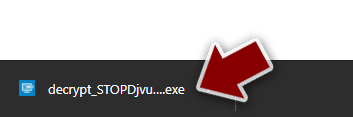
- If User Account Control (UAC) message shows up, press Yes.
- Agree to License Terms by pressing Yes.
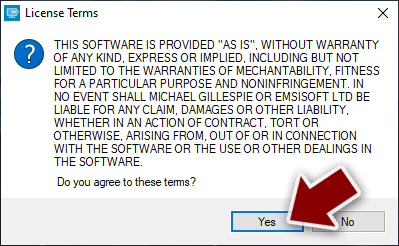
- After Disclaimer shows up, press OK.
- The tool should automatically populate the affected folders, although you can also do it by pressing Add folder at the bottom.
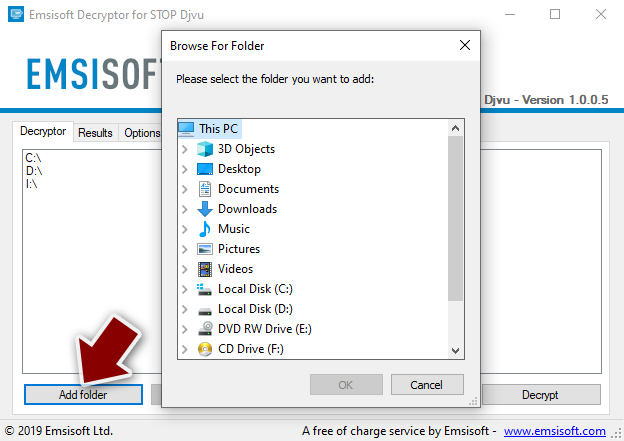
- Press Decrypt.
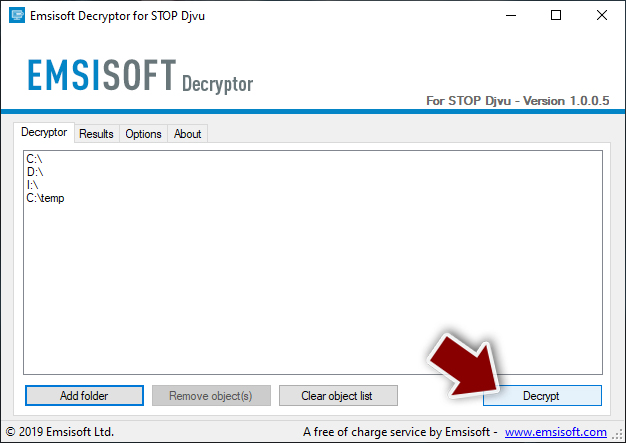


From here, there are three available outcomes:
- “Decrypted!” will be shown under files that were decrypted successfully – they are now usable again.
- “Error: Unable to decrypt file with ID:” means that the keys for this version of the virus have not yet been retrieved, so you should try later.
- “This ID appears to be an online ID, decryption is impossible” – you are unable to decrypt files with this tool.
Keeping the machine virus-free is possible
The infection mainly spreads using malicious files with the code for ransomware payload. These pieces can be attached to an email or added directly through links. Criminals rely heavily on pirating who offer these services online and torrent sites where users are more likely to ignore red flags.
This particular version of the ransomware was spread via various pirated programs like Photoshop or Adobe applications on such pirating services. Packages for licensed applications, game cracks, and cheats include the direct payload of the Moia ransomware virus.
Once a computer is infected with malware, its system is changed to operate differently. For example, an infection can alter the Windows registry database, damage vital bootup, and other sections, delete or corrupt DLL files, etc. Once a system file is damaged by malware, antivirus software cannot do anything about it, leaving it just the way it is. Consequently, users might experience performance, stability, and usability issues, to the point where a full Windows reinstallation is required.
Therefore, we highly recommend using a one-of-a-kind, patented technology of FortectIntego repair. Not only can it fix virus damage after the infection, but it is also capable of removing malware that has already broken into the system thanks to several engines used by the program. Besides, the application is also capable of fixing various Windows-related issues that are not caused by malware infections, for example, Blue Screen errors, freezes, registry errors, damaged DLLs, etc.
- Download the application by clicking on the link above
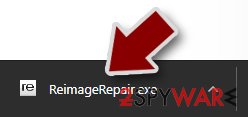
- Click on the ReimageRepair.exe
- If User Account Control (UAC) shows up, select Yes
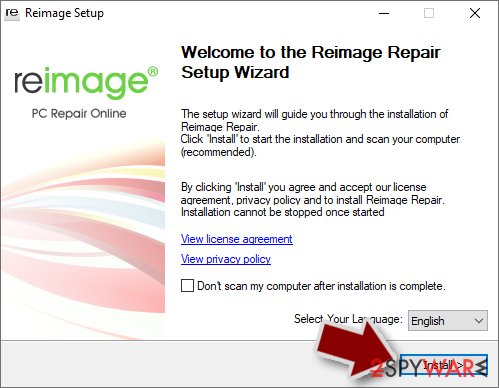
- Press Install and wait till the program finishes the installation process
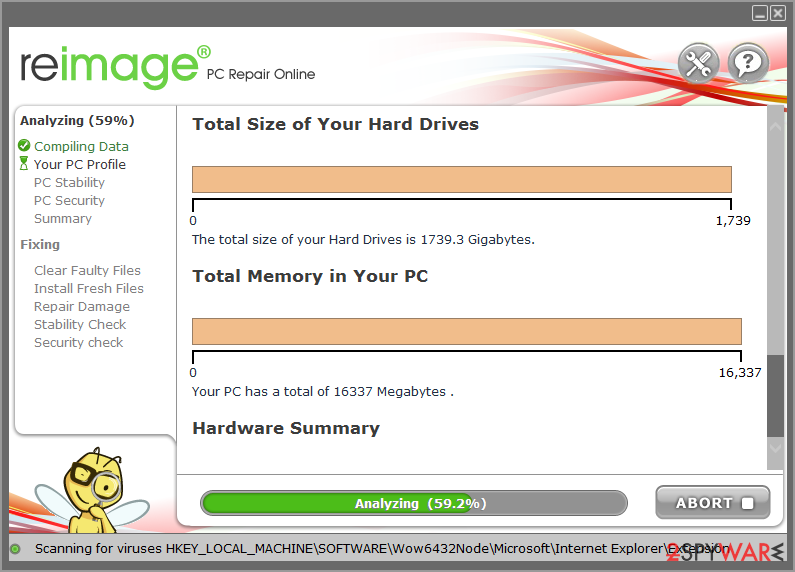
- The analysis of your machine will begin immediately
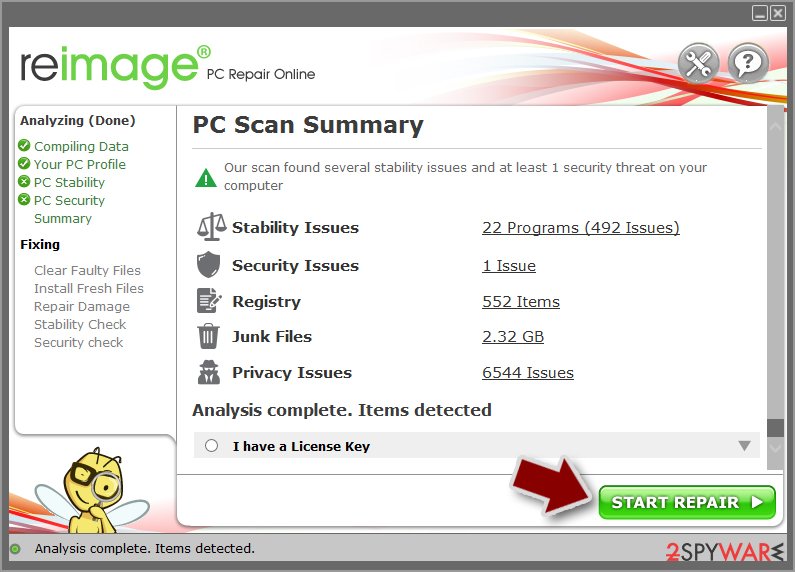
- Once complete, check the results – they will be listed in the Summary
- You can now click on each of the issues and fix them manually
- If you see many problems that you find difficult to fix, we recommend you purchase the license and fix them automatically.


Additional helpful tips and alternatives for decryption
Do not trust anyone who claims they can decrypt your files for a fee or even free. These people are either scammers or criminals, trying to overcharge you with lies. This is not a virus that could be easily decryptable, so do not believe any claims. The issue with such file locker services is that cryptocurrency extortionists might be involved in the process too.
Recovering files after a Moia ransomware attack can be done in two ways. If you have copies of your data, then paying off cybercriminals is not necessary to get access files back. However, there are various applications that might be found online. Remember to research online before purchasing anything.

If you have difficulty when trying to remove Moia ransomware, it might be because the virus managed to alter settings or programs on your machine needed for the threat elimination. This can include disabling security features that are related to anti-malware tools like firewall protection in an attempt for these programs will no longer work properly either! There are a few methods below that help to run SpyHunterCombo Cleaner or MalwarebytesMalwarebytes properly.
We know that the Moia file virus encrypted files are a major concern, but you should be careful when making quick decisions. This will avoid any potential system damage because if ransomware runs another round of encryption on those same sets of files again, permanent damage is not fixable.
It is important to get rid of all traces of infections by following proper cyber security practices while also avoiding risky actions. Run FortectIntego for a proper system repair. It can avoid more danger and issues.
Did this guide help?
Be the first to comment