

CladRumble mac virus can change browser settings, spam users with ads or even install malware
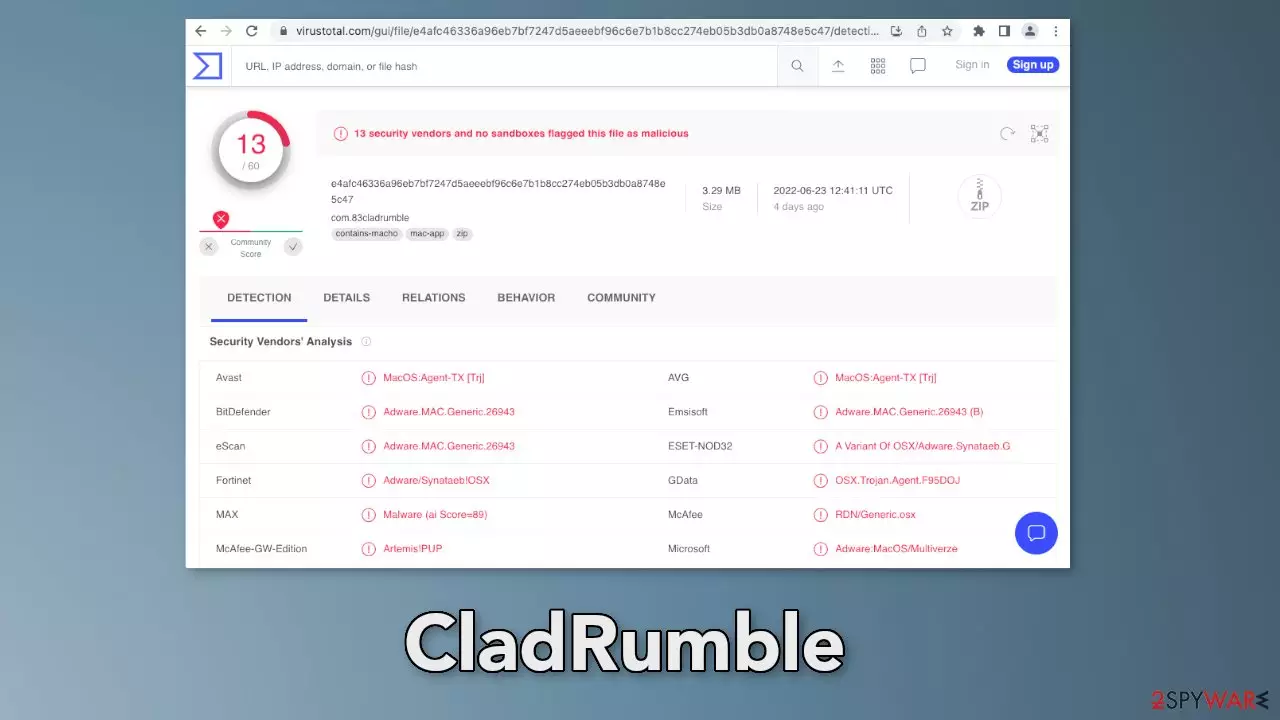
CladRumble belongs to the Adload malware family. It specifically targets mac machines. It infiltrates the system and acts as adware[1]and a browser hijacker. It can cause an increased amount of commercial content, like pop-ups, banners, and redirects. It may also change the main browser settings, like the homepage, new tab address, and search engine.
However, adware developed to infect Mac systems is much more aggressive than adware affecting Windows machines. It can perform scripts in the background and automatically install PUPs (potentially unwanted programs),[2] and even malware without the users' knowledge.
People can also end up on dangerous pages that try to lure out personal information because the ads might be placed by rogue advertising networks. Such intruders can lead to monetary losses, identity theft, and even operating system damage. You should read our guide fully to learn how to fully get rid of the intruder.
| NAME | CladRumble |
| TYPE | Adware, browser hijacker, mac virus |
| MALWARE FAMILY | Adload |
| SYMPTOMS | Different homepage and new tab addresses; redirects to some other search engine and shady websites; machine performs worse than before; unknown apps appear on the machine |
| DISTRIBUTION | Fake software updates, deceptive ads, installing programs from peer-to-peer file-sharing platforms |
| DANGERS | Altered search results can lead to dangerous websites; pop-up ads might be promoting scams; the virus can install other PUPs or even malware in the background |
| ELIMINATION | Eliminating this Mac virus manually can be quite complicated. The easiest and most effective way would be to open a professional security tool and scan your system to delete every related file |
| FURTHER STEPS | FortectIntego should be used to completely wipe out any data left and fix the remaining damage |
Adload overview
We previously wrote about many other mac viruses, like SystemsOffer, RelianceTask, VirtualHybrid, etc. All of them have the same icon – a magnifying glass inside a green, teal, or grey background. Usually, the main file can be found in the “Applications” folder.
However, that does not mean that the virus is easy to remove. It uses various evasion techniques to prevent people from removing it. It can also bypass Apple's own security system XProtect.[3] The intruder scatters its files across the machine disguised as normal system files. That is why for the removal of Adload it is best to use professional security tools.

Distribution methods
Many mac users are still under the impression that they cannot get infected. However, this has not been true for a long time. It is important to learn about the tactics that cybercriminals use to spread their malicious programs to prevent such infections from occurring again.
One of the most common reasons for Adload infections is fake Flash Player updates or installations. Threat actors use social engineering methods to trick people into thinking that their Flash Player is expired. They use deceptive messages to make people believe that if they do not install the latest version they will not be able to access media content. In reality, Flash Player was discontinued in 2020 and replaced by HTML5.
Another thing that you should be aware of is the danger of torrent[4] websites, and peer-to-peer file-sharing platforms. They are unregulated so they are the perfect breeding ground for malware. You can never know if the program you want to install is safe and not secretly a Trojan or another type of malware.
Make sure to never forget that hackers can use software vulnerabilities to deliver malicious programs. It is very important to keep your operating system and programs updated.[5] Developers regularly release security patches that fix newly found holes that could be exploited.
Removal of CladRumble mac virus
Some of the files can have a .plist extension which is a normal settings' file, also known as a “properties file,” used by macOS applications. It contains properties and configuration settings for various programs, so you should not do this yourself unless you know what you are doing and what kind of .plist files you need to delete.
The app uses various persistence techniques and drops many files across the system, which makes browser extension and application removal difficult. To keep your mind at peace, we recommend using professional anti-malware tools SpyHunterCombo Cleaner or MalwarebytesMalwarebytes, which can detect unwanted programs and eradicate them.
You also do not know if the virus installed any additional malicious programs so this is the safest method to ensure the system will be clean. If you still want to try and delete it manually, proceed with these steps:
- Open Applications folder
- Select Utilities
- Double-click Activity Monitor
- Here, look for suspicious processes related to adware and use Force Quit command to shut them down
- Go back to the Applications folder
- Find CladRumble in the list and move it to Trash.
If you are unable to shut down the related processes or can't move the app to Trash, you should look for malicious profiles and login items:
- Go to Preferences and select Accounts
- Click Login items and delete everything suspicious
- Next, pick System Preferences > Users & Groups
- Find Profiles and remove unwanted profiles from the list.
There are likely to be more .plist files hiding in the following locations – delete them all:
- Select Go > Go to Folder.
- Enter /Library/Application Support and click Go or press Enter.
- In the Application Support folder, look for any dubious entries and then delete them.
- Now enter /Library/LaunchAgents and /Library/LaunchDaemons folders the same way and terminate all the related .plist files.


The manual elimination process might not always result in full virus removal. Therefore, we still strongly suggest you perform a scan with security software.
Remove the extension gathering information

It is possible that CladRumble also collects browsing-related and sensitive information. Various scripts might be sending data to tracking servers. Some of the data that could be exposed is your IP address, user name, macOS and browsers' versions, an ID of the computer, items in the Applications folder, a list of installed agents, daemons, and system configuration profiles.
VirtualHybrid adware also employs an unwelcome add-on that messes with the settings. After the dangerous files are eliminated from your system, you should take care of your browsers. You can get rid of cookies and cache automatically with the help of FortectIntego. It will also fix any damaged files and system errors so you should notice an improvement in machine's performance.
If you prefer doing this yourself without additional help, here are the instructions. Steps for other browsers you will find at the bottom of this article.
- Click Safari > Preferences…
- In the new window, pick Extensions.
- Select the unwanted extension and select Uninstall.


Cookies and website data:
- Click Safari > Clear History…
- From the drop-down menu under Clear, pick all history.
- Confirm with Clear History.


The simplest and quickest solution to this is completely resetting Safari:
- Click Safari > Preferences…
- Go to Advanced tab.
- Tick the Show Develop menu in menu bar.
- From the menu bar, click Develop, and then select Empty Caches.


Remove from Mozilla Firefox (FF)
Remove dangerous extensions:
- Open Mozilla Firefox browser and click on the Menu (three horizontal lines at the top-right of the window).
- Select Add-ons.
- In here, select the unwanted extension and click Remove.


Reset the homepage:
- Click three horizontal lines at the top right corner to open the menu.
- Choose Settings.
- Under Home, set your preferred homepage and new tab settings.
Clear cookies and site data:
- Click Menu and pick Settings.
- Go to Privacy & Security section.
- Scroll down to locate Cookies and Site Data.
- Click on Clear Data...
- Select Cookies and Site Data and Temporary cached files and pages, then click Clear.


Reset Mozilla Firefox
If clearing the browser as explained above did not help, reset Mozilla Firefox:
- Open Mozilla Firefox browser and click the Menu.
- Go to Help and then choose Troubleshooting Information.

- Under Give Firefox a tune up section, click on Refresh Firefox...
- Once the pop-up shows up, confirm the action by pressing on Refresh Firefox.



Remove from Google Chrome
Delete malicious extensions from Google Chrome:
- Open Google Chrome, click on the Menu (three vertical dots at the top-right corner) and select More tools > Extensions.
- In the newly opened window, you will see all the installed extensions. Uninstall all suspicious extensions related to the unwanted program by clicking Remove.


Clear cache and web data from Chrome:
- Click on Menu and pick Settings.
- Under Privacy and security, select Clear browsing data.
- Select Browsing history, Cookies and other site data, as well as Cached images and files.
- Click Clear data.


Change your homepage:
- Click menu and choose Settings.
- Look for a suspicious site in the On startup section.
- Click on Open a specific or set of pages and click on three dots to find the Remove option.
Reset Google Chrome:
If the previous methods did not help you, reset Google Chrome to eliminate all the unwanted components:
- Click on Menu and select Settings.
- In the Settings, scroll down and click Advanced.
- Scroll down and locate Reset and clean up section.
- Now click Restore settings to their original defaults.
- Confirm with Reset settings.


Did this guide help?
Be the first to comment