

Add Extension to Leave ads push users into obtaining questionable software
“Add Extension to Leave” is a deceptive pop-up notification [1] that typically starts targeting web browsers when some adware-type virus secretly settles down on the computer. This pop-up prevents users from quitting the website on which it is displayed and forces them to download questionable extensions without properly explaining what these extensions are and why the user needs them. In fact, these notifications may appear when infected with any potentially unwanted program that is capable of generating ads and redirect capacities. So, if you start seeing Add Extension to Leave ads on your browser, you may as well watch out for other online content that might not be as innocent as the regular and legitimate ads. Keep in mind that creators of adware programs do not hesitate collaborating with all sorts of shady third-parties or even criminals as long as such cooperation brings them money [2]. This is the key reason to keep an eye on the computer and regularly scan the system for malware that might be silently running its processes undetected. The elimination of PUPs should help remove “Add Extension to Leave” ads and other annoying symptoms of adware hijack immediately. So, get started and scan your device with a reputable antivirus tool, such as FortectIntego.
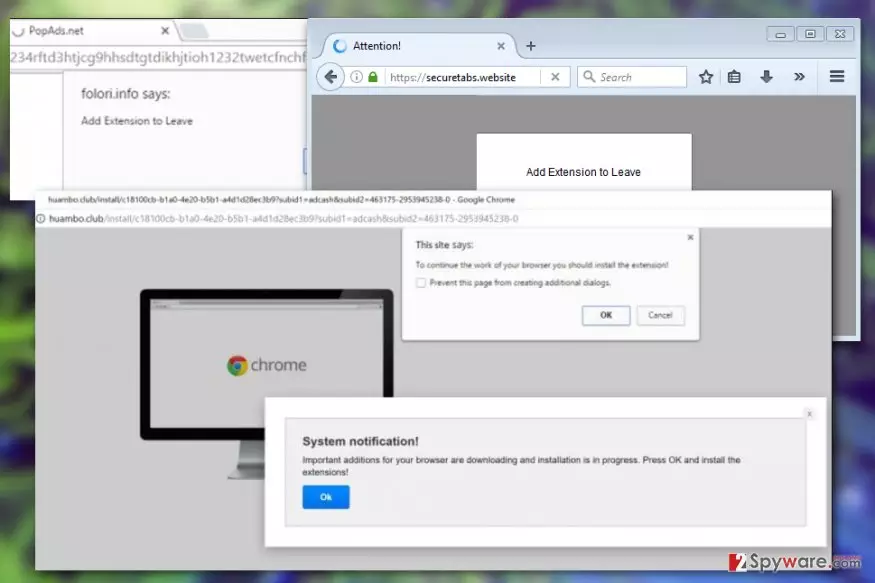
We should warn you that downloading extensions offered by Add Extension to Leave ads can put you in serious danger. First of all, these ads don’t usually say what extension will you install by clicking the “OK” button in the pop-up. It is highly possible that you will be simply tricked into downloading some malicious parasite on your computer which will steal your data, spy on you or work as backdoor helping other malware to enter your PC. So, you should not just stay away from these notifications but take care of “Add Extension to Leave” removal as soon as possible.

Adware distribution relies on software bundling
Indeed, software bundling is the top method creators of “Add Extension to Leave” malware employ to infiltrate computers. This technique gives them freedom in the distribution process as the malicious PUP can be attached to any popular program or file and put up for download on some software sharing website or peer-to-peer network. The users are responsible for the rest of the malware infiltration success. If they rush through the software installation, not paying close attention to what components exactly enter their computers — the infiltration is successful. However, unwanted programs can be prevented. To do that, you will simply have to opt for the Advanced installation mode when installing new software on your computer. Hopefully, these precautions will protect you from encountering “Add Extension to Leave” ads in the future.
Tips on how to remove Add Extension to Leave from your browser
You can remove Add Extension to Leave virus from your computer fairly easily. All it matters is that you use proper software for the removal. And by “proper” we mean legitimate, powerful and updated program that would be compatible with your device and your computing skills. Such software will take care of the Add Extension to Leave removal automatically, leaving no other junk files behind. However, if manual virus elimination does not intimidate you or you have no other choice but to eliminate the program yourself, we suggest taking a look at the professional instructions prepared below the article.
Uninstall from Windows
Uninstall from Windows 10/8:
- Type Control Panel into the Windows search box and open the result.
- Under Programs, select Uninstall a program.


Uninstall from Windows 7/XP:
- Click on Windows Start > Control Panel (Windows XP users should click on Add/Remove Programs).
- In Control Panel, select Programs > Uninstall a program.


Remove the unwanted program:
- In the Programs and Features window, look for any recently installed suspicious entries, select them, and click Uninstall.
- If User Account Control appears, click Yes to confirm, then complete the removal.


Delete from macOS
Remove the unwanted application:
- From the menu bar, select Go > Applications.
- In the Applications folder, look for any suspicious entries, then drag them to Trash (or right-click and pick Move to Trash).


Delete leftover files and folders:
- Select Go > Go to Folder.
- Enter /Library/Application Support and remove any suspicious folders related to the unwanted program.
- Repeat the same check in the /Library/LaunchAgents and /Library/LaunchDaemons folders, deleting any suspicious entries.

- Finally, empty the Trash to permanently remove the leftovers.

Reset Internet Explorer
Remove dangerous add-ons:
- Open Internet Explorer, click on the Gear icon (IE menu) on the top-right corner of the browser
- Pick Manage Add-ons.
- You will see a Manage Add-ons window. Here, look for suspicious plugins. Click on these entries and select Disable.


Change your homepage if it was altered:
- Open IE and click on the Gear icon.
- Select Internet Options.
- In the General tab, delete the Home page address and replace it by your preferred one (for example, Google.com).
- Click Apply and then select OK.


Delete temporary files:
- Press on the Gear icon and select Internet Options.
- Under Browsing history, click Delete...
- Select relevant fields and press Delete.


Reset Internet Explorer:
- Click on Gear icon > Internet options and select Advanced tab.
- Select Reset.
- In the new window, check Delete personal settings and select Reset.


Remove from Microsoft Edge
Delete unwanted extensions from MS Edge:
- Select Menu (three horizontal dots at the top-right of the browser window) and pick Extensions.
- From the list, pick the extension and click on the Gear icon.
- Click Remove.


Clear cookies and other browser data:
- Click on the Menu (three horizontal dots at the top-right of the browser window) and select Settings > Privacy, search, and services..
- Under Clear browsing data, pick Choose what to clear.
- Select Cookies and other site data and Cached images and files. (apart from passwords, although you might want to include Media licenses as well, if applicable) and click on Clear.


Restore new tab and homepage settings:
- Click the menu icon and choose Settings.
- Then find On startup section.
- Click Remove next to any suspicious startup page.
Reset MS Edge if the above steps did not work:
- Press on Ctrl + Shift + Esc to open Task Manager.
- Click on More details arrow at the bottom of the window.
- Select Details tab.
- Now scroll down and locate every entry with Microsoft Edge name in it. Right-click on each of them and select End Task to stop MS Edge from running.


Instructions for Chromium-based Edge
Delete extensions from MS Edge (Chromium):
- Open Edge and click select Settings > Extensions.
- Delete unwanted extensions by clicking Remove.


Clear cache and site data:
- Click on Menu and go to Settings.
- Select Privacy, search and services.
- Under Clear browsing data, pick Choose what to clear.
- Under Time range, pick All time.
- Select Clear now.


Reset Chromium-based MS Edge:
- Click on Menu and select Settings.
- On the left side, pick Reset settings.
- Select Restore settings to their default values.
- Confirm with Reset.
- This will disable extensions and reset startup pages but will not delete bookmarks, saved passwords, or browsing history.


Remove from Mozilla Firefox (FF)
Remove dangerous extensions:
- Open Mozilla Firefox browser and click on the Menu (three horizontal lines at the top-right of the window).
- Select Add-ons.
- In here, select the unwanted extension and click Remove.


Reset the homepage:
- Click three horizontal lines at the top right corner to open the menu.
- Choose Settings.
- Under Home, set your preferred homepage and new tab settings.
Clear cookies and site data:
- Click Menu and pick Settings.
- Go to Privacy & Security section.
- Scroll down to locate Cookies and Site Data.
- Click on Clear Data...
- Select Cookies and Site Data and Temporary cached files and pages, then click Clear.


Reset Mozilla Firefox
If clearing the browser as explained above did not help, reset Mozilla Firefox:
- Open Mozilla Firefox browser and click the Menu.
- Go to Help and then choose Troubleshooting Information.

- Under Give Firefox a tune up section, click on Refresh Firefox...
- Once the pop-up shows up, confirm the action by pressing on Refresh Firefox.



Remove from Google Chrome
Delete malicious extensions from Google Chrome:
- Open Google Chrome, click on the Menu (three vertical dots at the top-right corner) and select More tools > Extensions.
- In the newly opened window, you will see all the installed extensions. Uninstall all suspicious extensions related to the unwanted program by clicking Remove.


Clear cache and web data from Chrome:
- Click on Menu and pick Settings.
- Under Privacy and security, select Clear browsing data.
- Select Browsing history, Cookies and other site data, as well as Cached images and files.
- Click Clear data.


Change your homepage:
- Click menu and choose Settings.
- Look for a suspicious site in the On startup section.
- Click on Open a specific or set of pages and click on three dots to find the Remove option.
Reset Google Chrome:
If the previous methods did not help you, reset Google Chrome to eliminate all the unwanted components:
- Click on Menu and select Settings.
- In the Settings, scroll down and click Advanced.
- Scroll down and locate Reset and clean up section.
- Now click Restore settings to their original defaults.
- Confirm with Reset settings.


Delete from Safari
Remove dangerous extensions:
- Open Safari, click Safari in the menu at the top-left of the screen, and select Preferences.
- Go to the Extensions tab, look for any suspicious entries, and click Uninstall to remove them.


Clear history and website data:
- Click Safari in the menu and pick Clear History.
- Set Clear to all history and confirm with Clear History.


Reset Safari:
- Click Safari in the menu and select Preferences > Advanced.
- Enable Show Develop menu in menu bar.
- From the menu bar, click Develop and select Empty Caches.


Did this guide help?
3 comments
Sally
I have encountered these Add Extension to Leave pop-ups! Dont install it!!
Danielli
Thanks for the help !
Wayne
"Add Extension to Leave" virus haunts me everyday. I am glad that finally someone devoted some time to write such information! Very useful.