

Important facts about ALFA ransomware:
Not that long ago the online community was put on their feet by Alpha virus which encrypts the files and demands to pay up in order to get them back. However, viruses are evolving rapidly, and now Alpha is already old news since a new and more sophisticated version of this ransomware called ALFA has just hit the Internet. The virus creators seem to have joined forces with Cerber and, evidently, applied some features of this well-structured ransomware in the development of ALFA. Apparently, this collaboration has helped making this version much more complex compared to the previous one: at the moment of writing, the computer experts are still struggling to come up with a decryption tool which would help the virus victims to decrypt their important files without having to pay the ransom. The decryption tool may be invented tomorrow, but it may as well take a much longer time to crack this virus, but as long as this virus roams your PC, your current and future files are not safe. Thus, we suggest taking care of the ALFA removal as soon as possible using FortectIntego or some other anti-malware utility.
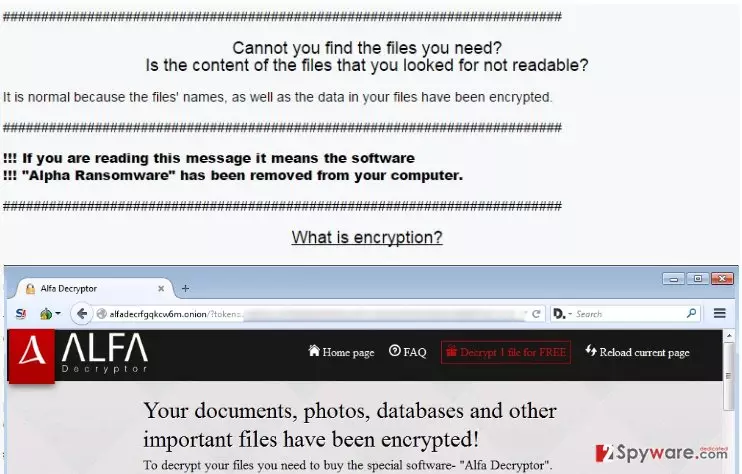
What the ALFA ransomware creators have learned from Cerber is to keep their identities private. Instead of demanding the ransom to be paid in iTunes gift cards (which is a rather easily trackable method of payment), the virus now orders the victims to connect to an anonymous TOR network and transfer the demanded sum of money in BitCoins through one of the provided sites. Currently, the criminals demand 650$ for the private file decryption key, but the sum may vary depending on the extent of encrypted data and its importance to the owner. What is also new with this version is that appends .bin extension to all of the encrypted files and instead of the Read Me (How Decrypt) !!!!.txt file now creates README HOW TO DECRYPT YOUR FILES.HTML and README HOW TO DECRYPT YOUR FILES.TXT documents on every infected folder of the PC. The ransom note displayed in these documents is almost identical to the one used by Cerber. It features information about what happened to the victim’s files, computer’s identification number needed to log in to the payment platform, and addresses through which these platforms can be reached. Remember, that real criminals are behind this virus, so following their demands can be extremely risky. Regardless of how important you files might be, it is always a safer option to simply delete the virus and protect your computer from even greater damage or financial loss. If you are willing to make such a sacrifice, you will find recommendations how to remove ALFA from your computer below.
How can you protect your device from ransomware?
Ransomware infections may be hazardous and devastating, but they can be predictable, too. Thus, when you know the typical places they are commonly encountered, you can easily bypass them. First of all, you should be careful around your email. Especially, keep away from the “Spam” folder, as it usually contains all the emails that have been deemed as potentially malicious by your email provider. Be careful, though, because some of them may still find their way into your regular inbox as well. Pay attention to the sender of the email – if it does not belong to your contact list or looks suspicious in any other way, it is better that you do not open such an email at all. If you still feel curious, another aspect to pay attention to is the content of the email. Usually, criminals will pose as representatives of governmental or legal institutions, so it is always useful to check in with these institutions directly, in case you receive some important information from them in your email. Apart from emails, ransomware can also enter computers through fake software updates or malicious ads, so you can hardly tell where such a virus can actually be lurking. The best way to protect your data from such infections is to make extra copies of your important files regularly and keep them on some external storage drives.
ALFA ransomware removal and file recovery solutions:
If you need professional assistance with ALFA removal, you’ve come to the right place because our team of virus analysts have already investigated this virus and found the best ways to eliminate this threat from the infected computer. In fact, you do not need special skills for that. All you need is a reliable antivirus scanner. Run a full system scan with, sit back and enjoy an effortless virus removal. If, for some reason, your antivirus utility encounters some difficulties getting rid of the virus, scroll below to find manual instructions which should help decontaminate the virus. You should keep in mind that this guide alone will not remove ALFA from your computer but will simply decontaminate it so you can get your antivirus running. When you are done with the virus elimination, you can then try recovering your data. PhotoRec, R-Studio or
Kaspersky virus-fighting utilities may be useful for this purpose.
Did this guide help?
3 comments
Yondee
You are lucky if you got infected with Alpha... cause ALFA is ten times more destructive
ian cole
What is the use of antivirus software if it cannot protect me from viruses like these???
fench98333
Maybe you have to be more careful yourself next time you browse online?