

Apple “Warning Virus Detected” is the intrusive adware program that locks the screen of victims' browser to display fake error messages
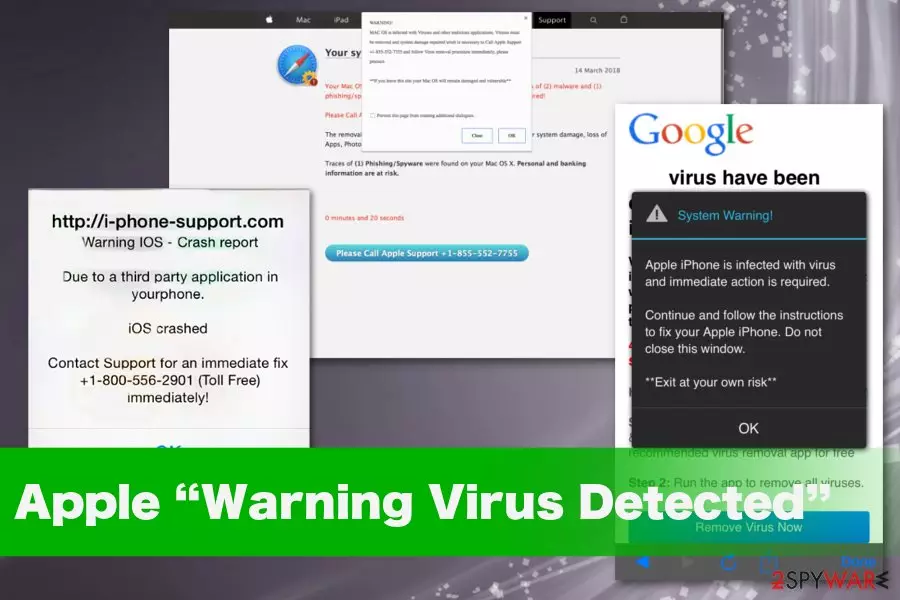
“Warning Virus Detected” is a fake pop-up message that might appear on iPhones screen[1]. Typically, it shows up when users browse the web using Safari. However, it’s not a real notification by Apple because no legitimate software or tech company delivers such messages to the screen directly, especially with provided phone numbers or contact information.
| Name | Apple “Warning Virus Detected” virus |
|---|---|
| Type | Technical support scam |
| Target | Apple devices |
| Symptoms | Fake system alerts show up on the screen of the device suggest contacting support team people via the provided phone number, commercial content redirects keep the user from accessing other pages |
| Distribution | Adware program already installed on the machine, deceptive advertisements, questionable pages |
| Main danger | Exposes to malicious content, criminals behind the “tech support number” trick people into revealing their personal information or paying for services. Attackers can get remote access to the PC and steal information directly from the machine |
| Elimination | Get a reliable anti-malware program and remove Apple “Warning Virus Detected” virus from the system alongside related applications |
Apple “Warning Virus Detected” scam is the fake alert message that mostly appears on mobile devices like iPads or iPhones and tricks people into calling the number or in any other way contacting scammers behind this malicious program. Once the victim gets scared and concerned about the state of his or her device and calls for support scammers can ask for various things and trick people into installing software, giving the remote access to the device.
Once the scammer gets into contact with the user they can lure people into revealing valuable information or paying for the service. If remote access is gained for the supposed help, attackers can install keystroke loggers or different maleware and once the person is asked to pay for the techincal support, all the credentials get captured and stolen.
Later on, the information collected by Apple “Warning Virus Detected” campaign can be sold to a third-party attacker, used in other scams, or used to stole money from the accounts directly. Such credentials, passwords, and logins get especially valuable on the dark web forums.
Apple “Warning Virus Detected” virus belongs to the group of technical support scams because of the warning contens. The purpose of such cyber threats is to convince people calling the provided number that can differ from victim to victim, in this case, +1-800-556-2901.
Even though the pop up claims that it’s a toll-free number, dialing it is not recommended due to these reasons:
- it might be an expensive phone call even though it is said it’s free of charge;
- crooks might trick you into installing or purchasing suspicious security software;
- scammers might swindle your personal information, including credit card information;
- you might be fooled into installing spyware or other malware on your iPhone.
The Apple “Warning Virus Detected” might seem legit at first glance. It has a similar interface as regular iPhone’s notification. The alert itself claims that iOS crashed due to some third-party application:
http:/i-iphone-support.com
Warning IOS – Crash reportDue to a third party application in
yourphone.iOS crashed
Contact Support for an immediate fix +1-800-556-2901 (Toll Free)
immediately!
If you are an attentive person, you can easily suspect “Warning Virus Detected” scam by left typos and mistakes. Several versions of the scam are spreading since 2015, asking for $80 for fixing their phones.[2] Otherwise, their personal information will be stolen and leaked.

Additionally, iPhone users report[3] about similar pop-up messages that tell about detected viruses on the device, compromised social media and banking apps, and other privacy-related issues. Crooks also use the 1-844-423-2464, 1-800-480-4170, 0800-279 -6211, 0800-652-4895 and other numbers for fake Apple Support.
iPhone owners should remain vigilant and do not follow the instructions provided on the smartphone’s screen. Once you receive this pop-up, just close Safari’s tab. It’s possible that you have entered a compromised website that was used for delivering tech support scam. However, if these alerts continue showing up, you should put more effort to remove Apple “Warning Virus Detected” virus.
These alerts might be delivered by adware or another potentially unwanted program (PUP) that already runs on your machine. Thus, you have to uninstall it and reset Safari or another browser that delivers these warnings. Additionally, you can opt for the automatic Apple “Warning Virus Detected” removal with FortectIntego or SpyHunterCombo Cleaner. 
Scammers reach potential victims using shady techniques
Often redirects to technical support scam sites or misleading pop-ups are triggered by compromised websites. However, mobile security experts from usunwirusa.pl[4] note that it might be adware’s responsibility as well. For instance, the adware may have sneaked inside your iPhone when you downloaded a third-party app outside Apple Store or iTunes.
However, you should not believe that misleading pop-up tells the truth and your smartphone is compromised due to a particular app. All you have to do is to get rid of this cyber threat and stop installing apps from questionable stores. Choosing the official provider gives the huge advantage of seeing all the included programs and de-selecting them from the list.
You should avoid using p2p networks, torrents, freeware download sites and similar services that allow free downloads of software, updates and other content. PUP developers distribute their questionable products this way and you can even get a serious malware on the machine.
Eliminate “Warning Virus Detected” scam
If you continuously receive this pop-up, it might be the sign that your iPhone is infected with adware. Thus, in order to remove “Warning Virus Detected” virus, you have to look up for suspicious apps and uninstall them. Additionally, Safari reset is also needed:
- Go to Settings.
- Find Safari.
- Find Clear History & Website Data option and tap on it.
However, if you received a similar alert on MacBook or desktop computer, you should follow Apple “Warning Virus Detected” removal guide below or use anti-spyware tools to uninstall this cyber threat.
Uninstall from Windows
Uninstall from Windows 10/8:
- Type Control Panel into the Windows search box and open the result.
- Under Programs, select Uninstall a program.


Uninstall from Windows 7/XP:
- Click on Windows Start > Control Panel (Windows XP users should click on Add/Remove Programs).
- In Control Panel, select Programs > Uninstall a program.


Remove the unwanted program:
- In the Programs and Features window, look for any recently installed suspicious entries, select them, and click Uninstall.
- If User Account Control appears, click Yes to confirm, then complete the removal.


Delete from macOS
Remove the unwanted application:
- From the menu bar, select Go > Applications.
- In the Applications folder, look for any suspicious entries, then drag them to Trash (or right-click and pick Move to Trash).


Delete leftover files and folders:
- Select Go > Go to Folder.
- Enter /Library/Application Support and remove any suspicious folders related to the unwanted program.
- Repeat the same check in the /Library/LaunchAgents and /Library/LaunchDaemons folders, deleting any suspicious entries.

- Finally, empty the Trash to permanently remove the leftovers.

Reset Internet Explorer
Remove dangerous add-ons:
- Open Internet Explorer, click on the Gear icon (IE menu) on the top-right corner of the browser
- Pick Manage Add-ons.
- You will see a Manage Add-ons window. Here, look for suspicious plugins. Click on these entries and select Disable.


Change your homepage if it was altered:
- Open IE and click on the Gear icon.
- Select Internet Options.
- In the General tab, delete the Home page address and replace it by your preferred one (for example, Google.com).
- Click Apply and then select OK.


Delete temporary files:
- Press on the Gear icon and select Internet Options.
- Under Browsing history, click Delete...
- Select relevant fields and press Delete.


Reset Internet Explorer:
- Click on Gear icon > Internet options and select Advanced tab.
- Select Reset.
- In the new window, check Delete personal settings and select Reset.


Remove from Microsoft Edge
Delete unwanted extensions from MS Edge:
- Select Menu (three horizontal dots at the top-right of the browser window) and pick Extensions.
- From the list, pick the extension and click on the Gear icon.
- Click Remove.


Clear cookies and other browser data:
- Click on the Menu (three horizontal dots at the top-right of the browser window) and select Settings > Privacy, search, and services..
- Under Clear browsing data, pick Choose what to clear.
- Select Cookies and other site data and Cached images and files. (apart from passwords, although you might want to include Media licenses as well, if applicable) and click on Clear.


Restore new tab and homepage settings:
- Click the menu icon and choose Settings.
- Then find On startup section.
- Click Remove next to any suspicious startup page.
Reset MS Edge if the above steps did not work:
- Press on Ctrl + Shift + Esc to open Task Manager.
- Click on More details arrow at the bottom of the window.
- Select Details tab.
- Now scroll down and locate every entry with Microsoft Edge name in it. Right-click on each of them and select End Task to stop MS Edge from running.


Instructions for Chromium-based Edge
Delete extensions from MS Edge (Chromium):
- Open Edge and click select Settings > Extensions.
- Delete unwanted extensions by clicking Remove.


Clear cache and site data:
- Click on Menu and go to Settings.
- Select Privacy, search and services.
- Under Clear browsing data, pick Choose what to clear.
- Under Time range, pick All time.
- Select Clear now.


Reset Chromium-based MS Edge:
- Click on Menu and select Settings.
- On the left side, pick Reset settings.
- Select Restore settings to their default values.
- Confirm with Reset.
- This will disable extensions and reset startup pages but will not delete bookmarks, saved passwords, or browsing history.


Remove from Mozilla Firefox (FF)
Remove dangerous extensions:
- Open Mozilla Firefox browser and click on the Menu (three horizontal lines at the top-right of the window).
- Select Add-ons.
- In here, select the unwanted extension and click Remove.


Reset the homepage:
- Click three horizontal lines at the top right corner to open the menu.
- Choose Settings.
- Under Home, set your preferred homepage and new tab settings.
Clear cookies and site data:
- Click Menu and pick Settings.
- Go to Privacy & Security section.
- Scroll down to locate Cookies and Site Data.
- Click on Clear Data...
- Select Cookies and Site Data and Temporary cached files and pages, then click Clear.


Reset Mozilla Firefox
If clearing the browser as explained above did not help, reset Mozilla Firefox:
- Open Mozilla Firefox browser and click the Menu.
- Go to Help and then choose Troubleshooting Information.

- Under Give Firefox a tune up section, click on Refresh Firefox...
- Once the pop-up shows up, confirm the action by pressing on Refresh Firefox.



Remove from Google Chrome
Delete malicious extensions from Google Chrome:
- Open Google Chrome, click on the Menu (three vertical dots at the top-right corner) and select More tools > Extensions.
- In the newly opened window, you will see all the installed extensions. Uninstall all suspicious extensions related to the unwanted program by clicking Remove.


Clear cache and web data from Chrome:
- Click on Menu and pick Settings.
- Under Privacy and security, select Clear browsing data.
- Select Browsing history, Cookies and other site data, as well as Cached images and files.
- Click Clear data.


Change your homepage:
- Click menu and choose Settings.
- Look for a suspicious site in the On startup section.
- Click on Open a specific or set of pages and click on three dots to find the Remove option.
Reset Google Chrome:
If the previous methods did not help you, reset Google Chrome to eliminate all the unwanted components:
- Click on Menu and select Settings.
- In the Settings, scroll down and click Advanced.
- Scroll down and locate Reset and clean up section.
- Now click Restore settings to their original defaults.
- Confirm with Reset settings.


Delete from Safari
Remove dangerous extensions:
- Open Safari, click Safari in the menu at the top-left of the screen, and select Preferences.
- Go to the Extensions tab, look for any suspicious entries, and click Uninstall to remove them.


Clear history and website data:
- Click Safari in the menu and pick Clear History.
- Set Clear to all history and confirm with Clear History.


Reset Safari:
- Click Safari in the menu and select Preferences > Advanced.
- Enable Show Develop menu in menu bar.
- From the menu bar, click Develop and select Empty Caches.


Did this guide help?
Be the first to comment