Background Colors adware causes pop-ups and redirects to monetize user activity
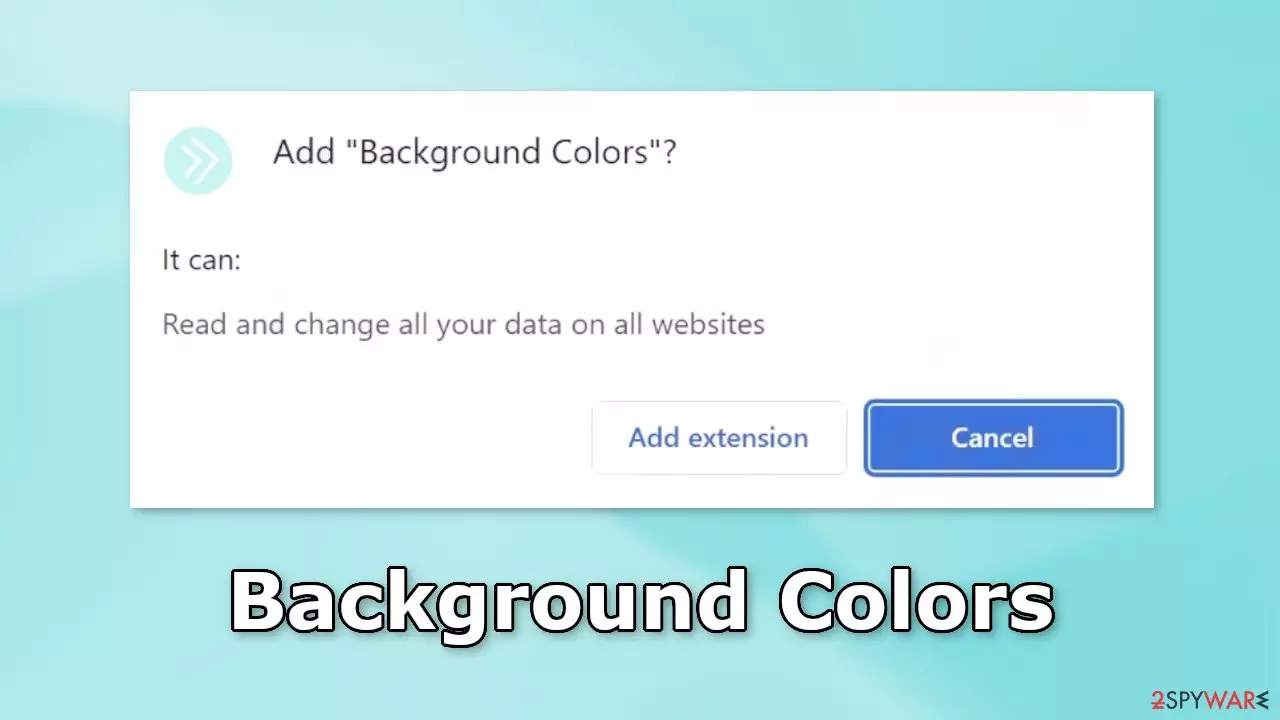
Background Colors is advertised as a handy tool that can change the background color of any website. However, instead of the promised functions, it acts as adware.[1] It can cause an increased amount of commercial content like pop-ups, banners, and redirects.
Crooks may be using rogue advertising networks that place ads leading to dangerous websites. So the existence of such a plugin can lure people to scam pages that try to trick people into providing personal information, downloading PUPs (potentially unwanted programs),[2] and even malware.
NAME
Background Colors
TYPE
Adware
SYMPTOMS
Annoying pop-ups and other types of advertisements start appearing on the screen
Links embedded in the ads might lead to dangerous websites
ELIMINATION
Eliminate the extension through your browser settings; scanning the machine with anti-malware tools is recommended
FURTHER STEPS
Use FortectIntego to get rid of any remaining damage and to optimize the machine
Distribution methods
Applications such as Background Colors are often found through fake download pages, like Watchintenselyoriginaltheproduct.vip. They use social engineering methods to trick people into thinking that they need to add a plugin to their browser to be able to perform some kind of action.
We recommend not browsing through websites you do not know. Do not click on random links or ads because they can lead to shady sites. Avoid websites that engage in illegal activities, like illegal streaming platforms because they are unregulated.
It is best to use official web stores and developer pages. Apps that get listed on digital marketplaces, have to go through an extensive review process. However, you should still do your research because some crooks manage to get their add-ons listed. Always read the reviews, look at the ratings, and the number of users.
Freeware installations can result in infections
There is one more possibility – Background Colors appeared in your browser without your knowledge. This can happen if you use freeware distribution platforms. They include additional programs in the installers to make their activity profitable. Most people skip through the installation process so they do not notice the bundled software.
You should always choose the “Custom” or “Advanced” installation methods, read the Privacy Policy and Terms of Use. The most important step is to check the file list and untick the boxes next to any unrelated applications. Even though it might get costly to get programs from official sources, you may save in the long run by keeping your system running smoothly.
Remove Background Colors adware
Background Colors adware can be removed by going to the browser settings and looking at the extension list. We recommend removing plugins one by one to see if you notice any changes.
Google Chrome
Open Google Chrome, click on the Menu (three vertical dots at the top-right corner) and select More tools > Extensions.
In the newly opened window, you will see all the installed extensions. Uninstall all the suspicious plugins that might be related to the unwanted program by clicking Remove.
MS Edge:
Select Menu (three horizontal dots at the top-right of the browser window) and pick Extensions.
From the list, pick the extension and click on the Gear icon.
Click on Uninstall at the bottom.
MS Edge (Chromium)
Open Edge and click select Settings > Extensions.
Delete unwanted extensions by clicking Remove.
Mozilla Firefox
Open Mozilla Firefox browser and click on the Menu (three horizontal lines at the top-right of the window).
Select Add-ons.
In here, select unwanted plugin and click Remove.
Safari
Click Safari > Preferences…
In the new window, pick Extensions.
Select the unwanted extension and select Uninstall.
Protect your privacy
Almost all websites and web applications nowadays require you to accept cookies[3] by throwing a big prompt in your face obstructing the view. Frustrated, many just click “Accept” because they want to proceed as quickly as possible. Because you experienced pop-up spam without knowing, there is a big chance you were browsing through questionable sites that could still be tracking your browsing activity.
Cookies can store data such as the websites you visit, links you click on, things you type in the search, and what you purchase online. It can alter be sold to advertising networks or other third parties. We recommend using a repair tool like FortectIntego, which can automatically clear your browsers from cookies and cache, clear up space, fix corrupted files, system errors and optimize the performance of the device.
Scan your system with anti-malware tools
If you completed all the previous steps but you still experience unwanted symptoms, you should check your system for other PUAs. We suggest using SpyHunterCombo Cleaner or MalwarebytesMalwarebytes anti-malware tools that will scan your machine, eliminate it, and prevent such infections in the future by giving you a warning before a PUP can make any changes.
Manual removal of potentially unwanted programs can sometimes result in the renewal of the infection as users often fail to eliminate all the related files and entries. Besides, crooks often disguise them as “handy” tools so it can be difficult to identify them. If manual removal is what you still prefer, we have instructions for Windows and Mac machines:
Windows 10/8:
Enter Control Panel into Windows search box and hit Enter or click on the search result.
Under Programs, select Uninstall a program.
From the list, find the entry of the suspicious program.
Right-click on the application and select Uninstall.
If User Account Control shows up, click Yes.
Wait till uninstallation process is complete and click OK.
Windows 7/XP:
Click on Windows Start >Control Panel located on the right pane (if you are Windows XP user, click on Add/Remove Programs).
In Control Panel, select Programs > Uninstall a program.
Pick the unwanted application by clicking on it once.
At the top, click Uninstall/Change.
In the confirmation prompt, pick Yes.
Click OK once the removal process is finished.
Mac:
From the menu bar, select Go > Applications.
In the Applications folder, look for all related entries.
Click on the app and drag it to Trash (or right-click and pick Move to Trash)
To fully remove an unwanted app, you need to access Application Support, LaunchAgents, and LaunchDaemons folders and delete relevant files:
Select Go > Go to Folder.
Enter /Library/Application Support and click Go or press Enter.
In the Application Support folder, look for any dubious entries and then delete them.
Now enter /Library/LaunchAgents and /Library/LaunchDaemons folders the same way and terminate all the related .plist files.






Be the first to comment