

Clicksgear.com is a potentially unwanted app that forces browsers to struggle by delivering an increasing amount of ads and redirects
Clicksgear.com virus is an adware-based[1] infection that uses redirects, pop-up ads, banners and other types of online marketing to sell or promote sponsored products. According to the statistics, the site receives 3828795 unique daily visitors from countries like the US, India, Japan[2], and Italy. Besides, primary estimation shows that the site generates revenue of thousands of dollars from its advertising sources.
However, Clicksgear.com is not such an innocent domain as it might look from the first view. One computer user has complained in a Malwarebytes forum[3] about this particular adware. He stated that the PUP kept redirecting him to odd pages no matter what he has done and interrupting the person's browsing and computing work constantly.
| Name | Clicksgear.com |
|---|---|
| Type | Adware |
| Category | Potentially unwanted program |
| Target(s) | This suspicious application targets all types of computers such as Mac and Windows. Also, it can appear on web browsers such as Google Chrome, Mozilla Firefox, Internet Explorer, Microsoft Edge, and Safari |
| Danger level | Even though this adware program holds the danger level of low, it can still cause some indirect damage by redirecting the user to potentially dangerous websites or acting as an intermediary for malware delivery |
| Symptoms | When you get this PUP installed on your computer system, you are likely to receive browser changes on the homepage and new tab sections. Also, the adware is likely to load you with intrusive advertisements and redirects during browsing sessions |
| Spreading | The suspicious app can be delivered through bundled software that comes from third-party downloading websites such as cnet.com, download.com, and soft32.com. Also, you can receive adware through infectious hyperlinks and advertisements |
| Elimination | You can get rid of the adware program from your computer and web browsers by using reputable antimalware software or by using the manual step-by-step guidelines that have been added to the end of this page |
| Fix | If you have discovered any compromised areas on your device, you can try repairing them with a tool such as FortectIntego |
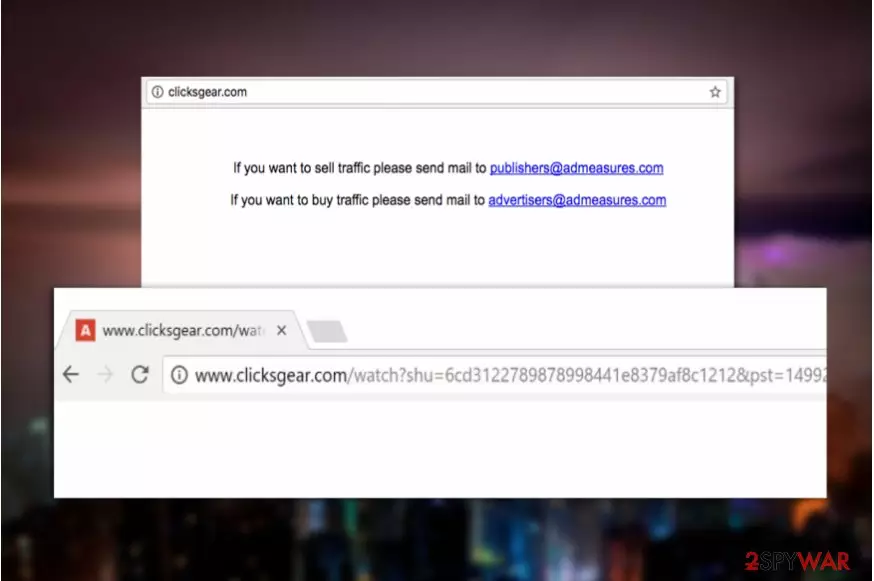
Clicksgear.com operates as a typical ad-supported program once it is installed on the Windows or Mac computer system. It infects web browser apps such as Google Chrome, Mozilla Firefox, Internet Explorer, Microsoft, Edge, Safari and completes suspicious modifications in the new tab URL and homepage sections. If you entered www.clicksgear.com into your URL tab you would end up on a page that features merely two brief lines:
If you want to sell traffic please send mail to publishers@admeasures.com
If you want to buy traffic please send mail to advertisers@admeasures.com
This is a clear indicator that Clicksgear is trading advertising and, remember the statistics, is quite good at it. The main purpose of adware programs, however, is to collect income for the developers and not for the users. Creators of such apps usually use the pay-per-click technique to make a monetary profit.
Clicksgear.com is capable of delivering various questionable advertisements on the computer screen while the user is using the infected web browser app. These ads can carry any types of offers and deals and encourage you to make purchases of useless computer security utilities, various services, and other products that you do not truly need.

Besides, Clicksgear.com can drop you questionable surveys and prize claims that offer winning some type of reward (mobile phone, laptop, iPad, etc.). Do not trust in such rogue information as it is very likely to be just a scam. Hackers might aim to swindle personal information or your money by providing you with such bogus surveys.
Despite the advertising activities, Clicksgear.com can also collect browsing information by including cookies, pixels, or beacons into the web browser settings. These objects can locate data such as your IP address, geolocation, commonly visited websites, saved bookmarks, hyperlinks clicked, and similar information. Afterward, developers share this type of information with other parties or use it in targeted advertising campaigns.
Finally, Clicksgear.com can ruin your web browsing experience by displaying ads and initiating redirects regardless of whether you like it or not. Your web browser might become sluggish and start struggling to operate normally. All your web searches will be redirected through http://www.clicksgear.com/watch?shu= until you end up on some suspicious websites you did not intend visiting.
You should remove Clicksgear.com redirects as they can take you to potentially malicious domains too. These areas might be infected with dangerous malware such as Trojan horses or ransomware viruses that will likely seek to appear on your computer system. This is how some hackers put their created malware on targeted devices.
If you want to prevent these unauthorized activities from being implemented on your computer, remove Clicksgear.com from the computer system by using a security utility that you can trust. Also, you can try employing the manual step-by-step guidelines that have been provided at the end of this article and should help you eliminate the adware successfully.
According to VirusTotal provided information,[4] Clicksgear.com domain has been detected as a malicious one by 4 different antivirus engines and as a spam app by another antimalware program. The AV tools include CRDF, Sophos AV, Spamhaus, CyRadar, and Sucuri SiteCheck.

Be aware that the adware can bring other potentially unwanted programs to your computer system or deliver even some malicious objects when acting as an intermediary for malware distribution. When you succeed in Clicksgear.com removal, you should check for possible system damage and try fixing altered areas (if some are found) with FortectIntego.
In some cases, you can start receiving ads from Clicksgear.com when you are visiting unsecured domains. This does not really signify an adware infection and might be fixed easily. If you want to prevent the annoying incoming adverts, you should try downloading an adblocking extension AdBlock[5] on your web browser app.
Users typically encounter adware when installing new software
Programs that fall under the category of browser hijackers have their specific methods of spreading around. In most of the cases, at least one of these methods includes system infiltration via software bundling. Bundled software[6] is promoted on download.com, soft32.com, and similar software sharing websites. The browser hijacker can come together with a questionable PDF manager, downloader, player, etc.
This is one of the main reasons why you must check the downloaded software package for bundled software every time you install new programs on your computer. You can do that manually, by performing the installation in Advanced or Custom modes. Always note that you should avoid downloading configuration that is marked as Quick or Recommended and download all of your products and services only from reliable developers.
Furthermore, you can encounter potentially unwanted programs while opening suspicious advertisements or hyperlinks on an unsecured website. You should always keep a distance from questionable sources that you might encounter on the Internet. If you accidentally or intentionally step on a domain that is marked as unsafe, you should close the window immediately. Also, employ reliable antimalware software that will keep you protected from potential threats.
Banish suspicious components from your PC by performing Clicksgear.com removal

To ensure Clicksgear.com removal is successful, one must locate and remove all components related to the virus. There are two ways to achieve that. You can either eliminate the virus using antivirus software or locate the app and all its suspicious files added on your Windows or Mac computer manually.
Automatic security software will help you remove Clicksgear.com virus from the PC quite easily, but if you do not have the ability to use such tools due to lower computer capacities or other reasons, we recommend taking a look at the instructions we have prepared in the removal suggestion section below the article.
There you will find suggestions on how to uninstall Clicksgear.com from your operating system and web browser applications such as Google Chrome, Mozilla Firefox, Internet Explorer, Safari, and Microsoft Edge. It is very important to eliminate every component related to the adware, otherwise, the app might return.
Uninstall from Windows
Uninstall from Windows 10/8:
- Type Control Panel into the Windows search box and open the result.
- Under Programs, select Uninstall a program.


Uninstall from Windows 7/XP:
- Click on Windows Start > Control Panel (Windows XP users should click on Add/Remove Programs).
- In Control Panel, select Programs > Uninstall a program.


Remove the unwanted program:
- In the Programs and Features window, look for any recently installed suspicious entries, select them, and click Uninstall.
- If User Account Control appears, click Yes to confirm, then complete the removal.


Delete from macOS
Remove the unwanted application:
- From the menu bar, select Go > Applications.
- In the Applications folder, look for any suspicious entries, then drag them to Trash (or right-click and pick Move to Trash).


Delete leftover files and folders:
- Select Go > Go to Folder.
- Enter /Library/Application Support and remove any suspicious folders related to the unwanted program.
- Repeat the same check in the /Library/LaunchAgents and /Library/LaunchDaemons folders, deleting any suspicious entries.

- Finally, empty the Trash to permanently remove the leftovers.

Reset Internet Explorer
Remove dangerous add-ons:
- Open Internet Explorer, click on the Gear icon (IE menu) on the top-right corner of the browser
- Pick Manage Add-ons.
- You will see a Manage Add-ons window. Here, look for suspicious plugins. Click on these entries and select Disable.


Change your homepage if it was altered:
- Open IE and click on the Gear icon.
- Select Internet Options.
- In the General tab, delete the Home page address and replace it by your preferred one (for example, Google.com).
- Click Apply and then select OK.


Delete temporary files:
- Press on the Gear icon and select Internet Options.
- Under Browsing history, click Delete...
- Select relevant fields and press Delete.


Reset Internet Explorer:
- Click on Gear icon > Internet options and select Advanced tab.
- Select Reset.
- In the new window, check Delete personal settings and select Reset.


Remove from Microsoft Edge
Delete unwanted extensions from MS Edge:
- Select Menu (three horizontal dots at the top-right of the browser window) and pick Extensions.
- From the list, pick the extension and click on the Gear icon.
- Click Remove.


Clear cookies and other browser data:
- Click on the Menu (three horizontal dots at the top-right of the browser window) and select Settings > Privacy, search, and services..
- Under Clear browsing data, pick Choose what to clear.
- Select Cookies and other site data and Cached images and files. (apart from passwords, although you might want to include Media licenses as well, if applicable) and click on Clear.


Restore new tab and homepage settings:
- Click the menu icon and choose Settings.
- Then find On startup section.
- Click Remove next to any suspicious startup page.
Reset MS Edge if the above steps did not work:
- Press on Ctrl + Shift + Esc to open Task Manager.
- Click on More details arrow at the bottom of the window.
- Select Details tab.
- Now scroll down and locate every entry with Microsoft Edge name in it. Right-click on each of them and select End Task to stop MS Edge from running.


Instructions for Chromium-based Edge
Delete extensions from MS Edge (Chromium):
- Open Edge and click select Settings > Extensions.
- Delete unwanted extensions by clicking Remove.


Clear cache and site data:
- Click on Menu and go to Settings.
- Select Privacy, search and services.
- Under Clear browsing data, pick Choose what to clear.
- Under Time range, pick All time.
- Select Clear now.


Reset Chromium-based MS Edge:
- Click on Menu and select Settings.
- On the left side, pick Reset settings.
- Select Restore settings to their default values.
- Confirm with Reset.
- This will disable extensions and reset startup pages but will not delete bookmarks, saved passwords, or browsing history.


Remove from Mozilla Firefox (FF)
Remove dangerous extensions:
- Open Mozilla Firefox browser and click on the Menu (three horizontal lines at the top-right of the window).
- Select Add-ons.
- In here, select the unwanted extension and click Remove.


Reset the homepage:
- Click three horizontal lines at the top right corner to open the menu.
- Choose Settings.
- Under Home, set your preferred homepage and new tab settings.
Clear cookies and site data:
- Click Menu and pick Settings.
- Go to Privacy & Security section.
- Scroll down to locate Cookies and Site Data.
- Click on Clear Data...
- Select Cookies and Site Data and Temporary cached files and pages, then click Clear.


Reset Mozilla Firefox
If clearing the browser as explained above did not help, reset Mozilla Firefox:
- Open Mozilla Firefox browser and click the Menu.
- Go to Help and then choose Troubleshooting Information.

- Under Give Firefox a tune up section, click on Refresh Firefox...
- Once the pop-up shows up, confirm the action by pressing on Refresh Firefox.



Remove from Google Chrome
Delete malicious extensions from Google Chrome:
- Open Google Chrome, click on the Menu (three vertical dots at the top-right corner) and select More tools > Extensions.
- In the newly opened window, you will see all the installed extensions. Uninstall all suspicious extensions related to the unwanted program by clicking Remove.


Clear cache and web data from Chrome:
- Click on Menu and pick Settings.
- Under Privacy and security, select Clear browsing data.
- Select Browsing history, Cookies and other site data, as well as Cached images and files.
- Click Clear data.


Change your homepage:
- Click menu and choose Settings.
- Look for a suspicious site in the On startup section.
- Click on Open a specific or set of pages and click on three dots to find the Remove option.
Reset Google Chrome:
If the previous methods did not help you, reset Google Chrome to eliminate all the unwanted components:
- Click on Menu and select Settings.
- In the Settings, scroll down and click Advanced.
- Scroll down and locate Reset and clean up section.
- Now click Restore settings to their original defaults.
- Confirm with Reset settings.


Delete from Safari
Remove dangerous extensions:
- Open Safari, click Safari in the menu at the top-left of the screen, and select Preferences.
- Go to the Extensions tab, look for any suspicious entries, and click Uninstall to remove them.


Clear history and website data:
- Click Safari in the menu and pick Clear History.
- Set Clear to all history and confirm with Clear History.


Reset Safari:
- Click Safari in the menu and select Preferences > Advanced.
- Enable Show Develop menu in menu bar.
- From the menu bar, click Develop and select Empty Caches.


Did this guide help?
Be the first to comment