

Daugava 2.0.0.701 adware is a nasty computer parasite, which should be deleted immediately after its detection. It is despondent that such deceptive programs deceive inexperienced computer users and make use of them. So if you are reading this article – congratulations, you have made first steps to secure your system and to learn how to deal with programs like Daugava 2.0.0.701. We are going to explain general information about this app and also provide instructions how to remove this program from your computer.
Daugava 2.0.0.701 adware – what is it?
First of all, let’s make it clear – what is adware? Adware is a PUP (potentially unwanted program), which delivers bogus ads to victim’s computer screen when the victim browses the Internet. Daugava 2.0.0.701 adware does not differ from thousands of other nasty adware programs – it is designed to send annoying ads to the computer screen. Usually, these ads appear as banners, in-text links, or pop-up ads (you are going to see these ones most of the time). You can recognize that you have been attacked from several different signs. Here are they:
- Constant and annoying ads that appear on the screen. These ads are entitled as “Daugava 2.0.0.701 ads,” “ads by Daugava 2.0.0.701,” “Daugava 2.0.0.701 deals,” “special offer for you by Daugava 2.0.0.701” and so on. Do not click on these ads!
- Decreased performance of the computer. If you are experiencing lags or even system freezes – there is no doubt some computer threat is functioning in the background processes.
Be aware of these rogue ads. They might look very attractive – still, do not fall for the nice appearance and do not click on them! Keep in mind that Daugava 2.0.0.701 PUP collects information about your browsing history, recent search inquiries, data entered into websites that you visit, and even IP address. This dubious software uses this information to get to know what is interesting for you, and then it picks targeted ads for you and sends them to you.
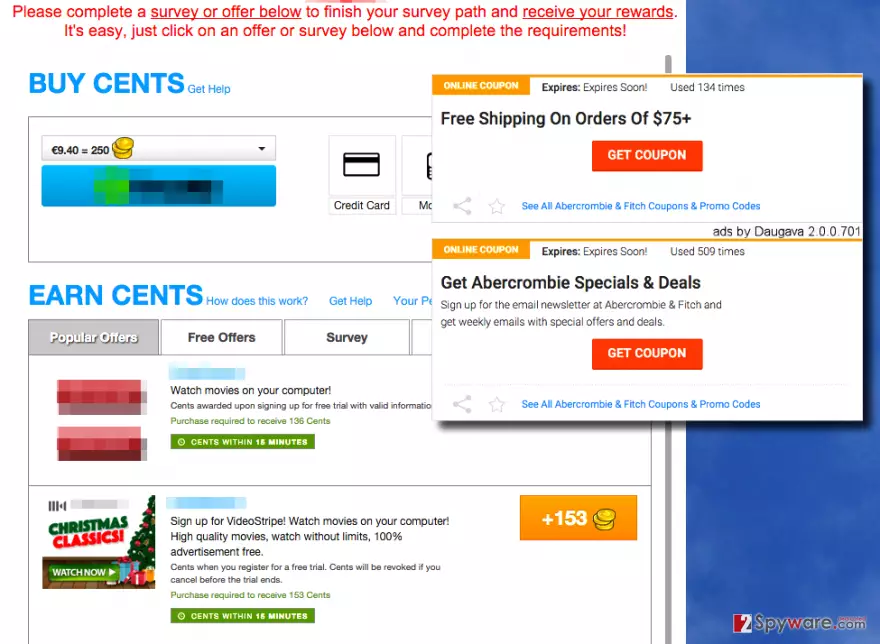
These ads are DECEPTIVE. Most of them commonly redirects users to third-party websites. According to our experience, websites that are promoted via potentially unwanted apps usually ask to fill surveys, sometimes they ask to fill in personal info (you SHOULD NOT do that!), but most of the time, such pages offer programs and program updates for free. You should refuse to install software from unreliable sources because you can never know what you are going to get – you might receive a malicious file, and cause harm for your PC this way. To remove Daugava 2.0.0.701 adware, you should use a reputable anti-spyware application, for example, FortectIntego.
How does Daugava 2.0.0.701 hijack computer system?
Surprisingly, this annoying app can be installed without your permission! You can end up with this software on your system in case you tend to install new apps without paying attention to the installation setup. Here are instructions how you should install software properly:
- Read the statements provided in the installation setup.
- Read Terms of Use document.
- Once you reach the step “Setup settings,” opt for Custom/Advanced installation mode.
- Deselect every suggestion to install optional freeware.
To uninstall Daugava 2.0.0.701, proceed to the following page and read the removal guidelines that were prepared by our PC security experts.
How to uninstall this annoying app?
Daugava 2.0.0.701 virus can be removed very easily. If you have the courage to uninstall this PC threat manually, then scroll down the page and carefully follow each step of the manual removal tutorial. For users who do not think that the manual removal method is safe, or for those who simply want to install a tool that is capable of securing the PC from spyware and malware attacks, we suggest installing an anti-malware program. The 2-spyware team wishes you luck removing this adware application!
Uninstall from Windows
Uninstall from Windows 10/8:
- Type Control Panel into the Windows search box and open the result.
- Under Programs, select Uninstall a program.


Uninstall from Windows 7/XP:
- Click on Windows Start > Control Panel (Windows XP users should click on Add/Remove Programs).
- In Control Panel, select Programs > Uninstall a program.


Remove the unwanted program:
- In the Programs and Features window, look for any recently installed suspicious entries, select them, and click Uninstall.
- If User Account Control appears, click Yes to confirm, then complete the removal.


Delete from macOS
Remove the unwanted application:
- From the menu bar, select Go > Applications.
- In the Applications folder, look for any suspicious entries, then drag them to Trash (or right-click and pick Move to Trash).


Delete leftover files and folders:
- Select Go > Go to Folder.
- Enter /Library/Application Support and remove any suspicious folders related to the unwanted program.
- Repeat the same check in the /Library/LaunchAgents and /Library/LaunchDaemons folders, deleting any suspicious entries.

- Finally, empty the Trash to permanently remove the leftovers.

Remove from Microsoft Edge
Delete unwanted extensions from MS Edge:
- Select Menu (three horizontal dots at the top-right of the browser window) and pick Extensions.
- From the list, pick the extension and click on the Gear icon.
- Click Remove.


Clear cookies and other browser data:
- Click on the Menu (three horizontal dots at the top-right of the browser window) and select Settings > Privacy, search, and services..
- Under Clear browsing data, pick Choose what to clear.
- Select Cookies and other site data and Cached images and files. (apart from passwords, although you might want to include Media licenses as well, if applicable) and click on Clear.


Restore new tab and homepage settings:
- Click the menu icon and choose Settings.
- Then find On startup section.
- Click Remove next to any suspicious startup page.
Reset MS Edge if the above steps did not work:
- Press on Ctrl + Shift + Esc to open Task Manager.
- Click on More details arrow at the bottom of the window.
- Select Details tab.
- Now scroll down and locate every entry with Microsoft Edge name in it. Right-click on each of them and select End Task to stop MS Edge from running.


Instructions for Chromium-based Edge
Delete extensions from MS Edge (Chromium):
- Open Edge and click select Settings > Extensions.
- Delete unwanted extensions by clicking Remove.


Clear cache and site data:
- Click on Menu and go to Settings.
- Select Privacy, search and services.
- Under Clear browsing data, pick Choose what to clear.
- Under Time range, pick All time.
- Select Clear now.


Reset Chromium-based MS Edge:
- Click on Menu and select Settings.
- On the left side, pick Reset settings.
- Select Restore settings to their default values.
- Confirm with Reset.
- This will disable extensions and reset startup pages but will not delete bookmarks, saved passwords, or browsing history.


Remove from Mozilla Firefox (FF)
Remove dangerous extensions:
- Open Mozilla Firefox browser and click on the Menu (three horizontal lines at the top-right of the window).
- Select Add-ons.
- In here, select the unwanted extension and click Remove.


Reset the homepage:
- Click three horizontal lines at the top right corner to open the menu.
- Choose Settings.
- Under Home, set your preferred homepage and new tab settings.
Clear cookies and site data:
- Click Menu and pick Settings.
- Go to Privacy & Security section.
- Scroll down to locate Cookies and Site Data.
- Click on Clear Data...
- Select Cookies and Site Data and Temporary cached files and pages, then click Clear.


Reset Mozilla Firefox
If clearing the browser as explained above did not help, reset Mozilla Firefox:
- Open Mozilla Firefox browser and click the Menu.
- Go to Help and then choose Troubleshooting Information.

- Under Give Firefox a tune up section, click on Refresh Firefox...
- Once the pop-up shows up, confirm the action by pressing on Refresh Firefox.



Remove from Google Chrome
Delete malicious extensions from Google Chrome:
- Open Google Chrome, click on the Menu (three vertical dots at the top-right corner) and select More tools > Extensions.
- In the newly opened window, you will see all the installed extensions. Uninstall all suspicious extensions related to the unwanted program by clicking Remove.


Clear cache and web data from Chrome:
- Click on Menu and pick Settings.
- Under Privacy and security, select Clear browsing data.
- Select Browsing history, Cookies and other site data, as well as Cached images and files.
- Click Clear data.


Change your homepage:
- Click menu and choose Settings.
- Look for a suspicious site in the On startup section.
- Click on Open a specific or set of pages and click on three dots to find the Remove option.
Reset Google Chrome:
If the previous methods did not help you, reset Google Chrome to eliminate all the unwanted components:
- Click on Menu and select Settings.
- In the Settings, scroll down and click Advanced.
- Scroll down and locate Reset and clean up section.
- Now click Restore settings to their original defaults.
- Confirm with Reset settings.


Delete from Safari
Remove dangerous extensions:
- Open Safari, click Safari in the menu at the top-left of the screen, and select Preferences.
- Go to the Extensions tab, look for any suspicious entries, and click Uninstall to remove them.


Clear history and website data:
- Click Safari in the menu and pick Clear History.
- Set Clear to all history and confirm with Clear History.


Reset Safari:
- Click Safari in the menu and select Preferences > Advanced.
- Enable Show Develop menu in menu bar.
- From the menu bar, click Develop and select Empty Caches.


Did this guide help?
4 comments
Quattro
Daugava virus has two versions?
Sylvian
Happy to get rid of this parasite finally!! It was driving me insane as I did not know what happened to my PC (it started to work reaaaaly slow).
freddoki
yeah there is another one called just Daugava
Shremmurd
Removed this adware a few secs ago. The ads do not show up anymore. I used anti-spyware software, it was a fast and easy way to fix the computer :) Just started the scan and it detected the threats, an then I commanded the app to remove these threats right away. Piece of cake.