

What is known about Dounty.com virus?
Typically, users set their web browsers to launch some kind of a search engine on the startup. If this page gets replaced by Dounty.com, it is not a good sign. In fact, it means that Dounty.com redirect virus managed to infiltrate the computer system and make arbitrary changes in browser settings. It is a potentially unwanted program (PUP), and symptoms of its existence shouldn’t be ignored. The search engine that we have just mentioned is designed to trigger redirects to certain Internet sites and make them more popular, but unfortunately, these sites can possibly expose you to insecure content.
You should think twice before entering a search term into this search engine, as it might provide you with misleading search results. Commonly, they look safe at the first sight, while in reality they can be injected with bogus links that are related to vague Internet sites. If you get redirected to suspicious Internet sites after trying to access sites linked to search results, avoid providing any of your personal information, not even details, and don’t try to download any software from there. Otherwise, your email box might get flooded by meaningless spam emails filled with commercial content, or, in case you install some of the suggested programs, annoying pop-up ads might show up shortly. In the worst scenario, you can unintentionally install malware on your computer, so beware! It is always better to think twice before exploring content provided on third-party websites because it can be dangerous and pose a threat to your computer. 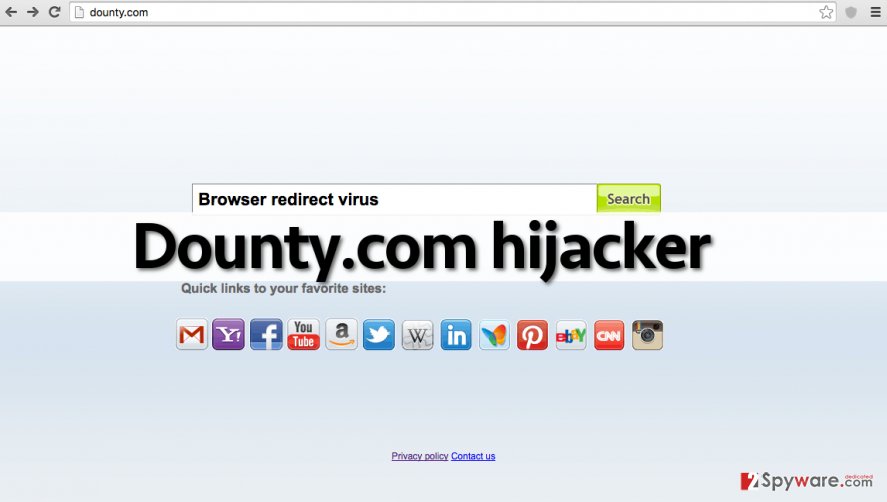
Dounty.com redirect issue is really annoying, but there is more. Did you know that the majority of potentially unwanted programs can collect information about your browsing habits? In fact, they can even find out what is your IP address, what do you search on the web, which websites do you go the most and what links/ads do you click on. Such PUPs commonly claim that they need such information in order to present tailored ads, but consider whether you want to receive them at all. If you think that you don’t need these advertisements in your life, remove Dounty.com hijacker with spyware removal software, for instance, FortectIntego.
How can Dounty.com hijack my computer?
Just like any other search engine, Dounty Search can be installed on the system voluntarily. However, if you have been convinced that you can trust this search search, you should think again because you can never be sure what search results it displays and what third parties it promotes. In addition, this search engine may appear on your computer without downloading it there because it has been added to various free programs in a form of ‘optional’ download. Fortunately, you can prevent infiltration of this search site and save your default search engine or start page from being hijacked. For that, you need to start monitoring installation of free programs. If you want to download such free program as download manager, PDF creator, etc., be sure to select Custom or Advanced installation option. After doing so, follow every installation step and uncheck all check boxes that claim that you agree to change your homepage/ default search engine or install browser add-ons, plugins, extensions and similar suspicious components. If web redirects have already started bothering you, you should waste no time and get rid of this suspicious search engine. It’s not hard to do that if you rely on a guide that is given below.
Dounty.com removal guide
If you are interested “como desinstalar Dounty.com virus,” then you have come to the right web page. You can find informative instructions below, which will help you to delete it manually. If you don’t want to waste time dealing with this hijacker manually, just run an anti-spyware software to uninstall it automatically.
Uninstall from Windows
Uninstall from Windows 10/8:
- Type Control Panel into the Windows search box and open the result.
- Under Programs, select Uninstall a program.


Uninstall from Windows 7/XP:
- Click on Windows Start > Control Panel (Windows XP users should click on Add/Remove Programs).
- In Control Panel, select Programs > Uninstall a program.


Remove the unwanted program:
- In the Programs and Features window, look for any recently installed suspicious entries, select them, and click Uninstall.
- If User Account Control appears, click Yes to confirm, then complete the removal.


Delete from macOS
Remove the unwanted application:
- From the menu bar, select Go > Applications.
- In the Applications folder, look for any suspicious entries, then drag them to Trash (or right-click and pick Move to Trash).


Delete leftover files and folders:
- Select Go > Go to Folder.
- Enter /Library/Application Support and remove any suspicious folders related to the unwanted program.
- Repeat the same check in the /Library/LaunchAgents and /Library/LaunchDaemons folders, deleting any suspicious entries.

- Finally, empty the Trash to permanently remove the leftovers.

Remove from Microsoft Edge
Delete unwanted extensions from MS Edge:
- Select Menu (three horizontal dots at the top-right of the browser window) and pick Extensions.
- From the list, pick the extension and click on the Gear icon.
- Click Remove.


Clear cookies and other browser data:
- Click on the Menu (three horizontal dots at the top-right of the browser window) and select Settings > Privacy, search, and services..
- Under Clear browsing data, pick Choose what to clear.
- Select Cookies and other site data and Cached images and files. (apart from passwords, although you might want to include Media licenses as well, if applicable) and click on Clear.


Restore new tab and homepage settings:
- Click the menu icon and choose Settings.
- Then find On startup section.
- Click Remove next to any suspicious startup page.
Reset MS Edge if the above steps did not work:
- Press on Ctrl + Shift + Esc to open Task Manager.
- Click on More details arrow at the bottom of the window.
- Select Details tab.
- Now scroll down and locate every entry with Microsoft Edge name in it. Right-click on each of them and select End Task to stop MS Edge from running.


Instructions for Chromium-based Edge
Delete extensions from MS Edge (Chromium):
- Open Edge and click select Settings > Extensions.
- Delete unwanted extensions by clicking Remove.


Clear cache and site data:
- Click on Menu and go to Settings.
- Select Privacy, search and services.
- Under Clear browsing data, pick Choose what to clear.
- Under Time range, pick All time.
- Select Clear now.


Reset Chromium-based MS Edge:
- Click on Menu and select Settings.
- On the left side, pick Reset settings.
- Select Restore settings to their default values.
- Confirm with Reset.
- This will disable extensions and reset startup pages but will not delete bookmarks, saved passwords, or browsing history.


Remove from Mozilla Firefox (FF)
Remove dangerous extensions:
- Open Mozilla Firefox browser and click on the Menu (three horizontal lines at the top-right of the window).
- Select Add-ons.
- In here, select the unwanted extension and click Remove.


Reset the homepage:
- Click three horizontal lines at the top right corner to open the menu.
- Choose Settings.
- Under Home, set your preferred homepage and new tab settings.
Clear cookies and site data:
- Click Menu and pick Settings.
- Go to Privacy & Security section.
- Scroll down to locate Cookies and Site Data.
- Click on Clear Data...
- Select Cookies and Site Data and Temporary cached files and pages, then click Clear.


Reset Mozilla Firefox
If clearing the browser as explained above did not help, reset Mozilla Firefox:
- Open Mozilla Firefox browser and click the Menu.
- Go to Help and then choose Troubleshooting Information.

- Under Give Firefox a tune up section, click on Refresh Firefox...
- Once the pop-up shows up, confirm the action by pressing on Refresh Firefox.



Remove from Google Chrome
Delete malicious extensions from Google Chrome:
- Open Google Chrome, click on the Menu (three vertical dots at the top-right corner) and select More tools > Extensions.
- In the newly opened window, you will see all the installed extensions. Uninstall all suspicious extensions related to the unwanted program by clicking Remove.


Clear cache and web data from Chrome:
- Click on Menu and pick Settings.
- Under Privacy and security, select Clear browsing data.
- Select Browsing history, Cookies and other site data, as well as Cached images and files.
- Click Clear data.


Change your homepage:
- Click menu and choose Settings.
- Look for a suspicious site in the On startup section.
- Click on Open a specific or set of pages and click on three dots to find the Remove option.
Reset Google Chrome:
If the previous methods did not help you, reset Google Chrome to eliminate all the unwanted components:
- Click on Menu and select Settings.
- In the Settings, scroll down and click Advanced.
- Scroll down and locate Reset and clean up section.
- Now click Restore settings to their original defaults.
- Confirm with Reset settings.


Delete from Safari
Remove dangerous extensions:
- Open Safari, click Safari in the menu at the top-left of the screen, and select Preferences.
- Go to the Extensions tab, look for any suspicious entries, and click Uninstall to remove them.


Clear history and website data:
- Click Safari in the menu and pick Clear History.
- Set Clear to all history and confirm with Clear History.


Reset Safari:
- Click Safari in the menu and select Preferences > Advanced.
- Enable Show Develop menu in menu bar.
- From the menu bar, click Develop and select Empty Caches.


Did this guide help?
4 comments
imscared!
I didnt even install Dounty what is it doing on my computer???
enrica
Handled this like a pro.
Reiss
Is this just me or these browser hijackers seem more dangerous than they actually are?
St4rlight
Could not remove it. Had to download the antivirus.