

GigaPromo claims to help you save money with improved searches
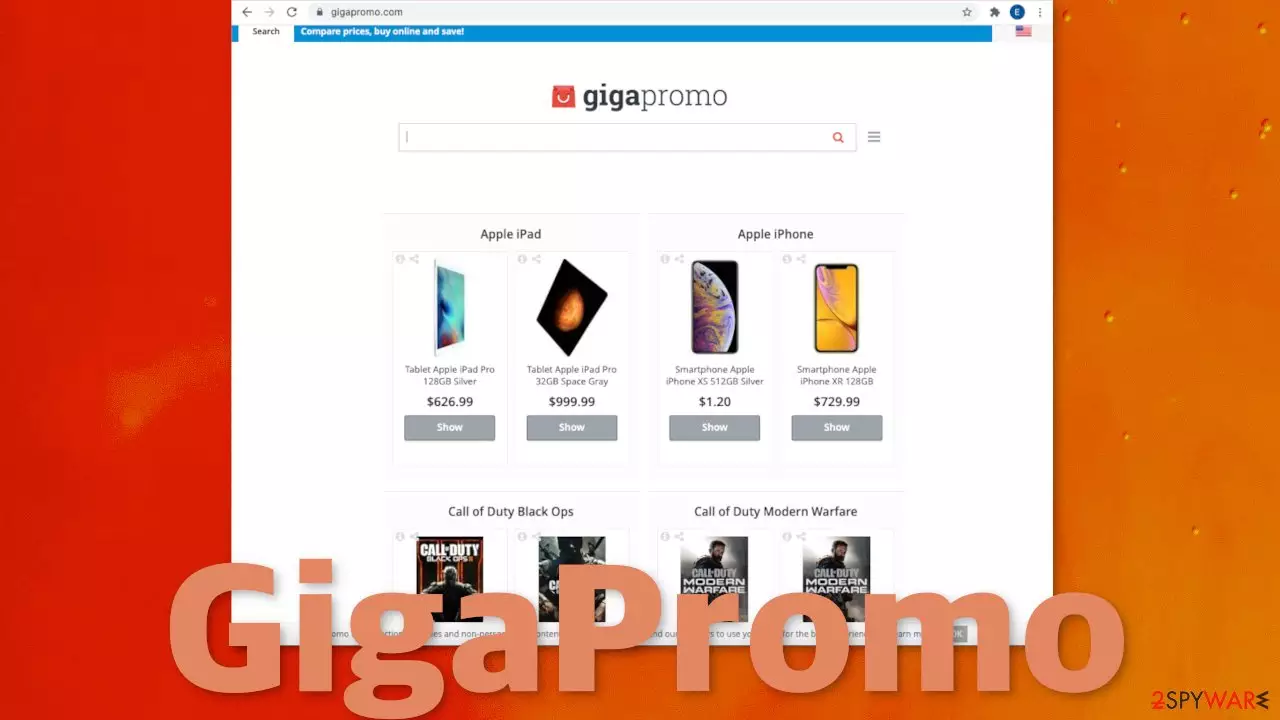
GigaPromo browser hijacker takes over users’ browsers by taking control of the most important settings. It changes the homepage, new tab address and implements its own search engine. The website claims that you can “compare prices, buy online and save!” But nowadays, you can do that using any browser with a click of a button. There are many more legitimate ways you can compare prices online, that do not completely change your browsing experience.
There are many browser hijackers similar to this one, like JustVideoSearch, Vanilla-search.com, GameSearchTech, and they are created for the sole purpose of generating their creators' revenue. This is done with the help of PPC advertising[1] and redirects. Every time you click on a sponsored link, you give money to creators. They do not care about user safety or privacy so ads you receive might lead to questionable websites where people can be exploited and suffer from financial losses or download potentially unwanted programs[2] and malware.[3]
The GigaPromo hijacker could have infiltrated your browser in the form of an extension or a PUP that you installed by accident. If it is simply an extension, you can remove it in your browser settings, and if it is a PUP, the removal can get a little complicated. Whatever the form of the intruder it is, in all cases, people usually add it themselves without realizing. That's because many think they care about online privacy but they take no actions to try to preserve it.
| NAME | GigaPromo |
| TYPE | Browser hijacker; potentially unwanted program |
| SYMPTOMS | Changed homepage, new tab address, and search engine; redirects to questionable sites |
| DISTRIBUTION | Deceptive ads, shady pages, free software installations from unofficial sources |
| DANGERS | Tracking of browsing behavior; display of ads and redirects to bogus websites |
| ELIMINATION | Remove the extension in your browser settings or by deleting a PUP from your system |
| FURTHER STEPS | Use an optimization tool FortectIntego to clear cookies, cache, and fix any other remaining damage |
Distribution methods of potentially unwanted programs
In order to get infected with a browser hijacker, you had to be surfing through some shady pages or downloading software from unofficial sources. It is a common misconception among some people that the Internet is a completely safe place but it is actually the opposite. Cybercriminals are more active than ever, especially since the pandemic started as people are spending more time on their screens. So you have to be careful with what links you click on and if you interact with safe websites.
The search results that you receive using gigapromo.com are unreliable and can lead to misinformation. The add-on or PUP implements its own search engine, which is nowhere near as good as some of the most popular ones. Besides that, you are constantly getting spammed with good phone, video game, and other “deals” which we cannot imagine being useful. Browser hijacker developers rarely create their own search engines, they rather implement already existing ones just to make them functional, so this one is an exception.

The most worrying thing is that when users are forced to use these shady search engines, everything they type into the search box, what links they click on, what they purchase can be tracked by the hijacker. It also uses cookies[4] to store that information. The good thing is that they are stored on your device, so. you can delete them anytime.
After you deal with this situation with the solutions we have provided below, we recommend using a maintenance tool like FortectIntego to clear your browsers completely from virus damage. It is a powerful software that can also fix various system errors, corrupted files and optimize the machine to improve performance.
You should stop the GigaPromo browser hijacker activities by clearing browsers too. So if you experience any other symptoms this is a great way to take care of it easily and automatically.
Get rid of the intruder
The first thing you should do is go to your browser settings and check if there are any suspicious extensions in the list. You might have added the extension by accident or because you saw a deceptive ad for it and you thought it will be useful. Instructions for the most often used browsers are below:
Google Chrome
- Open Google Chrome, click on the Menu (three vertical dots at the top-right corner) and select More tools > Extensions.
- In the newly opened window, you will see all the installed extensions. Uninstall all the suspicious plugins that might be related to the unwanted program by clicking Remove.


MS Edge:
- Select Menu (three horizontal dots at the top-right of the browser window) and pick Extensions.
- From the list, pick the extension and click on the Gear icon.
- Click on Uninstall at the bottom.


MS Edge (Chromium)
- Open Edge and click select Settings > Extensions.
- Delete unwanted extensions by clicking Remove.


Mozilla Firefox
- Open Mozilla Firefox browser and click on the Menu (three horizontal lines at the top-right of the window).
- Select Add-ons.
- In here, select unwanted plugin and click Remove.


Safari
- Click Safari > Preferences…
- In the new window, pick Extensions.
- Select the unwanted extension and select Uninstall.


Internet Explorer:
- Open Internet Explorer, click on the Gear icon (IE menu) on the top-right corner of the browser
- Pick Manage Add-ons.
- You will see a Manage Add-ons window. Here, look for suspicious plugins. Click on these entries and select Disable.


Websites that distribute freeware are a breeding ground for PUPs
If the previous removal method did not work, you might have a potentially unwanted program operating in your system without your knowledge. If that is the case, then simply removing the extension and changing your settings will not work – they will get reverted again until you completely eliminate the uninvited guest.
You should avoid installing free software from unofficial sources. We know it can get costly paying for software licenses but at least you will know that you can trust the websites, the program developers to not do anything shady. Freeware distributors, on the other hand, include additional programs in the installers without disclosing it so many people that rush through the installation process do not notice them.
That is why we suggest implementing some habits in your routine to keep the chance of this happening again to a minimum. Always choose the “Custom” or “Advanced “ installation method and read the Terms of Use, Privacy Policy. The most important part is to check the file list. If you see any additional programs included – untick the boxes next to them without thinking about it, you do not need them.
Manual removal of a GigaPromo PUA can get a little complicated because it is not known which particular program is causing such behavior of the browser. You might delete the wrong apps if you attempt to do this on your own. SpyHunterCombo Cleaner or MalwarebytesMalwarebytes are great professional security tools that can automatically scan your machine for suspicious processes in your system and eliminate them completely with all of the related files. If you still want to do this yourself, you can follow the step-by-step instructions for Windows and Mac users below:
Windows 10/8:
- Enter Control Panel into Windows search box and hit Enter or click on the search result.
- Under Programs, select Uninstall a program.

- From the list, find the entry of the suspicious program.
- Right-click on the application and select Uninstall.
- If User Account Control shows up, click Yes.
- Wait till uninstallation process is complete and click OK.



Windows 7/XP:
- Click on Windows Start > Control Panel located on the right pane (if you are Windows XP user, click on Add/Remove Programs).
- In Control Panel, select Programs > Uninstall a program.

- Pick the unwanted application by clicking on it once.
- At the top, click Uninstall/Change.
- In the confirmation prompt, pick Yes.
- Click OK once the removal process is finished.

Mac:
- From the menu bar, select Go > Applications.
- In the Applications folder, look for all related entries.
- Click on the app and drag it to Trash (or right-click and pick Move to Trash)


To fully remove an unwanted app, you need to access Application Support, LaunchAgents, and LaunchDaemons folders and delete relevant files:
- Select Go > Go to Folder.
- Enter /Library/Application Support and click Go or press Enter.
- In the Application Support folder, look for any dubious entries and then delete them.
- Now enter /Library/LaunchAgents and /Library/LaunchDaemons folders the same way and terminate all the related .plist files.


Remove from Microsoft Edge
Delete unwanted extensions from MS Edge:
- Select Menu (three horizontal dots at the top-right of the browser window) and pick Extensions.
- From the list, pick the extension and click on the Gear icon.
- Click Remove.
Clear cookies and other browser data:
- Click on the Menu (three horizontal dots at the top-right of the browser window) and select Settings > Privacy, search, and services..
- Under Clear browsing data, pick Choose what to clear.
- Select Cookies and other site data and Cached images and files. (apart from passwords, although you might want to include Media licenses as well, if applicable) and click on Clear.


Restore new tab and homepage settings:
- Click the menu icon and choose Settings.
- Then find On startup section.
- Click Remove next to any suspicious startup page.
Reset MS Edge if the above steps did not work:
- Press on Ctrl + Shift + Esc to open Task Manager.
- Click on More details arrow at the bottom of the window.
- Select Details tab.
- Now scroll down and locate every entry with Microsoft Edge name in it. Right-click on each of them and select End Task to stop MS Edge from running.


Instructions for Chromium-based Edge
Delete extensions from MS Edge (Chromium):
- Open Edge and click select Settings > Extensions.
- Delete unwanted extensions by clicking Remove.
Clear cache and site data:
- Click on Menu and go to Settings.
- Select Privacy, search and services.
- Under Clear browsing data, pick Choose what to clear.
- Under Time range, pick All time.
- Select Clear now.


Reset Chromium-based MS Edge:
- Click on Menu and select Settings.
- On the left side, pick Reset settings.
- Select Restore settings to their default values.
- Confirm with Reset.
- This will disable extensions and reset startup pages but will not delete bookmarks, saved passwords, or browsing history.


Remove from Mozilla Firefox (FF)
Remove dangerous extensions:
- Open Mozilla Firefox browser and click on the Menu (three horizontal lines at the top-right of the window).
- Select Add-ons.
- In here, select the unwanted extension and click Remove.
Reset the homepage:
- Click three horizontal lines at the top right corner to open the menu.
- Choose Settings.
- Under Home, set your preferred homepage and new tab settings.
Clear cookies and site data:
- Click Menu and pick Settings.
- Go to Privacy & Security section.
- Scroll down to locate Cookies and Site Data.
- Click on Clear Data...
- Select Cookies and Site Data and Temporary cached files and pages, then click Clear.


Reset Mozilla Firefox
If clearing the browser as explained above did not help, reset Mozilla Firefox:
- Open Mozilla Firefox browser and click the Menu.
- Go to Help and then choose Troubleshooting Information.

- Under Give Firefox a tune up section, click on Refresh Firefox...
- Once the pop-up shows up, confirm the action by pressing on Refresh Firefox.



Remove from Google Chrome
Delete malicious extensions from Google Chrome:
- Open Google Chrome, click on the Menu (three vertical dots at the top-right corner) and select More tools > Extensions.
- In the newly opened window, you will see all the installed extensions. Uninstall all suspicious extensions related to the unwanted program by clicking Remove.
Clear cache and web data from Chrome:
- Click on Menu and pick Settings.
- Under Privacy and security, select Clear browsing data.
- Select Browsing history, Cookies and other site data, as well as Cached images and files.
- Click Clear data.


Change your homepage:
- Click menu and choose Settings.
- Look for a suspicious site in the On startup section.
- Click on Open a specific or set of pages and click on three dots to find the Remove option.
Reset Google Chrome:
If the previous methods did not help you, reset Google Chrome to eliminate all the unwanted components:
- Click on Menu and select Settings.
- In the Settings, scroll down and click Advanced.
- Scroll down and locate Reset and clean up section.
- Now click Restore settings to their original defaults.
- Confirm with Reset settings.


Delete from Safari
Remove dangerous extensions:
- Open Safari, click Safari in the menu at the top-left of the screen, and select Preferences.
- Go to the Extensions tab, look for any suspicious entries, and click Uninstall to remove them.
Clear history and website data:
- Click Safari in the menu and pick Clear History.
- Set Clear to all history and confirm with Clear History.


Reset Safari:
- Click Safari in the menu and select Preferences > Advanced.
- Enable Show Develop menu in menu bar.
- From the menu bar, click Develop and select Empty Caches.


Did this guide help?
Be the first to comment