

Money Viking – adware that shows pop-up ads and can track browsing related activity
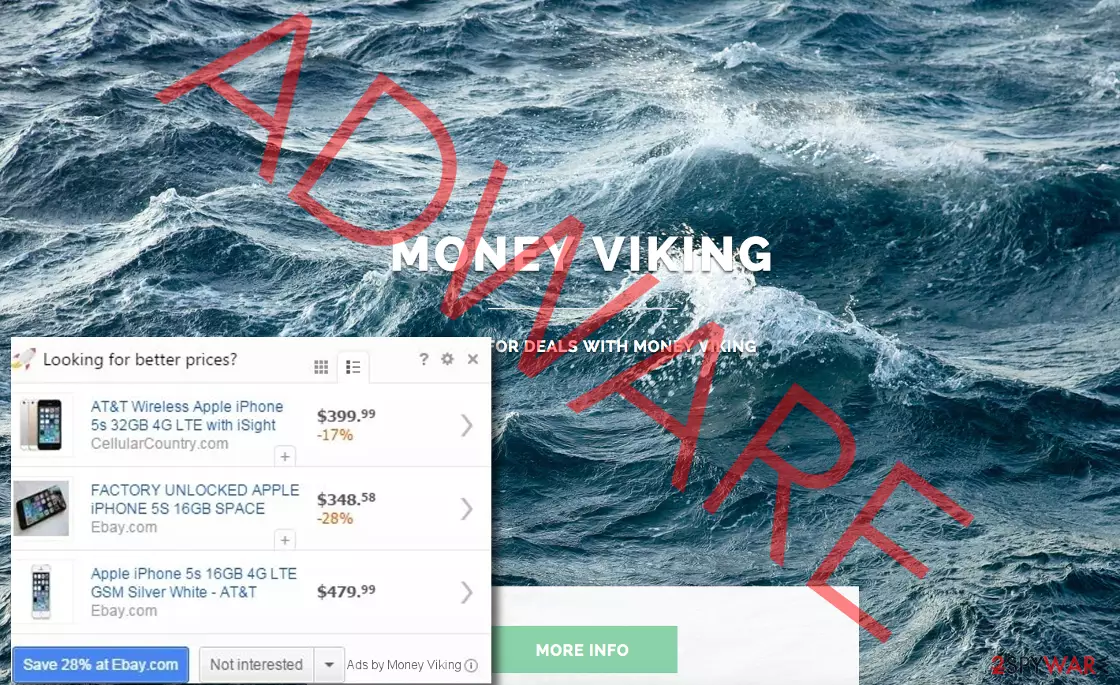
Money Viking is a type of software that can bring various inconveniences to your computer. It is categorized as adware, which is a type of potentially unwanted program. Initially, its operation is based on a good promise – to bring the best online shopping deals for you, but in reality, it just seeks to make you buy affiliated stuff. While it is not a crime, of course, it does not necessarily benefit the end-users, as it is also tracking user activity in the background.
The app usually comes as an extension for Mozilla Firefox, Google Chrome, and a BHO for Internet Explorer. The pop-up ads, coupons, banners, and other intrusive content may sometimes even interfere with the information shown on the visited website, which would greatly diminish the web browsing experience.
| Name | Money Viking |
| Type | Adware |
| Distribution | Software bundling, third-party websites |
| Operation | Promises deals, discounts and offers but instead creates a layer of ads on all visited websites |
| Removal | Use up-to-date anti-malware software |
| Optional | Cleaning web browsers is highly recommended – either follow the guide below or employ FortectIntego for the job |
You should be very careful if you notice signs of this applications’ presence. You can realize that your computer has been installed with this app if you keep seeing various pop-ups or banners entitled with these lines: “Money Viking ads,” “special deal for you by Money Viking,” “Money Viking deals.” These ads claim that this potentially unwanted program (PUP) has appeared on your computer with or without your authorization.
There are several reasons why you should remove adware as soon as you notice these ads. Firstly, the PUP slows down your machine’s performance, because it needs to use computer resources to load its ads.
Secondly, the displayed ads are highly unreliable. You should not believe what this rogue program says – it is not supposed to advertise real deals. A very interesting fact about this program is that it uses a crafty technique to convince the user that this PUP brings only the best deals.
The tool tracks your activity on the web; that is why this program usually shows attractive and interesting ads.
It reviews your browsing history, downloads, search queries, frequently used keywords, and other browsing-related information. Then it uses this data to generate specific ads for you, based on your interests and preferences on the Internet. You must avoid clicking on ads by Money Viking.
Unfortunately, the majority of these ads are going to lead you to unreliable websites that can include suspicious links or suggestions to install “great programs” for free.
Do not be deceived, because there is a great possibility to get an infectious file alongside such programs. If you suspect that there may be an adware program on your computer, and if you see intrusive ads from time to time, you should check your computer with an anti-spyware program, for example, SpyHunterCombo Cleaner or MalwarebytesMalwarebytes, and get rid of all potentially unwanted applications at once.
Ways to avoid potentially unwanted programs
Although this adware has its official website, you are not going to find much information on it. It is a shady application, and it is distributed in a rogue way. Developers collaborate with other freeware marketers and tend to bundle these apps together; therefore, they build bundled software.
Such a software package can be downloaded if you tend to download programs from unofficial or questionable sources. However, it is very easy to avoid installing undesired programs by performing a few security checks on the installation setup. You must read Terms of Use as well as Privacy Policy forms to detect possible statements about optional attachments – applications.
Also, you have to select the correct installation mode in order to see the suggestions to install bonus apps and to reject such offers. You have to opt for the “Custom/Advanced” installation mode. This mode expands the setup window and shows a list of bonus apps suggested for you. All you need to do is to opt-out of the boxes near such suggestions.
Uninstall Money Viking from your system
We suggest installing a professional PUPs’ removal tool to delete the virus from your computer for good. It is essential to have such a security program on your computer if you wish to maintain a good level of cyber-safety.
However, we have also provided a manual Money Viking removal option, and we have prepared the instructions for you. Follow the steps below to remove this adware manually.
Also, be careful while installing new applications in the future. If you do not want to download potentially unwanted programs again, always use the advanced/custom installation method.
Uninstall from Windows
Uninstall from Windows 10/8:
- Type Control Panel into the Windows search box and open the result.
- Under Programs, select Uninstall a program.


Uninstall from Windows 7/XP:
- Click on Windows Start > Control Panel (Windows XP users should click on Add/Remove Programs).
- In Control Panel, select Programs > Uninstall a program.


Remove the unwanted program:
- In the Programs and Features window, look for any recently installed suspicious entries, select them, and click Uninstall.
- If User Account Control appears, click Yes to confirm, then complete the removal.


Delete from macOS
Remove the unwanted application:
- From the menu bar, select Go > Applications.
- In the Applications folder, look for any suspicious entries, then drag them to Trash (or right-click and pick Move to Trash).


Delete leftover files and folders:
- Select Go > Go to Folder.
- Enter /Library/Application Support and remove any suspicious folders related to the unwanted program.
- Repeat the same check in the /Library/LaunchAgents and /Library/LaunchDaemons folders, deleting any suspicious entries.

- Finally, empty the Trash to permanently remove the leftovers.

Remove from Microsoft Edge
Delete unwanted extensions from MS Edge:
- Select Menu (three horizontal dots at the top-right of the browser window) and pick Extensions.
- From the list, pick the extension and click on the Gear icon.
- Click Remove.


Clear cookies and other browser data:
- Click on the Menu (three horizontal dots at the top-right of the browser window) and select Settings > Privacy, search, and services..
- Under Clear browsing data, pick Choose what to clear.
- Select Cookies and other site data and Cached images and files. (apart from passwords, although you might want to include Media licenses as well, if applicable) and click on Clear.


Restore new tab and homepage settings:
- Click the menu icon and choose Settings.
- Then find On startup section.
- Click Remove next to any suspicious startup page.
Reset MS Edge if the above steps did not work:
- Press on Ctrl + Shift + Esc to open Task Manager.
- Click on More details arrow at the bottom of the window.
- Select Details tab.
- Now scroll down and locate every entry with Microsoft Edge name in it. Right-click on each of them and select End Task to stop MS Edge from running.


Instructions for Chromium-based Edge
Delete extensions from MS Edge (Chromium):
- Open Edge and click select Settings > Extensions.
- Delete unwanted extensions by clicking Remove.


Clear cache and site data:
- Click on Menu and go to Settings.
- Select Privacy, search and services.
- Under Clear browsing data, pick Choose what to clear.
- Under Time range, pick All time.
- Select Clear now.


Reset Chromium-based MS Edge:
- Click on Menu and select Settings.
- On the left side, pick Reset settings.
- Select Restore settings to their default values.
- Confirm with Reset.
- This will disable extensions and reset startup pages but will not delete bookmarks, saved passwords, or browsing history.


Remove from Mozilla Firefox (FF)
Remove dangerous extensions:
- Open Mozilla Firefox browser and click on the Menu (three horizontal lines at the top-right of the window).
- Select Add-ons.
- In here, select the unwanted extension and click Remove.


Reset the homepage:
- Click three horizontal lines at the top right corner to open the menu.
- Choose Settings.
- Under Home, set your preferred homepage and new tab settings.
Clear cookies and site data:
- Click Menu and pick Settings.
- Go to Privacy & Security section.
- Scroll down to locate Cookies and Site Data.
- Click on Clear Data...
- Select Cookies and Site Data and Temporary cached files and pages, then click Clear.


Reset Mozilla Firefox
If clearing the browser as explained above did not help, reset Mozilla Firefox:
- Open Mozilla Firefox browser and click the Menu.
- Go to Help and then choose Troubleshooting Information.

- Under Give Firefox a tune up section, click on Refresh Firefox...
- Once the pop-up shows up, confirm the action by pressing on Refresh Firefox.



Remove from Google Chrome
Delete malicious extensions from Google Chrome:
- Open Google Chrome, click on the Menu (three vertical dots at the top-right corner) and select More tools > Extensions.
- In the newly opened window, you will see all the installed extensions. Uninstall all suspicious extensions related to the unwanted program by clicking Remove.


Clear cache and web data from Chrome:
- Click on Menu and pick Settings.
- Under Privacy and security, select Clear browsing data.
- Select Browsing history, Cookies and other site data, as well as Cached images and files.
- Click Clear data.


Change your homepage:
- Click menu and choose Settings.
- Look for a suspicious site in the On startup section.
- Click on Open a specific or set of pages and click on three dots to find the Remove option.
Reset Google Chrome:
If the previous methods did not help you, reset Google Chrome to eliminate all the unwanted components:
- Click on Menu and select Settings.
- In the Settings, scroll down and click Advanced.
- Scroll down and locate Reset and clean up section.
- Now click Restore settings to their original defaults.
- Confirm with Reset settings.


Delete from Safari
Remove dangerous extensions:
- Open Safari, click Safari in the menu at the top-left of the screen, and select Preferences.
- Go to the Extensions tab, look for any suspicious entries, and click Uninstall to remove them.


Clear history and website data:
- Click Safari in the menu and pick Clear History.
- Set Clear to all history and confirm with Clear History.


Reset Safari:
- Click Safari in the menu and select Preferences > Advanced.
- Enable Show Develop menu in menu bar.
- From the menu bar, click Develop and select Empty Caches.


Did this guide help?
4 comments
Hogwartz
Get rid of it as soon as you can
Outkaz
I thought these ads were supposed to deliver me best deals!! Now it turns out this app is a computer parasite. I am so disappointed!
bobby
I also thought that these ads are completely normal and that they are showing great prices...
Suppermasive
Dont get the point of this program - why show fake ads when you can show real ones and get money from trusted websites? Thats such a bad marketing strategy.