

NativeDesktopMediaService virus is an unwanted application that displays intrusive ads
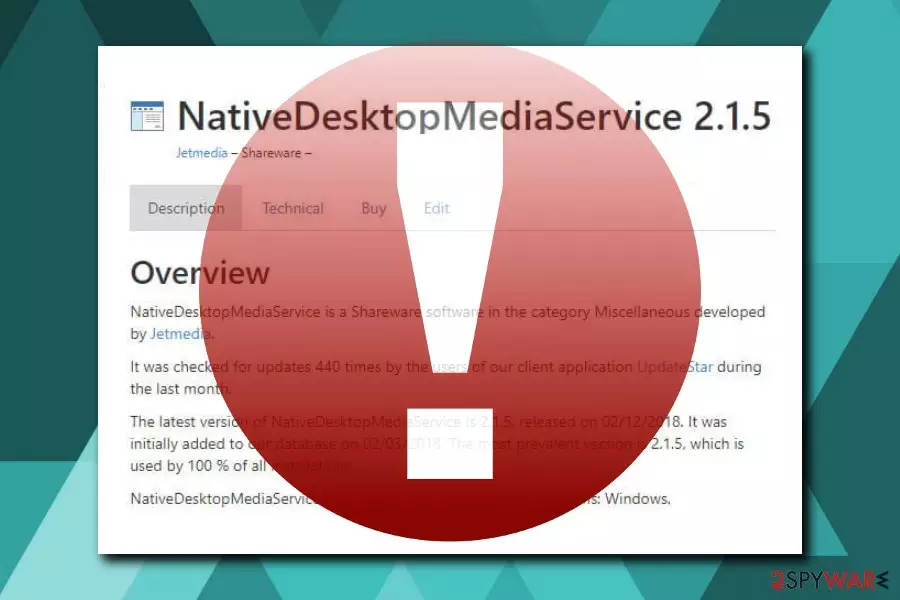
NativeDesktopMediaService is a type of adware[1] program which gathers a certain amount of information about users. As soon as the unwanted program enters the PC via software bundling, it creates two tasks in the task manager called NativeDesktopMediaService and Checker64. These commands are executed so that the malicious program could communicate with external servers and deliver advertisements.
| SUMMARY | |
| Name | NativeDesktopMediaService virus |
|---|---|
| Type | Adware, potentially unwanted program |
| Related tasks | NativeDesktopMediaService and Checker64 |
| Symptoms | Intrusive ads and continual redirects disturb browsing sessions |
| Distribution | Software bundling, suspicious sites |
| Main dangers | Malware infections, leaked data |
| Elimination | You can employ security software FortectIntego or eliminate the threat manually (instructions below) |
NativeDesktopMediaService will try to establish connection to the following domains:
- http://zoruniq.com;
- http://xfinucte.com;
- http://xfinucet.com;
- http://xfieunst.com;
- http://efiwuniq.com;
- http://xfinuest.com.
NativeDesktopMediaService adware tries to monetize on unsuspecting users, and their unfortunate browsing experience as their Google Chrome, Internet Explorer, Mozilla Firefox or another browser is spammed with pop-ups, banners, deals, coupons, offers and similar ads.
Additionally, these advertisements can hinder the view of legitimate websites and turn internet browsing from a pleasant and informative activity into a complete nightmare. Every time you click on ad NativeDesktopMediaService creators gain revenue. It also boosts traffic to less-popular sites, eventually increasing their sales.
While continual ads might be annoying to deal with, they are not the most treacherous feature of the virus. Its redirecting tendencies can bring you to survey scams, phishing, fake update, tech support scams[2] or even websites infected with malware. Thus, your computer might get contaminated with such cyber threats as ransomware – a file locking virus which renders all personal files unusable. NativeDesktopMediaService removal can save you from these dangerous programs.
Additionally, the malicious NativeDesktopMediaService program gathers a variety of information about you. PUPs authors employ such spying techniques to be able to create an online profile of the infected computer so that the targeted advertisement could be generated.
The gathered data includes, but is not limited to:
- IP address;
- Internet Service Provider;
- Geo-location;
- Websites visited;
- Clicks on links;
- System and software information, etc.
Data harvesting might seem insignificant at the start, as many companies use such marketing techniques. However, as NativeDesktopMediaService is a highly questionable application, it is unknown who could obtain this data. Thus, such activity might end in stolen money or even identity theft.
Therefore, you should remove NativeDesktopMediaService form your computer without hesitation. One of the quickest and most efficient ways to accomplish that is by employing a reputable security program, such as FortectIntego. Otherwise, you can delete NativeDesktopMediaService manually by using our guide below.

Unwanted applications are hidden inside freeware installers
Research conducted by ioys.gr[3] experts showed that users are typically unaware how unwanted applications travel around the web. Some inexperienced individuals think that viruses simply enter machines without warning – that is not true. Users are responsible for the online safety and should be aware of dangers lurking around the web.
Unwanted applications typically infiltrate victims’ computers using software bundling – a widespread marketing campaign used all over the world. Free software developers use a simple trick to disguise third-party applications within their installers – they urge users to pick Recommended/Quick installation mode.
Despite these suggestions, users should refrain themselves from trying to save time in such way. Users often miss the tiny “By clicking next, I accept terms and conditions” notice, which is purposely hidden by colorful install buttons and similar artwork.
Thus, never click Next without looking. Read through all the installation instructions properly and pick Custom/Advanced settings. Once prompted, remove all the tick marks next to search engines, add-ons, toolbars, optimization tools, PDF creators and similar useless software.
Uninstall NativeDesktopMediaService and continue safe internet browsing
There are two ways you can remove NativeDesktopMediaService virus: manual and automatic.
Manual NativeDesktopMediaService removal can be executed by following your detailed guide below. Every effort has been made to make it as clear as possible. Nevertheless, if you are not that computer-savvy individual, this task might prove too difficult for you.
Thus, pick a powerful malware removal tool and run a full system scan. We advise you to choose one of the programs below as these applications can ensure complete NativeDesktopMediaService elimination in just a few minutes.
Uninstall from Windows
Uninstall from Windows 10/8:
- Type Control Panel into the Windows search box and open the result.
- Under Programs, select Uninstall a program.


Uninstall from Windows 7/XP:
- Click on Windows Start > Control Panel (Windows XP users should click on Add/Remove Programs).
- In Control Panel, select Programs > Uninstall a program.


Remove the unwanted program:
- In the Programs and Features window, look for any recently installed suspicious entries, select them, and click Uninstall.
- If User Account Control appears, click Yes to confirm, then complete the removal.


Delete from macOS
Remove the unwanted application:
- From the menu bar, select Go > Applications.
- In the Applications folder, look for any suspicious entries, then drag them to Trash (or right-click and pick Move to Trash).


Delete leftover files and folders:
- Select Go > Go to Folder.
- Enter /Library/Application Support and remove any suspicious folders related to the unwanted program.
- Repeat the same check in the /Library/LaunchAgents and /Library/LaunchDaemons folders, deleting any suspicious entries.

- Finally, empty the Trash to permanently remove the leftovers.

Reset Internet Explorer
Remove dangerous add-ons:
- Open Internet Explorer, click on the Gear icon (IE menu) on the top-right corner of the browser
- Pick Manage Add-ons.
- You will see a Manage Add-ons window. Here, look for suspicious plugins. Click on these entries and select Disable.


Change your homepage if it was altered:
- Open IE and click on the Gear icon.
- Select Internet Options.
- In the General tab, delete the Home page address and replace it by your preferred one (for example, Google.com).
- Click Apply and then select OK.


Delete temporary files:
- Press on the Gear icon and select Internet Options.
- Under Browsing history, click Delete...
- Select relevant fields and press Delete.


Reset Internet Explorer:
- Click on Gear icon > Internet options and select Advanced tab.
- Select Reset.
- In the new window, check Delete personal settings and select Reset.


Remove from Microsoft Edge
Delete unwanted extensions from MS Edge:
- Select Menu (three horizontal dots at the top-right of the browser window) and pick Extensions.
- From the list, pick the extension and click on the Gear icon.
- Click Remove.


Clear cookies and other browser data:
- Click on the Menu (three horizontal dots at the top-right of the browser window) and select Settings > Privacy, search, and services..
- Under Clear browsing data, pick Choose what to clear.
- Select Cookies and other site data and Cached images and files. (apart from passwords, although you might want to include Media licenses as well, if applicable) and click on Clear.


Restore new tab and homepage settings:
- Click the menu icon and choose Settings.
- Then find On startup section.
- Click Remove next to any suspicious startup page.
Reset MS Edge if the above steps did not work:
- Press on Ctrl + Shift + Esc to open Task Manager.
- Click on More details arrow at the bottom of the window.
- Select Details tab.
- Now scroll down and locate every entry with Microsoft Edge name in it. Right-click on each of them and select End Task to stop MS Edge from running.


Instructions for Chromium-based Edge
Delete extensions from MS Edge (Chromium):
- Open Edge and click select Settings > Extensions.
- Delete unwanted extensions by clicking Remove.


Clear cache and site data:
- Click on Menu and go to Settings.
- Select Privacy, search and services.
- Under Clear browsing data, pick Choose what to clear.
- Under Time range, pick All time.
- Select Clear now.


Reset Chromium-based MS Edge:
- Click on Menu and select Settings.
- On the left side, pick Reset settings.
- Select Restore settings to their default values.
- Confirm with Reset.
- This will disable extensions and reset startup pages but will not delete bookmarks, saved passwords, or browsing history.


Remove from Mozilla Firefox (FF)
Remove dangerous extensions:
- Open Mozilla Firefox browser and click on the Menu (three horizontal lines at the top-right of the window).
- Select Add-ons.
- In here, select the unwanted extension and click Remove.


Reset the homepage:
- Click three horizontal lines at the top right corner to open the menu.
- Choose Settings.
- Under Home, set your preferred homepage and new tab settings.
Clear cookies and site data:
- Click Menu and pick Settings.
- Go to Privacy & Security section.
- Scroll down to locate Cookies and Site Data.
- Click on Clear Data...
- Select Cookies and Site Data and Temporary cached files and pages, then click Clear.


Reset Mozilla Firefox
If clearing the browser as explained above did not help, reset Mozilla Firefox:
- Open Mozilla Firefox browser and click the Menu.
- Go to Help and then choose Troubleshooting Information.

- Under Give Firefox a tune up section, click on Refresh Firefox...
- Once the pop-up shows up, confirm the action by pressing on Refresh Firefox.



Remove from Google Chrome
Delete malicious extensions from Google Chrome:
- Open Google Chrome, click on the Menu (three vertical dots at the top-right corner) and select More tools > Extensions.
- In the newly opened window, you will see all the installed extensions. Uninstall all suspicious extensions related to the unwanted program by clicking Remove.


Clear cache and web data from Chrome:
- Click on Menu and pick Settings.
- Under Privacy and security, select Clear browsing data.
- Select Browsing history, Cookies and other site data, as well as Cached images and files.
- Click Clear data.


Change your homepage:
- Click menu and choose Settings.
- Look for a suspicious site in the On startup section.
- Click on Open a specific or set of pages and click on three dots to find the Remove option.
Reset Google Chrome:
If the previous methods did not help you, reset Google Chrome to eliminate all the unwanted components:
- Click on Menu and select Settings.
- In the Settings, scroll down and click Advanced.
- Scroll down and locate Reset and clean up section.
- Now click Restore settings to their original defaults.
- Confirm with Reset settings.


Delete from Safari
Remove dangerous extensions:
- Open Safari, click Safari in the menu at the top-left of the screen, and select Preferences.
- Go to the Extensions tab, look for any suspicious entries, and click Uninstall to remove them.


Clear history and website data:
- Click Safari in the menu and pick Clear History.
- Set Clear to all history and confirm with Clear History.


Reset Safari:
- Click Safari in the menu and select Preferences > Advanced.
- Enable Show Develop menu in menu bar.
- From the menu bar, click Develop and select Empty Caches.


Did this guide help?
Be the first to comment