
Orange Defender Antivirus: what it is and how to remove it
Orange Defender Antivirus is a security application developed by Innovative Solutions. It is presented as an anti-malware suite that can protect users from viruses, potentially unwanted programs, worms, trojans, ransomware, and other threats.
Facts checked October 6, 2026. Removal steps tested on Windows 11 (26H2) and checked against Microsoft's and the browser makers' current documentation. Sections marked as our earlier report are the original text: they describe the threat as it was then and have not been reviewed since. The 2026 status, the removal steps and the questions are current.
Automatic
Get a free scan and check if your PC is infected.
Fortect finds malware, unwanted programs and the Windows damage they leave behind, and repairs it in one pass.
Programs like Orange Defender Antivirus usually arrive in groups; a free scan lists the companions that are easy to miss.
Do it yourself · free Remove Orange Defender Antivirus yourself 5 steps, about 15 minutes, no software needed.
Start the steps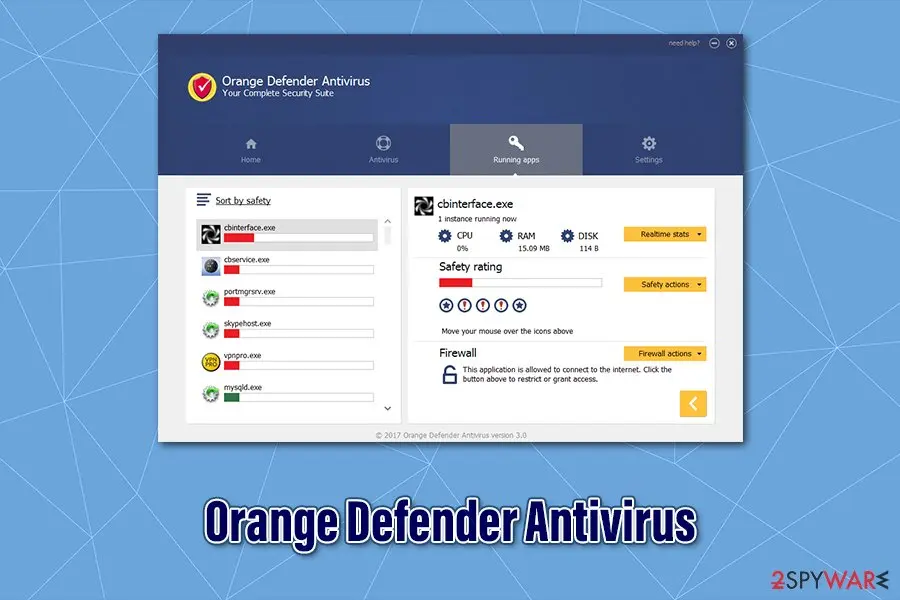
Orange Defender Antivirus: summary
| Distribution | While users can install the app through its official websites, many can find it on their computers after downloading freeware from third-party websites (software bundling technique); also, the PUP can be promoted via other websites or the installed applications |
|---|---|
| Damage | A false sense of security since the program is not effective in protecting users from online threats; financial losses due to purchasing of useless software |
| Name | Orange Defender Antivirus |
| Type | Potentially unwanted program |
| Symptoms | An app initiates scans and claims that several issues have been detected. To eliminate them, users are asked to purchase a full version of the app |
| Detection names | No Microsoft detection name is known |
| Removal | Scan the PC with security software to find and remove the malware and anything installed with it. Fortect scans Windows for malware and repairs the system files and settings it damaged. Remove it nowTo use the full-featured product, you have to purchase a license for Fortect. The scan is free. |
Show 4 more facts
| Evidence | 4 write-ups by security sites; details still limited |
|---|---|
| Program | Orange Defender Antivirus |
| First seen | 26 June 2020 |
| Facts checked | 6 October 2026 |
Is Orange Defender Antivirus a real security program?
From our report of Jun 2020 · not reviewed since
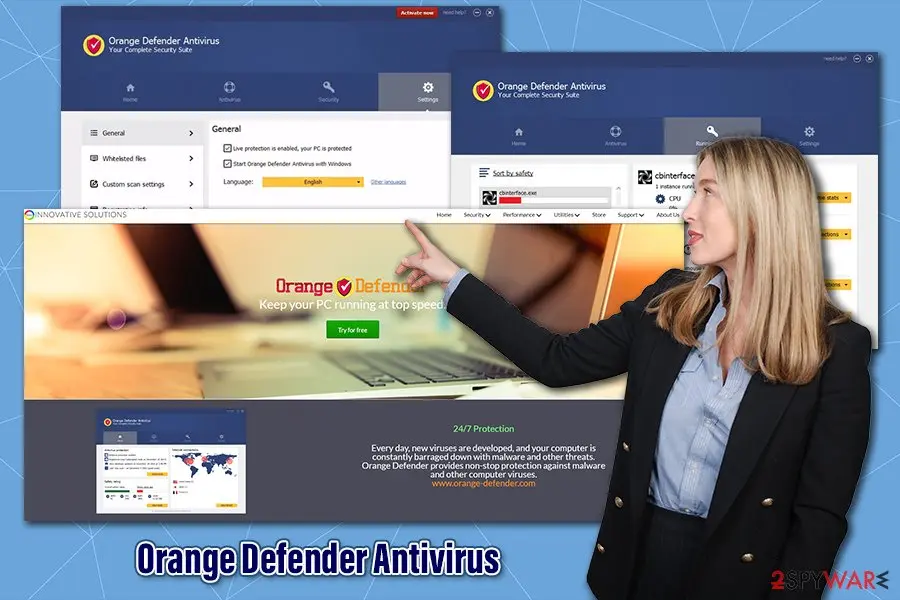
Orange Defender Antivirus is a questionable antivirus program that will most likely appear on your computer without permission
Orange Defender Antivirus is a security application developed by Innovative Solutions.
It is presented as an anti-malware suite that can protect users from viruses, potentially unwanted programs, worms, trojans, ransomware, and other threats. However, the app is frequently distributed via third-party websites that employ software bundling - a technique that uses deception in order to make users install Orange Defender Antivirus unintentionally.
However, this is not the only reason why Orange Defender Antivirus can be called a potentially unwanted program. Multiple reputable anti-virus solutions classify it as a PUP or even mark it as malicious/malware. Based only on this, it is easy to conclude that Orange Defender Antivirus is something you should not employ to protect your computer from malware and increase online security.
Developers behind Orange Defender Antivirus are known to be the creators of several other potentially unwanted applications, including Drivermax, Advanced uninstaller, NeoSetup, BetterHash, and a few more. While some security firms expand their field of expertise by creating privacy-enhancing tools like VPN, most companies that boast about their "solutions for everything" should not be trusted, as being a skilled player in the field requires a lot of practice and experience.
As a matter of fact, most of the reputable security researchers will greatly discourage using tools like driver updaters, as they can mess up the operating system by download wrong drivers or showing false-positives in order to make users buy the license of the tool.
Additionally, users who install Orange Defender Antivirus might also be offered one of the developers' products in redirects or pop-up windows, which can be pretty annoying.
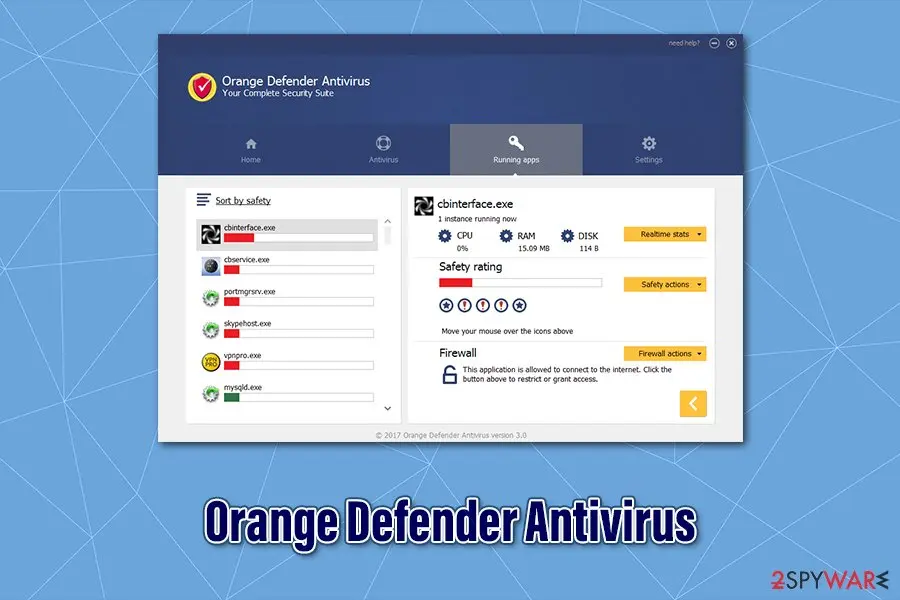
Orange Defender Antivirus posses an array of seemingly useful features, such as malware removal, real-time protection, security rating of the installed apps and their CPU/Disk usage, connection locations that app employ, and so forth. However, this information is relatively useless for most regular users, and more advanced users can check these statistics within Windows OS itself, without installing Orange Defender Antivirus for that.
Orange Defender Antivirus should not be employed as a tool for computer protection, as there is no indication of its efficiency. As a result, users might believe that their systems are fully protected due to this, while in reality, many malware samples could get through and infect the computer.
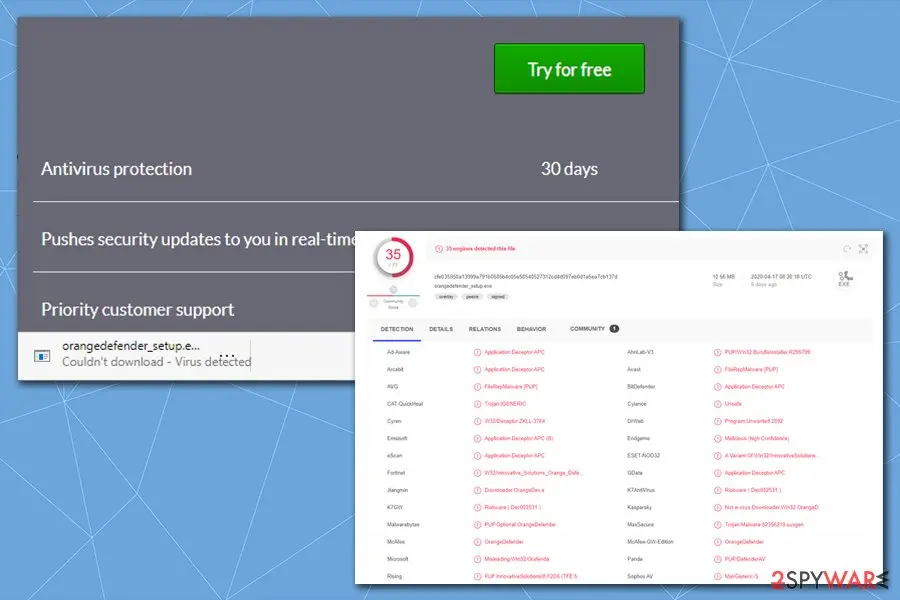
In fact, several reputable anti-malware solutions recognize Orange Defender Antivirus as potentially unwanted or malicious under the following names:
If you found the app on your system unexpectedly, we highly recommend you remove Orange Defender Antivirus, as it will not provide sufficient protection for your computer. Instead, employ reputable security solutions that are not detected as malicious or potentially unwanted - such as or .
- Trojan.Win32.Generic!BT
- PUP.Optional.OrangeDefender
- FileRepMalware
- A Variant Of Win32/InnovativeSolutions.C Potenti
- Misleading:Win32/Orafenda
- Application.Deceptor.APC
- W32/Innovative_Solutions_Orange_Defender_Ant
- PUA.Superfluss, etc.
From our report of Jun 2020 · not reviewed since
Avoid potentially unwanted programs by being attentive online
Over time, the internet is becoming more secure - web browsers employ built-in defenses, email providers scan the incoming messages to warn about potential danger, and security apps are more advanced than ever.
However, thousands of new malicious websites and embedded links are released daily, email attachments still infect thousands with ransomware and similar high-risk threats, and many users fail to install reputable security software in order to protect their machines from harm.
Implemented security solutions are as good as users allow them to be - they can still let a malicious app in despite warnings from browsers or built-in Windows defenses like User Account Control. Therefore, while it is imperative to employ useful security tools for overall computer protection, it is just as important to be alert when browsing the web, checking email, and installing new programs.
The most important pointer when it comes to PUPs is to be careful when installing new applications. First of all, prefer official sources for your downloads if possible, as third-party sites are often distribute software bundles, where several apps are bundled into a single installer package. If you still insist on using third-party sites, please be aware of the following things:
- Before installing a new app, check reviews, forum posts, and other information about it online;
- During installation, always opt for Advanced/Custom settings;
- Watch out for various tricks used by developers: pre-ticked boxes, misleading offers, misplaced buttons, fine print text, etc.;
- Ensure that the app includes Terms of Service and Privacy Policy that you should take a look at;
- Employ anti-malware software that could warn you about potentially unwanted programs.
From our report of Jun 2020 · not reviewed since
More from our earlier report on Orange Defender Antivirus
- If you find suspicious programs on your system or your computer is suffering from persistent errors, crashes, and lag, you should check it for malware.
- In case it is present, eliminate it with anti-malware and then repair with
How to remove Orange Defender Antivirus
Nothing it reports is real.
These steps remove it and undo a payment if you made one.
Step 1: Do not pay, and undo a payment if you made one
Orange Defender Antivirus reports problems to sell a licence: the "threats" or "errors" it lists are invented or harmless leftovers. If you already paid, ask your card issuer to dispute the charge and cancel the subscription both in the seller's account and through your bank.
If you called a phone number it showed and let someone connect, treat the PC as remotely accessed and remove the remote tool. Uninstalling it from Windows 11 or Windows 10 does not cancel a subscription by itself.
Full procedure with screenshots: What to do after paying a scammer
Step 2: Uninstall Orange Defender Antivirus
Open Settings > Apps > Installed apps in Windows 11, or Settings > Apps > Apps & features in Windows 10.
Sort the list by install date and find Orange Defender Antivirus, then choose Uninstall from the three-dot menu next to it (in Windows 10, click the entry and then Uninstall).
Remove anything else installed on the same day that you do not recognise, because such programs usually arrive together in one installer. If the uninstaller opens a browser page with an offer or a survey, close it: the program is removed either way.
Full procedure with screenshots: Uninstall a program or app in Windows On uGetFix
Step 3: Remove it from startup
Whatever Orange Defender Antivirus installed usually starts with Windows.
Open Task Manager with Ctrl + Shift + Esc, go to Startup apps in Windows 11 or the Startup tab in Windows 10, and disable what you do not know, starting with entries that have an empty Publisher column.
Open file location on the right-click menu shows the file, which helps you decide and tells you what to delete later. Disabling is safe: if something you need stops working, switch it back on.
Full procedure with screenshots: Stop apps from opening at startup On uGetFix
Step 4: Delete the folders left behind
What the uninstaller leaves behind is usually in the user folders. Open File Explorer, switch on View > Show > Hidden items (in Windows 10 View > Hidden items), and go through
%LocalAppData%,%AppData%, %ProgramData% and the two Program Files folders.Sort by Date modified and delete folders that appeared together with the problem and belong to no program you use. Folders with random names that hold
.exe,.dll, .js or .ps1 files are the strongest sign.Full procedure with screenshots: Remove what malware leaves behind in Windows
Step 5: Scan the PC, then run the offline scan
Open Windows Security > Virus & threat protection > Scan options, run a Full scan and remove everything it finds. Then select Microsoft Defender Antivirus (offline scan) and click Scan now: the PC restarts and scans before Windows loads, which finds files that hide while Windows runs.
Save your work first, because the offline scan takes about 15 minutes. Both scans are built into Windows 11 and Windows 10, and a second scanner from another vendor is a useful extra opinion.
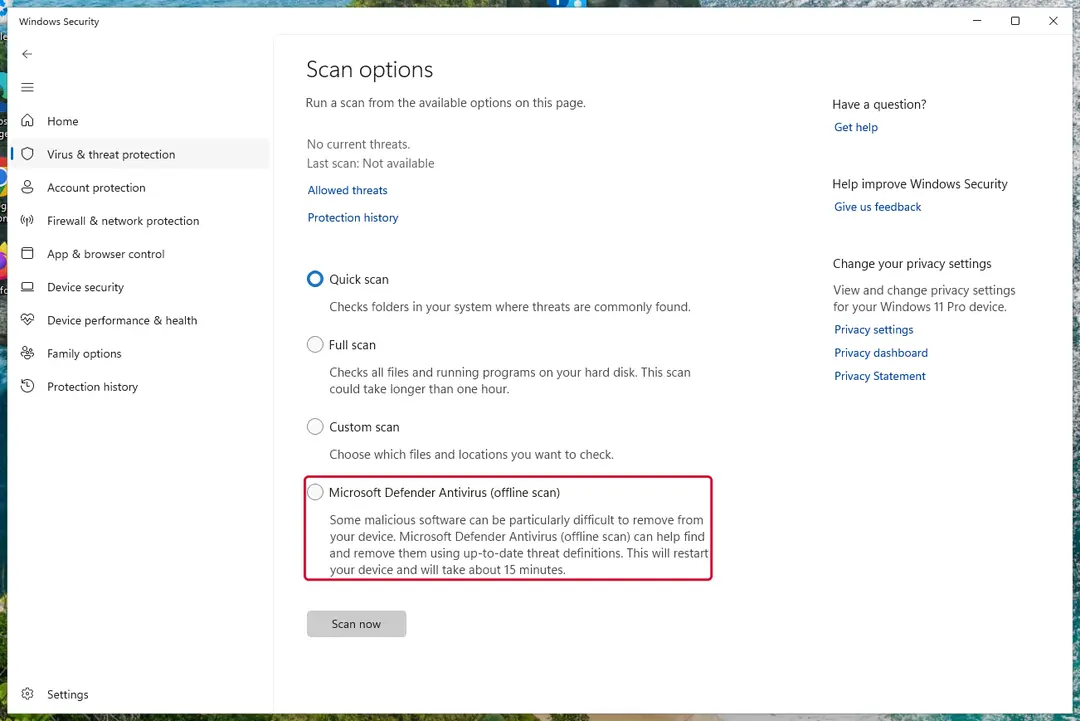
Windows 11: Windows Security > Virus & threat protection > Scan options. Full procedure with screenshots: Run a Microsoft Defender Offline scan
Instructions for each browser and system
The detailed steps for every browser and system this guide covers. Open the one you use.
Uninstall from Windows
To uninstall Orange Defender Antivirus, follow these steps:
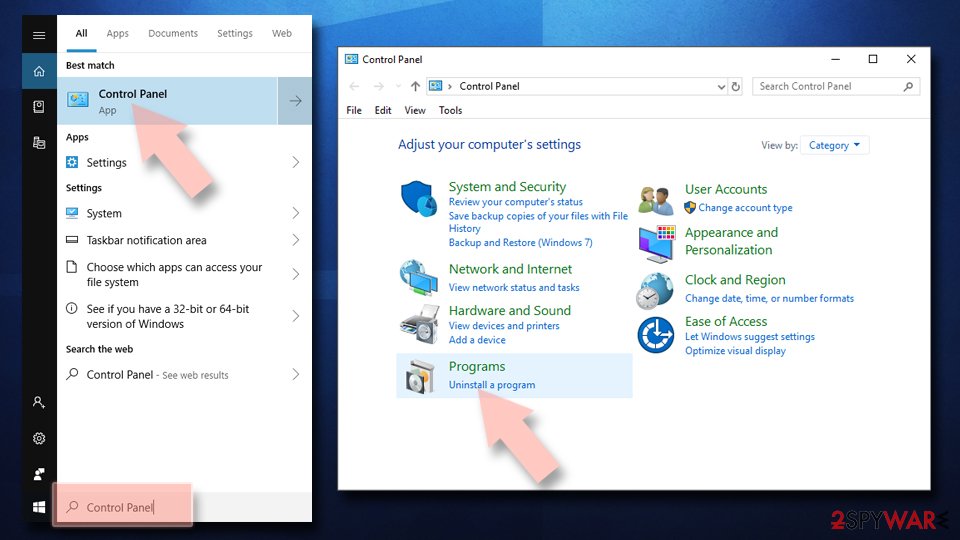
Uninstall from Windows 10/8:
- Type Control Panel into the Windows search box and open the result.
- Under Programs, select Uninstall a program.
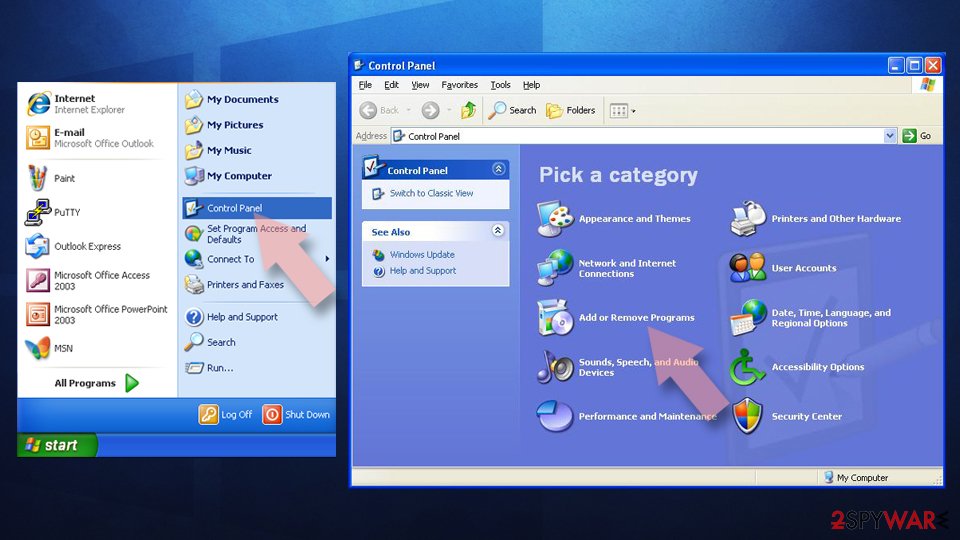
Uninstall from Windows 7/XP:
- Click on Windows Start > Control Panel (Windows XP users should click on Add/Remove Programs).
- In Control Panel, select Programs > Uninstall a program.
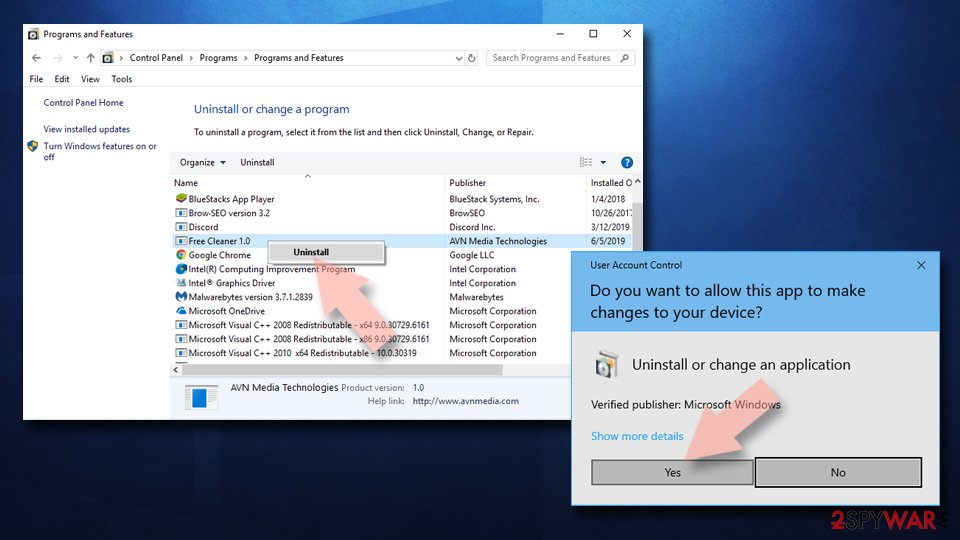
Remove the unwanted program:
- In the Programs and Features window, look for any recently installed suspicious entries, select them, and click Uninstall.
- If User Account Control appears, click Yes to confirm, then complete the removal.
Remove from Google Chrome
Reset Google Chrome as soon as you remove the PUP from your system:
Delete malicious extensions from Google Chrome:
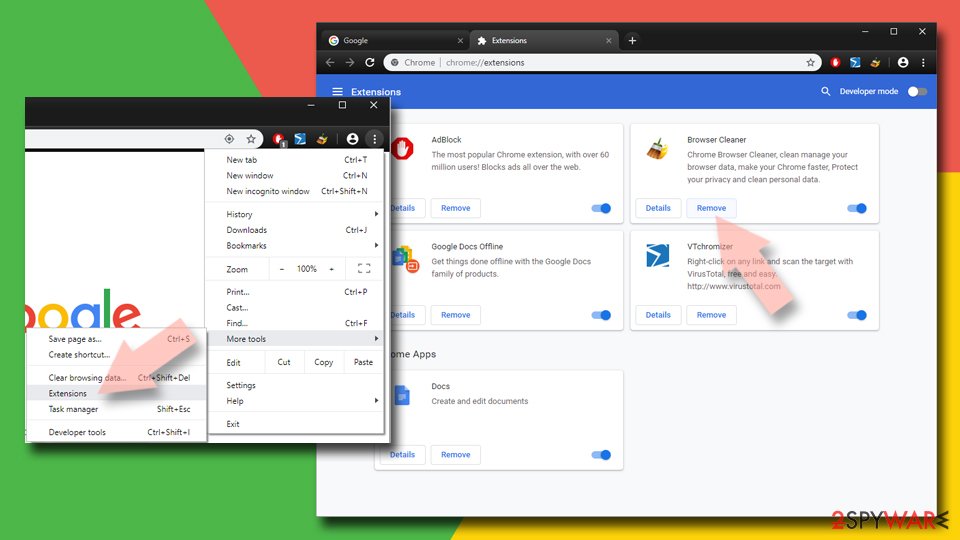
- Open Google Chrome, click on the Menu (three vertical dots at the top-right corner) and select More tools > Extensions.
- In the newly opened window, you will see all the installed extensions. Uninstall all suspicious extensions related to the unwanted program by clicking Remove.
Clear cache and web data from Chrome:
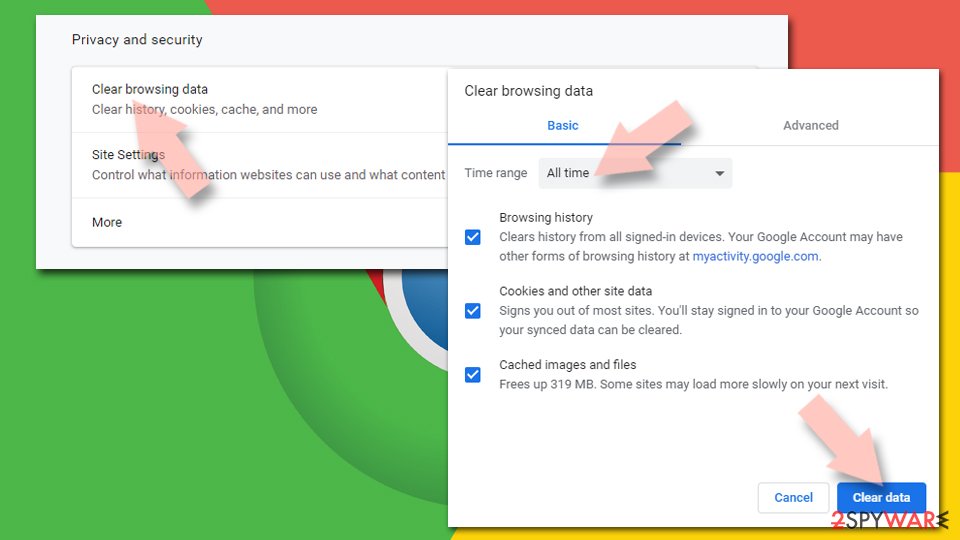
- Click on Menu and pick Settings.
- Under Privacy and security, select Clear browsing data.
- Select Browsing history, Cookies and other site data, as well as Cached images and files.
- Click Clear data.
Change your homepage:
- Click menu and choose Settings.
- Look for a suspicious site in the On startup section.
- Click on Open a specific or set of pages and click on three dots to find the Remove option.
Reset Google Chrome:
If the previous methods did not help you, reset Google Chrome to eliminate all the unwanted components:
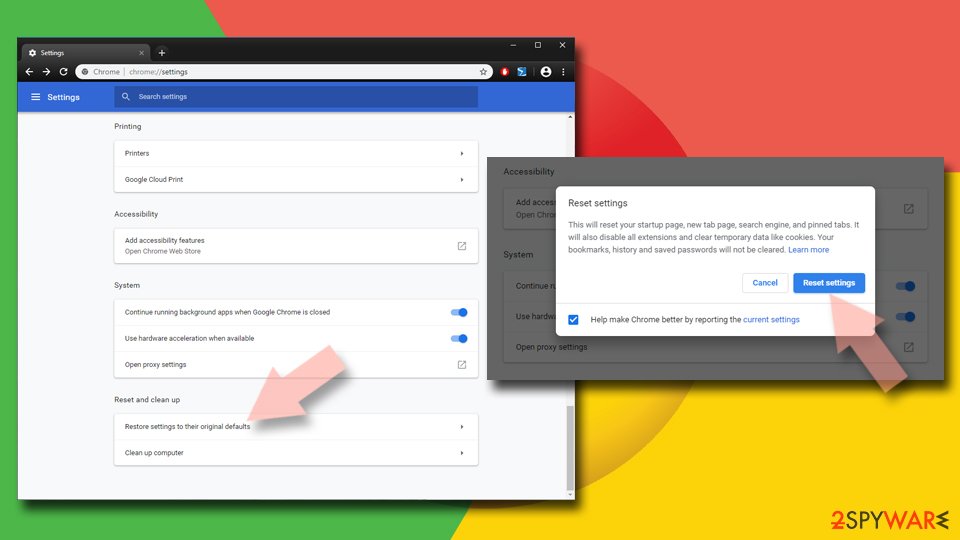
- Click on Menu and select Settings.
- In the Settings, scroll down and click Advanced.
- Scroll down and locate Reset and clean up section.
- Now click Restore settings to their original defaults.
- Confirm with Reset settings.
Remove from Microsoft Edge
Delete unwanted extensions from MS Edge:
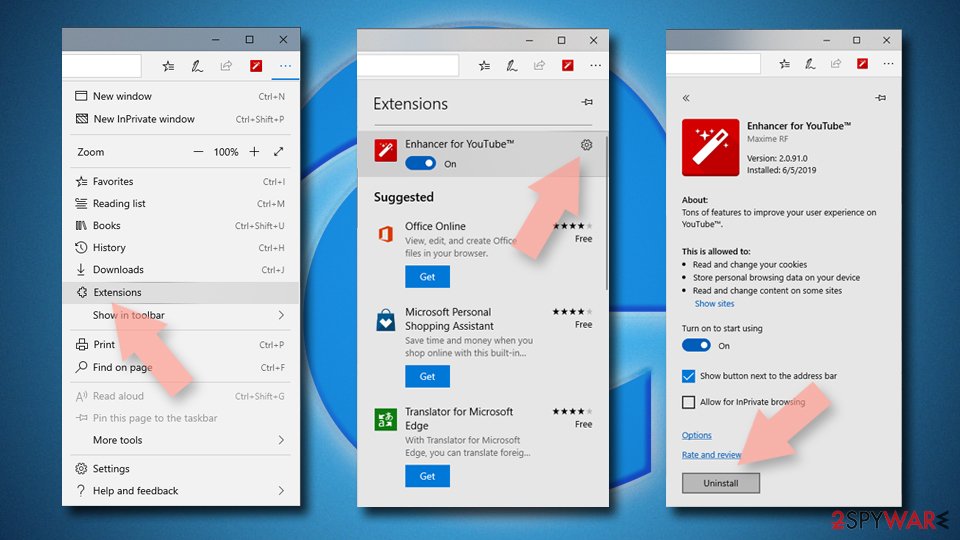
- Select Menu (three horizontal dots at the top-right of the browser window) and pick Extensions.
- From the list, pick the extension and click on the Gear icon.
- Click Remove.
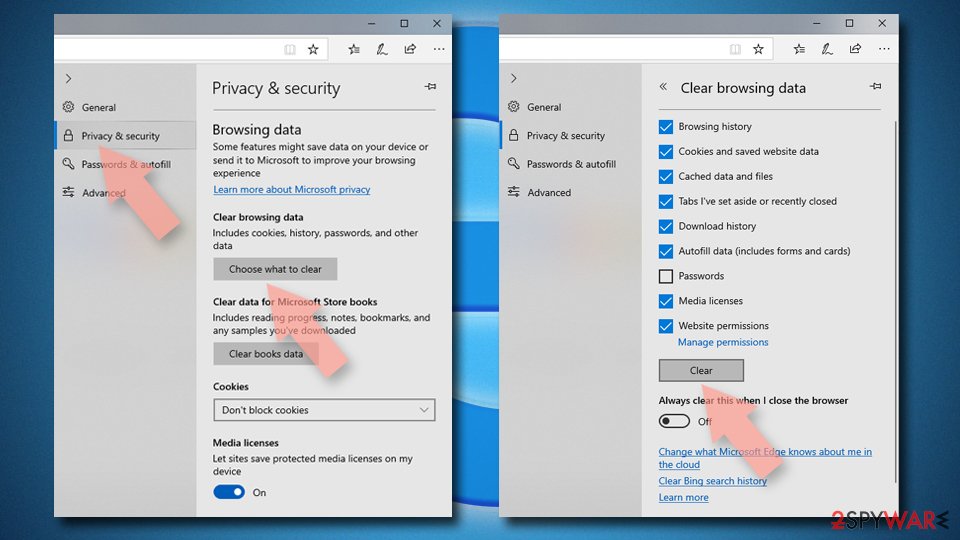
Clear cookies and other browser data:
- Click on the Menu (three horizontal dots at the top-right of the browser window) and select Settings > Privacy, search, and services..
- Under Clear browsing data, pick Choose what to clear.
- Select Cookies and other site data and Cached images and files. (apart from passwords, although you might want to include Media licenses as well, if applicable) and click on Clear.
Restore new tab and homepage settings:
- Click the menu icon and choose Settings.
- Then find On startup section.
- Click Remove next to any suspicious startup page.
Reset MS Edge if the above steps did not work:
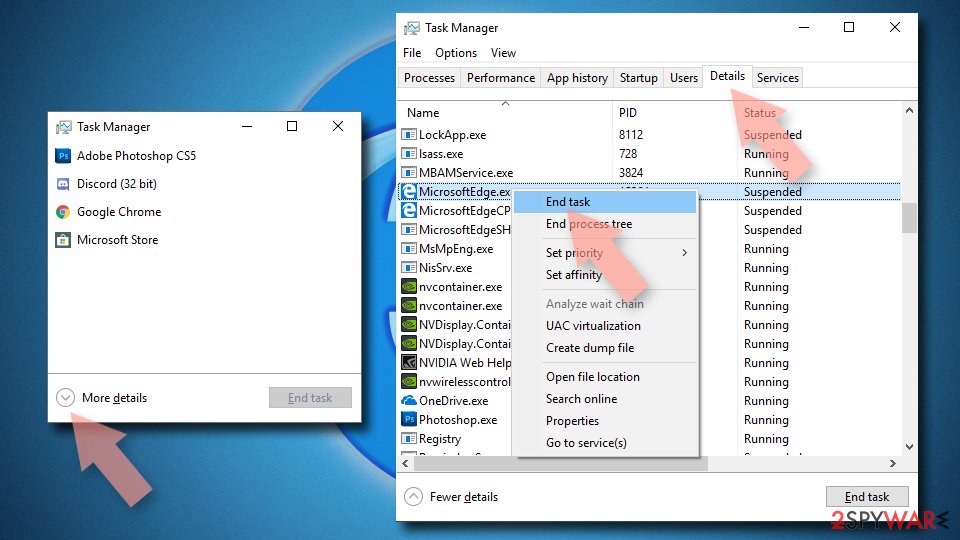
- Press on Ctrl + Shift + Esc to open Task Manager.
- Click on More details arrow at the bottom of the window.
- Select Details tab.
- Now scroll down and locate every entry with Microsoft Edge name in it. Right-click on each of them and select End Task to stop MS Edge from running.
Delete extensions from MS Edge (Chromium):
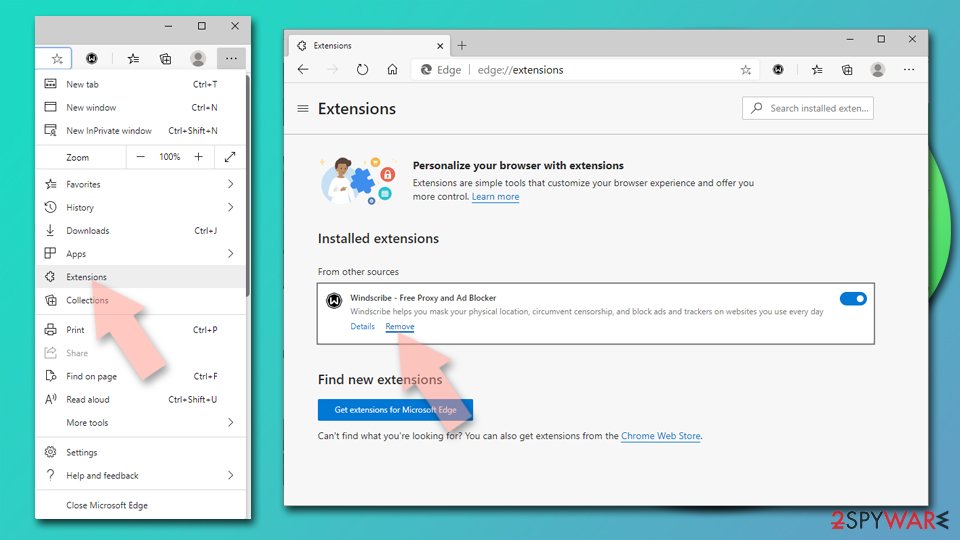
- Open Edge and click select Settings > Extensions.
- Delete unwanted extensions by clicking Remove.
Clear cache and site data:
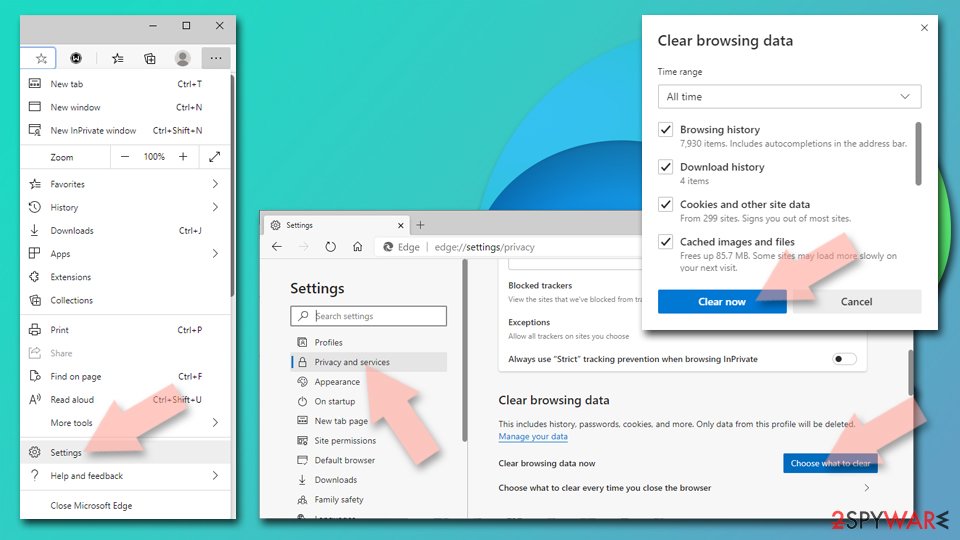
- Click on Menu and go to Settings.
- Select Privacy, search and services.
- Under Clear browsing data, pick Choose what to clear.
- Under Time range, pick All time.
- Select Clear now.
Reset Chromium-based MS Edge:
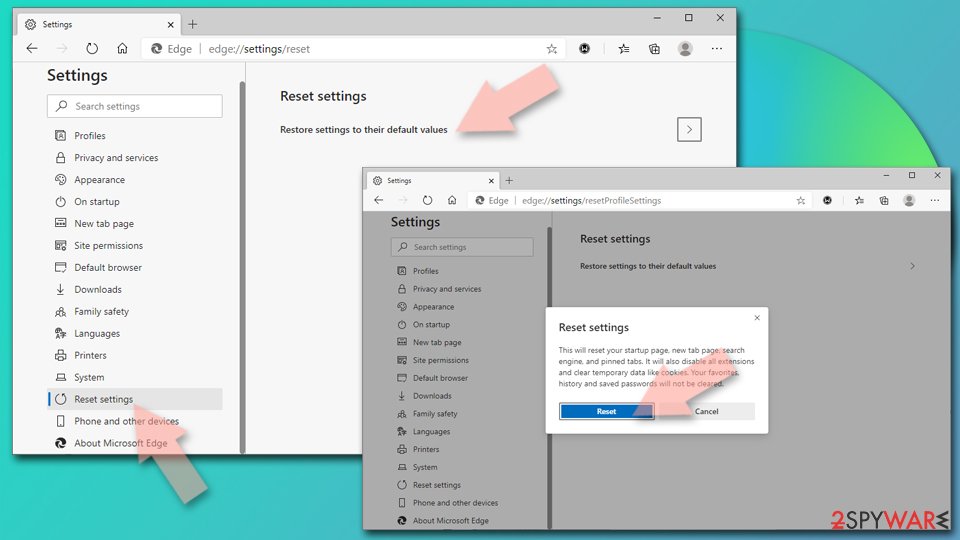
- Click on Menu and select Settings.
- On the left side, pick Reset settings.
- Select Restore settings to their default values.
- Confirm with Reset.
- This will disable extensions and reset startup pages but will not delete bookmarks, saved passwords, or browsing history.
Remove from Mozilla Firefox (FF)
Remove dangerous extensions:
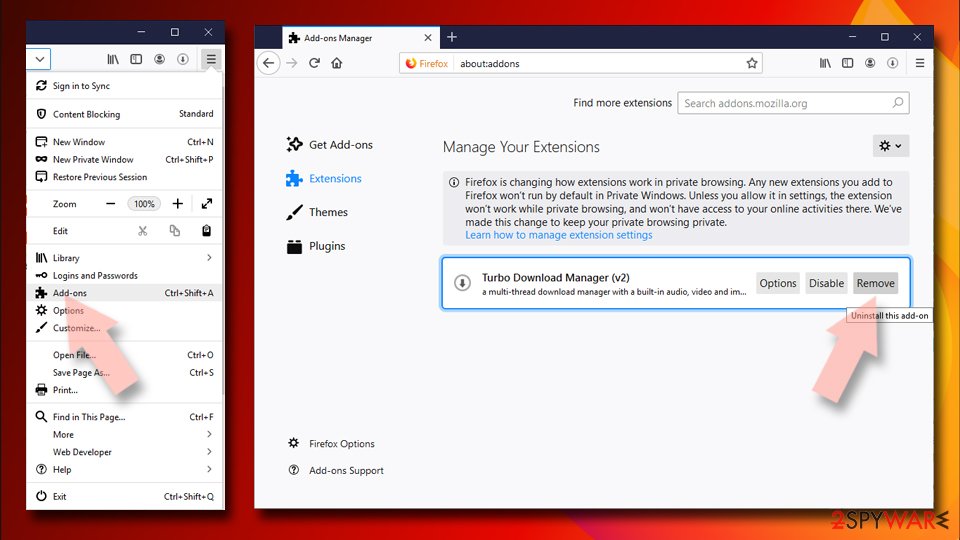
- Open Mozilla Firefox browser and click on the Menu (three horizontal lines at the top-right of the window).
- Select Add-ons.
- In here, select the unwanted extension and click Remove.
Reset the homepage:
- Click three horizontal lines at the top right corner to open the menu.
- Choose Settings.
- Under Home, set your preferred homepage and new tab settings.
Clear cookies and site data:
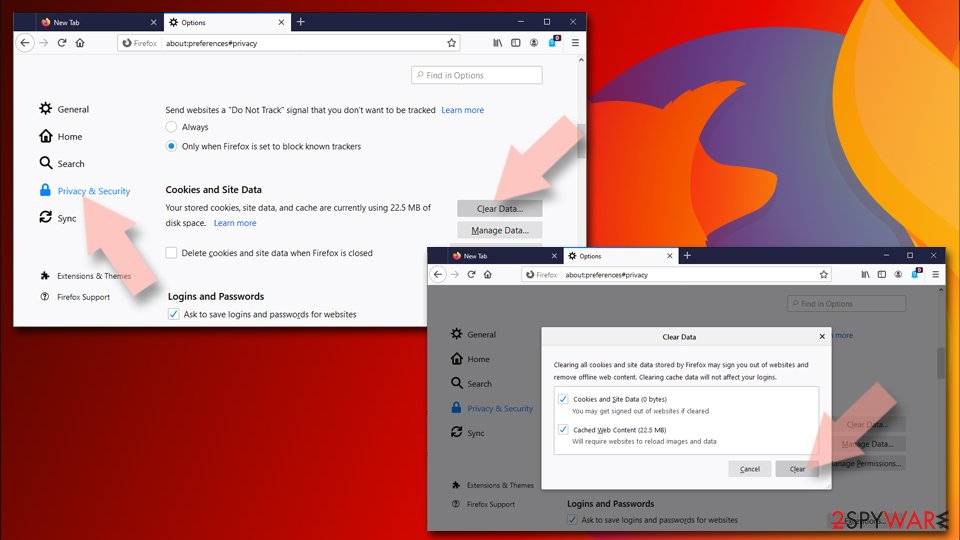
- Click Menu and pick Settings.
- Go to Privacy & Security section.
- Scroll down to locate Cookies and Site Data.
- Click on Clear Data...
- Select Cookies and Site Data and Temporary cached files and pages, then click Clear.
Reset Mozilla Firefox
If clearing the browser as explained above did not help, reset Mozilla Firefox:
- Open Mozilla Firefox browser and click the Menu.
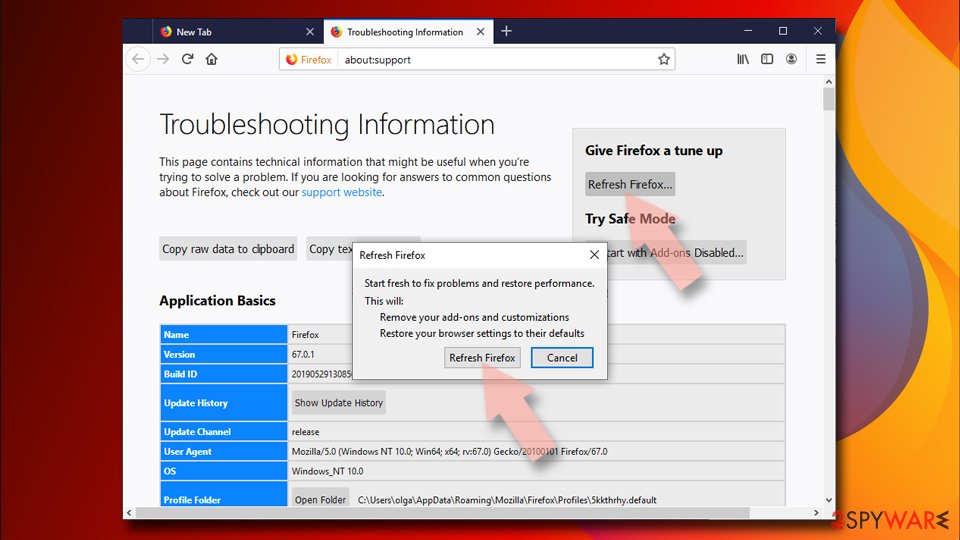
- Go to Help and then choose Troubleshooting Information.
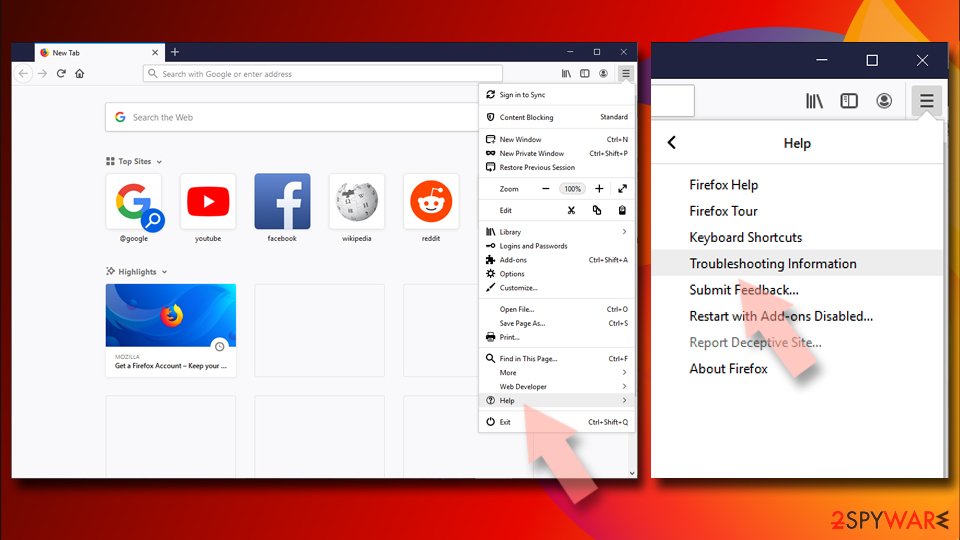
- Under Give Firefox a tune up section, click on Refresh Firefox...
- Once the pop-up shows up, confirm the action by pressing on Refresh Firefox.
Delete from Safari
Remove dangerous extensions:
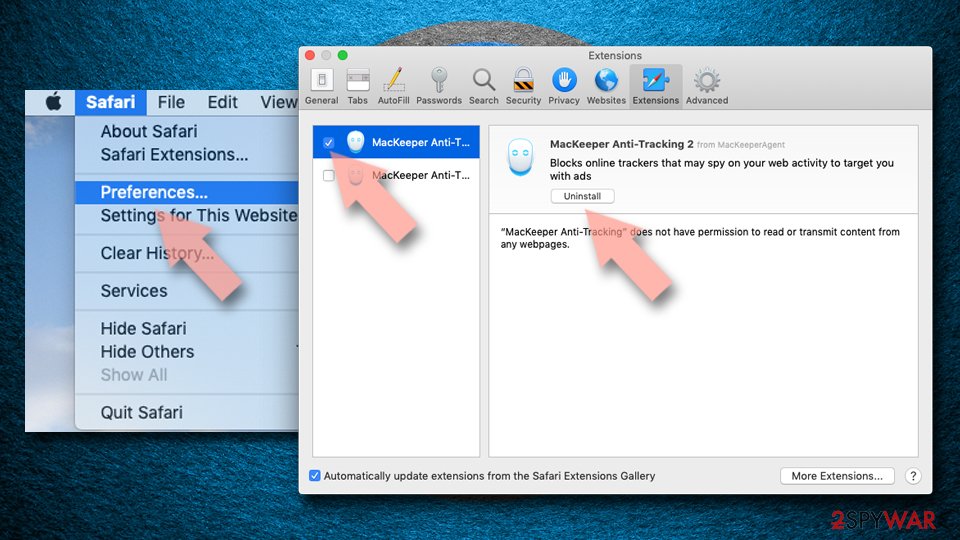
- Open Safari, click Safari in the menu at the top-left of the screen, and select Preferences.
- Go to the Extensions tab, look for any suspicious entries, and click Uninstall to remove them.
Clear history and website data:
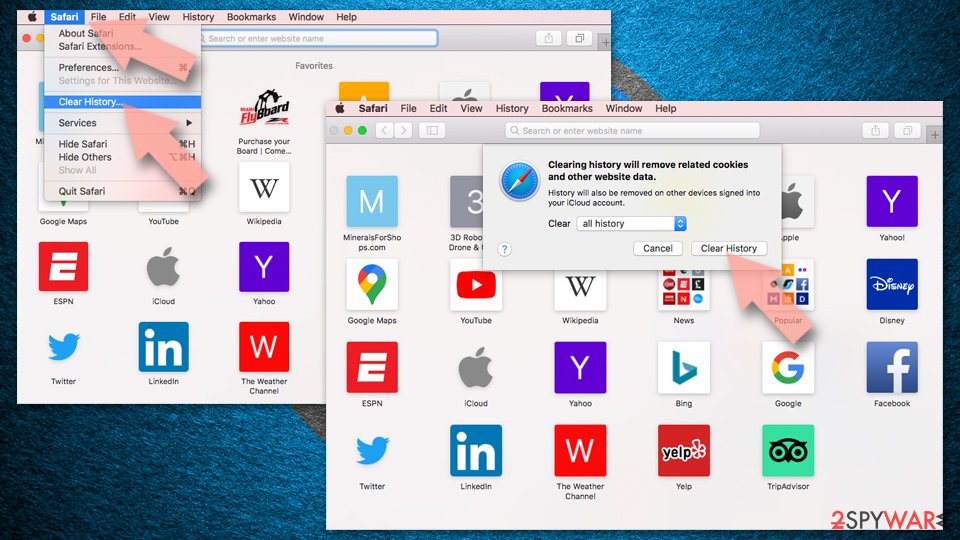
- Click Safari in the menu and pick Clear History.
- Set Clear to all history and confirm with Clear History.
Reset Safari:
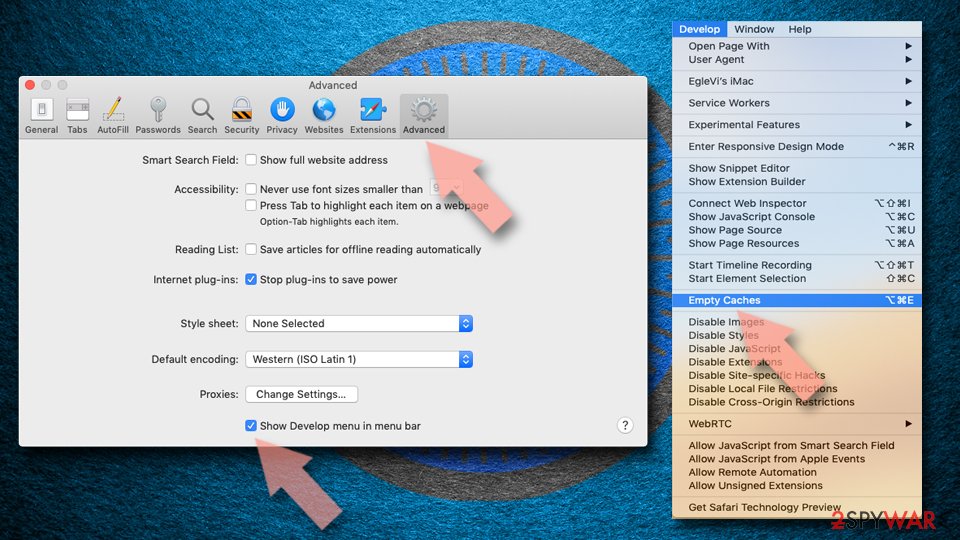
- Click Safari in the menu and select Preferences > Advanced.
- Enable Show Develop menu in menu bar.
- From the menu bar, click Develop and select Empty Caches.
Reset Internet Explorer
Remove dangerous add-ons:
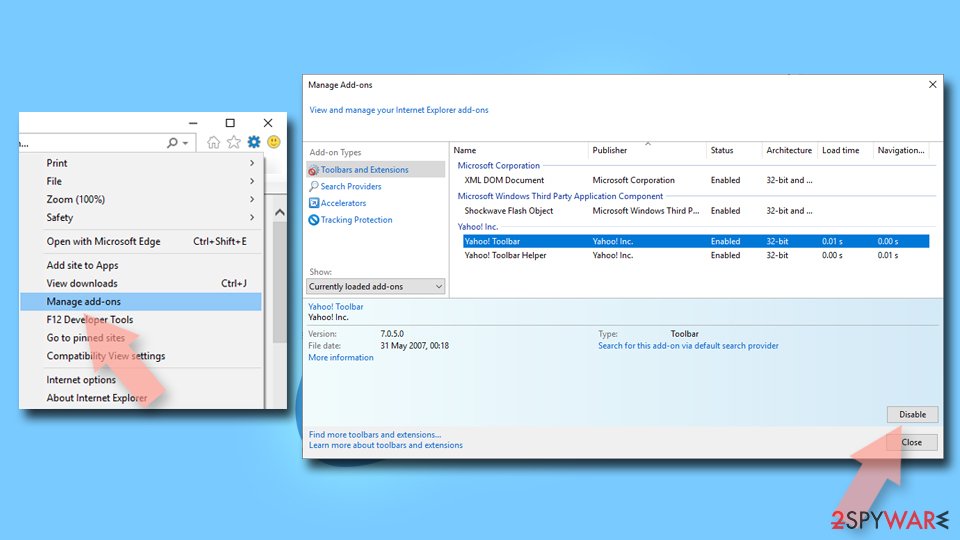
- Open Internet Explorer, click on the Gear icon (IE menu) on the top-right corner of the browser
- Pick Manage Add-ons.
- You will see a Manage Add-ons window. Here, look for suspicious plugins. Click on these entries and select Disable.
Change your homepage if it was altered:
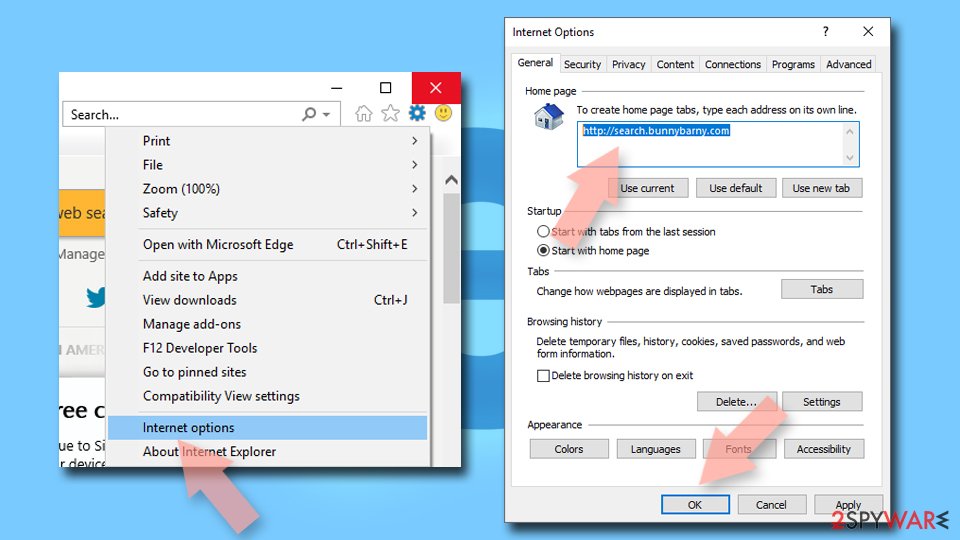
- Open IE and click on the Gear icon.
- Select Internet Options.
- In the General tab, delete the Home page address and replace it by your preferred one (for example, Google.com).
- Click Apply and then select OK.
Delete temporary files:
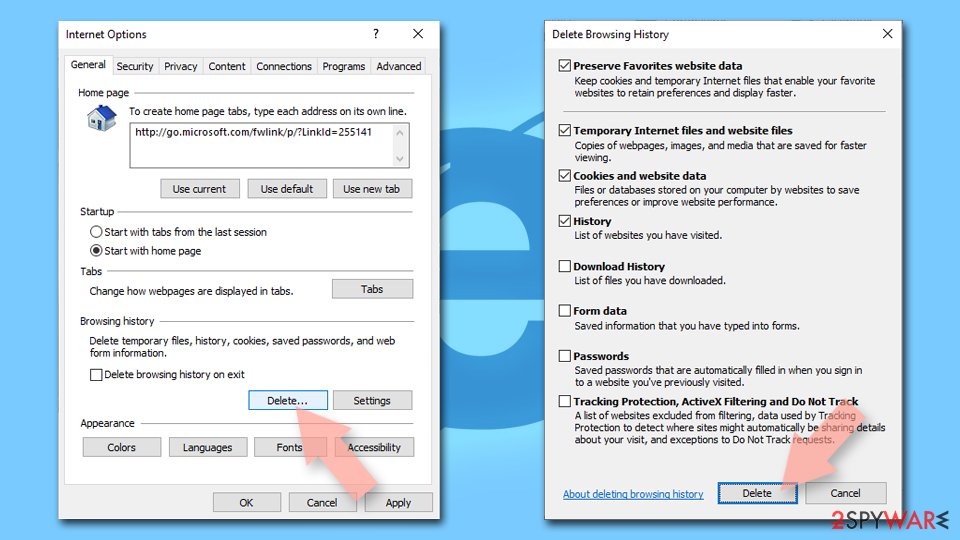
- Press on the Gear icon and select Internet Options.
- Under Browsing history, click Delete...
- Select relevant fields and press Delete.
Reset Internet Explorer:
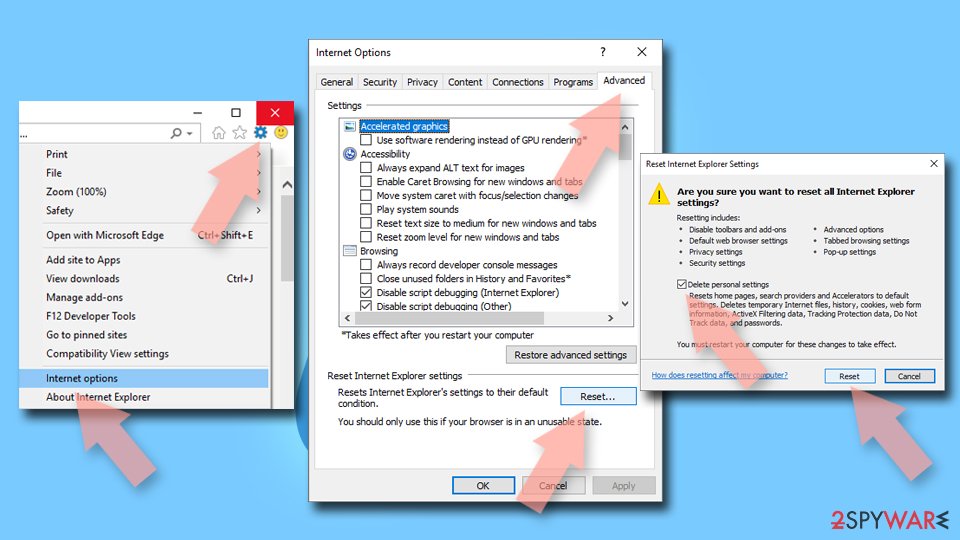
- Click on Gear icon > Internet options and select Advanced tab.
- Select Reset.
- In the new window, check Delete personal settings and select Reset.
Stream videos without limitations, no matter where you are
There are multiple parties that could find out almost anything about you by checking your online activity.
While this is highly unlikely, advertisers and tech companies are constantly tracking you online. The first step to privacy should be a secure browser that focuses on tracker reduction to a minimum.
Even if you employ a secure browser, you will not be able to access websites that are restricted due to local government laws or other reasons. In other words, you may not be able to stream Disney+ or US-based Netflix in some countries. To bypass these restrictions, you can employ a powerful VPN, which provides dedicated servers for torrenting and streaming, not slowing you down in the process.
Data backups are important - recover your lost files
Ransomware is one of the biggest threats to personal data.
Once it is executed on a machine, it launches a sophisticated encryption algorithm that locks all your files, although it does not destroy them. The most common misconception is that anti-malware software can return files to their previous states. This is not true, however, and data remains locked after the malicious payload is deleted.
While regular data backups are the only secure method to recover your files after a ransomware attack, tools such as can also be effective and restore at least some of your lost data.
From our report of Jun 2020 · not reviewed since
Get rid of Orange Defender Antivirus and use reputable security software instead
However, since the app is security software, it gains various privileges within the system, gaining access to SE_TAKE_OWNERSHIP_PRIVILEGE and SE_LOAD_DRIVER_PRIVILEGE.
As a result, Orange Defender Antivirus removal might fail for some users.
This will ensure that the permissions and other settings that were employed by Orange Defender Antivirus are removed or reverted back to normal. Additionally, such a scan can ensure that no malware or other potentially unwanted programs that could have slipped in unnoticed are eliminated at once.
Additionally, if you see an increased amount of advertisements, it might be because your web browser settings were altered by Orange Defender Antivirus or another PUP. If that is the case, you can reset all the installed browsers, as explained below.
Questions about Orange Defender Antivirus
Can I safely uninstall Orange Defender Antivirus?
If you did not install Orange Defender Antivirus yourself and it is not part of your hardware or a program you rely on, yes. Uninstalling an unwanted program does not harm Windows.
Before you do, search the exact name and publisher to be sure it is not a driver tool, a printer utility or a game launcher with an odd name. Then remove it from Settings, Apps, Installed apps.
Ignore any offers or warnings in its uninstaller about losing protection or performance. Afterwards check Startup apps and your browsers for leftovers, and restart once to confirm that it does not reinstall itself.
Orange Defender Antivirus will not uninstall. What can I do?
First restart the PC and try again, because the program may have been running and locked its own files. If the uninstaller is missing or fails, start Windows in Safe Mode, where most third-party programs do not start, and remove Orange Defender Antivirus from Installed apps there.
If it still refuses, delete its startup entry and its scheduled task, restart, and try once more. A program that actively prevents removal is behaving like malware, so finish with a Microsoft Defender offline scan. Avoid third-party uninstallers offered on search ads; several of them are unwanted programs themselves.
What if I paid Orange Defender Antivirus?
Contact your bank or card issuer the same day, explain that the payment went to a fake security program and ask for a chargeback. Keep screenshots of orange Defender Antivirus in the list of installed apps, the payment receipt and any e-mails.
If you gave card details in the program, ask the bank to block and replace the card. Then uninstall the program and run a full scan in Windows Security. If you also called a number and let someone connect to your PC, uninstall the remote-access tool they used and change your passwords from another device.
Should I reset my PC because of Orange Defender Antivirus?
Only if the signs point to deeper access. Reset when you see orange Defender Antivirus in the list of installed apps again after removal, when Windows Security cannot start or update, when remote access tools you did not install keep appearing, or when you simply cannot trust the PC any more.
Otherwise, the plan in this guide plus an offline scan is enough. If you do reset, choose Remove everything and Cloud download for a fresh copy of Windows, restore only documents and photos, and reinstall programs from their official sites. Change important passwords from the clean system afterwards.
I entered my card number in Orange Defender Antivirus. What should I do?
Call your card issuer using the number on the back of the card, report the purchase as fraud and ask for a new card. Ask them to block further charges from the same merchant. Watch your statements for small test charges, which often come before larger ones.
If you used a password on the order page or the same e-mail for the purchase, change that password and expect phishing e-mails that mention the purchase. Your bank can also tell you whether the merchant is linked to other fraud reports.
Orange Defender Antivirus has no uninstaller. How do I get rid of it?
Some scareware does not register an uninstaller, or its uninstaller only opens another sales page. In that case, end the program in Task Manager, then go to Task Manager > Startup apps, right-click its entry and choose Open file location to find its folder. Disable the startup entry, restart in Safe Mode and delete the folder.
Check Task Scheduler for tasks with the same name. Finally, run the Microsoft Defender offline scan, which removes remaining files that Microsoft knows about. Restart afterwards and check that nothing named after Orange Defender Antivirus starts again.
Do I need to buy antivirus after removing Orange Defender Antivirus?
No. Windows 11 and Windows 10 include Microsoft Defender in Windows Security, which provides real-time protection, scheduled scans, the offline scan and protection against unwanted apps at no cost. Keep it switched on and updated, and turn on Reputation-based protection under App & browser control.
If you prefer a third-party product, buy it from the vendor's own site after reading independent test results, never from a pop-up or a phone call. The lesson of Orange Defender Antivirus is that security offers which arrive unasked are the ones to avoid.
Will the seller of Orange Defender Antivirus refund me if I ask?
Sometimes, but do not depend on it and do not let them steer the process. If you contact the seller, do it in writing and keep the replies. Never install software, share your screen or give banking details to get a refund.
The more reliable route is your card issuer or PayPal: a chargeback or dispute for a product sold with false claims. If the seller or anyone claiming to represent them calls you first about a refund, treat it as a scam and hang up.
I let a technician connect to my PC because of Orange Defender Antivirus. Is it safe now?
Not until you check. While connected, the caller could install other programs, create a user account or look at saved passwords. Disconnect from the internet, uninstall the remote access program and anything else installed during the call, and run a full scan and the Microsoft Defender offline scan.
From another device, change your e-mail and banking passwords and turn on two-step verification. If the caller opened your online banking, call the bank today. A reset of Windows is the safest option if you cannot tell what was done.
Will Fortect remove Orange Defender Antivirus?
Fortect scans Windows for malware and unwanted programs and repairs the system files and settings they change, and its free scan shows what it finds on your PC before you decide anything.
For Orange Defender Antivirus, follow the plan above as well: the browser steps take back permissions and settings that no scanner treats as a threat, and uninstalling the program that brought it removes the source.
Run Microsoft Defender's full scan and, if anything was found, its offline scan as a second opinion. If the symptoms are gone after the plan and both scans are clean, there is nothing more to do.
Sources
- How-To Geek: Never Download a Driver-Updating Utility; They're Worse Than Useless (read October 6, 2026)
- Virus Total: orangedefender_setup.exe (read October 6, 2026)
- InformationWeek: It's Not That Antivirus Has Died, It's That People Have Stopped Using It (read October 6, 2026)
- FTC: How to recognize, remove and avoid malware (read October 6, 2026)
- Microsoft Learn: Microsoft Defender Offline (read October 6, 2026)