

Quick-Seeker.com – an adware domain that causes redirects to other odd locations such as 681a22.lifeimpressions.net
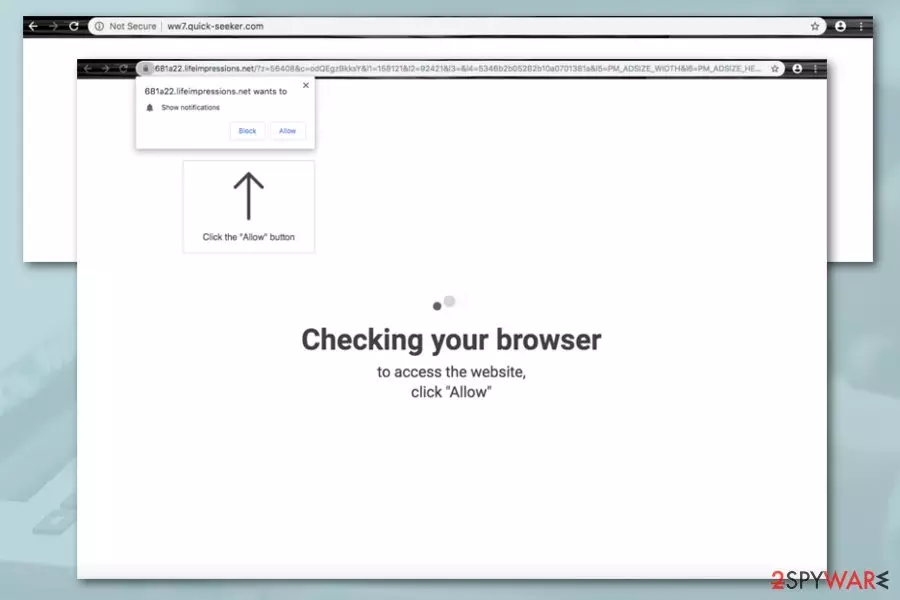
Quick-Seeker.com is a questionable domain that forces redirects to other potentially suspicious sources such as 681a22.lifeimpressions.net. Also, the odd URL supports adware-based functions such as frequent advertising and deal promoting during browsing sessions, collecting browsing-based data for targeted advertising. Quick-Seeker.com virus might also affect any type of web browser and make unexpected modifications in the homepage and new tab URL directories.
Quick-Seeker.com is not an app to trust even though it holds the danger level of low. However, low does not mean that there are no dangers at all. For example, intense redirecting activities might force you to land on a malware-laden source and get your computer system infected with a dangerous parasite.
| Name | Quick-Seeker.com |
|---|---|
| Type | Adware/PUP |
| Danger level | This rogue app holds the danger level of low, however, it still can cause some indirect damage by redirecting the user to malware-laden locations |
| Redirects | If you ever get this adware installed on your computer, you can get redirected to 681a22.lifeimpressions.net that is another third-party domain |
| Task | The main goal of this potentially unwanted program is to gather income from the pay-per-click technique |
| Removal | You can eliminate the suspicious products with the help of antimalware software or step-by-step guidelines (look at the end of this article) |
| Repair | If you have discovered any compromised system files, you can try restoring them with a tool such as FortectIntego |
In some cases, Quick-Seeker.com and its affiliate domains might appear just occasionally. If you receive ads from this URL rarely, installing an ad-blocking application or blocking the URL in your browser settings might be enough to prevent repeated advertising. For browsers:
- Open the browser that has been loading you ads.
- Find the three dots or lines on the upper right corner of your browser window and click them to open the menu.
- Go to Settings > Advanced.
- Afterward, you should find Notifications under Site Settings.
- Search for Quick-Seeker.com or any other questionable domain and get rid of the PUPs by clicking the remove or disable button.
Quick-Seeker.com might use tracking objects such as HTTP cookies, beacons, and pixels[1] that record your browsing information and can use it for targeted advertising in the future. This way, the developers increase their chances of earning income from the cost-per-click technique[2] (also known as pay-per-click).

Be careful with Quick-Seeker.com pop-up ads as you might be provided with a huge variety of untrustworthy products and services that you truly do not need. This way the adware might even try to promote rogue security software and convince you to buy the product for an inadequate price.
Continuously, Quick-Seeker.com might try to get you involved in various scamming schemes by providing you fake prize claims, surveys, questionnaires, etc. The PUP might ask you to type in personally-identifiable information or even credentials when the main goal is to swindle some money from you.
Our suggestion would be not to provide any sensitive data to Quick-Seeker.com or other PUPs. This way you might find your information breached or your identity stolen if the information falls in the hands of a bad actor. However, the main benefit of adware for third-party developers comes from intrusive advertising.
Intense advertising from Quick-Seeker.com domain might force your browser to suddenly freeze while carrying multiple actions. Nevertheless, many activities that come from this app might also slow down your entire computer system and relate to the high usage of your CPU and GPU work.

Avoid all annoying activities by performing the Quick-Seeker.com removal process automatically or manually. However, note that you have to get rid of the adware not only from your OS but also web browsers such as Chrome, Firefox, Explorer, Edge, and Safari.
Once you remove Quick-Seeker.com from your computer and browser apps, it is time to check for file compromisation as the adware program might have affected some of your system files. If you find signs of compromising, you can try repairing the components with a tool such as FortectIntego.
Promotion techniques of adware apps
PUPs such as adware are promoted via various techniques. You may discover bogus apps installed on your PC without any permission asked. That's because they were added to various free programs as an optional component. If you don't like to monitor the installation of the freeware and simply keep clicking the “Next” button when installing one on your PC system, you can also allow the installation of a questionable product.
That is why we always outline the fact that you should always check what is said in the program's end user's license agreement, privacy policy and other sources of information. In addition, you should also make sure that you select Custom or Advanced installation options and opt-out of such “optional components” as various browser add-ons, extensions,[3] toolbars. and plugins. Of course, you should never agree with the changes in your homepage or default search engine or any other browser/computer settings.
Furthermore, adware programs can get delivered via fake software updates such as Adobe Flash Player or JavaScript. Other spreading ways include secret PUP injection via hyperlinks and advertisements that are loaded on third-party websites. Our point would be to avoid opening any questionable content that you encounter on secondary sources. Also, have an adware app running on your machine for automatical protection and threat detection.
Eliminate Quick-Seeker.com from the computer system/browsers
If you see that Quick-Seeker.com and its activities have already started bothering you frequently, it is time to check your computer. For that, we recommend using a reputable anti-spyware that will help you to check the entire PC system and will also help you to delete all bogus apps.
However, you can remove Quick-Seeker.com with the help of manual step-by-step guidelines too. Below you will find instructions on how to clean your Windows/macOS computer systems and web browsers such as Google Chrome, Mozilla Firefox, Internet Explorer, Microsoft Edge, and Safari.
After Quick-Seeker.com removal, go back to the section where we were talking about necessary steps to avoid adware infections. Memorize them all again and increase your computer safety level to be secure in the upcoming future. Regarding Virusai.lt experts[4] claim, combining both manual and automatical security should work the best for every user.
Uninstall from Windows
Uninstall from Windows 10/8:
- Type Control Panel into the Windows search box and open the result.
- Under Programs, select Uninstall a program.


Uninstall from Windows 7/XP:
- Click on Windows Start > Control Panel (Windows XP users should click on Add/Remove Programs).
- In Control Panel, select Programs > Uninstall a program.


Remove the unwanted program:
- In the Programs and Features window, look for any recently installed suspicious entries, select them, and click Uninstall.
- If User Account Control appears, click Yes to confirm, then complete the removal.


Delete from macOS
Remove the unwanted application:
- From the menu bar, select Go > Applications.
- In the Applications folder, look for any suspicious entries, then drag them to Trash (or right-click and pick Move to Trash).


Delete leftover files and folders:
- Select Go > Go to Folder.
- Enter /Library/Application Support and remove any suspicious folders related to the unwanted program.
- Repeat the same check in the /Library/LaunchAgents and /Library/LaunchDaemons folders, deleting any suspicious entries.

- Finally, empty the Trash to permanently remove the leftovers.

Reset Internet Explorer
Remove dangerous add-ons:
- Open Internet Explorer, click on the Gear icon (IE menu) on the top-right corner of the browser
- Pick Manage Add-ons.
- You will see a Manage Add-ons window. Here, look for suspicious plugins. Click on these entries and select Disable.


Change your homepage if it was altered:
- Open IE and click on the Gear icon.
- Select Internet Options.
- In the General tab, delete the Home page address and replace it by your preferred one (for example, Google.com).
- Click Apply and then select OK.


Delete temporary files:
- Press on the Gear icon and select Internet Options.
- Under Browsing history, click Delete...
- Select relevant fields and press Delete.


Reset Internet Explorer:
- Click on Gear icon > Internet options and select Advanced tab.
- Select Reset.
- In the new window, check Delete personal settings and select Reset.


Remove from Microsoft Edge
Delete unwanted extensions from MS Edge:
- Select Menu (three horizontal dots at the top-right of the browser window) and pick Extensions.
- From the list, pick the extension and click on the Gear icon.
- Click Remove.


Clear cookies and other browser data:
- Click on the Menu (three horizontal dots at the top-right of the browser window) and select Settings > Privacy, search, and services..
- Under Clear browsing data, pick Choose what to clear.
- Select Cookies and other site data and Cached images and files. (apart from passwords, although you might want to include Media licenses as well, if applicable) and click on Clear.


Restore new tab and homepage settings:
- Click the menu icon and choose Settings.
- Then find On startup section.
- Click Remove next to any suspicious startup page.
Reset MS Edge if the above steps did not work:
- Press on Ctrl + Shift + Esc to open Task Manager.
- Click on More details arrow at the bottom of the window.
- Select Details tab.
- Now scroll down and locate every entry with Microsoft Edge name in it. Right-click on each of them and select End Task to stop MS Edge from running.


Instructions for Chromium-based Edge
Delete extensions from MS Edge (Chromium):
- Open Edge and click select Settings > Extensions.
- Delete unwanted extensions by clicking Remove.


Clear cache and site data:
- Click on Menu and go to Settings.
- Select Privacy, search and services.
- Under Clear browsing data, pick Choose what to clear.
- Under Time range, pick All time.
- Select Clear now.


Reset Chromium-based MS Edge:
- Click on Menu and select Settings.
- On the left side, pick Reset settings.
- Select Restore settings to their default values.
- Confirm with Reset.
- This will disable extensions and reset startup pages but will not delete bookmarks, saved passwords, or browsing history.


Remove from Mozilla Firefox (FF)
Remove dangerous extensions:
- Open Mozilla Firefox browser and click on the Menu (three horizontal lines at the top-right of the window).
- Select Add-ons.
- In here, select the unwanted extension and click Remove.


Reset the homepage:
- Click three horizontal lines at the top right corner to open the menu.
- Choose Settings.
- Under Home, set your preferred homepage and new tab settings.
Clear cookies and site data:
- Click Menu and pick Settings.
- Go to Privacy & Security section.
- Scroll down to locate Cookies and Site Data.
- Click on Clear Data...
- Select Cookies and Site Data and Temporary cached files and pages, then click Clear.


Reset Mozilla Firefox
If clearing the browser as explained above did not help, reset Mozilla Firefox:
- Open Mozilla Firefox browser and click the Menu.
- Go to Help and then choose Troubleshooting Information.

- Under Give Firefox a tune up section, click on Refresh Firefox...
- Once the pop-up shows up, confirm the action by pressing on Refresh Firefox.



Remove from Google Chrome
Delete malicious extensions from Google Chrome:
- Open Google Chrome, click on the Menu (three vertical dots at the top-right corner) and select More tools > Extensions.
- In the newly opened window, you will see all the installed extensions. Uninstall all suspicious extensions related to the unwanted program by clicking Remove.


Clear cache and web data from Chrome:
- Click on Menu and pick Settings.
- Under Privacy and security, select Clear browsing data.
- Select Browsing history, Cookies and other site data, as well as Cached images and files.
- Click Clear data.


Change your homepage:
- Click menu and choose Settings.
- Look for a suspicious site in the On startup section.
- Click on Open a specific or set of pages and click on three dots to find the Remove option.
Reset Google Chrome:
If the previous methods did not help you, reset Google Chrome to eliminate all the unwanted components:
- Click on Menu and select Settings.
- In the Settings, scroll down and click Advanced.
- Scroll down and locate Reset and clean up section.
- Now click Restore settings to their original defaults.
- Confirm with Reset settings.


Delete from Safari
Remove dangerous extensions:
- Open Safari, click Safari in the menu at the top-left of the screen, and select Preferences.
- Go to the Extensions tab, look for any suspicious entries, and click Uninstall to remove them.


Clear history and website data:
- Click Safari in the menu and pick Clear History.
- Set Clear to all history and confirm with Clear History.


Reset Safari:
- Click Safari in the menu and select Preferences > Advanced.
- Enable Show Develop menu in menu bar.
- From the menu bar, click Develop and select Empty Caches.


Did this guide help?
Be the first to comment