

eType is the browser hijacker that comes together with shareware applications and can install additional extensions
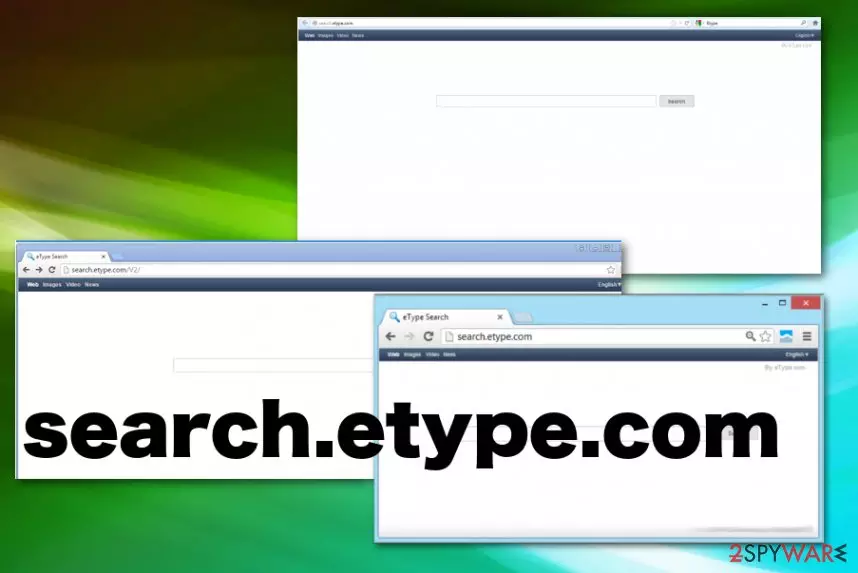
Search.etype.com is the program that significantly affects time online with tons of redirects and altered search results so that it can be categorized as a browser hijacker. The program also called eType offers a dictionary, translator, and other options that seem to be useful for today's Internet user. However, people who have installed the suspicious software on purpose claim that their computers have started to behave strangely. People mostly report about continuous browser's redirections and commercial content injected on commonly visited pages.
In reality, Search.etype.com virus uses hijacking functionality and keeps the user form searching online normally. Also, it tends to alter DNS settings and redirect people to other domains filled with advertisements or even malicious material. If you suffer from annoying browser's redirections, your PC has been infected and affected by the PUP, so you should scan your computer immediately to end the annoying activities.
| Name | Search.etype.com |
|---|---|
| Alternate name | eType |
| Type | Browser hijacker |
| Category | Potentially unwanted program[1] |
| Symptoms | Makes changes on the browser, delivers pop-ups and redirects to suspicious pages, installs other extensions and toolbars |
| Main danger | Tracks online browsing-related data and details about users' habits online, location. This information can be shared with third-party companies |
| Distribution | Freeware, software bundling,[2] and other cyber threats |
| Elimination | Install FortectIntego for Search.etype.com removal |
eType is the alternate name of this browser hijacker program that infects common types of web browsers like Internet Explorer, Google Chrome, Mozilla Firefox, Safari. It adds plugins or toolbars and extensions that supposed to improve the in-browser searching activities and make a major difference in your satisfaction. The program keeps you from finding the needed information because commercial content is all that you see since redirecting is the main purpose the PUP got designed for.
Instead, this potentially unwanted program changes various settings on the machine and the browser itself. eType alterations include:
- new tab settings,
- homepage preferences,
- default search engine;
- startup program preferences.
Search.etype.com is not a genuine search provider, so you should avoid using it as your search engine on the browser. Instead, get rid of the PUP as soon as it appears on the machine, especially when your DNS and browser settings get altered without permission.

Search.etype.com has another annoying feature – installation of eType toolbar and other applications based on hijacking and redirecting the user. Although the extension claims to be a useful utility for dictionary and translation while you typing, the internet is filled with such useless tools and you can encounter more severe cyber infiltrations instead of getting the useful service.
eType, as any other PUP can access information about you:
- IP addresses;
- location;
- browsing history;
- most viewed items;
- commonly visited sites.
Bare this data tracking and sharing function in mind and rely on tools that experts[3] recommend for eType removal. Anti-malware tools are highly suggested for infections like this because of the information recording. Adware, rogue tools, browser hijackers and other viruses of this type haven't disclosed the issue fully.
All those details needed for the sponsor or publisher of the program- advertiser. So, eType itself can be promoted to other users and pushed as free download program on pop-up ads. Avoid clicking on such material yourself because PUPs can automatically install from these banners or redirects from one click on the content.
When inside the system, a user may be suffering not only from annoying redirections – this browser hijacker can also change the start page and also make the victim continuously confront sponsored advertisements, spam, and similar, suspiciously-looking websites. So, we do NOT recommend ignoring redirections to search.etype.com website because it's dangerous.
In order to stop this activity, you must uninstall eType software and also check your computer with an anti-malware program to remove search.etype.com from your computer altogether. For this, you can rely on FortectIntego and other anti-malware tools designed to eliminate such programs.

Hijacker spreading methods involve deceptive promotional content
Such useless and intrusive software can get inside the system either voluntary or not:
- it can be downloaded from its official page,
- loaded from misleading promotional notifications, that pop-up out of nowhere and offer free dictionaries and translators.
Basically, as soon as click on such alert, you may download the PUP on your computer, which alters homepage and other browser's settings. We do not recommend leaving this software on your computer because its advertisements may lead you to additional software of third party spyware platforms.
Also, choose Advanced or Custom options during the installation and de-select toolbars, add-ons, other suspicious material from the list on the installation setup. When you go to Recommended or Quick installations, all the included programs get automatically added on the computer.
Delete eType virus from the system and get rid of the unwanted behavior
You should focus on cleaning the system when performing Search.etype.com removal because the program reads and changes various settings, so you need to pay attention to alterations and reverse them back. Employ anti-malware tools, and this way you can save you precious time for resetting the browsers because that is the process that requires manual interference but the malware elimination gives better results with professional tools.
Finally, scan your computer with a reputable anti-malware program to remove Search.etype.com or any corrupted, useless, or even infected files from your computer. Tools like this can check the system fully and indicate various issues with your machine besides the infiltration of PUPs.
Uninstall from Windows
Uninstall from Windows 10/8:
- Type Control Panel into the Windows search box and open the result.
- Under Programs, select Uninstall a program.


Uninstall from Windows 7/XP:
- Click on Windows Start > Control Panel (Windows XP users should click on Add/Remove Programs).
- In Control Panel, select Programs > Uninstall a program.


Remove the unwanted program:
- In the Programs and Features window, look for any recently installed suspicious entries, select them, and click Uninstall.
- If User Account Control appears, click Yes to confirm, then complete the removal.


Delete from macOS
Remove the unwanted application:
- From the menu bar, select Go > Applications.
- In the Applications folder, look for any suspicious entries, then drag them to Trash (or right-click and pick Move to Trash).


Delete leftover files and folders:
- Select Go > Go to Folder.
- Enter /Library/Application Support and remove any suspicious folders related to the unwanted program.
- Repeat the same check in the /Library/LaunchAgents and /Library/LaunchDaemons folders, deleting any suspicious entries.

- Finally, empty the Trash to permanently remove the leftovers.

Reset Internet Explorer
Remove dangerous add-ons:
- Open Internet Explorer, click on the Gear icon (IE menu) on the top-right corner of the browser
- Pick Manage Add-ons.
- You will see a Manage Add-ons window. Here, look for suspicious plugins. Click on these entries and select Disable.


Change your homepage if it was altered:
- Open IE and click on the Gear icon.
- Select Internet Options.
- In the General tab, delete the Home page address and replace it by your preferred one (for example, Google.com).
- Click Apply and then select OK.


Delete temporary files:
- Press on the Gear icon and select Internet Options.
- Under Browsing history, click Delete...
- Select relevant fields and press Delete.


Reset Internet Explorer:
- Click on Gear icon > Internet options and select Advanced tab.
- Select Reset.
- In the new window, check Delete personal settings and select Reset.


Remove from Microsoft Edge
Delete unwanted extensions from MS Edge:
- Select Menu (three horizontal dots at the top-right of the browser window) and pick Extensions.
- From the list, pick the extension and click on the Gear icon.
- Click Remove.


Clear cookies and other browser data:
- Click on the Menu (three horizontal dots at the top-right of the browser window) and select Settings > Privacy, search, and services..
- Under Clear browsing data, pick Choose what to clear.
- Select Cookies and other site data and Cached images and files. (apart from passwords, although you might want to include Media licenses as well, if applicable) and click on Clear.


Restore new tab and homepage settings:
- Click the menu icon and choose Settings.
- Then find On startup section.
- Click Remove next to any suspicious startup page.
Reset MS Edge if the above steps did not work:
- Press on Ctrl + Shift + Esc to open Task Manager.
- Click on More details arrow at the bottom of the window.
- Select Details tab.
- Now scroll down and locate every entry with Microsoft Edge name in it. Right-click on each of them and select End Task to stop MS Edge from running.


Instructions for Chromium-based Edge
Delete extensions from MS Edge (Chromium):
- Open Edge and click select Settings > Extensions.
- Delete unwanted extensions by clicking Remove.


Clear cache and site data:
- Click on Menu and go to Settings.
- Select Privacy, search and services.
- Under Clear browsing data, pick Choose what to clear.
- Under Time range, pick All time.
- Select Clear now.


Reset Chromium-based MS Edge:
- Click on Menu and select Settings.
- On the left side, pick Reset settings.
- Select Restore settings to their default values.
- Confirm with Reset.
- This will disable extensions and reset startup pages but will not delete bookmarks, saved passwords, or browsing history.


Remove from Mozilla Firefox (FF)
Remove dangerous extensions:
- Open Mozilla Firefox browser and click on the Menu (three horizontal lines at the top-right of the window).
- Select Add-ons.
- In here, select the unwanted extension and click Remove.


Reset the homepage:
- Click three horizontal lines at the top right corner to open the menu.
- Choose Settings.
- Under Home, set your preferred homepage and new tab settings.
Clear cookies and site data:
- Click Menu and pick Settings.
- Go to Privacy & Security section.
- Scroll down to locate Cookies and Site Data.
- Click on Clear Data...
- Select Cookies and Site Data and Temporary cached files and pages, then click Clear.


Reset Mozilla Firefox
If clearing the browser as explained above did not help, reset Mozilla Firefox:
- Open Mozilla Firefox browser and click the Menu.
- Go to Help and then choose Troubleshooting Information.

- Under Give Firefox a tune up section, click on Refresh Firefox...
- Once the pop-up shows up, confirm the action by pressing on Refresh Firefox.



Remove from Google Chrome
Delete malicious extensions from Google Chrome:
- Open Google Chrome, click on the Menu (three vertical dots at the top-right corner) and select More tools > Extensions.
- In the newly opened window, you will see all the installed extensions. Uninstall all suspicious extensions related to the unwanted program by clicking Remove.


Clear cache and web data from Chrome:
- Click on Menu and pick Settings.
- Under Privacy and security, select Clear browsing data.
- Select Browsing history, Cookies and other site data, as well as Cached images and files.
- Click Clear data.


Change your homepage:
- Click menu and choose Settings.
- Look for a suspicious site in the On startup section.
- Click on Open a specific or set of pages and click on three dots to find the Remove option.
Reset Google Chrome:
If the previous methods did not help you, reset Google Chrome to eliminate all the unwanted components:
- Click on Menu and select Settings.
- In the Settings, scroll down and click Advanced.
- Scroll down and locate Reset and clean up section.
- Now click Restore settings to their original defaults.
- Confirm with Reset settings.


Delete from Safari
Remove dangerous extensions:
- Open Safari, click Safari in the menu at the top-left of the screen, and select Preferences.
- Go to the Extensions tab, look for any suspicious entries, and click Uninstall to remove them.


Clear history and website data:
- Click Safari in the menu and pick Clear History.
- Set Clear to all history and confirm with Clear History.


Reset Safari:
- Click Safari in the menu and select Preferences > Advanced.
- Enable Show Develop menu in menu bar.
- From the menu bar, click Develop and select Empty Caches.


Did this guide help?
Be the first to comment