

Search.hfreeliveradio.co is a questionable search engine that tries to give a useful look to its services
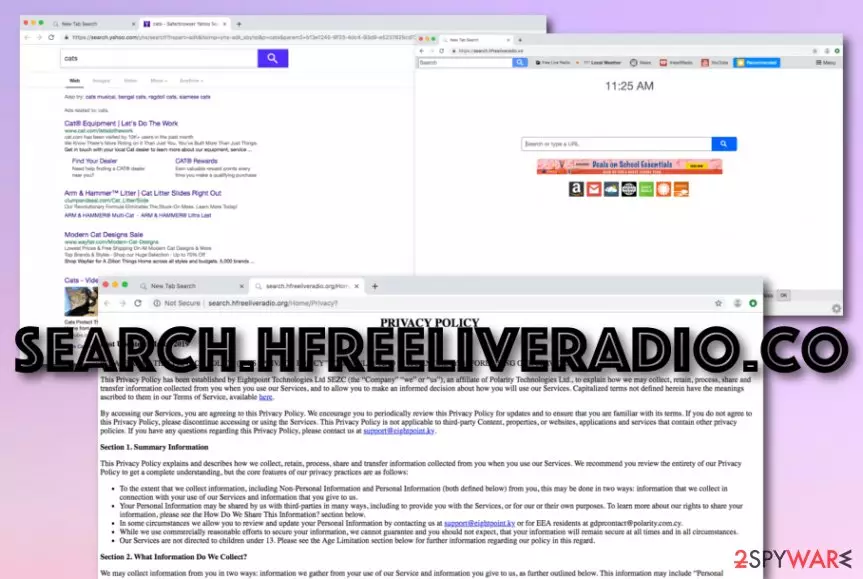
Search.hfreeliveradio.co, also known as Free Live Radio, is a search tool created by Polarity Technologies Ltd. The program is promoted via Free Live Radio extension in software packages. Afterward, the browser hijacker aims to change the default search engine and main page to New Tab Search zone where users are forced to carry out search queries by using the new engine. Additionally, Search.hfreeliveradio.co virus provides itself as a useful app by including fast access to weather-viewing networks, news portals, online-shopping, video-watching, and radio-listening sources such as nationalweatheragency.org, news.mynewswire.co, iheart.com, Amazon, Youtube, etc.
| Name | Search.hfreeliveradio.co, Search.hfreeliveradio.org |
|---|---|
| Also known as | Free Live Radio |
| Category | Browser hijacker |
| Creator/developer | Polarity Technologies Ltd. |
| Engine/homepage | New Tab Search |
| Promoted sources | nationalweatheragency.org, news.mynewswire.co, iheart.com, Amazon, Youtube, etc. |
| Detection names | Adware.Spigot.145, Win32.Application.SpringTech.A, Application.Toolbar (A), and similar |
| Activities | Modifying web browsers, promoting rogue deals, pushing redirects to affiliate sources |
| Distribution | Bundled programs or unsecured networks/services |
| Elimination | Use FortectIntego for performing a full system scan and get rid of the PUP automatically or manually |
Free Live Radio travels through unsecured downloads and might appear on your computer and browser if you have downloaded questionable products from websites such as descargar.es, filewin.com, filewon.com, malavida.es, etc. Once inserted on a specific machine, the browser hijacker will access browsers such as Chrome, Firefox, Explorer, and so on.
We have made research on this browser-hijacking application and discovered that many users have been searching for proper ways to get rid of Free Live Radio.[1] Be aware that this hijacker supports two domains which are Search.hfreeliveradio.co and Search.hfreeliveradio.org so any of these URLs can appear in your new tab address bar.
Free Live Radio virus has been detected suspicious, malicious, and in other different names by 23 AV engines, according to Virus Total.[2] Some detection names of this browser-hijacking program refer to:
- ApplicUnwnt@#2mqsn979zotvv;
- Application.Toolbar (A);
- Adware.Spigot.145;
- GenericR-PBK!B860CF8C4CB5;
- GrayWare[AdWare]/Win32.WebSearch;
- Generic.mg.b860cf8c4cb5dc67;
- Win32.Application.SpringTech.A.
Be careful and do not fall for the useful look that Search.hfreeliveradio.co might provide you with. Fast access to popular websites and networks is not a worthy reason for using this hijacker as you can insert bookmarks on your browser toolbar instead and avoid all the annoying activities and changes that will be likely brought by the PUP while using its services.

Free Live Radio is likely to display unwanted advertising content all over your computer screen during browser sessions and other similar activity. Developers might use this app to promote various rogue deals, offers, and fake rewards. Be careful with such content and do not fall for suggestions to purchase rogue products or answer dubious surveys.
Additionally, Free Live Radio is capable of collecting browsing-related information. What makes this potentially dangerous is that the developers do not take care of the user's information privacy and collected data can be easily passed on to other third-parties and get accidentally (or purposely) leaked. This way you might end up facing data theft consequences.
According to the Privacy Policy that is written by Free Live Radio developers, this potentially unwanted program can collect personal and non-personal information altogether. Personal information mostly refers to the user himself, e.g. name, surname, email address, and similar. Continuously, non-personal information refers to the person's browsing habits and computing activity:
We may collect information from you in two ways: information we gather from your use of our Service and information you give to us, as further outlined below. This information may include“Personal Information” and “Non-Personal Information.” For purposes of this Privacy Policy, “Personal Information” means information that you provide to us that personally identifies you, such as your first and last name, email address, physical address, telephone number and billing information. For purposes of this Privacy Policy, “Non-Personal Information” means information that does not specifically identify you.
Even though Search.hfreeliveradio.co looks like an ordinary search tool that has quick access to popular social networks, email services, and radio-themed websites. It redirects searches to Yahoo; however, it might display tons of commercial content and trigger redirects that diminishes browsing experience and might put you at risk.
Search.hfreeliveradio.co removal is necessary to avoid aggressive ads and protect sensitive data[3] from unknown third-parties. However, it might be a complicated task because the PUP might alter Windows registry and browser shortcuts to strengthen its presence. Note that all browser hijacker-related content needs to be removed from the system, otherwise, the PUP might repeatedly appear on the computer after the next machine boot.

Fortunately, professional anti-malware, such as FortectIntego can scan the entire system for possibly-affected sources and help to remove Search.hfreeliveradio.co quickly. Therefore, just download the program, update it and run a full system check-up. However, if you have been looking for manual guidelines that will help you to complete the process, you can find such type of instructions at the end of this article.
It is known that Free Live Radio mostly spreads in the United States and other English-speaking regions. However, it might also cause problems in Asian or European countries, including Sweden[4] and the Netherlands. If the PUP has encountered your system and web browsers, do not wait until it completely annoys you with pop-up ads, redirecting, and uninstall the browser hijacker without any hesitation.
PUPs travel in software packages
A browser hijacker can often be found as an optional component in freeware and shareware bundles. When users install new software under Standard/Recommended settings, users give indirect permission for PUPs to be installed too. These settings do not inform about additional downloads.
However, you can stop the installation of undesired apps with the help of Advanced/Custom settings. This setup shows up the list of third-party software and allows rejecting their installation by deselecting check-boxes next to them. By choosing this type of configuration you will be the one in control of all downloads and installations.
Continuously, secondary networks and services can also be the sources of potentially unwanted content. Be careful while using third-party services, e.g. gambling, online-dating, porn-watching, and gaming networks as browser hijackers might be hidden anywhere in these types of locations.

Last but not least, it is important to take care of automatical protection on your computer system. For this purpose, you need to choose a reliable antivirus program and regularly scan the entire machine with it. Also, it is a necessity to regularly update your anti-malware software, otherwise, it might not operate properly.
Two ways to get rid of Search.hfreeliveradio.co virus
After the hijack, you have two Search.hfreeliveradio.co removal options. One of them offers to eliminate the hijacker manually. By following the step-by-step guide below, you have to uninstall suspicious programs, browser extensions and reset each of the web browsers, including Google Chrome, Mozilla Firefox, Internet Explorer, Microsoft Edge, and Safari.
The other method suggests uninstalling the hijacker with anti-malware/anti-spyware. To remove Search.hfreeliveradio.co, you have to scan the system with an updated tool. You can choose software from our below-provided anti-malware list or you can download/install a program that suits your own likings and expectations.
According to experts from LosVirus.es, it is very important to get rid of various cyber threats and PUPs such as Search.hfreeliveradio.co virus if you want to stabilize your computer system and perform computing work in full quality. Make sure that once you start eliminating the browser hijacker, you clean all infected directories. If you leave some suspicious content in the system, you might find out that the PUP[5] has returned.
Uninstall from Windows
Uninstall from Windows 10/8:
- Type Control Panel into the Windows search box and open the result.
- Under Programs, select Uninstall a program.


Uninstall from Windows 7/XP:
- Click on Windows Start > Control Panel (Windows XP users should click on Add/Remove Programs).
- In Control Panel, select Programs > Uninstall a program.


Remove the unwanted program:
- In the Programs and Features window, look for any recently installed suspicious entries, select them, and click Uninstall.
- If User Account Control appears, click Yes to confirm, then complete the removal.


Delete from macOS
Remove the unwanted application:
- From the menu bar, select Go > Applications.
- In the Applications folder, look for any suspicious entries, then drag them to Trash (or right-click and pick Move to Trash).


Delete leftover files and folders:
- Select Go > Go to Folder.
- Enter /Library/Application Support and remove any suspicious folders related to the unwanted program.
- Repeat the same check in the /Library/LaunchAgents and /Library/LaunchDaemons folders, deleting any suspicious entries.

- Finally, empty the Trash to permanently remove the leftovers.

Reset Internet Explorer
Remove dangerous add-ons:
- Open Internet Explorer, click on the Gear icon (IE menu) on the top-right corner of the browser
- Pick Manage Add-ons.
- You will see a Manage Add-ons window. Here, look for suspicious plugins. Click on these entries and select Disable.


Change your homepage if it was altered:
- Open IE and click on the Gear icon.
- Select Internet Options.
- In the General tab, delete the Home page address and replace it by your preferred one (for example, Google.com).
- Click Apply and then select OK.


Delete temporary files:
- Press on the Gear icon and select Internet Options.
- Under Browsing history, click Delete...
- Select relevant fields and press Delete.


Reset Internet Explorer:
- Click on Gear icon > Internet options and select Advanced tab.
- Select Reset.
- In the new window, check Delete personal settings and select Reset.


Remove from Microsoft Edge
Delete unwanted extensions from MS Edge:
- Select Menu (three horizontal dots at the top-right of the browser window) and pick Extensions.
- From the list, pick the extension and click on the Gear icon.
- Click Remove.


Clear cookies and other browser data:
- Click on the Menu (three horizontal dots at the top-right of the browser window) and select Settings > Privacy, search, and services..
- Under Clear browsing data, pick Choose what to clear.
- Select Cookies and other site data and Cached images and files. (apart from passwords, although you might want to include Media licenses as well, if applicable) and click on Clear.


Restore new tab and homepage settings:
- Click the menu icon and choose Settings.
- Then find On startup section.
- Click Remove next to any suspicious startup page.
Reset MS Edge if the above steps did not work:
- Press on Ctrl + Shift + Esc to open Task Manager.
- Click on More details arrow at the bottom of the window.
- Select Details tab.
- Now scroll down and locate every entry with Microsoft Edge name in it. Right-click on each of them and select End Task to stop MS Edge from running.


Instructions for Chromium-based Edge
Delete extensions from MS Edge (Chromium):
- Open Edge and click select Settings > Extensions.
- Delete unwanted extensions by clicking Remove.


Clear cache and site data:
- Click on Menu and go to Settings.
- Select Privacy, search and services.
- Under Clear browsing data, pick Choose what to clear.
- Under Time range, pick All time.
- Select Clear now.


Reset Chromium-based MS Edge:
- Click on Menu and select Settings.
- On the left side, pick Reset settings.
- Select Restore settings to their default values.
- Confirm with Reset.
- This will disable extensions and reset startup pages but will not delete bookmarks, saved passwords, or browsing history.


Remove from Mozilla Firefox (FF)
Remove dangerous extensions:
- Open Mozilla Firefox browser and click on the Menu (three horizontal lines at the top-right of the window).
- Select Add-ons.
- In here, select the unwanted extension and click Remove.


Reset the homepage:
- Click three horizontal lines at the top right corner to open the menu.
- Choose Settings.
- Under Home, set your preferred homepage and new tab settings.
Clear cookies and site data:
- Click Menu and pick Settings.
- Go to Privacy & Security section.
- Scroll down to locate Cookies and Site Data.
- Click on Clear Data...
- Select Cookies and Site Data and Temporary cached files and pages, then click Clear.


Reset Mozilla Firefox
If clearing the browser as explained above did not help, reset Mozilla Firefox:
- Open Mozilla Firefox browser and click the Menu.
- Go to Help and then choose Troubleshooting Information.

- Under Give Firefox a tune up section, click on Refresh Firefox...
- Once the pop-up shows up, confirm the action by pressing on Refresh Firefox.



Remove from Google Chrome
Delete malicious extensions from Google Chrome:
- Open Google Chrome, click on the Menu (three vertical dots at the top-right corner) and select More tools > Extensions.
- In the newly opened window, you will see all the installed extensions. Uninstall all suspicious extensions related to the unwanted program by clicking Remove.


Clear cache and web data from Chrome:
- Click on Menu and pick Settings.
- Under Privacy and security, select Clear browsing data.
- Select Browsing history, Cookies and other site data, as well as Cached images and files.
- Click Clear data.


Change your homepage:
- Click menu and choose Settings.
- Look for a suspicious site in the On startup section.
- Click on Open a specific or set of pages and click on three dots to find the Remove option.
Reset Google Chrome:
If the previous methods did not help you, reset Google Chrome to eliminate all the unwanted components:
- Click on Menu and select Settings.
- In the Settings, scroll down and click Advanced.
- Scroll down and locate Reset and clean up section.
- Now click Restore settings to their original defaults.
- Confirm with Reset settings.


Delete from Safari
Remove dangerous extensions:
- Open Safari, click Safari in the menu at the top-left of the screen, and select Preferences.
- Go to the Extensions tab, look for any suspicious entries, and click Uninstall to remove them.


Clear history and website data:
- Click Safari in the menu and pick Clear History.
- Set Clear to all history and confirm with Clear History.


Reset Safari:
- Click Safari in the menu and select Preferences > Advanced.
- Enable Show Develop menu in menu bar.
- From the menu bar, click Develop and select Empty Caches.


Did this guide help?
Be the first to comment