

Search.pikatika.com browser hijacker aims to compromise your Mac to deliver ads
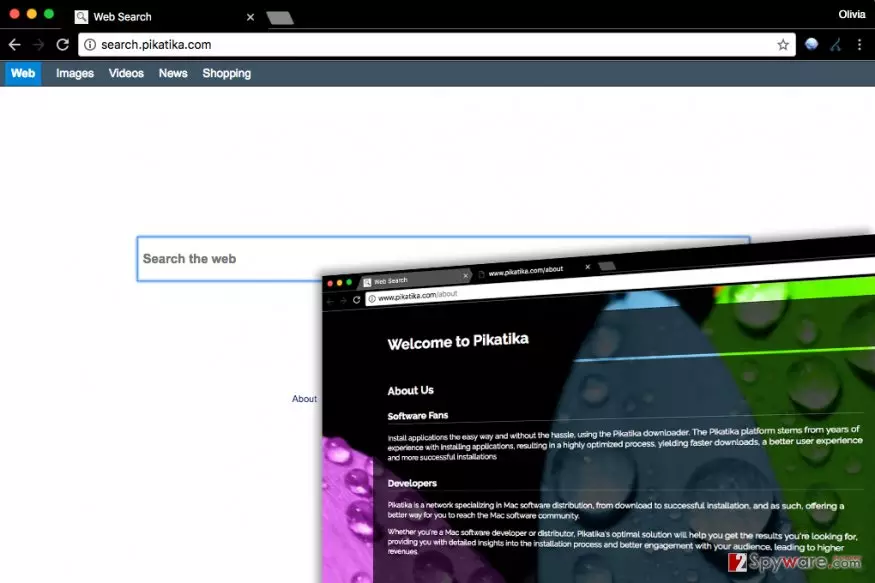
Search.pikatika.com is presented as a traditional search engine, although it is actually an untrustworthy browser hijacker[1] that spreads via suspicious software bundles. The potentially unwanted program (PUP) infects Macs mainly and compromises each web browser to set http://Search.pikatika.com/ as default search engine and homepage address.
The described search site is promoted with a dubious Mac application called Pikatika downloader. Installing it on your computer will disrupt your browser experience and force you to receive modified search results. The problem is that these results look trustworthy, although they can disguise dangerous URLs leading to low-reputation Internet sites.
Computer users who seek to protect their computers from potentially unwanted programs and more critical programs should remember that unexpected changes on the computer system should not be ignored. If you noticed one of the listed signs on your computer, you must remove Search.pikatika.com virus from it:
- Your browser acts slower than usual and displays you annoying ads (banners, pop-ups);
- You receive suspicious search results (for instance, you started receiving Yahoo search results although you were using Google the day before);
- Your browser automatically redirects you to Search.pikatika website each time you open it;
- Clicking on search results takes you to vague websites that make you question their reliability.
You must remember that browser hijackers are not programs designed for user’s benefit. According to LesVirus.fr[2], they function as money-making tools that pretend to be providing “web search services” although they are used only for ad serving[3]. Browser hijackers usually take search results from trustworthy search engines such as Yahoo and fill them up with sponsored links.
For a successful Search.pikatika.com removal, we strongly recommend using anti-malware program. We know that you can remove this annoying Mac parasite manually (especially with instructions provided by us!) but using anti-spyware or anti-malware software can save you tons of time.
For instance, FortectIntego can not only clean your computer from malware but speed up the entire system by removing junk files and fixing errors.

Suggestions how to avoid browser hijackers
Keeping computer spyware and malware free can be tough. However, there is one thing that should help you to keep at least non-malicious but ad-supported programs at bay. You simply need to decompose software packages before installing them on your computer.
Free programs often travel in software bundles that look like regular programs. Each time you download a game, download manager or another free app, consider choosing Custom/Advanced settings for its installation.
This way, you will get a chance to drop off all programs bundled alongside your chosen app. Try to avoid Default, Standard or any other installation option marked as “recommended.” They usually hide agreements to install unknown programs such as Pikatika virus.
Search.pikatika.com removal requires computing skills or a special program
You can remove Search.pikatika.com virus in two ways – automatically or manually. Like any other non-malicious program, it can be rooted out from your Mac OS rather easily. If you decided to go for this uninstallation option, please follow the instructions provided below the article.
However, if you seek for a little more precise computer cleanup, consider the automatic Search.pikatika.com removal option. To complete the removal automatically, you will need anti-spyware or anti-malware software, obviously. Consider choosing one of the ones we recommend.
Delete from macOS
Remove the unwanted application:
- From the menu bar, select Go > Applications.
- In the Applications folder, look for any suspicious entries, then drag them to Trash (or right-click and pick Move to Trash).


Delete leftover files and folders:
- Select Go > Go to Folder.
- Enter /Library/Application Support and remove any suspicious folders related to the unwanted program.
- Repeat the same check in the /Library/LaunchAgents and /Library/LaunchDaemons folders, deleting any suspicious entries.

- Finally, empty the Trash to permanently remove the leftovers.

Reset Internet Explorer
Remove dangerous add-ons:
- Open Internet Explorer, click on the Gear icon (IE menu) on the top-right corner of the browser
- Pick Manage Add-ons.
- You will see a Manage Add-ons window. Here, look for suspicious plugins. Click on these entries and select Disable.


Change your homepage if it was altered:
- Open IE and click on the Gear icon.
- Select Internet Options.
- In the General tab, delete the Home page address and replace it by your preferred one (for example, Google.com).
- Click Apply and then select OK.


Delete temporary files:
- Press on the Gear icon and select Internet Options.
- Under Browsing history, click Delete...
- Select relevant fields and press Delete.


Reset Internet Explorer:
- Click on Gear icon > Internet options and select Advanced tab.
- Select Reset.
- In the new window, check Delete personal settings and select Reset.


Remove from Microsoft Edge
Delete unwanted extensions from MS Edge:
- Select Menu (three horizontal dots at the top-right of the browser window) and pick Extensions.
- From the list, pick the extension and click on the Gear icon.
- Click Remove.


Clear cookies and other browser data:
- Click on the Menu (three horizontal dots at the top-right of the browser window) and select Settings > Privacy, search, and services..
- Under Clear browsing data, pick Choose what to clear.
- Select Cookies and other site data and Cached images and files. (apart from passwords, although you might want to include Media licenses as well, if applicable) and click on Clear.


Restore new tab and homepage settings:
- Click the menu icon and choose Settings.
- Then find On startup section.
- Click Remove next to any suspicious startup page.
Reset MS Edge if the above steps did not work:
- Press on Ctrl + Shift + Esc to open Task Manager.
- Click on More details arrow at the bottom of the window.
- Select Details tab.
- Now scroll down and locate every entry with Microsoft Edge name in it. Right-click on each of them and select End Task to stop MS Edge from running.


Instructions for Chromium-based Edge
Delete extensions from MS Edge (Chromium):
- Open Edge and click select Settings > Extensions.
- Delete unwanted extensions by clicking Remove.


Clear cache and site data:
- Click on Menu and go to Settings.
- Select Privacy, search and services.
- Under Clear browsing data, pick Choose what to clear.
- Under Time range, pick All time.
- Select Clear now.


Reset Chromium-based MS Edge:
- Click on Menu and select Settings.
- On the left side, pick Reset settings.
- Select Restore settings to their default values.
- Confirm with Reset.
- This will disable extensions and reset startup pages but will not delete bookmarks, saved passwords, or browsing history.


Remove from Mozilla Firefox (FF)
Remove dangerous extensions:
- Open Mozilla Firefox browser and click on the Menu (three horizontal lines at the top-right of the window).
- Select Add-ons.
- In here, select the unwanted extension and click Remove.


Reset the homepage:
- Click three horizontal lines at the top right corner to open the menu.
- Choose Settings.
- Under Home, set your preferred homepage and new tab settings.
Clear cookies and site data:
- Click Menu and pick Settings.
- Go to Privacy & Security section.
- Scroll down to locate Cookies and Site Data.
- Click on Clear Data...
- Select Cookies and Site Data and Temporary cached files and pages, then click Clear.


Reset Mozilla Firefox
If clearing the browser as explained above did not help, reset Mozilla Firefox:
- Open Mozilla Firefox browser and click the Menu.
- Go to Help and then choose Troubleshooting Information.

- Under Give Firefox a tune up section, click on Refresh Firefox...
- Once the pop-up shows up, confirm the action by pressing on Refresh Firefox.



Remove from Google Chrome
Delete malicious extensions from Google Chrome:
- Open Google Chrome, click on the Menu (three vertical dots at the top-right corner) and select More tools > Extensions.
- In the newly opened window, you will see all the installed extensions. Uninstall all suspicious extensions related to the unwanted program by clicking Remove.


Clear cache and web data from Chrome:
- Click on Menu and pick Settings.
- Under Privacy and security, select Clear browsing data.
- Select Browsing history, Cookies and other site data, as well as Cached images and files.
- Click Clear data.


Change your homepage:
- Click menu and choose Settings.
- Look for a suspicious site in the On startup section.
- Click on Open a specific or set of pages and click on three dots to find the Remove option.
Reset Google Chrome:
If the previous methods did not help you, reset Google Chrome to eliminate all the unwanted components:
- Click on Menu and select Settings.
- In the Settings, scroll down and click Advanced.
- Scroll down and locate Reset and clean up section.
- Now click Restore settings to their original defaults.
- Confirm with Reset settings.


Delete from Safari
Remove dangerous extensions:
- Open Safari, click Safari in the menu at the top-left of the screen, and select Preferences.
- Go to the Extensions tab, look for any suspicious entries, and click Uninstall to remove them.


Clear history and website data:
- Click Safari in the menu and pick Clear History.
- Set Clear to all history and confirm with Clear History.


Reset Safari:
- Click Safari in the menu and select Preferences > Advanced.
- Enable Show Develop menu in menu bar.
- From the menu bar, click Develop and select Empty Caches.


Did this guide help?
Be the first to comment