

Search.safefinderchoose.com – a browser hijacker that fills search results with misleading ads
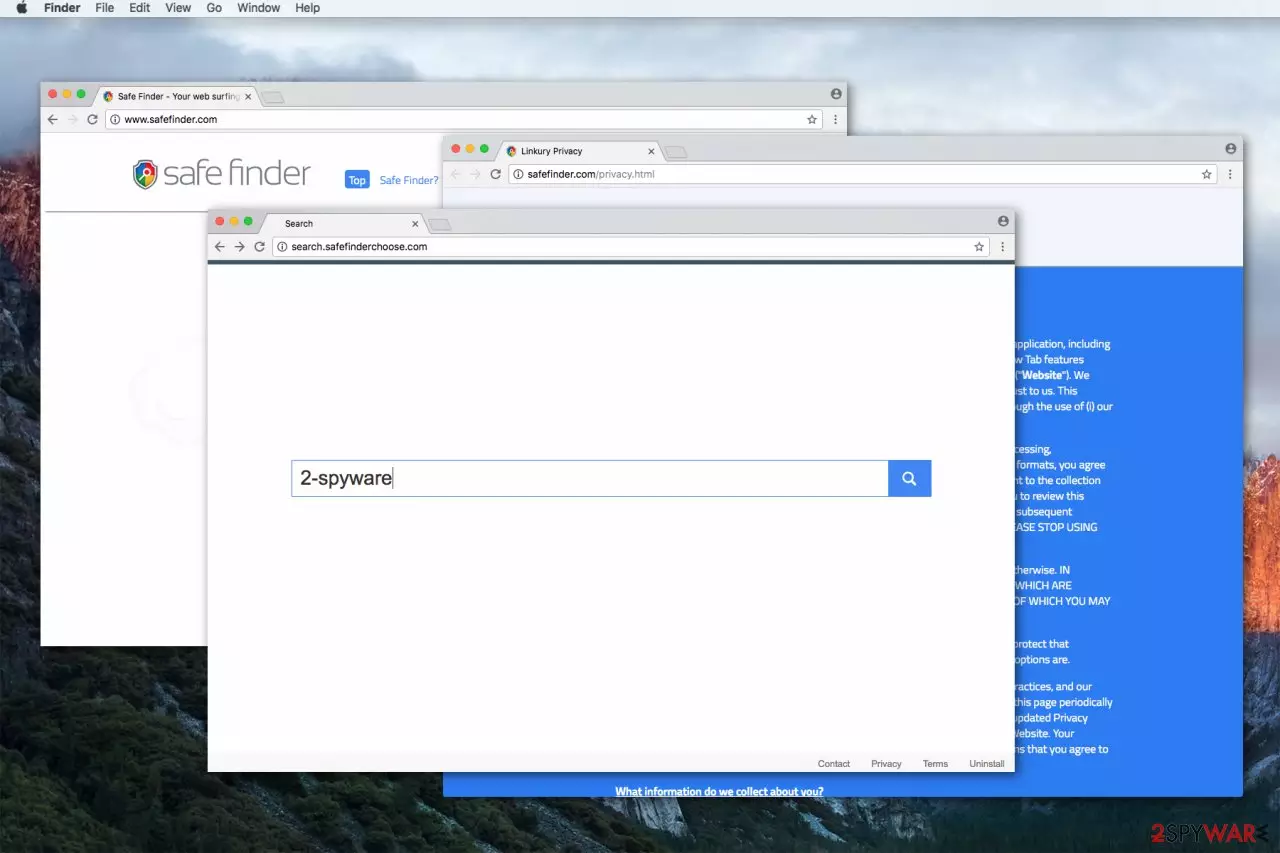
Search.safefinderchoose.com is categorized as a browser hijacker[1] that claims to improve your search results significantly and is developed by Linkury Ltd. In reality, it stealthily modifies your new tab URL, homepage, and default search engine. Typically, this fake website targets Mozilla Firefox, Internet Explorer, Google Chrome, or Safari users.
| name | Search.safefinderchoose.com |
|---|---|
| Type | Redirect virus, browser hijacker, potentially unwanted program |
| Symptoms of infection | Default browser settings are modified without your direct consent; search results contain numerous adverts; browsing speed is severely diminished |
| Risks | Installation of other PUPs, privacy issues, monetary losses |
| Distribution | Software bundles, file-sharing platforms, deceptive ads |
| Elimination | You can remove the intruder by performing a full system scan with our recommended security software |
| System repair | You must fix modified system files for your device to run normally. You can do that by running system diagnostics with the FortectIntego software |
We want to warn you that the hijacker by Safe Finder is not a real virus. However, you may face a frustrating process of its removal — plug-ins that come along are designed to reassign the browser settings mentioned above to Search.safefinderchoose.com every time the user attempts to change it to the previous state.
Moreover, the fake search engine collects data that is related to browsing. Be aware that it might be personally identifiable and compromise your privacy. For example, if you submit your e-mail address in the search bar, it could be used to send spam emails and distribute high-risk computer infections.
Also, the developers make considerable investments to make their browser hijacker look similar to Google, Yahoo, or Bing and attract naive computer users. It even impersonates Yahoo when displaying search results. To make sure that you are not being deceived, you should check the link in the address bar of legitimate Yahoo results and the ones displayed by search.safefinderchoose.com.
We can assure you that they are different. It is just a smart marketing trick to delude user’s that their browsing experience improved for real. Even if you did not notice, the hijacker provides search results that are filled with sponsored ads. The fake engine performs this activity to obtain click-generated revenue rather than produce useful query results for the user.
Additionally, Safe Finder Choose causes intrusive ads to pop up. If you are lured into clicking on them, it may lead you to suspicious websites[2] that potentially can be designed to distribute other high-risk computer infections, draw out your personal details, etc.
Thus, if you have noticed that your computer’s performance significantly decreased, annoying ads are displayed, and you often get redirected to illegal sites — your system is corrupted. We suggest you remove search.safefinderchoose.com using reliable security software such as MalwarebytesMalwarebytes or SpyHunterCombo Cleaner.
Afterward, you need to delete all tracking cookies stored by questionable domains, and repair the registry with other core system directories. You can hit two birds with one stone by using the time-tested FortectIntego PC repair tool.

Browser hijackers are distributed with freeware
Many developers tend to distribute their vague products by hiding the information about browser hijackers being bundled with the regular software. You should never rush through the installation steps by pressing the “Next” button.
Quick or Recommended settings should also be avoided since they do not allow to un-tick the box permitting the installation of potentially unwanted programs (PUPs). Instead, choose to install free apps with a Custom/Advanced installation process and thoroughly follow the steps.
You should never allow downloading any suspicious programs from unknown developers. If you have no other option, make sure to scan the file using a reliable security system beforehand. Speaking of deceptive files, DieViren.de experts provide a huge database with their descriptions.[3]
Easy instructions to remove Search.safefinderchoose.com
You can quickly remove Search.safefinderchoose.com virus automatically. Firstly, download a security software of your choice — make sure to choose wisely since scammers may offer highly expensive and useless programs.
Once installed, you should run a full system scan. It will detect the potentially unwanted programs (PUPs) and uninstall them. Also, your computer will be protected from other types of infections in the future.
Moreover, you can choose the manual removal option. To make it easier for you, our IT specialists have prepared detailed instructions provided below. Carefully follow the steps below to avoid doing, even more, harm to your system.
Uninstall from Windows
Uninstall from Windows 10/8:
- Type Control Panel into the Windows search box and open the result.
- Under Programs, select Uninstall a program.


Uninstall from Windows 7/XP:
- Click on Windows Start > Control Panel (Windows XP users should click on Add/Remove Programs).
- In Control Panel, select Programs > Uninstall a program.


Remove the unwanted program:
- In the Programs and Features window, look for any recently installed suspicious entries, select them, and click Uninstall.
- If User Account Control appears, click Yes to confirm, then complete the removal.


Delete from macOS
Remove the unwanted application:
- From the menu bar, select Go > Applications.
- In the Applications folder, look for any suspicious entries, then drag them to Trash (or right-click and pick Move to Trash).


Delete leftover files and folders:
- Select Go > Go to Folder.
- Enter /Library/Application Support and remove any suspicious folders related to the unwanted program.
- Repeat the same check in the /Library/LaunchAgents and /Library/LaunchDaemons folders, deleting any suspicious entries.

- Finally, empty the Trash to permanently remove the leftovers.

Remove from Microsoft Edge
Delete unwanted extensions from MS Edge:
- Select Menu (three horizontal dots at the top-right of the browser window) and pick Extensions.
- From the list, pick the extension and click on the Gear icon.
- Click Remove.


Clear cookies and other browser data:
- Click on the Menu (three horizontal dots at the top-right of the browser window) and select Settings > Privacy, search, and services..
- Under Clear browsing data, pick Choose what to clear.
- Select Cookies and other site data and Cached images and files. (apart from passwords, although you might want to include Media licenses as well, if applicable) and click on Clear.


Restore new tab and homepage settings:
- Click the menu icon and choose Settings.
- Then find On startup section.
- Click Remove next to any suspicious startup page.
Reset MS Edge if the above steps did not work:
- Press on Ctrl + Shift + Esc to open Task Manager.
- Click on More details arrow at the bottom of the window.
- Select Details tab.
- Now scroll down and locate every entry with Microsoft Edge name in it. Right-click on each of them and select End Task to stop MS Edge from running.


Instructions for Chromium-based Edge
Delete extensions from MS Edge (Chromium):
- Open Edge and click select Settings > Extensions.
- Delete unwanted extensions by clicking Remove.


Clear cache and site data:
- Click on Menu and go to Settings.
- Select Privacy, search and services.
- Under Clear browsing data, pick Choose what to clear.
- Under Time range, pick All time.
- Select Clear now.


Reset Chromium-based MS Edge:
- Click on Menu and select Settings.
- On the left side, pick Reset settings.
- Select Restore settings to their default values.
- Confirm with Reset.
- This will disable extensions and reset startup pages but will not delete bookmarks, saved passwords, or browsing history.


Remove from Mozilla Firefox (FF)
Remove dangerous extensions:
- Open Mozilla Firefox browser and click on the Menu (three horizontal lines at the top-right of the window).
- Select Add-ons.
- In here, select the unwanted extension and click Remove.


Reset the homepage:
- Click three horizontal lines at the top right corner to open the menu.
- Choose Settings.
- Under Home, set your preferred homepage and new tab settings.
Clear cookies and site data:
- Click Menu and pick Settings.
- Go to Privacy & Security section.
- Scroll down to locate Cookies and Site Data.
- Click on Clear Data...
- Select Cookies and Site Data and Temporary cached files and pages, then click Clear.


Reset Mozilla Firefox
If clearing the browser as explained above did not help, reset Mozilla Firefox:
- Open Mozilla Firefox browser and click the Menu.
- Go to Help and then choose Troubleshooting Information.

- Under Give Firefox a tune up section, click on Refresh Firefox...
- Once the pop-up shows up, confirm the action by pressing on Refresh Firefox.



Remove from Google Chrome
Delete malicious extensions from Google Chrome:
- Open Google Chrome, click on the Menu (three vertical dots at the top-right corner) and select More tools > Extensions.
- In the newly opened window, you will see all the installed extensions. Uninstall all suspicious extensions related to the unwanted program by clicking Remove.


Clear cache and web data from Chrome:
- Click on Menu and pick Settings.
- Under Privacy and security, select Clear browsing data.
- Select Browsing history, Cookies and other site data, as well as Cached images and files.
- Click Clear data.


Change your homepage:
- Click menu and choose Settings.
- Look for a suspicious site in the On startup section.
- Click on Open a specific or set of pages and click on three dots to find the Remove option.
Reset Google Chrome:
If the previous methods did not help you, reset Google Chrome to eliminate all the unwanted components:
- Click on Menu and select Settings.
- In the Settings, scroll down and click Advanced.
- Scroll down and locate Reset and clean up section.
- Now click Restore settings to their original defaults.
- Confirm with Reset settings.


Delete from Safari
Remove dangerous extensions:
- Open Safari, click Safari in the menu at the top-left of the screen, and select Preferences.
- Go to the Extensions tab, look for any suspicious entries, and click Uninstall to remove them.


Clear history and website data:
- Click Safari in the menu and pick Clear History.
- Set Clear to all history and confirm with Clear History.


Reset Safari:
- Click Safari in the menu and select Preferences > Advanced.
- Enable Show Develop menu in menu bar.
- From the menu bar, click Develop and select Empty Caches.


Did this guide help?
Be the first to comment