

Search.searcheazel.com – a fake search engine that shows ads injected into search results
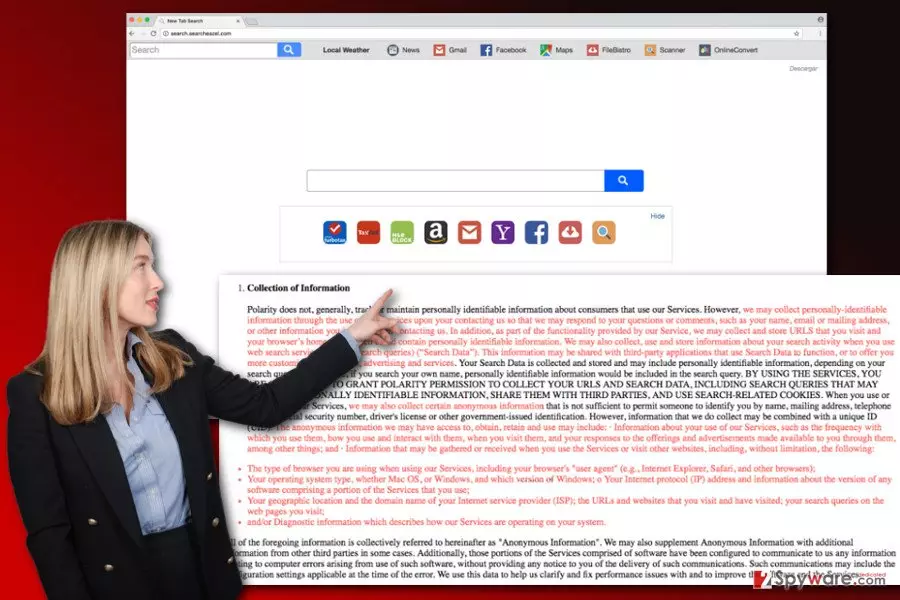
Search.searcheazel.com virus is another shady search engine developed by Cyprus-based company Polarity Technologies Ltd. Developers have already presented plenty of similar engines that are described as browser hijackers. These potentially unwanted programs are mostly used as advertising tools, and users only experience negative aspects of them.
After the hijack, this application replaces the targeted web browser’s homepage, default search engine and in-built search box, new tab URL address, and other possible modifications. When users open an infected Chrome, Firefox, Explorer or Safari web browser, they found a new homepage that offers to use an unknown search engine, access various websites through provided shortcuts and toolbar with shady applications provided by Safer Browser.
| name | Search.searcheazel.com virus |
|---|---|
| Type | Browser hijacker, PUP |
| Symptoms | Browser preferences are changed so that all search inquiries go through the culprit's website; ads are shown in search results; slower browsing speed |
| Risks | Malware infections, PUP installation, privacy issues |
| Distribution | Software bundling, fake Flash Player updates |
| Elimination | Remove all suspicious or malicious entries from your device by scanning it with a dependable security tool |
| System health | Use the FortectIntego PC repair tool to fix all system inconsistencies that cause crashing and other system failures |
At the bottom of the page, developers leave the links to the Privacy Policy[1] and EULA[2] where you can find out that this tool not only installs tracking cookies[3] but also allows installing partner’s cookies as well. Therefore, developers do not need to share or sell aggregated information about the users to third-party; they allow them to get to know the users themselves.
However, the Privacy Policy reveals that some of the gathered data might be shared with the third-parties and advertising networks. Thus, if you do not want to see your browser crashing from online ads, you should remove Search.searcheazel.com from the computer immediately.
Browser hijackers are not dangerous cyber threats. Though, they might let people enter unsafe websites or encourage to click on a malicious ad or banner.[4] The redirect issues are the main problems of the browser hijacker. Hijackers often employ a “virtual layer” that allows placing ads on any website.
Though, deceptive, misleading, or even malware-laden ads might show up on legitimate Internet sites. Nevertheless, developers of this search engine generate revenue from pay-per-click and affiliate marketing strategies; they do not care about the users and do not take responsibility for promoted third-party content.
Hence, while the hijacker resides on the system, the chances to become a victim of cyber crimes increases[5]. We highly recommend minimizing the risk of a malware attack by scanning the computer with SpyHunterCombo Cleaner or MalwarebytesMalwarebytes. Either of these security tools will perform the removal quickly and protect your machine from the other cyber parasites.
Afterward, you can reset your browser to default settings by using our detailed instructions below, of course, if you need them. To ensure that your device runs as it supposed to, we advise using the FortectIntego system diagnostics tool that fixes system errors.
How this threat infected your device?
Search.searcheazel.com virus is closely related to the Descargar application; hence, it may get inside the computer when a user installs it. However, it often happens without the user’s knowledge because these potentially unwanted programs spread bundled with freeware and shareware.
Hence, they are hidden in software packages as extra applications. If the installation of the free programs is performed under Quick or Recommended settings, the users give indirect permission to install all programs that might have been attached to the software package.
However, switching from Recommended to Advanced/Custom settings prevents installing all programs that are pre-selected. This installation mode reveals the list of optional downloads and you have to opt-out from installing all apps that look at least a bit suspicious.
How to remove Search.searcheazel.com virus from a device?
At the end of this article, we have provided detailed and illustrated instructions that will guide you through the manual Search.searcheazel.com removal procedure. Be aware that you need not only eliminate this particular hijacker but also other suspicious entries.
Don’t forget that problems rarely come alone; just like potentially unwanted programs. You may find plenty of suspicious applications installed on the computer and web browsers. However, if you do not want to spend the whole day cleaning your computer, you can remove all of them automatically. This method requires running a full system scan with an anti-malware program.
Uninstall from Windows
Uninstall from Windows 10/8:
- Type Control Panel into the Windows search box and open the result.
- Under Programs, select Uninstall a program.


Uninstall from Windows 7/XP:
- Click on Windows Start > Control Panel (Windows XP users should click on Add/Remove Programs).
- In Control Panel, select Programs > Uninstall a program.


Remove the unwanted program:
- In the Programs and Features window, look for any recently installed suspicious entries, select them, and click Uninstall.
- If User Account Control appears, click Yes to confirm, then complete the removal.


Delete from macOS
Remove the unwanted application:
- From the menu bar, select Go > Applications.
- In the Applications folder, look for any suspicious entries, then drag them to Trash (or right-click and pick Move to Trash).


Delete leftover files and folders:
- Select Go > Go to Folder.
- Enter /Library/Application Support and remove any suspicious folders related to the unwanted program.
- Repeat the same check in the /Library/LaunchAgents and /Library/LaunchDaemons folders, deleting any suspicious entries.

- Finally, empty the Trash to permanently remove the leftovers.

Remove from Microsoft Edge
Delete unwanted extensions from MS Edge:
- Select Menu (three horizontal dots at the top-right of the browser window) and pick Extensions.
- From the list, pick the extension and click on the Gear icon.
- Click Remove.


Clear cookies and other browser data:
- Click on the Menu (three horizontal dots at the top-right of the browser window) and select Settings > Privacy, search, and services..
- Under Clear browsing data, pick Choose what to clear.
- Select Cookies and other site data and Cached images and files. (apart from passwords, although you might want to include Media licenses as well, if applicable) and click on Clear.


Restore new tab and homepage settings:
- Click the menu icon and choose Settings.
- Then find On startup section.
- Click Remove next to any suspicious startup page.
Reset MS Edge if the above steps did not work:
- Press on Ctrl + Shift + Esc to open Task Manager.
- Click on More details arrow at the bottom of the window.
- Select Details tab.
- Now scroll down and locate every entry with Microsoft Edge name in it. Right-click on each of them and select End Task to stop MS Edge from running.


Instructions for Chromium-based Edge
Delete extensions from MS Edge (Chromium):
- Open Edge and click select Settings > Extensions.
- Delete unwanted extensions by clicking Remove.


Clear cache and site data:
- Click on Menu and go to Settings.
- Select Privacy, search and services.
- Under Clear browsing data, pick Choose what to clear.
- Under Time range, pick All time.
- Select Clear now.


Reset Chromium-based MS Edge:
- Click on Menu and select Settings.
- On the left side, pick Reset settings.
- Select Restore settings to their default values.
- Confirm with Reset.
- This will disable extensions and reset startup pages but will not delete bookmarks, saved passwords, or browsing history.


Remove from Mozilla Firefox (FF)
Remove dangerous extensions:
- Open Mozilla Firefox browser and click on the Menu (three horizontal lines at the top-right of the window).
- Select Add-ons.
- In here, select the unwanted extension and click Remove.


Reset the homepage:
- Click three horizontal lines at the top right corner to open the menu.
- Choose Settings.
- Under Home, set your preferred homepage and new tab settings.
Clear cookies and site data:
- Click Menu and pick Settings.
- Go to Privacy & Security section.
- Scroll down to locate Cookies and Site Data.
- Click on Clear Data...
- Select Cookies and Site Data and Temporary cached files and pages, then click Clear.


Reset Mozilla Firefox
If clearing the browser as explained above did not help, reset Mozilla Firefox:
- Open Mozilla Firefox browser and click the Menu.
- Go to Help and then choose Troubleshooting Information.

- Under Give Firefox a tune up section, click on Refresh Firefox...
- Once the pop-up shows up, confirm the action by pressing on Refresh Firefox.



Remove from Google Chrome
Delete malicious extensions from Google Chrome:
- Open Google Chrome, click on the Menu (three vertical dots at the top-right corner) and select More tools > Extensions.
- In the newly opened window, you will see all the installed extensions. Uninstall all suspicious extensions related to the unwanted program by clicking Remove.


Clear cache and web data from Chrome:
- Click on Menu and pick Settings.
- Under Privacy and security, select Clear browsing data.
- Select Browsing history, Cookies and other site data, as well as Cached images and files.
- Click Clear data.


Change your homepage:
- Click menu and choose Settings.
- Look for a suspicious site in the On startup section.
- Click on Open a specific or set of pages and click on three dots to find the Remove option.
Reset Google Chrome:
If the previous methods did not help you, reset Google Chrome to eliminate all the unwanted components:
- Click on Menu and select Settings.
- In the Settings, scroll down and click Advanced.
- Scroll down and locate Reset and clean up section.
- Now click Restore settings to their original defaults.
- Confirm with Reset settings.


Delete from Safari
Remove dangerous extensions:
- Open Safari, click Safari in the menu at the top-left of the screen, and select Preferences.
- Go to the Extensions tab, look for any suspicious entries, and click Uninstall to remove them.


Clear history and website data:
- Click Safari in the menu and pick Clear History.
- Set Clear to all history and confirm with Clear History.


Reset Safari:
- Click Safari in the menu and select Preferences > Advanced.
- Enable Show Develop menu in menu bar.
- From the menu bar, click Develop and select Empty Caches.


Did this guide help?
3 comments
morris
another fake search engine...
ruth001
How could someone decide to use this engine? It looks strange and shady
july
even the name of the search engine looks strange. its impossible to memorize it.