

Why can I see posts titled “Searchtudo.com virus”?
You can see posts using titles “Searchtudo.com virus” because this search engine is not a typical one. Beware that it uses misleading techniques for infiltrating people’s computers. Once it does that, it modifies their web browsers and starts tracking their online activities. Mostly, this search engine collects search terms, information about mostly visited websites, computers’ IP addresses, their location, users’ email addresses and similar data. Would you like to reveal this data to someone who you don’t really know? We don’t think so. Besides, security experts have reported about Searchtudo.com redirect to sponsored websites, which is initiated once this browser hijacker is inside the system. Typically, such activity is used to promote third party websites that are trying to increase their popularity. However, you can never know who is hiding behind them. As you can see, there is no doubt that you have to remove Searchtudo.com from the system. For a quick result, you can obtain a reputable anti-malware tool like FortectIntego to take care of the infection. We also provide a detailed manual virus removal guide at the end of the article if you fancy a little bit of challenge. Nevertheless, there are several other issues related to this virus we have not mentioned yet. So if you are interested in finding more about this suspicious application, please keep reading.
If you are wondering how to recognize the Searchtudo.com hijack, we can assure you that it is quite easy.This virus manifests itself through the altered browser settings. Internet Explorer, Google Chrome, and Mozilla Firefox, all can be affected by this virus. So, once you are infected, you will be quick to notice your default search engine, homepage, and new URL tab assigned to nav.brotstation.com, which redirects you straight to the Searchtudo.com. What is more, you may start noticing suspicious software update notifications which disappear after closing the browser. These notifications are only another treat this virus may bring to your computer. Typically, clicking on the ads generated by Searchtudo.com the users to some infectious websites where the user risks contaminating the system with a variety of other viruses, trojans, worms and other parasites. On top of it all, if you decide to use this program as your default search engine, keep in mind that it will track and store information about what you are browsing on the web, what pages you are visiting, etc. We do not think this is an honest and, let alone, functional service; therefore, we encourage you to remove Searchtudo.com from your computer ASAP.
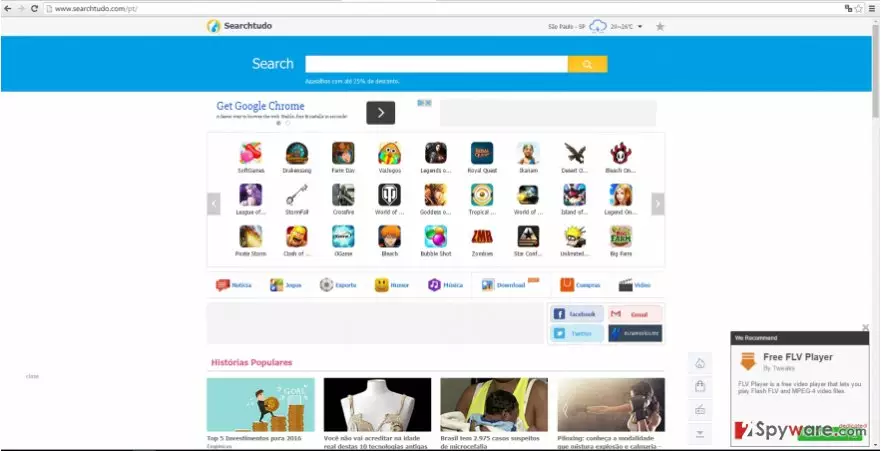
How can this virus hijack my computer?
Browser hijackers usually enter the users’ computers indirectly. This means that in the most cases, the user does not download the program him/herself. Nevertheless, this program cannot enter the computer without any human interaction either. At some point, the virus must be allowed to get into the system. This usually happens when the users are inattentively installing new software. The PUP creators hide information about these optional programs in the advanced settings and through these settings only can the additional installation options be monitored and managed. So, it would be wise if you used “Custom” or “Advanced” settings every time you are installing some new software on your computer. In this way, you will bypass all the unwanted programs and, also, keep the potential viruses away from your system.
Tips on Searchtudo.com removal
The key aspect of successful Searchtudo.com removal is choosing the correct strategy. There are two fundamental strategies that you need to look up to if you want to remove this virus from your computer, that is manual and automatic removal. The manual removal technique, as you may probably imagine, is not the fastest way to get rid of the virus. Besides, it also requires substantial computer knowledge too. However, it does not matter if you are computer newbie or consider yourself a pro, mistakes can happen, and you may end up with this virus bouncing back to your browser even after you remove the program. This is mainly due to the fact that browser hijackers usually install helper objects such as toolbars, add-ons, which help this virus to restore its settings. So, to avoid such mistakes, it is better to remove Searchtudo.com virus with the help of a reputable antivirus suite and ensure that your system is thoroughly protected. In this case, you just need to choose a program from the ones that are given below.
Uninstall from Windows
Uninstall from Windows 10/8:
- Type Control Panel into the Windows search box and open the result.
- Under Programs, select Uninstall a program.


Uninstall from Windows 7/XP:
- Click on Windows Start > Control Panel (Windows XP users should click on Add/Remove Programs).
- In Control Panel, select Programs > Uninstall a program.


Remove the unwanted program:
- In the Programs and Features window, look for any recently installed suspicious entries, select them, and click Uninstall.
- If User Account Control appears, click Yes to confirm, then complete the removal.


Delete from macOS
Remove the unwanted application:
- From the menu bar, select Go > Applications.
- In the Applications folder, look for any suspicious entries, then drag them to Trash (or right-click and pick Move to Trash).


Delete leftover files and folders:
- Select Go > Go to Folder.
- Enter /Library/Application Support and remove any suspicious folders related to the unwanted program.
- Repeat the same check in the /Library/LaunchAgents and /Library/LaunchDaemons folders, deleting any suspicious entries.

- Finally, empty the Trash to permanently remove the leftovers.

Remove from Microsoft Edge
Delete unwanted extensions from MS Edge:
- Select Menu (three horizontal dots at the top-right of the browser window) and pick Extensions.
- From the list, pick the extension and click on the Gear icon.
- Click Remove.


Clear cookies and other browser data:
- Click on the Menu (three horizontal dots at the top-right of the browser window) and select Settings > Privacy, search, and services..
- Under Clear browsing data, pick Choose what to clear.
- Select Cookies and other site data and Cached images and files. (apart from passwords, although you might want to include Media licenses as well, if applicable) and click on Clear.


Restore new tab and homepage settings:
- Click the menu icon and choose Settings.
- Then find On startup section.
- Click Remove next to any suspicious startup page.
Reset MS Edge if the above steps did not work:
- Press on Ctrl + Shift + Esc to open Task Manager.
- Click on More details arrow at the bottom of the window.
- Select Details tab.
- Now scroll down and locate every entry with Microsoft Edge name in it. Right-click on each of them and select End Task to stop MS Edge from running.


Instructions for Chromium-based Edge
Delete extensions from MS Edge (Chromium):
- Open Edge and click select Settings > Extensions.
- Delete unwanted extensions by clicking Remove.


Clear cache and site data:
- Click on Menu and go to Settings.
- Select Privacy, search and services.
- Under Clear browsing data, pick Choose what to clear.
- Under Time range, pick All time.
- Select Clear now.


Reset Chromium-based MS Edge:
- Click on Menu and select Settings.
- On the left side, pick Reset settings.
- Select Restore settings to their default values.
- Confirm with Reset.
- This will disable extensions and reset startup pages but will not delete bookmarks, saved passwords, or browsing history.


Remove from Mozilla Firefox (FF)
Remove dangerous extensions:
- Open Mozilla Firefox browser and click on the Menu (three horizontal lines at the top-right of the window).
- Select Add-ons.
- In here, select the unwanted extension and click Remove.


Reset the homepage:
- Click three horizontal lines at the top right corner to open the menu.
- Choose Settings.
- Under Home, set your preferred homepage and new tab settings.
Clear cookies and site data:
- Click Menu and pick Settings.
- Go to Privacy & Security section.
- Scroll down to locate Cookies and Site Data.
- Click on Clear Data...
- Select Cookies and Site Data and Temporary cached files and pages, then click Clear.


Reset Mozilla Firefox
If clearing the browser as explained above did not help, reset Mozilla Firefox:
- Open Mozilla Firefox browser and click the Menu.
- Go to Help and then choose Troubleshooting Information.

- Under Give Firefox a tune up section, click on Refresh Firefox...
- Once the pop-up shows up, confirm the action by pressing on Refresh Firefox.



Remove from Google Chrome
Delete malicious extensions from Google Chrome:
- Open Google Chrome, click on the Menu (three vertical dots at the top-right corner) and select More tools > Extensions.
- In the newly opened window, you will see all the installed extensions. Uninstall all suspicious extensions related to the unwanted program by clicking Remove.


Clear cache and web data from Chrome:
- Click on Menu and pick Settings.
- Under Privacy and security, select Clear browsing data.
- Select Browsing history, Cookies and other site data, as well as Cached images and files.
- Click Clear data.


Change your homepage:
- Click menu and choose Settings.
- Look for a suspicious site in the On startup section.
- Click on Open a specific or set of pages and click on three dots to find the Remove option.
Reset Google Chrome:
If the previous methods did not help you, reset Google Chrome to eliminate all the unwanted components:
- Click on Menu and select Settings.
- In the Settings, scroll down and click Advanced.
- Scroll down and locate Reset and clean up section.
- Now click Restore settings to their original defaults.
- Confirm with Reset settings.


Delete from Safari
Remove dangerous extensions:
- Open Safari, click Safari in the menu at the top-left of the screen, and select Preferences.
- Go to the Extensions tab, look for any suspicious entries, and click Uninstall to remove them.


Clear history and website data:
- Click Safari in the menu and pick Clear History.
- Set Clear to all history and confirm with Clear History.


Reset Safari:
- Click Safari in the menu and select Preferences > Advanced.
- Enable Show Develop menu in menu bar.
- From the menu bar, click Develop and select Empty Caches.


Did this guide help?
3 comments
Billy K
This is complete nonsense Im using this website and it works fine for me!
CAROL76
I wouldnt say the same... I had it on my computer and during that time, my browser just exploded with ads! Luckily, I removed it with SpyHunter
Daniel Gregory
Grrreat! Another annoying virus! Will they ever stop??