

SpecialSearchOption – a potentially unwanted program that affects mostly Chrome browsers
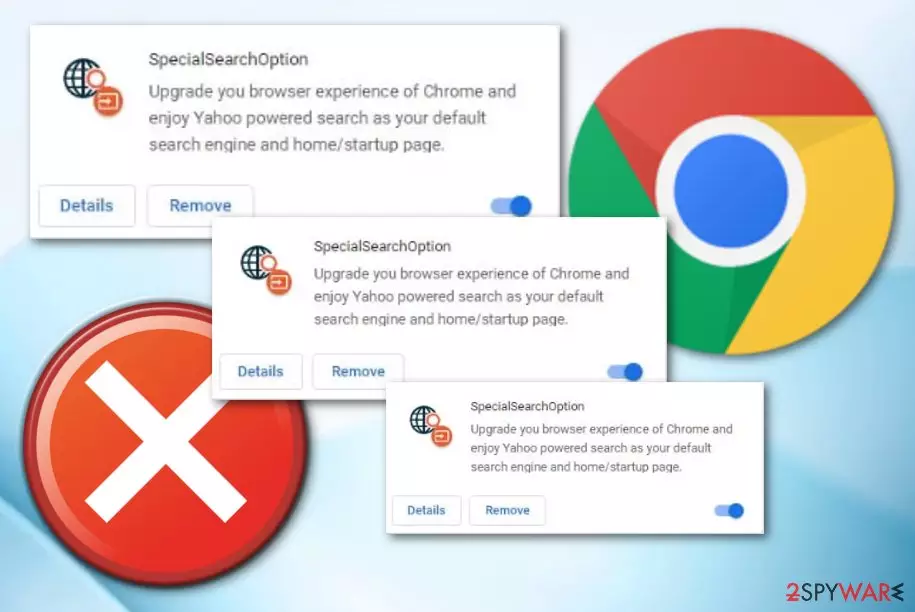
SpecialSearchOption is a browser-hijacking application[1] that has mostly been infecting Chrome. However, we cannot deny the opportunity that this unwanted program might start infiltrating other web browsers such as Firefox, Edge, and Explorer in the future. If you are infected with this virus, you will see changes such as modified search engine, different homepage, etc.
Remember, you will be forced to use the new search engine[2] each time you browse the web until you get rid of the extension which is allowing this type of activity. Furthermore, browsing-hijacking programs can be very annoying as they can start redirecting you to odd pages. You can also land on a harmful one and infect your computer with malware! Keep on reading and learn more about this hijacker and methods to remove it.
| Name | SpecialSearchOption |
|---|---|
| Type | Browser hijacker |
| Sub-type | Potentially unwanted program (PUP) |
| Browsers affected | At the time of writing, compatible with Google Chrome only |
| Symptoms | Modified web browser settings |
| Distribution | Other programs, third-party sources, unknown websites, etc. |
| Prevention methods | Stay away from questionable content and track your downloads by using the Custom/Advanced mode |
| Detection | Use reliable security tools to locate and remove any unwelcomed, hazardous guests |
| System health | We suggest using FortectIntego to find and repair all system irregularities |
If the article's culprit virus has occupied one of your browsers, there is a big chance that you will experience symptoms like these:
- redirects to unfamiliar and suspicious pages;
- changes for the default search engine, homepage;
- the SpecialSearchOption extension in your browser.
Spotting these signs means that PUP has occupied your web browser. There is no need of keeping this potentially unwanted application as it does not bring any true value for the user. Such programs are created for beneficial reasons and will only intrude on your browsing activity with all the redirecting that is caused.
According to tech experts from LosVirus.es,[3] if you do not eliminate the browser hijacker, you will be forced to use the new search engine. Even though the browser hijacker provides search results from Yahoo,[4] some of them might appear to be misleading. What you need to do is get rid of the potentially unwanted program from Chrome or other infected browsers permanently.
To remove SpecialSearchOption virus from the web browser, you should eliminate its extension. Moreover, you will need to refresh the browser in order to reverse all changes that were made by the browser-hijacking app. However, we advise using a computer security program such as SpyHunterCombo Cleaner, or MalwarebytesMalwarebytes which will help you to detect all rogue content in the system.
If you perform the removal as soon as possible, you should avoid unwanted consequences. However, if you will postpone the deletion of this rogue program, there is a risk of getting your system damaged. Even though the program itself is not harmful, it can redirect you to pages where malware might be hidden. Once the intruder is gone, scan your device for system errors with the FortectIntego PC tune-up software.

Browser hijackers are spread by using stealth techniques
If you have overcome a browser-hijacking application in your computer system, there is a very big chance that such a program infiltrated your computer through other software. To avoid such a possibility in the future you should track all of your downloads. You can do such a thing by activating the Advanced/Custom installation option in your browser settings.
Furthermore, avoid visiting various third-party pages. Note that secondary sources can be harmful as they might not only distribute potentially unwanted programs but the malware also. If you ever enter an unrecognizable website, make sure that you eliminate it the same minute and never return to it again.
Additionally, installing reliable computer protection will increase the protection level. Do not hesitate to invest in a truly reliable computer tool as these programs are truly useful if taken care of properly. Once you install antimalware on your PC, make sure you update it regularly. If you do so, the tool will keep your system protected from all different kinds of infections daily.
Remove SpecialSearchOption browser-hijacking application by performing some steps
If you want to remove SpecialSearchOption virus from your computer, you will need to eliminate the PUP-added extensions from web browsers such as Google Chrome, Mozilla Firefox, Internet Explorer, Microsoft Edge, and Safari. You can find more detailed instructions below the article. Make sure that you follow each step carefully to reach the best results possible.
Furthermore, you can perform the PUP removal in an easier way. All you have to do is download and install a reputable security program on your computer. The entire elimination process will take only a few minutes. Furthermore, refresh all web browsers that were infected with the browser-hijacking application to ensure that the PUP is gone permanently.
Uninstall from Windows
Uninstall from Windows 10/8:
- Type Control Panel into the Windows search box and open the result.
- Under Programs, select Uninstall a program.


Uninstall from Windows 7/XP:
- Click on Windows Start > Control Panel (Windows XP users should click on Add/Remove Programs).
- In Control Panel, select Programs > Uninstall a program.


Remove the unwanted program:
- In the Programs and Features window, look for any recently installed suspicious entries, select them, and click Uninstall.
- If User Account Control appears, click Yes to confirm, then complete the removal.


Remove from Microsoft Edge
Delete unwanted extensions from MS Edge:
- Select Menu (three horizontal dots at the top-right of the browser window) and pick Extensions.
- From the list, pick the extension and click on the Gear icon.
- Click Remove.


Clear cookies and other browser data:
- Click on the Menu (three horizontal dots at the top-right of the browser window) and select Settings > Privacy, search, and services..
- Under Clear browsing data, pick Choose what to clear.
- Select Cookies and other site data and Cached images and files. (apart from passwords, although you might want to include Media licenses as well, if applicable) and click on Clear.


Restore new tab and homepage settings:
- Click the menu icon and choose Settings.
- Then find On startup section.
- Click Remove next to any suspicious startup page.
Reset MS Edge if the above steps did not work:
- Press on Ctrl + Shift + Esc to open Task Manager.
- Click on More details arrow at the bottom of the window.
- Select Details tab.
- Now scroll down and locate every entry with Microsoft Edge name in it. Right-click on each of them and select End Task to stop MS Edge from running.


Instructions for Chromium-based Edge
Delete extensions from MS Edge (Chromium):
- Open Edge and click select Settings > Extensions.
- Delete unwanted extensions by clicking Remove.


Clear cache and site data:
- Click on Menu and go to Settings.
- Select Privacy, search and services.
- Under Clear browsing data, pick Choose what to clear.
- Under Time range, pick All time.
- Select Clear now.


Reset Chromium-based MS Edge:
- Click on Menu and select Settings.
- On the left side, pick Reset settings.
- Select Restore settings to their default values.
- Confirm with Reset.
- This will disable extensions and reset startup pages but will not delete bookmarks, saved passwords, or browsing history.


Remove from Mozilla Firefox (FF)
Remove dangerous extensions:
- Open Mozilla Firefox browser and click on the Menu (three horizontal lines at the top-right of the window).
- Select Add-ons.
- In here, select the unwanted extension and click Remove.


Reset the homepage:
- Click three horizontal lines at the top right corner to open the menu.
- Choose Settings.
- Under Home, set your preferred homepage and new tab settings.
Clear cookies and site data:
- Click Menu and pick Settings.
- Go to Privacy & Security section.
- Scroll down to locate Cookies and Site Data.
- Click on Clear Data...
- Select Cookies and Site Data and Temporary cached files and pages, then click Clear.


Reset Mozilla Firefox
If clearing the browser as explained above did not help, reset Mozilla Firefox:
- Open Mozilla Firefox browser and click the Menu.
- Go to Help and then choose Troubleshooting Information.

- Under Give Firefox a tune up section, click on Refresh Firefox...
- Once the pop-up shows up, confirm the action by pressing on Refresh Firefox.



Remove from Google Chrome
Delete malicious extensions from Google Chrome:
- Open Google Chrome, click on the Menu (three vertical dots at the top-right corner) and select More tools > Extensions.
- In the newly opened window, you will see all the installed extensions. Uninstall all suspicious extensions related to the unwanted program by clicking Remove.


Clear cache and web data from Chrome:
- Click on Menu and pick Settings.
- Under Privacy and security, select Clear browsing data.
- Select Browsing history, Cookies and other site data, as well as Cached images and files.
- Click Clear data.


Change your homepage:
- Click menu and choose Settings.
- Look for a suspicious site in the On startup section.
- Click on Open a specific or set of pages and click on three dots to find the Remove option.
Reset Google Chrome:
If the previous methods did not help you, reset Google Chrome to eliminate all the unwanted components:
- Click on Menu and select Settings.
- In the Settings, scroll down and click Advanced.
- Scroll down and locate Reset and clean up section.
- Now click Restore settings to their original defaults.
- Confirm with Reset settings.


Delete from Safari
Remove dangerous extensions:
- Open Safari, click Safari in the menu at the top-left of the screen, and select Preferences.
- Go to the Extensions tab, look for any suspicious entries, and click Uninstall to remove them.


Clear history and website data:
- Click Safari in the menu and pick Clear History.
- Set Clear to all history and confirm with Clear History.


Reset Safari:
- Click Safari in the menu and select Preferences > Advanced.
- Enable Show Develop menu in menu bar.
- From the menu bar, click Develop and select Empty Caches.


Did this guide help?
Be the first to comment