

What is TidyNetwork?
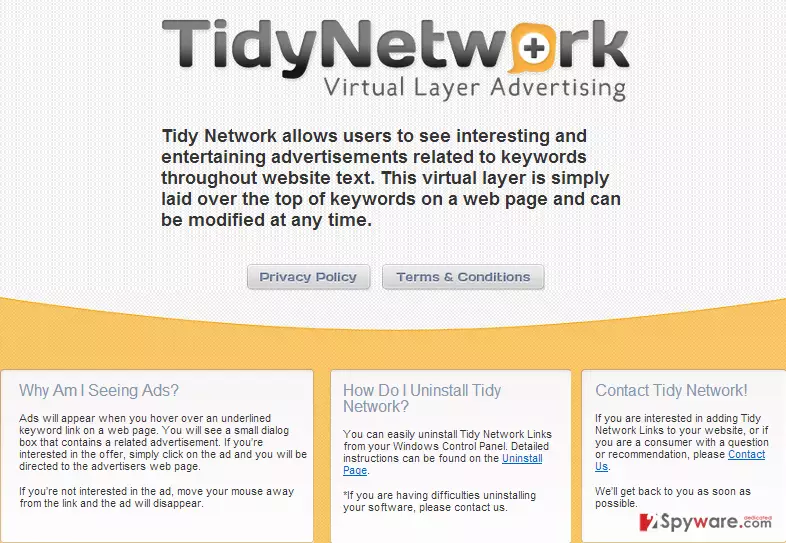
If you noticed ‘Ads by TidyNetwork’ and similar notifications, it means that your PC was affected by adware-type program. By the way, this program is capable of causing not only unwanted advertisements on every website user tries to enter. It may also initiate redirects to affiliate websites, slowdowns and similar issues. All TidyNetwork advertisements are related to people’s interests because this program may also be set to track people and their browsing habits as soon as it enters computer. It is mostly interested in their search terms, mostly visited websites and similar things, but it may also record information about PC’s IP address, location, email address and data that is entered on each of website. You should be very careful with TidyNetwork virus because you can never know where its accumulated data is sent to. After collecting needed keywords, this program additionally redirects people to relevant websites. Of course, this usually happens out of nowhere, without any user’s permission asked. Of course, the main reason why tidynetwork.com ads are displayed while people are visiting their favorite websites is the money. Just like Setaga Deal Finder, this program may easily affect all web browsers and then initiate serious havoc during people’s browsing sessions. If you are constantly bombarded by TidyNetwork ads or suffer from its redirects to affiliate websites, remember that all these notifications are commercial, misleading and may be filled with the spammy content. We do NOT recommend ignoring these ads, you should remove tidynetwork.com virus from your computer without any delay.
How can TidyNetwork hijack my computer?
As we have already mentioned before, people start seeing ‘Ads by TidyNetwork’ and similar advertisements once this adware-type program (it has also been labeled as potentially unwanted program) gets inside computer. While this virus is not a notorious one, it can easily initiate unwanted problems for its victim, so you should try to avoid it. If you want to do that, try to be very careful when downloading free programs on the system. Make sure you read End user’s license agreement and similar information about the program that you want to install. If you think that everything sounds normal, select Custom or Advanced installation option and carefully look for ‘optional downloads’ and similar free programs that are offered in a bundle. Of course, you should opt out of TidyNetwork. Otherwise, you may start suffering from annoying commercials and redirects to suspicious pages. We do NOT recommend trusting such programs as this one because it is mostly used for affiliate marketing and may lead you to annoying redirects, tons of commercial advertisements and similar inconveniences that are initiated in order to earn the money. Keep in mind: TidyNetwork.com redirects or unwanted active words on websites mean that your PC has been affected by adware, so you should run a full system scan with anti-malware program and remove it from your machine.
How to remove TidyNetwork.com virus?
In order to get rid of ‘Ads by TidyNetwork’, you should follow this guide:
Uninstall from Windows
Uninstall from Windows 10/8:
- Type Control Panel into the Windows search box and open the result.
- Under Programs, select Uninstall a program.


Uninstall from Windows 7/XP:
- Click on Windows Start > Control Panel (Windows XP users should click on Add/Remove Programs).
- In Control Panel, select Programs > Uninstall a program.


Remove the unwanted program:
- In the Programs and Features window, look for any recently installed suspicious entries, select them, and click Uninstall.
- If User Account Control appears, click Yes to confirm, then complete the removal.


Delete from macOS
Remove the unwanted application:
- From the menu bar, select Go > Applications.
- In the Applications folder, look for any suspicious entries, then drag them to Trash (or right-click and pick Move to Trash).


Delete leftover files and folders:
- Select Go > Go to Folder.
- Enter /Library/Application Support and remove any suspicious folders related to the unwanted program.
- Repeat the same check in the /Library/LaunchAgents and /Library/LaunchDaemons folders, deleting any suspicious entries.

- Finally, empty the Trash to permanently remove the leftovers.

Remove from Microsoft Edge
Delete unwanted extensions from MS Edge:
- Select Menu (three horizontal dots at the top-right of the browser window) and pick Extensions.
- From the list, pick the extension and click on the Gear icon.
- Click Remove.


Clear cookies and other browser data:
- Click on the Menu (three horizontal dots at the top-right of the browser window) and select Settings > Privacy, search, and services..
- Under Clear browsing data, pick Choose what to clear.
- Select Cookies and other site data and Cached images and files. (apart from passwords, although you might want to include Media licenses as well, if applicable) and click on Clear.


Restore new tab and homepage settings:
- Click the menu icon and choose Settings.
- Then find On startup section.
- Click Remove next to any suspicious startup page.
Reset MS Edge if the above steps did not work:
- Press on Ctrl + Shift + Esc to open Task Manager.
- Click on More details arrow at the bottom of the window.
- Select Details tab.
- Now scroll down and locate every entry with Microsoft Edge name in it. Right-click on each of them and select End Task to stop MS Edge from running.


Instructions for Chromium-based Edge
Delete extensions from MS Edge (Chromium):
- Open Edge and click select Settings > Extensions.
- Delete unwanted extensions by clicking Remove.


Clear cache and site data:
- Click on Menu and go to Settings.
- Select Privacy, search and services.
- Under Clear browsing data, pick Choose what to clear.
- Under Time range, pick All time.
- Select Clear now.


Reset Chromium-based MS Edge:
- Click on Menu and select Settings.
- On the left side, pick Reset settings.
- Select Restore settings to their default values.
- Confirm with Reset.
- This will disable extensions and reset startup pages but will not delete bookmarks, saved passwords, or browsing history.


Remove from Mozilla Firefox (FF)
Remove dangerous extensions:
- Open Mozilla Firefox browser and click on the Menu (three horizontal lines at the top-right of the window).
- Select Add-ons.
- In here, select the unwanted extension and click Remove.


Reset the homepage:
- Click three horizontal lines at the top right corner to open the menu.
- Choose Settings.
- Under Home, set your preferred homepage and new tab settings.
Clear cookies and site data:
- Click Menu and pick Settings.
- Go to Privacy & Security section.
- Scroll down to locate Cookies and Site Data.
- Click on Clear Data...
- Select Cookies and Site Data and Temporary cached files and pages, then click Clear.


Reset Mozilla Firefox
If clearing the browser as explained above did not help, reset Mozilla Firefox:
- Open Mozilla Firefox browser and click the Menu.
- Go to Help and then choose Troubleshooting Information.

- Under Give Firefox a tune up section, click on Refresh Firefox...
- Once the pop-up shows up, confirm the action by pressing on Refresh Firefox.



Remove from Google Chrome
Delete malicious extensions from Google Chrome:
- Open Google Chrome, click on the Menu (three vertical dots at the top-right corner) and select More tools > Extensions.
- In the newly opened window, you will see all the installed extensions. Uninstall all suspicious extensions related to the unwanted program by clicking Remove.


Clear cache and web data from Chrome:
- Click on Menu and pick Settings.
- Under Privacy and security, select Clear browsing data.
- Select Browsing history, Cookies and other site data, as well as Cached images and files.
- Click Clear data.


Change your homepage:
- Click menu and choose Settings.
- Look for a suspicious site in the On startup section.
- Click on Open a specific or set of pages and click on three dots to find the Remove option.
Reset Google Chrome:
If the previous methods did not help you, reset Google Chrome to eliminate all the unwanted components:
- Click on Menu and select Settings.
- In the Settings, scroll down and click Advanced.
- Scroll down and locate Reset and clean up section.
- Now click Restore settings to their original defaults.
- Confirm with Reset settings.


Delete from Safari
Remove dangerous extensions:
- Open Safari, click Safari in the menu at the top-left of the screen, and select Preferences.
- Go to the Extensions tab, look for any suspicious entries, and click Uninstall to remove them.


Clear history and website data:
- Click Safari in the menu and pick Clear History.
- Set Clear to all history and confirm with Clear History.


Reset Safari:
- Click Safari in the menu and select Preferences > Advanced.
- Enable Show Develop menu in menu bar.
- From the menu bar, click Develop and select Empty Caches.


Did this guide help?
4 comments
hunter
i have this as well
John
Make sure you have an anitvirus running when you uninstall "tindy network"!!
Uninstalling "tidy network" launches a second virus called "radar (something)"
I use norton and it caught it when I tried to uninstall.
willowy
i have removed everything in my computer files & programs that said tidynetwork...its STILL on here hiding somewhere, it pops ip all the time...i even sent pics of it to tidynetwork support..theyre saying they cant tell its tidynetwork...REALLY!! IT SAYS TIDYNETWORK! How do i get this off???
knowlton
i need instructions for manual assistance. Ran StopZilla and cleaned tons of malware but TidyNetworks still survives! it is evil!!