
"You have won 2 years subscription to HBO Max" scam: what it is and what to do
"You have won 2 years subscription to HBO Max" is a fake prize page that shows a QR code and sends your phone on to surveys, notification requests and card forms. No subscription waits at the end: close it, scan nothing, and if you typed card details, call your card issuer today.
Facts checked October 9, 2026. Removal steps tested on Windows 11 (26H2) and checked against Microsoft's and the browser makers' current documentation.
Automatic
Get a free scan and check if your PC is infected.
Fortect finds malware, unwanted programs and the Windows damage they leave behind, and repairs it in one pass.
Do it yourself · free Remove "You have won 2 years subscription to HBO Max" scam yourself 3 steps, about 9 minutes, no software needed.
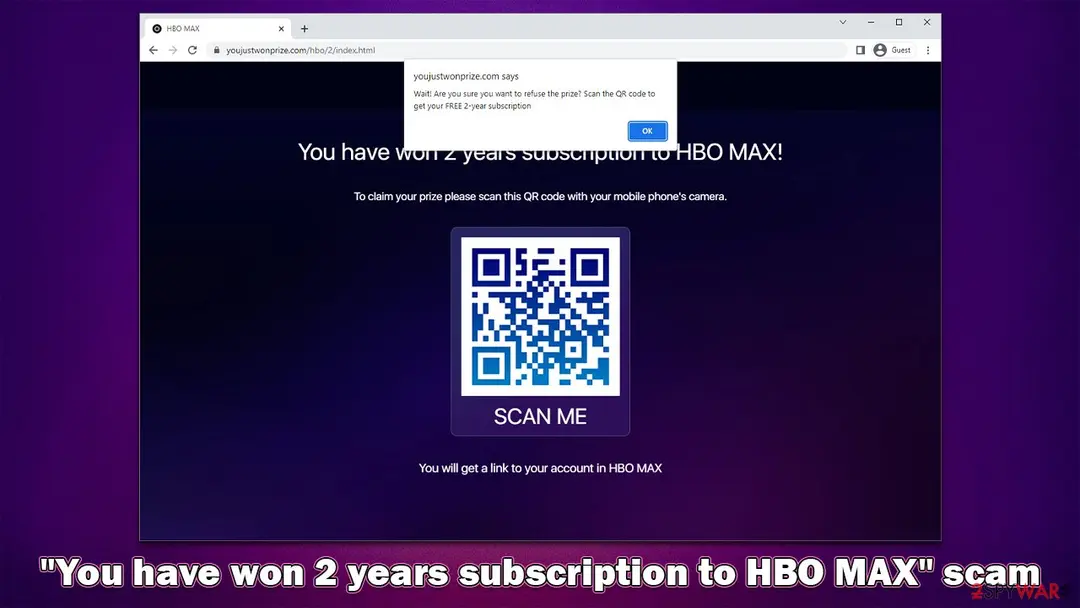
"You have won 2 years subscription to HBO Max" scam: summary
| Type | Fake prize page that uses the HBO Max name; not a virus and not an offer from HBO Max |
|---|---|
| Risk | High if you type card details or pay a fee; medium if you allowed notifications; none if you only close the tab |
| Symptoms | A page saying you won two years of HBO Max, a SCAN ME QR code and a "Wait! Are you sure you want to refuse the prize?" box when you leave |
| How to get rid of it | Close the tab, take back notification permissions on the computer and phone, remove unknown apps and extensions, dispute card charges |
| Our check (9 October 2026) | A desk check: no page opened; the 2022 address youjustwonprize.com is not registered now |
| First seen | Our guide came out 12 September 2022; the lure fits the brand again since HBO Max took back its name in July 2025 |
| Removal | Scan the PC with security software to find and remove the malware and anything installed with it. Fortect scans Windows for malware and repairs the system files and settings it damaged. Remove it nowTo use the full-featured product, you have to purchase a license for Fortect. The scan is free. |
Show 10 more facts
| Address in 2022 | youjustwonprize.com/hbo/2/index.html; other addresses possible |
|---|---|
| Distribution | Ads and redirects on low-quality sites, notifications allowed earlier, and the QR code that moves you to your phone |
| Damage | Card charges and subscriptions, personal details sold, notification spam, unwanted downloads |
| Name | "You have won 2 years subscription to HBO Max" scam |
| Evidence | One report; details still limited |
| Imitates | HBO Max (called Max from 2023 to July 2025) |
| Domains | youjustwonprize[.]com |
| Arrives through | Redirect from ads and low-quality sites, then a QR code that moves you to your phone |
| Promised prize | "FREE 2-year subscription" to HBO Max, claimed by scanning a QR code |
| Facts checked | 9 October 2026 |
Facts checked on 9 October 2026 against the FTC, HBO Max help, Google Chrome help and the .com registry. We did not open the live page; what lay past the QR code comes from our 2022 guide and is marked as such.
What the HBO Max prize page is
The "You have won 2 years subscription to HBO Max" page is a fake prize page. It borrows the streaming brand and its logo, then asks you to scan a QR code with your phone. HBO Max and its owner Warner Bros. Discovery have nothing to do with it, and no subscription is waiting for you.
- What it claims
- You have won two years of HBO Max; scan the QR code and "you will get a link to your account"
- Where we saw it
- youjustwonprize.com/hbo/2/index.html in September 2022, opened in a desktop browser
- Why a QR code
- It moves you from the computer to your phone, where the next pages (surveys, notification prompts, card forms) are harder to check
- What it is not
- A virus, or an offer from HBO Max. Looking at the page installs nothing by itself
- What to do
- Close the tab and do not scan. If you scanned, allowed notifications or typed a card number, use the steps further down
What the "You have won 2 years subscription to HBO Max" scam page looks like
You have won 2 years subscription to HBO MAX!
To claim your prize please scan this QR code with your mobile phone's camera.
SCAN ME
You will get a link to your account in HBO MAX
Wait! Are you sure you want to refuse the prize? Scan the QR code to get your FREE 2-year subscription
What the "You have won 2 years subscription to HBO Max" scam scammers want
Our check on 9 October 2026
HBO Max prize page · desk check · 9 October 2026 · no page was opened
- Live pageNot opened for this rewrite. We ran no site test, so we cannot say which ad network or redirect chain serves the page today.
- youjustwonprize.comThe 2022 address is not registered now: the .com registry's RDAP service (Verisign) answered "not found" on 9 October 2026. The same page can sit on any other name.
- facevideosc.comThe notification page in our 2022 screenshot used a subdomain of facevideosc.com. The registry shows that name registered again on 22 July 2025, so whoever holds it now may not be the 2022 operator. We did not open it.
- The "Wait!" boxOur 2022 screenshot shows a browser dialog, "Are you sure you want to refuse the prize?", when you try to leave. That is a pressure trick, not a feature of any real offer.
Fake prize page The page is a scam whatever a test shows. This is a desk check, not a visit: a quiet visit later would not clear it, because such pages change what they show by country, device, referrer and time.
The page, line by line
| What the page says | What is really going on |
|---|---|
| "You have won 2 years subscription to HBO MAX!" | You did not enter anything, so you did not win. The FTC's question for any prize: did you enter? If not, you did not win. The same words go to every visitor. |
| "To claim your prize please scan this QR code with your mobile phone's camera." | The code hides the next address from you. On a phone the address bar is short and the next pages fill the screen, so the switch makes the trick easier. |
| "You will get a link to your account in HBO MAX" | HBO Max sells plans on hbomax.com and through providers. It does not hand out accounts through a code on a random domain. |
| "Wait! Are you sure you want to refuse the prize?" | A dialog that fires when you try to leave. The FTC lists pressure to act now among the marks of a prize scam. |
| The HBO Max logo and dark purple design | A copied look. Our 2022 screenshot shows the address youjustwonprize.com, not an HBO Max domain. |
Our old guide made the point plainly: a prize page works only if you believe you won, and a free two-year subscription is easy to want. Real giveaways by Amazon, Netflix, Apple or HBO Max are announced on the company's own site and accounts, not shown to random visitors.
How the page and the brand changed
September 2022
The page we saw
We found the page at youjustwonprize.com/hbo/2/index.html. Closing it raised the "Wait!" dialog.
Our 2022 screenshot of the page, with the "Wait! Are you sure you want to refuse the prize?" dialog on top. The title strip at the bottom is our artwork. 12 September 2022
Our first guide
We published the guide with a second picture: the prize page next to a phone page that asked visitors to press Allow to watch a video, the usual way such chains collect notification permissions.
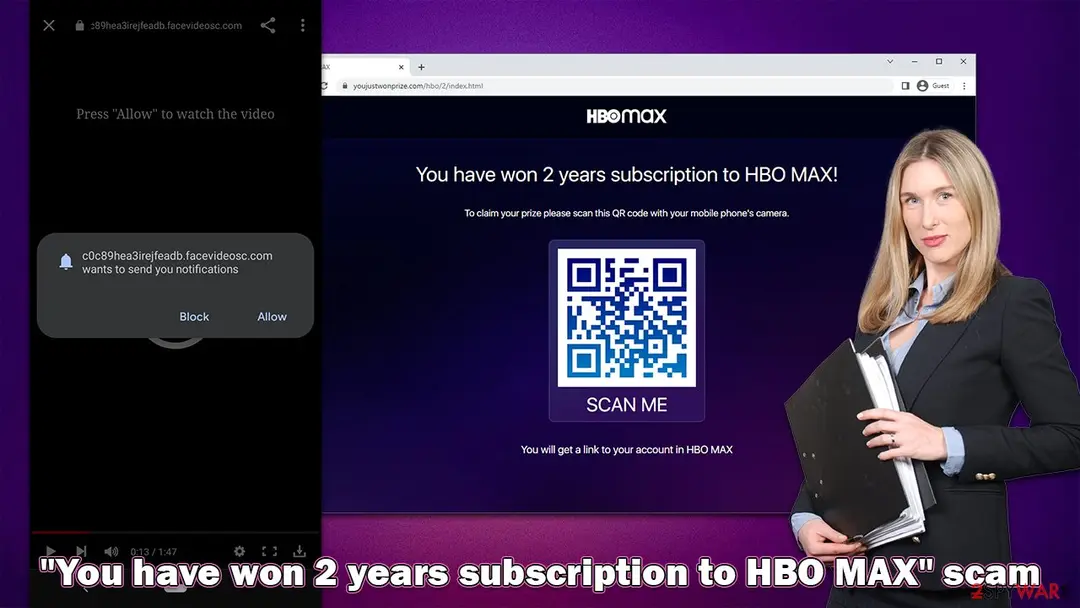
Our 2022 collage: the prize page and a phone page asking to send notifications. The woman and the purple background are our artwork, not part of either page. 2023
HBO Max becomes Max
Warner Bros. Discovery dropped "HBO" from the name and relaunched the service as Max. Pages that still said HBO Max now used an out-of-date name, which is one more sign they were not from the company.
9 July 2025
Back to HBO Max
The service went back to the HBO Max name, announced on 14 May 2025. A prize page that says HBO Max looks current again, so the old lure fits today's brand.
9 October 2026
Our desk check
youjustwonprize.com is not registered. In the United States HBO Max plans cost $10.99 to $22.99 a month, up from the $14.99 our 2022 guide quoted, which keeps a "free two years" offer tempting.
How a free prize turns into card charges
We did not follow the 2022 page past the QR code, so we cannot show its exact card form.
The pattern below is the one the FTC describes in its cases about "free" offers that cost only shipping, and it is where prize pages like this one usually end.
- 1
A survey or a spin
A few easy questions or a wheel make the win feel earned. Our old guide notes that such pages promise prizes like a new iPhone and then ask for a home address or card details.
- 2
"Just pay shipping"
A small fee, often a few dollars, is asked to "ship" or "activate" the prize. The FTC says a request to pay taxes, shipping and handling or processing fees to get a prize means you are dealing with a scammer.
- 3
The card form
You type the full card number, expiry and code. The fine print, if there is any, signs you up for a trial of something else.
- 4
The real charges
In one FTC case a $4.99 shipping fee led to charges of more than $90 and a monthly subscription if people did not cancel within 14 or 15 days. In another, the first shipment cost up to $98.71.
Our old guide also put it simply: the aim is to make you visit paying pages, so the people behind it are paid for every visit, sign-up and allowed notification.
The real risks, from most to least serious
- High
Card charges you did not agree to
A "shipping fee" can hide a trial that renews every month. The FTC's free-trial cases show first charges of $90 or more. This is where people lose real money.
- High
Personal details sold or reused
Name, address, e-mail and phone number typed into a prize form can be sold or used for phishing. The FTC notes that even real contest promoters may sell entries to advertisers.
- Medium
Notification spam
If you pressed Allow, the site can send ads straight to your desktop or phone until you remove it. Our old guide says the alerts carry misleading messages and links, and the operators earn from each one.
- Medium
Downloads offered on the way
Our old guide says some pages in the chain offer software downloads. We did not see the files, so what they were is not confirmed.
- Low
Adult and other unwanted sites
Our old guide says redirects to adult sites were common. We have no 2026 sample.
If you typed card details or paid a fee
- 1
Call your card issuer today
Use the number on the back of the card. Say you entered the card on a scam prize page, ask them to block it and send a new one, and ask which recent charges they see from that merchant.
- 2
Dispute every charge you did not agree to
The FTC says to dispute unauthorized charges with your credit or debit card right away. For credit cards, the Fair Credit Billing Act lets you dispute in writing; the letter must reach the issuer within 60 days after the first bill with the error was sent (What to do after paying a scammer).
- 3
Know what the issuer must do
Under the same law the issuer must acknowledge your dispute within 30 days and resolve it within 90 days. Federal law limits what you owe for unauthorized credit card charges to $50.
- 4
Look for a trial you did not mean to start
Search your statements for small charges with names you do not know, then larger ones a few weeks later. Each of them can be disputed.
- 5
Report it
Tell the FTC at ReportFraud.ftc.gov. If someone used your personal details, go to IdentityTheft.gov. Keep screenshots of the pages and any e-mail you received.
Why "You have won 2 years subscription to HBO Max" scam opens in your browser
How the page reaches you
| Route | What happens | What to check |
|---|---|---|
| A redirect from another site | Our old guide says the page shows up while you browse less secure sites: streaming, file sharing and crack sites full of ads. One click on an ad or a fake player opens it. | Close the tab. Nothing is installed by the visit. |
| Notifications you allowed earlier | A site you once let send notifications can push "You won" alerts at any time, whatever site you are on. Our 2022 screenshot shows the trick used to get that permission: "Press Allow to watch the video". | The site list in your browser's notification settings. |
| The QR code itself | Scanning moves you to the phone. Our old guide says the code leads to one of several pages that ask for notifications, offer downloads or go to adult sites. | Your phone browser's notification list, and any app installed from the pages. |
| An unwanted program or extension | Our old guide says adware can make scam pages appear more often. We could not tie any program to this page in 2026. | Extensions and installed programs added around the time the pages started. |
Adware is software that makes its money by showing ads, often low-quality ones. If the page keeps coming back on sites you trust, read our adware guide. For the notification side of this, see push notification spam, and for similar prize lures, our fake prize and gift card scams topic.
How to keep prize pages away
Do
- Check any HBO Max offer on hbomax.com or in the app you already use; a real promotion is shown there.
- Turn on quiet notification prompts in Chrome, or block all notification requests, so pages cannot ask with a pop-up.
- Pick Custom or Advanced when you install free software and untick every extra offer.
- Keep a current backup with the tools built into Windows or macOS. A VPN hides your IP address, but it does not block a prize page.
Don't
- Do not scan a QR code shown by a page you did not expect, and do not download anything it offers.
- Do not press Allow to "watch a video" or "prove you are not a robot".
- Do not pay shipping, a fee or a tax to receive a prize, and never type a card number on a prize page.
- Do not use file-sharing and crack sites; our old guide notes they carry booby-trapped links, repacked installers and malicious ads.
If you entered your details or paid
- 1
You only looked
There is nothing to undo. Close the tab and think about which site or ad opened it.
- 2
You scanned the QR code
Close the page on the phone. If you pressed Allow there, use the phone steps above. If you typed nothing and installed nothing, you are done.
- 3
You downloaded or ran a program on Windows
Open Start > Settings > Apps > Installed apps (Windows 10: Apps & features), sort by install date, choose Uninstall on anything you do not know and confirm ().
- 4
Run a scan
Open Windows Security > Virus & threat protection > Scan options, run a Full scan, restart and check Installed apps again (Run a Microsoft Defender Offline scan).
- 5
Still redirected?
Remove extensions you did not add and reset the browser; the browser tabs on this page list the steps.
How to get rid of the "You have won 2 years subscription to HBO Max" scam pages
There is no prize.
Close the page, stop the notifications, and protect your card if you entered it.
Which browser shows the ads?
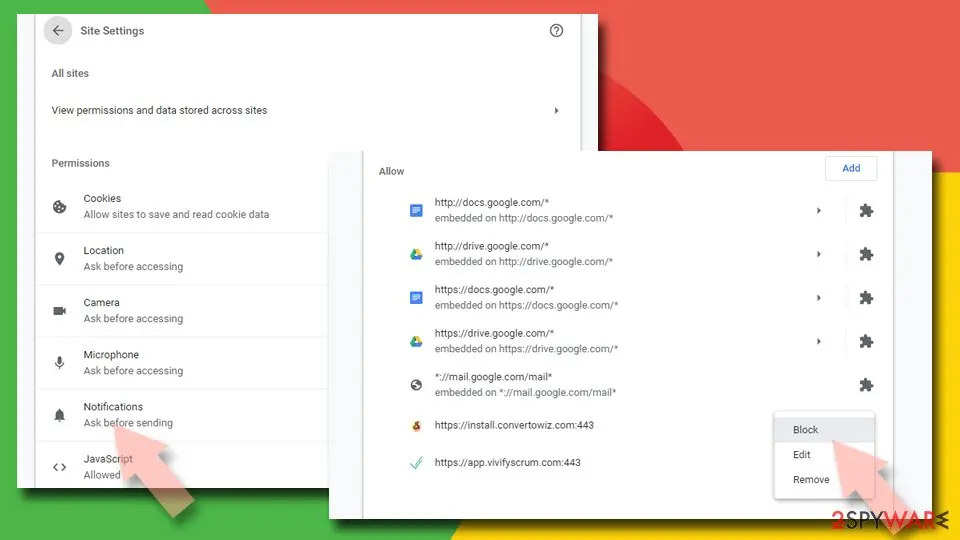
Step 1: Remove youjustwonprize[.]com from Chrome's notification list
Chrome keeps a list of every site you once allowed to send notifications, and
youjustwonprize[.]comis on it. Pastechrome://settings/content/notificationsinto the address bar, find youjustwonprize[.]com under Allowed to send notifications, open the three-dot menu next to it and pick Remove.Then click Add next to Not allowed to send notifications and type youjustwonprize[.]com, so the site cannot ask a second time. Repeat it in every Chrome profile you use on Windows 11 or Windows 10, since each profile has its own list.
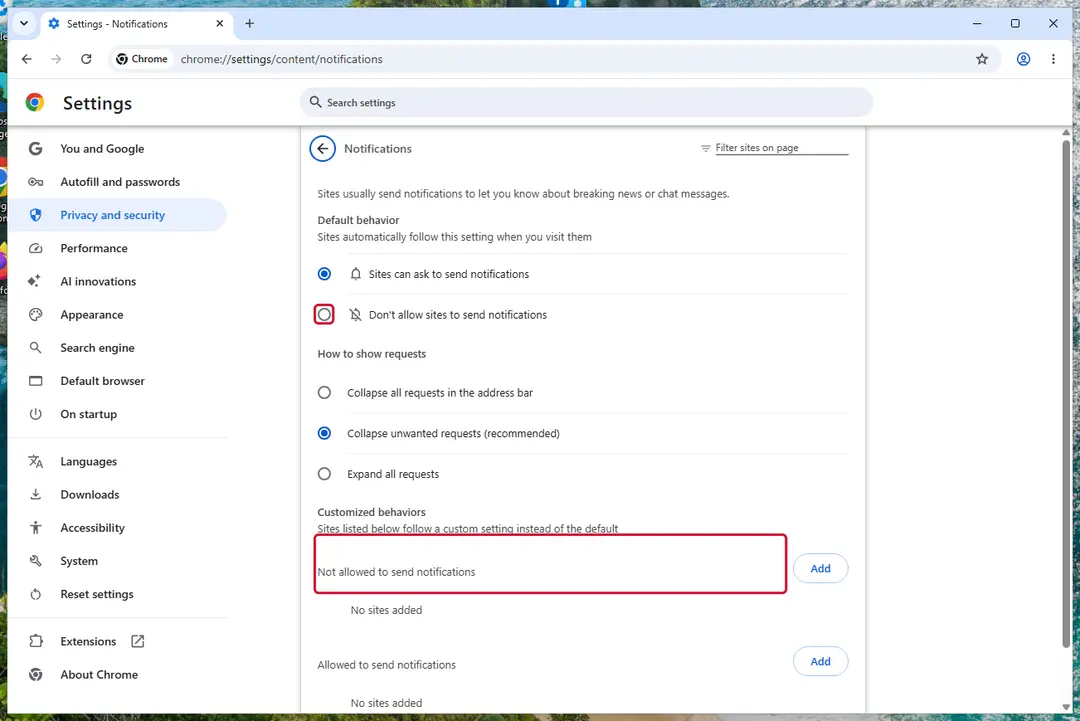
Chrome on Windows 11: Settings > Privacy and security > Site settings > Notifications. Full procedure with screenshots: Stop website notifications and pop-ups
Still there? More for Google Chrome
Remove extensions you do not recognise
Paste
chrome://extensionsinto the address bar and click Remove on anything you did not install yourself, especially video downloaders, coupon or "search" helpers added recently.Full procedure with screenshots: Remove a browser extension
Reset Chrome
Open Settings > Reset settings > Restore settings to their original defaults and confirm with Reset settings. This resets the start page, search engine and pinned tabs and turns off extensions; bookmarks and saved passwords stay.
Full procedure with screenshots: Reset a browser and fix a hijacked search engine
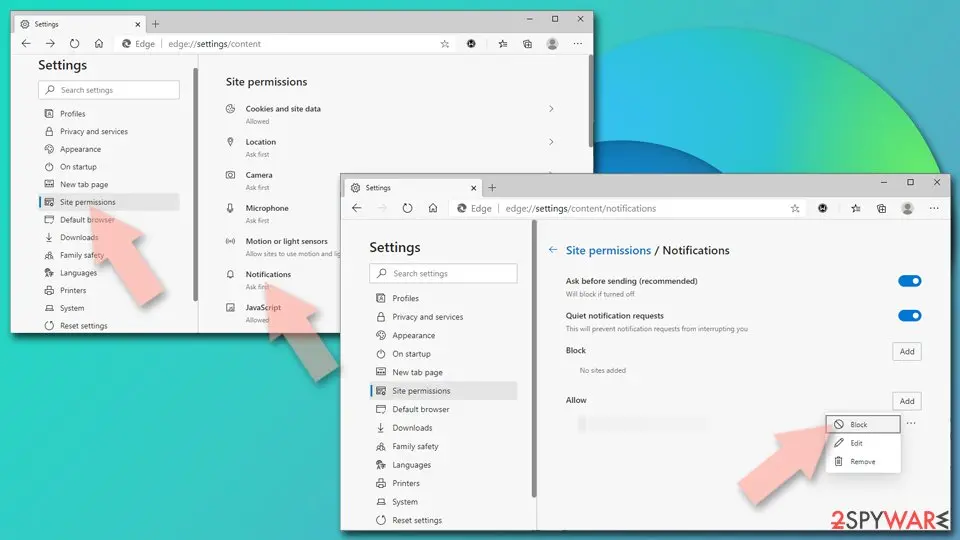
Step 1: Remove youjustwonprize[.]com from Edge's notification list
Open Settings and more (the three dots) > Settings > Privacy, search, and services > Site permissions > All permissions > Notifications. Remove
youjustwonprize[.]comfrom the Allowed list, then click Add site next to Not allowed to send notifications and enter it there.Edge is built into both Windows 11 and Windows 10, so check it even if you normally use another browser. If the notifications came with the Edge logo, this is the browser that holds the permission.
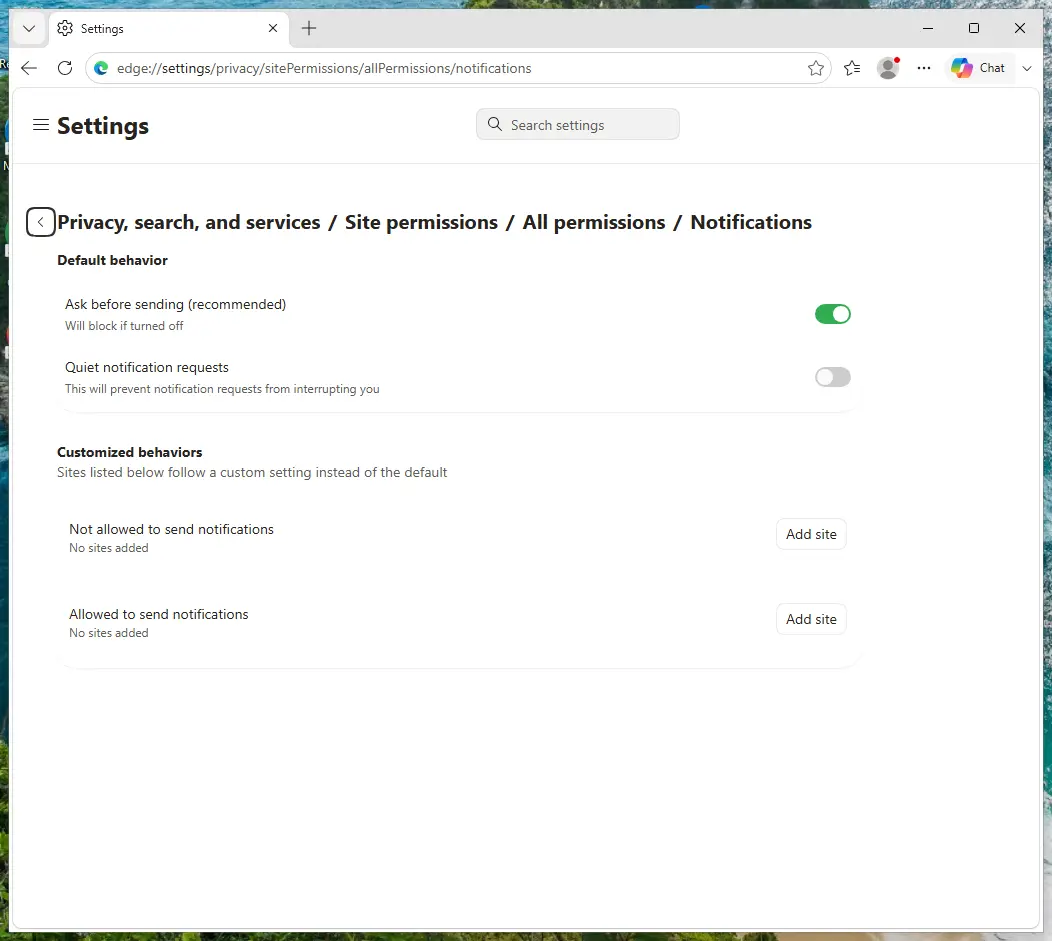
Edge on Windows 11: Site permissions > All permissions > Notifications. Full procedure with screenshots: Stop website notifications and pop-ups
Still there? More for Microsoft Edge
Remove extensions you do not recognise
Paste
edge://extensionsinto the address bar and click Remove under anything you did not install yourself.Full procedure with screenshots: Remove a browser extension
Reset Edge
Open Settings > Reset settings > Restore settings to their default values and confirm with Reset. Extensions are turned off and the start page goes back to default; favourites, history and saved passwords stay.
Full procedure with screenshots: Reset a browser and fix a hijacked search engine
Step 1: Remove youjustwonprize[.]com from Firefox's notification permissions
Open the menu (three lines) > Settings and click Permissions and data in the left list, then Notifications. Select
youjustwonprize[.]com, click Remove Website and confirm with Save Changes.In versions older than Firefox 152 the same list sits under Privacy & Security, behind a Settings button next to Notifications. Firefox shows these notifications only while it is running, on Windows 11 and Windows 10 alike.
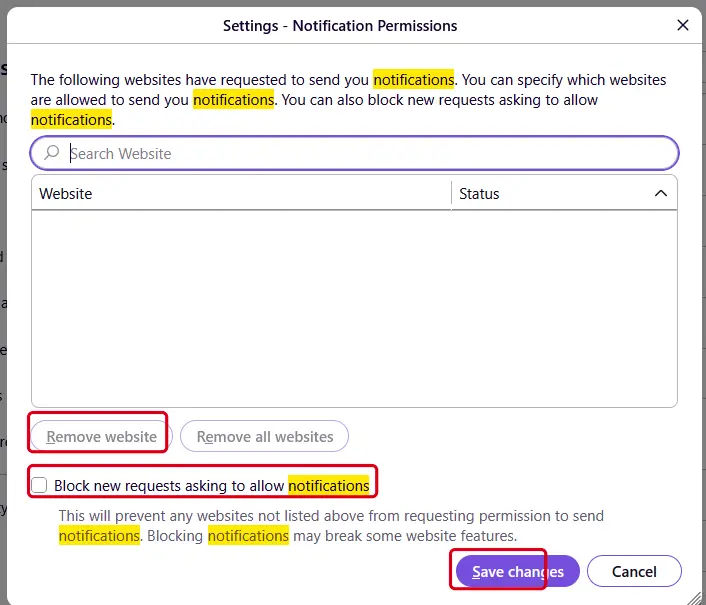
Firefox on Windows 11: the Notification Permissions window. Full procedure with screenshots: Stop website notifications and pop-ups
Still there? More for Mozilla Firefox
Remove add-ons you do not recognise
Paste
about:addonsinto the address bar, open Extensions, and choose Remove from the three-dot menu of anything you did not install yourself.Full procedure with screenshots: Remove a browser extension
Refresh Firefox
Open the menu > Help > More troubleshooting information and click Refresh Firefox. Add-ons and custom settings are removed; bookmarks, history and passwords stay.
Full procedure with screenshots: Reset a browser and fix a hijacked search engine
Take back the notification permission
Safari 18 and later on macOS: open Safari > Settings > Websites > Notifications, select any site you do not recognise and set it to Deny, or click Remove. Untick Allow websites to ask for permission to send notifications so no site can ask again.
Remove extensions you do not recognise
In Safari > Settings > Extensions, select anything you did not install yourself and click Uninstall.
Check the Mac for apps from the pages
In Finder > Applications, move anything you do not know to the Bin, then check System Settings > General > Login Items & Extensions for entries that came with it.
Then, whichever browser you use
Step 2: Close the page without touching its buttons
Press Ctrl + Shift + Esc to open Task Manager, select the browser on Processes and click End task: buttons on the page, including Close and Cancel, can trigger downloads or more pop-ups. When you reopen the browser, do not restore the previous tabs.
Warning: Never call a number shown in a browser warning; Microsoft and antivirus companies do not put phone numbers in warnings.
If the page opens again by itself, notifications or an extension are bringing it back. Task Manager works the same in Windows 11 and Windows 10.
Full procedure with screenshots: Close a frozen app (Task Manager, Force Quit) On uGetFix
Step 3: Block the card if you entered it
Card details entered on a fake page are used within hours. Block the card in your bank's app or by calling the number on the card, and ask for a replacement.
Dispute every charge you did not make, and keep the scam message as evidence for the bank. Do not reuse the same card number on any site until it is replaced, whether you shop on a phone or a Windows 11 or Windows 10 PC.
Full procedure with screenshots: What to do after paying a scammer
On an Android phone or an iPhone
- 1
Android 14 and 15, Chrome
Open Chrome, tap More (three dots) > Settings > Site settings > Notifications and remove or block any site you do not know. For a site that already pushes alerts, swipe down to the alert and tap Unsubscribe. Under Settings > Permissions, turn off Pop-ups and redirects.
- 2
Samsung Galaxy, Samsung Internet
Open Samsung Internet, tap the menu (three lines) > Settings > Sites and downloads > Notifications, and turn off or remove unknown sites. One UI also lists them under Settings > Notifications > App notifications > Samsung Internet.
- 3
iPhone with iOS 18
Safari tabs cannot send notifications; only a site you added to the Home Screen can. Check Settings > Notifications for an entry named like a site, turn it off and delete its icon. Then open Settings > Apps > Safari and tap Clear History and Website Data.
- 4
Apps you installed from the pages
Android: Settings > Apps, open the app and tap Uninstall. iPhone: touch and hold the icon and tap Remove App > Delete App.
Remove the notification permission on a computer
If you pressed Allow on any page in the chain, the site keeps sending alerts until you take the permission back (Stop website notifications and pop-ups).
These are the current paths; our 2022 guide used older menu names.
| Browser | Where the site list is | What to click |
|---|---|---|
| Chrome | Paste chrome://settings/content/notifications, or Settings > Privacy and security > Site settings > Notifications | Next to the site under Allowed to send notifications, open the three-dot menu and pick Block or Remove |
| Edge | Paste edge://settings/content/notifications, or Settings > Cookies and site permissions > Notifications | Next to the site under Allow, open More actions (three dots) and pick Block or Remove |
| Firefox | Settings > Privacy & Security > Permissions > Notifications > Settings | Select the site, set it to Block or click Remove Website, then Save Changes |
| Safari on Mac | Safari > Settings > Websites > Notifications | Select the site and set it to Deny, or click Remove |
Questions about "You have won 2 years subscription to HBO Max" scam
Is "You have won 2 years subscription to HBO Max" real?
No. It is a fake prize page that copies the HBO Max logo and asks you to scan a QR code.
You did not enter any contest, so you did not win one, and the FTC's first test for a prize is exactly that question. The page we saw in 2022 sat on youjustwonprize.com, not on an HBO Max address, and it fired a "Wait!
Are you sure you want to refuse the prize?" box when visitors tried to leave. HBO Max sells its plans on hbomax.com and through providers. Close the page and scan nothing.
I scanned the QR code. Is my phone infected?
Scanning a code only opens a web address, so it does not install anything by itself. What matters is what you did on the next pages. If you only looked and closed them, nothing is left to remove.
If you pressed Allow on a notification request, remove the site in Chrome under Settings, Site settings, Notifications, or in Samsung Internet under Settings, Sites and downloads, Notifications. If you installed an app from the pages, uninstall it in Settings, Apps. If you typed a card number, call your card issuer today.
I paid a small shipping fee to get the prize. What happens now?
Expect more charges and act today. The FTC says a request to pay shipping, handling or processing fees for a prize means you are dealing with a scammer. In its free-trial cases, a $4.99 shipping fee led to charges of more than $90 and monthly subscriptions.
Call the number on the back of your card, ask for the card to be blocked and replaced, and dispute the fee and any later charges. For credit cards the written dispute must reach the issuer within 60 days of the first bill with the charge. Report the page at ReportFraud.ftc.gov.
Can I get my money back from the HBO Max prize scam?
Often yes, if you paid by card and move fast. A credit card dispute under the Fair Credit Billing Act covers charges you did not authorize; the issuer must acknowledge your letter within 30 days and settle it within 90, and your liability for unauthorized charges is capped at $50.
The FTC also tells people to dispute free-trial charges with a credit or debit card immediately. Gift cards, wire transfers and crypto are much harder to recover, which is why scammers prefer them. Keep screenshots of the pages and your statements.
Why do I keep getting "You won" pop-ups after visiting the page?
Most likely you allowed notifications on one of the pages. Our 2022 screenshot shows a phone page in the chain that said "Press Allow to watch the video", and one tap on Allow lets a site send alerts until you take the permission back.
The alerts appear in the corner of the desktop or in the phone's notification shade, on top of any site. Open your browser's notification settings, find sites you do not recognise under the allowed list and choose Block or Remove. If pages open on their own without alerts, check your extensions.
Is HBO Max called Max now?
Not any more. Warner Bros. Discovery renamed the service Max in 2023 and went back to HBO Max on 9 July 2025, after announcing the change on 14 May 2025.
So a prize page that says HBO Max uses the current name, which makes the old 2022 lure look up to date again. The name tells you nothing about whether an offer is real.
In the United States HBO Max plans cost $10.99, $18.49 or $22.99 a month in October 2026, and any real promotion appears on hbomax.com or in the app.
Does HBO Max ever give away free subscriptions?
Not through pop-up pages. Free or discounted access usually comes through a provider, a bundle or a published promotion that you can see when you sign in on hbomax.com or in the app.
None of those asks you to scan a code on an unknown website or pay shipping for a streaming plan, which has nothing to ship. If you are unsure, open the HBO Max app or site yourself, not from a link, and look for the offer there. If it is not shown, it does not exist.
Is the HBO Max prize page a virus?
No, it is a web page, and opening it does not install a program. Our old guide says some people meet it more often because adware on their computer shows scam ads, but we could not tie any program to this page in 2026.
If you saw it once after a click on an ad, close the tab and that is the end of it. If it keeps opening on sites you trust, check notification permissions first, then extensions and Installed apps for something you did not add, and run a Microsoft Defender full scan.
Will Fortect remove "You have won 2 years subscription to HBO Max" scam?
Fortect scans Windows for malware and unwanted programs and repairs the system files and settings they change, and its free scan shows what it finds on your PC before you decide anything.
For "You have won 2 years subscription to HBO Max" scam, follow the plan above as well: the browser steps take back permissions and settings that no scanner treats as a threat, and uninstalling the program that brought it removes the source.
Run Microsoft Defender's full scan and, if anything was found, its offline scan as a second opinion. If the symptoms are gone after the plan and both scans are clean, there is nothing more to do.
Sources
- FTC Consumer Advice: Fake prize, sweepstakes and lottery scams (read October 9, 2026)
- FTC Consumer Alert: Are you really the lucky winner? Spot the prize scams (read October 9, 2026)
- FTC Consumer Alert: Here's the skinny on "free trials" for skin creams (read October 9, 2026)
- FTC Consumer Alert: Don't let "FREE" cost you (read October 9, 2026)
- FTC Consumer Advice: Using credit cards and disputing charges (read October 9, 2026)
- HBO Max Help: HBO Max plans and prices (read October 9, 2026)
- Variety: Max changed back to HBO Max (read October 9, 2026)
- Wikipedia: HBO Max (name history) (read October 9, 2026)
- Google Chrome Help: Use notifications to get alerts (Android and computer) (no longer online) (read October 9, 2026)
- Verisign .com registry lookup (RDAP): youjustwonprize.com, not found (read October 9, 2026)
- Verisign .com registry lookup (RDAP): facevideosc.com (read October 9, 2026)