

EdgeLocker virus joins ransomware family
Unfortunately, EdgeLocker virus is another crypto-malware which ran wild in the virtual world. It belongs to the same category of Locker viruses. Most likely, it has been generated by the same felons who create threats named after notorious CryptoLocker. Some of the examples, such as AdamLocker and ZyklonLocker, have roamed on the web quite for a while. Though the authors release similar threats once a while, neither of the versions is able to maintain its position in the ransomware market [1]. However, the activity of these threats surely alarm users that there is no safe place on the Web and one should be careful while surfing the vast spaces of the Internet. However, even if you are cautious, there is no guarantee that you will not run into this ransomware. More information about EdgeLocker removal and distribution peculiarities is given in the article. While you are reading it, you may let FortectIntego to eliminate the virus [2].
The original version of CryptoLocker has been terrorizing the virtual world since 2013 [3]. Usually, it sneaked into the system via a trojan. In fact, the latter threat is quite an exquisite threat since it is able to evade the detection of security application by passing itself as a legitimate file [4]. Thus, outdated anti-virus may fail to detect it. In this relation, it is likely that EdgeLocker malware might also exploit this infection as a temporary disguise to assault victims. If it succeeds in infiltrating the device, firstly, it will run several tasks in the background of Task Manager. In order to avoid the detection by individual users, the task processes might be entitled as the related processes of WinRAR or another legitimate the application not to cause any suspicion.
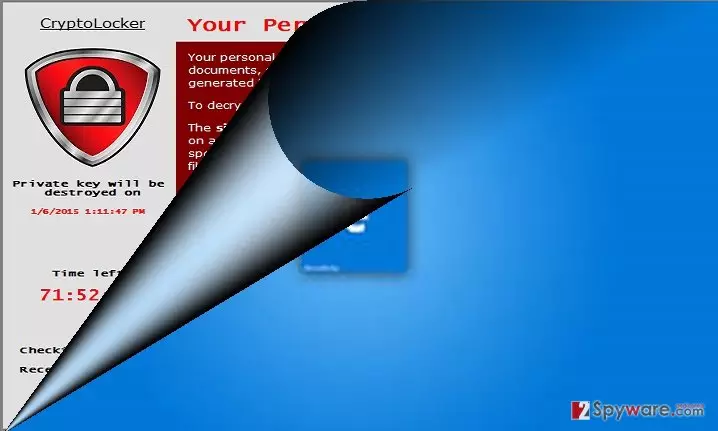
When the preparation actions are finished, Edge Locker targets files in local drives. Thus, a broad range of music, image, excel files and documents might be encoded with the AES-256 algorithm. Consequently, they now are labeled with .edge file extensions. The hackers want you to think that there is no other choice of retrieving the encoded files except by transferring the money. Even if companies or users might do whatever it takes to get personal files back, we suggest looking for alternative solutions. Remove EdgeLocker and then proceed to the decryption instructions.
The transmission peculiarities of the ransomware
All the mock versions of CryptoLocker virus supposedly spread via spam messages. There have been several techniques released to fool netizens into opening the specific email disguised as an invoice or another important document [5]. After opening the attachment, a full content of Pandora box is released – a cyber menace, in this case, EdgeLocker hijack, gets activated. Afterward, it is nearly impossible to prevent the infection from execution. Some ransomware is known for distributing via exploit kits. Improving your general security of the operating system is of key importance. Install an anti-spyware tool to remove EdgeLocker from the computer.
Is there a way to completely get rid of EdgeLocker?
Ransomware is surely bad news for a user. Despite how desperate the situation might look like, there is a solution. Entrust EdgeLocker removal to FortectIntego or MalwarebytesMalwarebytes. Either of these programs will help you eradicate all components of the threat. After the process is finished, you can think about data recovery procedure. Take a look at our bonus recovery instructions. If your computer becomes non-responding and due to certain malfunctioning functions you cannot remove EdgeLocker virus, regain the access by using these instructions.
Did this guide help?
2 comments
remmmy
new "Locker" each day?
DianaM
Gove me a break...