

Russian ads – unwanted advertisements delivered by adware program
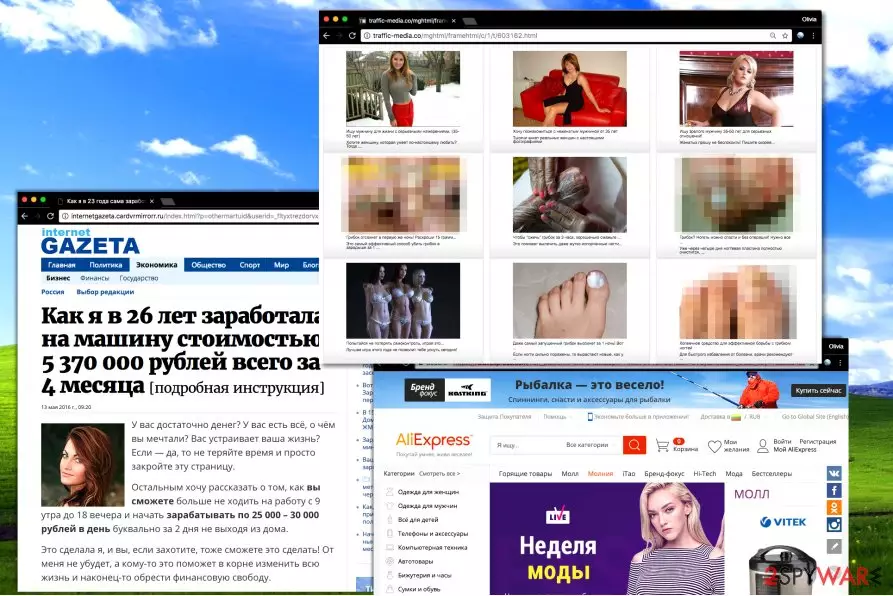
Russian ads are the group of pop-ups, banners, in-text ads, and other advertisements that are displayed on the affected web browser by adware.[1] This potentially unwanted program (PUP) typically interacts with numerous ad networks which might display malicious content as well. After adware hijack, unwanted ads might show up on any website, including YouTube, Facebook, and other popular sites.
| Summary | |
| Name | Russian ads |
| Type | Adware |
| Danger level | Medium. Adware cannot pose a direct danger to the system. However, it alters browser's settings and might display malware-laden ads |
| Symptoms | Ads, pop-ups, and banners are delivered on Facebook and other websites; ads appear before YouTube videos, redirects to questionable Russian websites |
| Distribution methods | Software bundling, drive-by downloads, compromised websites |
| To uninstall virus which is related to ads, install FortectIntego and run a full system scan | |
The names of specific adware programs that are responsible for displaying Russian ads are unknown. However, they can enter the system unnoticed, alter browser's settings or even Windows Registry in order to display commercial content. Such programs can open web browser all of a sudden and cause several redirects before landing the user on pages like Traff-1.ru, Scearch-naitiy.ru, traffic-media.co, Thirafileb-uk.ru, or Searchi-clan.ru.
Just like the name of the cyber threat suggests, these ads are targeted at Russian-speaking computer users. However, annoying advertisements might bombard any other user's web browser. In most cases, these ads contain unpleasant or shocking images that are meant to lure users into clicking on them. Users have also expressed complaints about seeing Russian ads on Youtube or Facebook.

Russian ads on Youtube typically replace video suggestions with unpleasant ads or might show up before playing the video, Meanwhile, ads on Facebook are often too intrusive or appear in pop-ups or banners, it is clear that they do not originate from Facebook. In such scenario, you have to fix your browsers and uninstall vague programs from your PC ASAP.
If this happened to you, it is a must to scan your PC with anti-spyware like FortectIntego because some suspicious program is clearly controlling your web browser at the moment. System scan with security software will help to remove Russian ads together with the adware which is responsible for delivering them.

Commercial pop-up ads typically promote highly suspicious content
Users complaining about Russian ads in browser state that these pop-ups and banners provide vague offers. Most of the time, they receive ads that promote such content:
- Dubious money-making strategies;
- Suspicious diet pills;
- Adult games;
- Dating websites;
- Weight loss plans;
- Supplements for men;
- Click bait articles with attention-seeking headlines.

Probably the most annoying site that bothers computer users is Internetgazeta.cardvrmirrorr.ru[2], which promises enormous incomes each day by trading binary options. Many computer users expressed their opinion stating that the website is a scam that suggests investing money in exchange for nothing.
Therefore, if you noticed Russian ads on YouTube, Facebook, and other websites, you should stay away from them. They are most likely to redirect you to potentially dangerous, scam, phishing or infected website where your PC can get infected with malware or you might suffer from personal information loss. Hence, you should get rid of adware with the help of reputable anti-malware software to avoid such damage.
Researchers report about an increased activity of suspicious ads in the Slavic language
Recently, we noticed an increased activity of viruses[3] that provide offers in Slavic language. There are hundreds of programs that can display you Russian pop-up ads, for example, LoadLeader. Programs that provide such advertising tend to drop various files on the system, including standalone programs or/and browser extensions.

Some critical adware programs can even modify browser shortcuts or Windows Registry keys in order to connect to the ad network and load an ad as soon as the victim opens a compromised web browser.
Without exception, such ads can be displayed via Google Chrome, Mozilla Firefox, Internet Explorer and possibly other web browsers. Keep in mind that clicking on these advertisements can trigger redirects to websites that can pose a threat to PC’s security and your privacy.

For example, deceptive websites such as Domflash.ru can convince you to install dangerous software updates like Flash Player. Remember that bogus software updates frequently contain critical malware such as Trojans or even ransomware[4].
If your computer runs slowly and you receive annoying ads or experience redirects to Russian websites, make Russian ads removal your top-priority task ASAP.
Methods used to install adware on the computers
Such ads typically start appearing on the computer screen after installation of an adware program that is set to connect to ad networks. You can install such program when visiting deceptive file sharing websites, clicking on untrustworthy ads, or installing licensed software illegally.
Be careful when you try to download free software from the Internet because many file sharing sites promote software bundles that look like individual programs. Due to this problem, many users end up installing unwanted programs without realizing it.
In reality, the main issue is that computer users tend to rush to install freshly downloaded programs as quickly as possible, without reading statements provided by software installers. To avoid installing potentially unwanted software that delivers Russian advertisements or hijacks web browsers without notifying you should:
- Download programs from the developers' website only and do not rely on torrents or third-party download sites.
- Read EULA, the Privacy Policy, and similar documents provided by the developers.
- Pick Custom or Advanced settings for the installation instead of Quick or Recommended.
- Look for suggestions to add extra programs. If possible, deselect the suggestions.
Get rid of Russian ads
In order to remove Russian ads from your browsers, you have to find and uninstall the program which is responsible for displaying them. It may have arrived in the software that you have recently installed. Hence, you should check the list of installed programs and browser extensions. After elimination of unwanted applications, you have to reset affected web browsers too.
The instructions below will help you to perform Russian ads removal completely. However, if you are one of the Russian-speaking computer users who suffered from this adware, you can find the manual removal guide in your language on our partner's site – Bedynet.ru.[5]
Moreover, you can speed up the process by employing a professional anti-malware software. After the system scan, you just need to reset affected web browser in order to continue browsing the web without intrusive pop-ups or banners in the Russian language.
Uninstall from Windows
Uninstall from Windows 10/8:
- Type Control Panel into the Windows search box and open the result.
- Under Programs, select Uninstall a program.


Uninstall from Windows 7/XP:
- Click on Windows Start > Control Panel (Windows XP users should click on Add/Remove Programs).
- In Control Panel, select Programs > Uninstall a program.


Remove the unwanted program:
- In the Programs and Features window, look for any recently installed suspicious entries, select them, and click Uninstall.
- If User Account Control appears, click Yes to confirm, then complete the removal.


Delete from macOS
Remove the unwanted application:
- From the menu bar, select Go > Applications.
- In the Applications folder, look for any suspicious entries, then drag them to Trash (or right-click and pick Move to Trash).


Delete leftover files and folders:
- Select Go > Go to Folder.
- Enter /Library/Application Support and remove any suspicious folders related to the unwanted program.
- Repeat the same check in the /Library/LaunchAgents and /Library/LaunchDaemons folders, deleting any suspicious entries.

- Finally, empty the Trash to permanently remove the leftovers.

Reset Internet Explorer
Remove dangerous add-ons:
- Open Internet Explorer, click on the Gear icon (IE menu) on the top-right corner of the browser
- Pick Manage Add-ons.
- You will see a Manage Add-ons window. Here, look for suspicious plugins. Click on these entries and select Disable.


Change your homepage if it was altered:
- Open IE and click on the Gear icon.
- Select Internet Options.
- In the General tab, delete the Home page address and replace it by your preferred one (for example, Google.com).
- Click Apply and then select OK.


Delete temporary files:
- Press on the Gear icon and select Internet Options.
- Under Browsing history, click Delete...
- Select relevant fields and press Delete.


Reset Internet Explorer:
- Click on Gear icon > Internet options and select Advanced tab.
- Select Reset.
- In the new window, check Delete personal settings and select Reset.


Remove from Microsoft Edge
Delete unwanted extensions from MS Edge:
- Select Menu (three horizontal dots at the top-right of the browser window) and pick Extensions.
- From the list, pick the extension and click on the Gear icon.
- Click Remove.


Clear cookies and other browser data:
- Click on the Menu (three horizontal dots at the top-right of the browser window) and select Settings > Privacy, search, and services..
- Under Clear browsing data, pick Choose what to clear.
- Select Cookies and other site data and Cached images and files. (apart from passwords, although you might want to include Media licenses as well, if applicable) and click on Clear.


Restore new tab and homepage settings:
- Click the menu icon and choose Settings.
- Then find On startup section.
- Click Remove next to any suspicious startup page.
Reset MS Edge if the above steps did not work:
- Press on Ctrl + Shift + Esc to open Task Manager.
- Click on More details arrow at the bottom of the window.
- Select Details tab.
- Now scroll down and locate every entry with Microsoft Edge name in it. Right-click on each of them and select End Task to stop MS Edge from running.


Instructions for Chromium-based Edge
Delete extensions from MS Edge (Chromium):
- Open Edge and click select Settings > Extensions.
- Delete unwanted extensions by clicking Remove.


Clear cache and site data:
- Click on Menu and go to Settings.
- Select Privacy, search and services.
- Under Clear browsing data, pick Choose what to clear.
- Under Time range, pick All time.
- Select Clear now.


Reset Chromium-based MS Edge:
- Click on Menu and select Settings.
- On the left side, pick Reset settings.
- Select Restore settings to their default values.
- Confirm with Reset.
- This will disable extensions and reset startup pages but will not delete bookmarks, saved passwords, or browsing history.


Remove from Mozilla Firefox (FF)
Remove dangerous extensions:
- Open Mozilla Firefox browser and click on the Menu (three horizontal lines at the top-right of the window).
- Select Add-ons.
- In here, select the unwanted extension and click Remove.


Reset the homepage:
- Click three horizontal lines at the top right corner to open the menu.
- Choose Settings.
- Under Home, set your preferred homepage and new tab settings.
Clear cookies and site data:
- Click Menu and pick Settings.
- Go to Privacy & Security section.
- Scroll down to locate Cookies and Site Data.
- Click on Clear Data...
- Select Cookies and Site Data and Temporary cached files and pages, then click Clear.


Reset Mozilla Firefox
If clearing the browser as explained above did not help, reset Mozilla Firefox:
- Open Mozilla Firefox browser and click the Menu.
- Go to Help and then choose Troubleshooting Information.

- Under Give Firefox a tune up section, click on Refresh Firefox...
- Once the pop-up shows up, confirm the action by pressing on Refresh Firefox.



Remove from Google Chrome
Delete malicious extensions from Google Chrome:
- Open Google Chrome, click on the Menu (three vertical dots at the top-right corner) and select More tools > Extensions.
- In the newly opened window, you will see all the installed extensions. Uninstall all suspicious extensions related to the unwanted program by clicking Remove.


Clear cache and web data from Chrome:
- Click on Menu and pick Settings.
- Under Privacy and security, select Clear browsing data.
- Select Browsing history, Cookies and other site data, as well as Cached images and files.
- Click Clear data.


Change your homepage:
- Click menu and choose Settings.
- Look for a suspicious site in the On startup section.
- Click on Open a specific or set of pages and click on three dots to find the Remove option.
Reset Google Chrome:
If the previous methods did not help you, reset Google Chrome to eliminate all the unwanted components:
- Click on Menu and select Settings.
- In the Settings, scroll down and click Advanced.
- Scroll down and locate Reset and clean up section.
- Now click Restore settings to their original defaults.
- Confirm with Reset settings.


Delete from Safari
Remove dangerous extensions:
- Open Safari, click Safari in the menu at the top-left of the screen, and select Preferences.
- Go to the Extensions tab, look for any suspicious entries, and click Uninstall to remove them.


Clear history and website data:
- Click Safari in the menu and pick Clear History.
- Set Clear to all history and confirm with Clear History.


Reset Safari:
- Click Safari in the menu and select Preferences > Advanced.
- Enable Show Develop menu in menu bar.
- From the menu bar, click Develop and select Empty Caches.


Did this guide help?
Be the first to comment