

Any Search Manager is a misleading extension which can hijack your computer after updating Flash Player
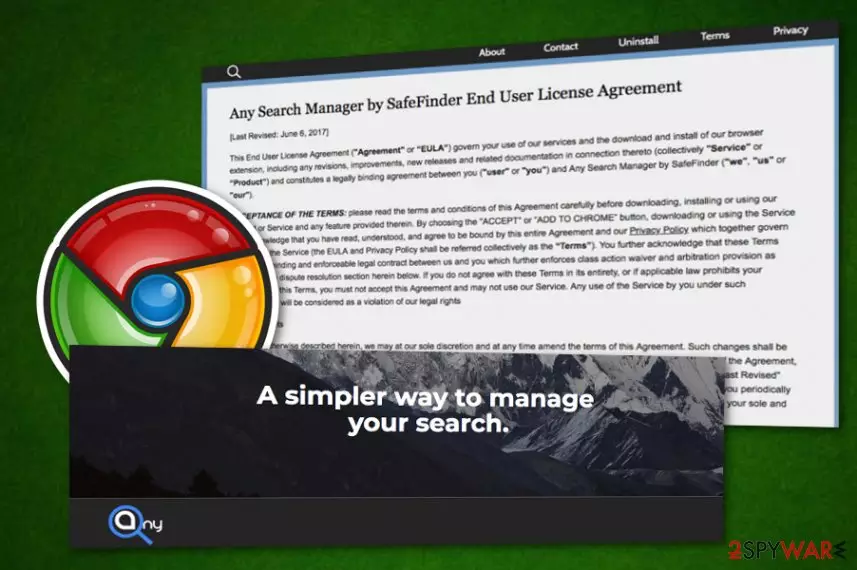
Any Search Manager is a suspicious web browser extension from Safe Finder virus family. Users claims state that this suspicious component appeared on Chrome, Firefox, and Safari after updating Flash Player. Nevertheless, an additional component named akamaihd.net which is a third-party advertising website has shown up together with the extension.[1] After Any Search Manager virus Mac appears on the machine, the user is forced to use Search.anysearch.com or Anysearchmanager.com as a default start page, search provider, and new tab URL. Security experts agree upon the fact that these types of features are typical to cyber infection groups called “browser hijacker” and “Potentially Unwanted Program” (PUP).[2]
| Name | Any Search Manager |
|---|---|
| Type | Browser hijacker |
| Related to | Search.anysearch.com; Anysearchmanager.com |
| Additional content | A user has stated that the extension came together with akamaihd.net |
| OS affected | Mostly, Mac OS X but can appear on Windows also |
| Promises | Claims to provide a simpler way to manage search sessions |
| Main issues caused | Redirects to third party websites, aggressive pop-up ads, slowdowns of web browsers |
| Main dangers | You can be redirected to a malicious website, reveal your private information or tricked into installing malware |
| Appearance | You can find the extension on its official website or it can be delivered to you through software bundles |
| Removal | To uninstall Any Search Manager, scan the system with FortectIntego. It is the easiest way to detect its files and other components |
Many threads are created on IT-related discussion forums where Google Chrome, Mozilla Firefox, and Safari users ask how to remove Any Search Manager from mac. Such questions are not surprising since AnySearch Manager removal can be a difficult task to perform. To eliminate this PUP, web browser users have to delete PUPs from the system and then reset all altered web browsers.
Users also often refer to this hijacker as Any Search Manager virus or Safe Finder virus. Although one might think that the latter association is related to the name of the developer, the truth is that this PUP usually spreads along with Safe Finder extension, which is yet another PUP initiating misleading advertising campaigns.
Any Search Manager does not harm the system directly. It might initiate a slight CPU[3] usage increment and web browsers slowdowns, but that's all it does directly. The rest of the tasks that it might be set to perform are initiated within the web browser. However, note that any changes that are made to your browser apps can be reversed only after Any Search Manager removal.
The reason why Any Search Manager replaces a default start page and search provider is clear – it seeks to promote affiliated websites. However, it's not clear what content its partners are hiding behind the links, so each time you click on the links provided by this dubious search engine, you risk exposing your PC at risk of malware or virus infection.[4]

Senzavirus.it[5] researchers recommend getting rid of this hijacker to prevent the web browser from generating intrusive pop-up and other forms of ads. Any Search Manager virus might be involved in shady advertising campaigns. Thus, be careful with ads promoting software updates, online virus scanners or asking to participate in online surveys.
Even though you are not fond of using a dubious site for your search activities, you may not be allowed to use alternative search. For that, you will have to put Any Search Manager Mac remove process as your top priority. Note that This extension may root deeply into the web browser, as well as alter Windows Registry entries, browser's shortcuts, Windows startup, and other settings that might be difficult to restore manually.
If you want to give manual PUP removal a try, you can use a step-by-step removal tutorial provided at the end of this article. If the procedure failed, try FortectIntego, SpyHunterCombo Cleaner or another security tool to uninstall Any Search Manager from Mac or Windows. After that, don't forget to reset your web browser to the previous state.

Another important reason to get rid of Any Search Manager from your affected computer system and clean all infected and hijacked web browsers is that this browser hijacker can collect information not only related to your browsing activities but also some more personal data such as your email address, and even IP address. This is also stated in the Privacy Policy of this extension's official page:
The second type of information is individually identifiable information, namely information that identifies an individual or entity or may with reasonable effort identify an individual (“Personal Information”). The Personal Information we collect on or through the Services includes the following:
- Contact Information: if you voluntarily contact us, you might provide us with your contact information such as your name and e-mail address, etc. we will use this information in order to respond to your request and support your needs as well as to send you updates and other commercial messages.
- “Identifiers”: we may collect certain identifiers such as your IP addresses.
Freeware packages are still in use for PUP distribution
The PUP we have just described have an official download source. The search engine it promotes can also be visited by directly typing its URL in the address bar. However, that's not enough as a ground that this search is reliable. In fact, the sign that it's alternatively distributed via freeware is the clearest sign that the tool cannot be trusted.
The question is how then PUPs like this manage to slither onto the system. For the sake of monetization, they are distributed via software packages alongside free apps. Therefore, it's essential to verify the installation of free programs to reject the installation of “optional downloads.”
Even the most accurate users will not see additional installers as long as they rely on Quick or Basic installation options. You can avoid PUPs by selecting Advanced or Custom installation and deselecting each “optional download” despite the fact that it's said to be free and useful.
If you have been suffering from unexpected redirects for a while, you should check your Mac or Windows OS for this hijacker. Browser hijackers and similar PUPs can show up on your computer when you don't expect that. Thus, it is useful to have at least a few Secure-surf.net removal options prepared in advance.

Delete Any Search Manager PUP from Mac and Windows
If you wonder how to stop unexpected web browser's redirects to suspicious domains or terminate intrusive advertisements, you must see a step-by-step removal tutorial created by our research team. It will help you to eliminate the virus manually. However, you must be very careful while performing every step which is needed to remove Any Search Manager from the system. Make sure you perform them in exact order.
If, however, you prefer spending time on more significant tasks than fixing your PC, automatic Any Search Manager removal is what you need. All you need for this method is to install a professional anti-malware tool and set it to run a deep scan. After all, reset web browser's default settings. Nevertheless, you can keep the anti-malware as security software after the process also.
Use video-based removal guidelines for an accurate view on Any Search Manager removal
If Any Search Manager virus has appeared out of nowhere and started to bother you, it is about time to opt for its elimination. In case you are a less-experienced user and have never completed manual termination before, we have created and provided a video clip that will guide you throughout the entire process. You can find it here:
Uninstall from Windows
Uninstall from Windows 10/8:
- Type Control Panel into the Windows search box and open the result.
- Under Programs, select Uninstall a program.


Uninstall from Windows 7/XP:
- Click on Windows Start > Control Panel (Windows XP users should click on Add/Remove Programs).
- In Control Panel, select Programs > Uninstall a program.


Remove the unwanted program:
- In the Programs and Features window, look for any recently installed suspicious entries, select them, and click Uninstall.
- If User Account Control appears, click Yes to confirm, then complete the removal.


Delete from macOS
Remove the unwanted application:
- From the menu bar, select Go > Applications.
- In the Applications folder, look for any suspicious entries, then drag them to Trash (or right-click and pick Move to Trash).


Delete leftover files and folders:
- Select Go > Go to Folder.
- Enter /Library/Application Support and remove any suspicious folders related to the unwanted program.
- Repeat the same check in the /Library/LaunchAgents and /Library/LaunchDaemons folders, deleting any suspicious entries.

- Finally, empty the Trash to permanently remove the leftovers.

Reset Internet Explorer
Remove dangerous add-ons:
- Open Internet Explorer, click on the Gear icon (IE menu) on the top-right corner of the browser
- Pick Manage Add-ons.
- You will see a Manage Add-ons window. Here, look for suspicious plugins. Click on these entries and select Disable.


Change your homepage if it was altered:
- Open IE and click on the Gear icon.
- Select Internet Options.
- In the General tab, delete the Home page address and replace it by your preferred one (for example, Google.com).
- Click Apply and then select OK.


Delete temporary files:
- Press on the Gear icon and select Internet Options.
- Under Browsing history, click Delete...
- Select relevant fields and press Delete.


Reset Internet Explorer:
- Click on Gear icon > Internet options and select Advanced tab.
- Select Reset.
- In the new window, check Delete personal settings and select Reset.


Remove from Microsoft Edge
Delete unwanted extensions from MS Edge:
- Select Menu (three horizontal dots at the top-right of the browser window) and pick Extensions.
- From the list, pick the extension and click on the Gear icon.
- Click Remove.


Clear cookies and other browser data:
- Click on the Menu (three horizontal dots at the top-right of the browser window) and select Settings > Privacy, search, and services..
- Under Clear browsing data, pick Choose what to clear.
- Select Cookies and other site data and Cached images and files. (apart from passwords, although you might want to include Media licenses as well, if applicable) and click on Clear.


Restore new tab and homepage settings:
- Click the menu icon and choose Settings.
- Then find On startup section.
- Click Remove next to any suspicious startup page.
Reset MS Edge if the above steps did not work:
- Press on Ctrl + Shift + Esc to open Task Manager.
- Click on More details arrow at the bottom of the window.
- Select Details tab.
- Now scroll down and locate every entry with Microsoft Edge name in it. Right-click on each of them and select End Task to stop MS Edge from running.


Instructions for Chromium-based Edge
Delete extensions from MS Edge (Chromium):
- Open Edge and click select Settings > Extensions.
- Delete unwanted extensions by clicking Remove.


Clear cache and site data:
- Click on Menu and go to Settings.
- Select Privacy, search and services.
- Under Clear browsing data, pick Choose what to clear.
- Under Time range, pick All time.
- Select Clear now.


Reset Chromium-based MS Edge:
- Click on Menu and select Settings.
- On the left side, pick Reset settings.
- Select Restore settings to their default values.
- Confirm with Reset.
- This will disable extensions and reset startup pages but will not delete bookmarks, saved passwords, or browsing history.


Remove from Mozilla Firefox (FF)
Remove dangerous extensions:
- Open Mozilla Firefox browser and click on the Menu (three horizontal lines at the top-right of the window).
- Select Add-ons.
- In here, select the unwanted extension and click Remove.


Reset the homepage:
- Click three horizontal lines at the top right corner to open the menu.
- Choose Settings.
- Under Home, set your preferred homepage and new tab settings.
Clear cookies and site data:
- Click Menu and pick Settings.
- Go to Privacy & Security section.
- Scroll down to locate Cookies and Site Data.
- Click on Clear Data...
- Select Cookies and Site Data and Temporary cached files and pages, then click Clear.


Reset Mozilla Firefox
If clearing the browser as explained above did not help, reset Mozilla Firefox:
- Open Mozilla Firefox browser and click the Menu.
- Go to Help and then choose Troubleshooting Information.

- Under Give Firefox a tune up section, click on Refresh Firefox...
- Once the pop-up shows up, confirm the action by pressing on Refresh Firefox.



Remove from Google Chrome
Delete malicious extensions from Google Chrome:
- Open Google Chrome, click on the Menu (three vertical dots at the top-right corner) and select More tools > Extensions.
- In the newly opened window, you will see all the installed extensions. Uninstall all suspicious extensions related to the unwanted program by clicking Remove.


Clear cache and web data from Chrome:
- Click on Menu and pick Settings.
- Under Privacy and security, select Clear browsing data.
- Select Browsing history, Cookies and other site data, as well as Cached images and files.
- Click Clear data.


Change your homepage:
- Click menu and choose Settings.
- Look for a suspicious site in the On startup section.
- Click on Open a specific or set of pages and click on three dots to find the Remove option.
Reset Google Chrome:
If the previous methods did not help you, reset Google Chrome to eliminate all the unwanted components:
- Click on Menu and select Settings.
- In the Settings, scroll down and click Advanced.
- Scroll down and locate Reset and clean up section.
- Now click Restore settings to their original defaults.
- Confirm with Reset settings.


Delete from Safari
Remove dangerous extensions:
- Open Safari, click Safari in the menu at the top-left of the screen, and select Preferences.
- Go to the Extensions tab, look for any suspicious entries, and click Uninstall to remove them.


Clear history and website data:
- Click Safari in the menu and pick Clear History.
- Set Clear to all history and confirm with Clear History.


Reset Safari:
- Click Safari in the menu and select Preferences > Advanced.
- Enable Show Develop menu in menu bar.
- From the menu bar, click Develop and select Empty Caches.


Did this guide help?
Be the first to comment