

Do Not Ignore This Windows Alert is a fake pop-up that tries to trick users into contacting bogus tech support

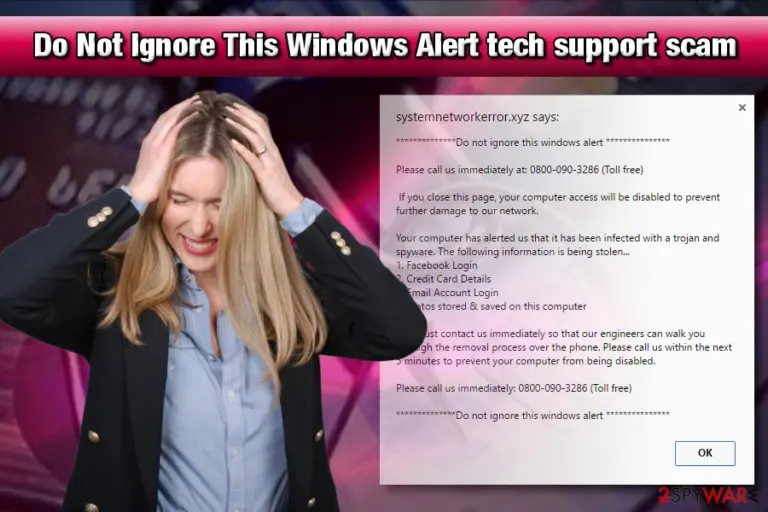
Do Not Ignore This Windows Alert is a tech support scam[1] that is targeting unsuspecting users by showing them a fake pop-up message. It deceptively informs users, that their computer is infected with malware that is endangering personal information. Supposedly, the only way to remove the virus is by calling the provided number.
| SUMMARY | |
| Name | Do Not Ignore This Windows Alert |
|---|---|
| Type | Adware |
| Subtype | Tech support scam |
| Provided phone number | 0800-046-5718, 0800-090-3286, etc. |
| Main dangers | Stolen money from bank account, malware infections, etc. |
| Distribution | Bundling, malicious websites |
| Elimination | Download and install FortectIntego. Otherwise, use manual removal instructions below |
Error 268D3-XC00037 tech support scam, Threats Detected, Microsoft Warning Alert and many others are a similar type of scams that are lurking around the world wide web. Developers of all of these have one goal – to make victims call the provided number in order to extort money.
Thus, do not get into this trap. To remove Do Not Ignore This Windows Alert messages from your computer, you merely need to get rid of adware which is initiating these pop-ups. The easiest way to do so is by using robust security software like FortectIntego. Otherwise, you can check our manual guide below this post.
The message states that a trojan and spyware infected the computer and the following information is being stolen:
- Facebook login
- Credit card details
- Email account login
- Photos stored & saved on this computer
Cybercriminals often use social engineering[2] skills to deceive less computer-savvy people to make them fall for the trick. Indeed, social engineering is a great marketing tool. Unfortunately, crooks adapted it for illicit purposes.
As evident, most people who never encountered Do Not Ignore This Windows Alert virus or other scam messages would be worried about the important data being stolen and call the provided number – 0800-046-5718. Remember that phone number may vary.
As soon as the victim contacts fake tech support, the person who answers the phone typically speaks slowly, using many complicated computer terms to confuse users even more. Then they proceed by explaining that the only way to fix their computer is by either giving crooks remote access to it or by downloading and installing bogus anti-malware software.
If remote access is granted, the thief might install malware on the PC or steal sensitive information, like bank account details and later abuse it to withdraw money. Additionally, users could get an expensive phone bill because the contact number might be charged at premium rate.
Nevertheless, all the explanations from these people are lies, and they should never be trusted. Instead, you should proceed with Do Not Ignore This Windows Alert removal and never contact cybercriminals in the first place.
Adware can get into your computer with free software
Inexperienced users get tricked by these scams because they do not understand how they work. As we already mentioned, adware or other PUPs typically redirect users to malicious websites, including phishing, malware-infested, fake software or others.
To protect yourself from adware infections, security experts[3] advise following these rules:
- Before installing unknown software, research it online. There is plenty of information around on forums, blogs, cybersecurity articles, etc.;
- Always thoroughly read EULA and Privacy Policy before installation;
- Never rush and read installation instruction well;
- When you come across the choice between Recommended/Quick and Advanced/Custom settings, always pick the latter. Note that developers will perpetually advise using Recommended installation mode;
- In Advanced mode, deselect all pre-selected tick boxes next to toolbars, add-ons, search engines, bogus security tools, etc.

Get rid of Do Not Ignore This Windows Alert fake pop-ups immediately
Scam messages are probably the most dangerous as they prompt users to contact crooks directly. Additionally, adware might cause many other disturbances, like spamming Google Chrome or another browser with pop-ups, deals, banners, special offers and similar annoying advertisements. This disturbs web browsing sessions immensely.
You can remove Do Not Ignore This Windows Alert virus by checking our illustrated guidelines below. Beware that incorrect procedure might damage certain system files and make your computer buggy. So make sure you follow every step carefully.
Alternatively, Do Not Ignore This Windows Alert removal can be performed by installing a reliable security tool. You can pick one of the programs below and fully scanning your system. This way, all threats will be eliminated from your machine.
Uninstall from Windows
Uninstall from Windows 10/8:
- Type Control Panel into the Windows search box and open the result.
- Under Programs, select Uninstall a program.


Uninstall from Windows 7/XP:
- Click on Windows Start > Control Panel (Windows XP users should click on Add/Remove Programs).
- In Control Panel, select Programs > Uninstall a program.


Remove the unwanted program:
- In the Programs and Features window, look for any recently installed suspicious entries, select them, and click Uninstall.
- If User Account Control appears, click Yes to confirm, then complete the removal.


Delete from macOS
Remove the unwanted application:
- From the menu bar, select Go > Applications.
- In the Applications folder, look for any suspicious entries, then drag them to Trash (or right-click and pick Move to Trash).


Delete leftover files and folders:
- Select Go > Go to Folder.
- Enter /Library/Application Support and remove any suspicious folders related to the unwanted program.
- Repeat the same check in the /Library/LaunchAgents and /Library/LaunchDaemons folders, deleting any suspicious entries.

- Finally, empty the Trash to permanently remove the leftovers.

Reset Internet Explorer
Remove dangerous add-ons:
- Open Internet Explorer, click on the Gear icon (IE menu) on the top-right corner of the browser
- Pick Manage Add-ons.
- You will see a Manage Add-ons window. Here, look for suspicious plugins. Click on these entries and select Disable.


Change your homepage if it was altered:
- Open IE and click on the Gear icon.
- Select Internet Options.
- In the General tab, delete the Home page address and replace it by your preferred one (for example, Google.com).
- Click Apply and then select OK.


Delete temporary files:
- Press on the Gear icon and select Internet Options.
- Under Browsing history, click Delete...
- Select relevant fields and press Delete.


Reset Internet Explorer:
- Click on Gear icon > Internet options and select Advanced tab.
- Select Reset.
- In the new window, check Delete personal settings and select Reset.


Remove from Microsoft Edge
Delete unwanted extensions from MS Edge:
- Select Menu (three horizontal dots at the top-right of the browser window) and pick Extensions.
- From the list, pick the extension and click on the Gear icon.
- Click Remove.


Clear cookies and other browser data:
- Click on the Menu (three horizontal dots at the top-right of the browser window) and select Settings > Privacy, search, and services..
- Under Clear browsing data, pick Choose what to clear.
- Select Cookies and other site data and Cached images and files. (apart from passwords, although you might want to include Media licenses as well, if applicable) and click on Clear.


Restore new tab and homepage settings:
- Click the menu icon and choose Settings.
- Then find On startup section.
- Click Remove next to any suspicious startup page.
Reset MS Edge if the above steps did not work:
- Press on Ctrl + Shift + Esc to open Task Manager.
- Click on More details arrow at the bottom of the window.
- Select Details tab.
- Now scroll down and locate every entry with Microsoft Edge name in it. Right-click on each of them and select End Task to stop MS Edge from running.


Instructions for Chromium-based Edge
Delete extensions from MS Edge (Chromium):
- Open Edge and click select Settings > Extensions.
- Delete unwanted extensions by clicking Remove.


Clear cache and site data:
- Click on Menu and go to Settings.
- Select Privacy, search and services.
- Under Clear browsing data, pick Choose what to clear.
- Under Time range, pick All time.
- Select Clear now.


Reset Chromium-based MS Edge:
- Click on Menu and select Settings.
- On the left side, pick Reset settings.
- Select Restore settings to their default values.
- Confirm with Reset.
- This will disable extensions and reset startup pages but will not delete bookmarks, saved passwords, or browsing history.


Remove from Mozilla Firefox (FF)
Remove dangerous extensions:
- Open Mozilla Firefox browser and click on the Menu (three horizontal lines at the top-right of the window).
- Select Add-ons.
- In here, select the unwanted extension and click Remove.


Reset the homepage:
- Click three horizontal lines at the top right corner to open the menu.
- Choose Settings.
- Under Home, set your preferred homepage and new tab settings.
Clear cookies and site data:
- Click Menu and pick Settings.
- Go to Privacy & Security section.
- Scroll down to locate Cookies and Site Data.
- Click on Clear Data...
- Select Cookies and Site Data and Temporary cached files and pages, then click Clear.


Reset Mozilla Firefox
If clearing the browser as explained above did not help, reset Mozilla Firefox:
- Open Mozilla Firefox browser and click the Menu.
- Go to Help and then choose Troubleshooting Information.

- Under Give Firefox a tune up section, click on Refresh Firefox...
- Once the pop-up shows up, confirm the action by pressing on Refresh Firefox.



Remove from Google Chrome
Delete malicious extensions from Google Chrome:
- Open Google Chrome, click on the Menu (three vertical dots at the top-right corner) and select More tools > Extensions.
- In the newly opened window, you will see all the installed extensions. Uninstall all suspicious extensions related to the unwanted program by clicking Remove.


Clear cache and web data from Chrome:
- Click on Menu and pick Settings.
- Under Privacy and security, select Clear browsing data.
- Select Browsing history, Cookies and other site data, as well as Cached images and files.
- Click Clear data.


Change your homepage:
- Click menu and choose Settings.
- Look for a suspicious site in the On startup section.
- Click on Open a specific or set of pages and click on three dots to find the Remove option.
Reset Google Chrome:
If the previous methods did not help you, reset Google Chrome to eliminate all the unwanted components:
- Click on Menu and select Settings.
- In the Settings, scroll down and click Advanced.
- Scroll down and locate Reset and clean up section.
- Now click Restore settings to their original defaults.
- Confirm with Reset settings.


Delete from Safari
Remove dangerous extensions:
- Open Safari, click Safari in the menu at the top-left of the screen, and select Preferences.
- Go to the Extensions tab, look for any suspicious entries, and click Uninstall to remove them.


Clear history and website data:
- Click Safari in the menu and pick Clear History.
- Set Clear to all history and confirm with Clear History.


Reset Safari:
- Click Safari in the menu and select Preferences > Advanced.
- Enable Show Develop menu in menu bar.
- From the menu bar, click Develop and select Empty Caches.


Did this guide help?
Be the first to comment