

Search.hwallstreetwatch.co is a potentially unwanted program which promises a lot of benefits but brings nothing but misery to users
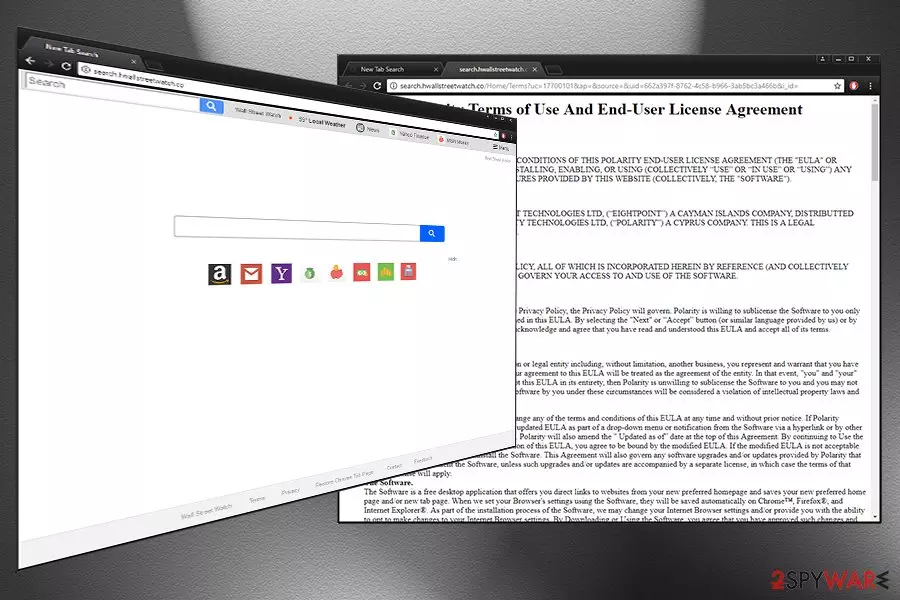
Search.hwallstreetwatch.co is a browser hijacker[1] created by Polarity Technologies Ltd. This company is notorious for its excessive amount of PUP production. Although these programs are not malware, users often start looking for solutions to problems they are having with their Google Chrome, Internet Explorer, Mozilla Firefox, Safari and other browsers. They quickly notice that their browsing sessions are greatly disturbed by excessive advertisement, redirecting to questionable sites, and slow browser operation. What is more, users might inject their machines with malware if they will not be careful enough.
| Summary | |
| Name | Search.hwallstreetwatch.co |
| Type | Browser hijacker |
| Developer | Polarity Technologies |
| Similar unwanted programs | Search.searchmev2.com, Search.Searchipdf2.com, Search.hfastmapfinder.com, etc. |
| Symptoms | Hijacked Google Chrome or other browser, altered search results, disruptive ads and redirects, etc. |
| Distribution | Software bundling |
| Elimination | Download and install FortectIntego |
Wall Street Watch (a browser extension that is connected to the hijacker) tries to lure users who are interested in everything finance, money, stock exchange data, etc. Indeed, many tools and websites on the internet can be used to help users with finances. However, these websites can be accessed without the help of a potentially unwanted program, as it will add a layer of advertisements and will try to sell you sponsors' products or services.
All search queries are redirected to Yahoo, meaning that developers participate in Yahoo's affiliate's program. Although Yahoo is a legitimate search engine, the search results generated through a browser hijacker will not be genuine, and you will see quite a few sponsored links. Immediately remove Search.hwallstreetwatch.co virus from your machine, if your browser is showing questionable startup page and redirects all search queries to Yahoo.
The intrusive PUP comes bundled with shareware or freeware. Thus, you might not even notice how it got into your machine and not even know it's there. Nevertheless, you can notice Search.hwallstreetwatch.co hijack by the altered search engine and startup page of your browser, which is now set to hxxp://search.hwallstreetwatch.co. As you can see, Polarity is not using HTTPS[2] protocol – the secure way of transferring data. Instead, they use HTTP and Chrome warns users about the following:
Your connection to this site is not secure
You should not enter any sensitive information on this site (for example, passwords or credit cards), because it could be stolen by attackers.
What is more, the non-personally identifiable information (IP address, ISP, search data, geo-location, etc.) and any personal data you provide that is collected by the developers can be shared in the following ways:
- Shared with Polarity's vendors, subcontractors, and business partners;
- Companies within Polarity's group of companies;
- For fraud prevention;
- For law enforcement purposes and public safety;
- Data is transferred if the business is sold or merged with another company;
- Advertisers and advertising networks may collect cookies and other information.
The worst part is that, if not being careful, accidental clicks on suspicious ads or redirects might lead you to dangerous sites. Eventually, you might end up with malware infections. Thus, security experts from novirus.uk[3] advise users to proceed with Search.hwallstreetwatch.co removal. Quickest way achieving that is by employing security software like FortectIntego.

Avoid potentially unwanted programs
Users mistakenly think that PUPs appear out of nowhere. However, it's a misconception, and they install browser hijackers or adware programs as optional components in software bundles. It happens due to people rushing installation and not reading the instructions properly. Thus, we advise users to carefully study each of the installation windows and make sure not let the optional installs through.
Being attentive is not enough, however, as users should always pick Advanced or Custom installation mode instead of Recommended/Quick one, as, in most cases, the additional components are hiding here. Make sure you remove any pre-ticked tick marks next to browser extensions, search engines, system optimizers and similar useless software.
Wall Street Watch removal guide
Please do not bother with manual Search.hwallstreetwatch.co removal if you are not familiar with computers and their operation. It will result in a failure to eliminate the PUP. In the worst case scenario, you could even damage system files which could make your machine malfunction. However, if you are computer-savvy enough, please check our illustrated guide below.
For those who want to remove Search.hwallstreetwatch.co virus quickly and effortlessly, our security experts advise using reputable security software. Just pick one of the programs listed below, install it and bring it up to date. Finally, perform a full system scan.
Uninstall from Windows
Uninstall from Windows 10/8:
- Type Control Panel into the Windows search box and open the result.
- Under Programs, select Uninstall a program.


Uninstall from Windows 7/XP:
- Click on Windows Start > Control Panel (Windows XP users should click on Add/Remove Programs).
- In Control Panel, select Programs > Uninstall a program.


Remove the unwanted program:
- In the Programs and Features window, look for any recently installed suspicious entries, select them, and click Uninstall.
- If User Account Control appears, click Yes to confirm, then complete the removal.


Delete from macOS
Remove the unwanted application:
- From the menu bar, select Go > Applications.
- In the Applications folder, look for any suspicious entries, then drag them to Trash (or right-click and pick Move to Trash).


Delete leftover files and folders:
- Select Go > Go to Folder.
- Enter /Library/Application Support and remove any suspicious folders related to the unwanted program.
- Repeat the same check in the /Library/LaunchAgents and /Library/LaunchDaemons folders, deleting any suspicious entries.

- Finally, empty the Trash to permanently remove the leftovers.

Reset Internet Explorer
Remove dangerous add-ons:
- Open Internet Explorer, click on the Gear icon (IE menu) on the top-right corner of the browser
- Pick Manage Add-ons.
- You will see a Manage Add-ons window. Here, look for suspicious plugins. Click on these entries and select Disable.


Change your homepage if it was altered:
- Open IE and click on the Gear icon.
- Select Internet Options.
- In the General tab, delete the Home page address and replace it by your preferred one (for example, Google.com).
- Click Apply and then select OK.


Delete temporary files:
- Press on the Gear icon and select Internet Options.
- Under Browsing history, click Delete...
- Select relevant fields and press Delete.


Reset Internet Explorer:
- Click on Gear icon > Internet options and select Advanced tab.
- Select Reset.
- In the new window, check Delete personal settings and select Reset.


Remove from Microsoft Edge
Delete unwanted extensions from MS Edge:
- Select Menu (three horizontal dots at the top-right of the browser window) and pick Extensions.
- From the list, pick the extension and click on the Gear icon.
- Click Remove.


Clear cookies and other browser data:
- Click on the Menu (three horizontal dots at the top-right of the browser window) and select Settings > Privacy, search, and services..
- Under Clear browsing data, pick Choose what to clear.
- Select Cookies and other site data and Cached images and files. (apart from passwords, although you might want to include Media licenses as well, if applicable) and click on Clear.


Restore new tab and homepage settings:
- Click the menu icon and choose Settings.
- Then find On startup section.
- Click Remove next to any suspicious startup page.
Reset MS Edge if the above steps did not work:
- Press on Ctrl + Shift + Esc to open Task Manager.
- Click on More details arrow at the bottom of the window.
- Select Details tab.
- Now scroll down and locate every entry with Microsoft Edge name in it. Right-click on each of them and select End Task to stop MS Edge from running.


Instructions for Chromium-based Edge
Delete extensions from MS Edge (Chromium):
- Open Edge and click select Settings > Extensions.
- Delete unwanted extensions by clicking Remove.


Clear cache and site data:
- Click on Menu and go to Settings.
- Select Privacy, search and services.
- Under Clear browsing data, pick Choose what to clear.
- Under Time range, pick All time.
- Select Clear now.


Reset Chromium-based MS Edge:
- Click on Menu and select Settings.
- On the left side, pick Reset settings.
- Select Restore settings to their default values.
- Confirm with Reset.
- This will disable extensions and reset startup pages but will not delete bookmarks, saved passwords, or browsing history.


Remove from Mozilla Firefox (FF)
Remove dangerous extensions:
- Open Mozilla Firefox browser and click on the Menu (three horizontal lines at the top-right of the window).
- Select Add-ons.
- In here, select the unwanted extension and click Remove.


Reset the homepage:
- Click three horizontal lines at the top right corner to open the menu.
- Choose Settings.
- Under Home, set your preferred homepage and new tab settings.
Clear cookies and site data:
- Click Menu and pick Settings.
- Go to Privacy & Security section.
- Scroll down to locate Cookies and Site Data.
- Click on Clear Data...
- Select Cookies and Site Data and Temporary cached files and pages, then click Clear.


Reset Mozilla Firefox
If clearing the browser as explained above did not help, reset Mozilla Firefox:
- Open Mozilla Firefox browser and click the Menu.
- Go to Help and then choose Troubleshooting Information.

- Under Give Firefox a tune up section, click on Refresh Firefox...
- Once the pop-up shows up, confirm the action by pressing on Refresh Firefox.



Remove from Google Chrome
Delete malicious extensions from Google Chrome:
- Open Google Chrome, click on the Menu (three vertical dots at the top-right corner) and select More tools > Extensions.
- In the newly opened window, you will see all the installed extensions. Uninstall all suspicious extensions related to the unwanted program by clicking Remove.


Clear cache and web data from Chrome:
- Click on Menu and pick Settings.
- Under Privacy and security, select Clear browsing data.
- Select Browsing history, Cookies and other site data, as well as Cached images and files.
- Click Clear data.


Change your homepage:
- Click menu and choose Settings.
- Look for a suspicious site in the On startup section.
- Click on Open a specific or set of pages and click on three dots to find the Remove option.
Reset Google Chrome:
If the previous methods did not help you, reset Google Chrome to eliminate all the unwanted components:
- Click on Menu and select Settings.
- In the Settings, scroll down and click Advanced.
- Scroll down and locate Reset and clean up section.
- Now click Restore settings to their original defaults.
- Confirm with Reset settings.


Delete from Safari
Remove dangerous extensions:
- Open Safari, click Safari in the menu at the top-left of the screen, and select Preferences.
- Go to the Extensions tab, look for any suspicious entries, and click Uninstall to remove them.


Clear history and website data:
- Click Safari in the menu and pick Clear History.
- Set Clear to all history and confirm with Clear History.


Reset Safari:
- Click Safari in the menu and select Preferences > Advanced.
- Enable Show Develop menu in menu bar.
- From the menu bar, click Develop and select Empty Caches.


Did this guide help?
Be the first to comment