

How useful is AllInOneDocs Toolbar?
AllInOneDocs Toolbar serves as the plug-in and a search engine. It belongs to the production of Mindspark Interactive Network[1]. It is the company which offers online products such as toolbars, add-ons, plug-ins and search engines. It also steadily grows by incorporating other smaller companies within it[2]You might be familiar with MyYay browsing tools. Recently, the company has published a series of toolbars: GetForms Online, SearchFormsOnline, and Streamlined DIY, etc. They try to allure visitors by offering additional features such as file-converting services, email accounts, and other possibly practical domains. However, if you have ever had one of their products, you might remember its pervasive behavior. Be it a toolbar or a browsing tool, it is promoted annoyingly and attempts to get through into your system without your primary discontent. Such phenomenon sparks suspicion over the reliability of Mindspark toolbars[3]. If you are interested in know more or you are you are looking for a way to remove AllInOneDocs Toolbar quickly, you have come to the right place. While you are reading the article, let FortectIntego deal with the toolbar.
One of the key features of all the products of this company is that when you enable whatever toolbar or a browser extension, your homepage will be immediately changed into one of Myway search engine variations. At first glance, this browsing engine does not stand out in any way in comparison to search engines. Nonetheless, within a while, you might notice more customized advertisements, which match your personal interests, popping up. It is not surprising since the toolbar collects (non)personal information about your browsing activities. According to the privacy policy, it may share it with its partner companies and third parties operating in other countries.
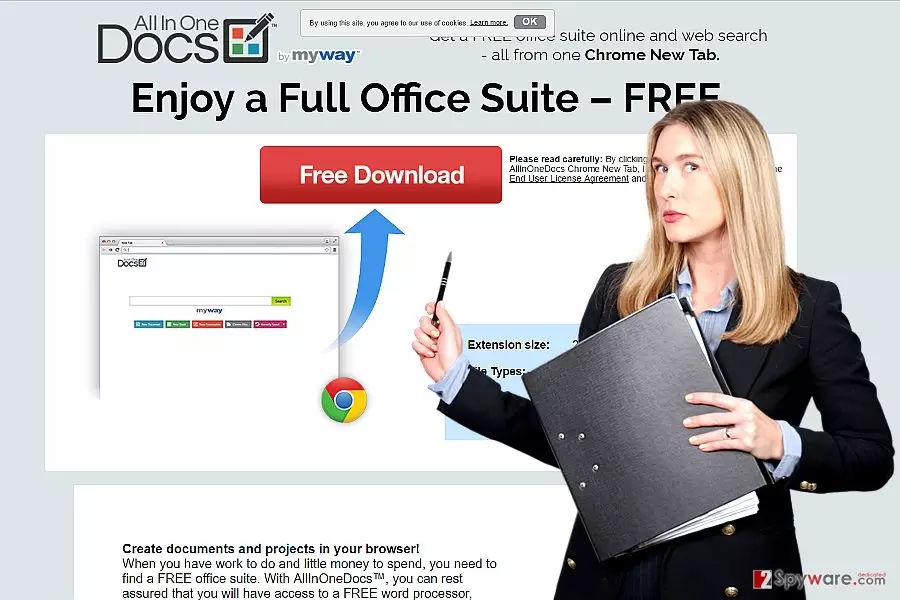
Along with installing All In One Docs Toolbar, PremierDownloadManager, DownloadManagerTool, and DownloadManagerNow will be incorporated in your homepage as well. As a result, these companies also are able to collect information about your personal preferences and habits. Some users may ignore this phenomenon, but for others, the tendency to collect information may serve as a wake-up call[4]. Keep in mind that your personal information may be misused not only for marketing and advertising purposes but for the improvement of hacking techniques as well[5]. In this regard, this toolbar may not satisfy your privacy expectations as well. Below the article, you will find quick AllInOneDocs removal guide.
Can this toolbar enter my PC without my approval?
Mindspark company quite aggressively advertises their products so it would be not a surprise to spot it traveling along with freeware. If you didn’t download this toolbar on purpose from this official web page, it is likely that you accidentally installed it with a recently downloaded free software. In order to detect all optional add-ons, choose “Custom” installation mode. Then, carefully advance through the stages and unmark all shady programs. Likewise, you will prevent the discreet installation of all questionable programs. This habit serves against the installation of adware and browser hijackers as well.
Uninstalling All In One Docs Toolbar
Fortunately, it is not difficult to remove AllInOneDocs Toolbar. You can do it combining manual and automatic elimination options. Install an anti-spyware program to do the job for you. Then, it would be better to reset the browser’s settings to clear all elements and plug-ins related with this toolbar. Since this company closely cooperates with third parties, uninstall all download managers and its MyWay homepage as well. Below you will find guidelines how to complete full AllInOneDocs Toolbar removal.
Recently, the developer of this program contacted us asking us to remove this post from 2-spyware.com website. We believe that we shouldn’t do that as long as programs that we offer for the removal of GetFormsOnline Toolbar can detect it and help users to remove it from the system. As it is mentioned under each of download buttons, we ARE affiliated with these anti-malware programs, and while some of them are free, others can remove a virus only after purchasing them. These mentions fully fulfill each of the requirements of FTC.
Nevertheless, we have recently decided to make a revision of this and other posts that are related to this developer. We claim that all of them are described properly.
Uninstall from Windows
Uninstall from Windows 10/8:
- Type Control Panel into the Windows search box and open the result.
- Under Programs, select Uninstall a program.


Uninstall from Windows 7/XP:
- Click on Windows Start > Control Panel (Windows XP users should click on Add/Remove Programs).
- In Control Panel, select Programs > Uninstall a program.


Remove the unwanted program:
- In the Programs and Features window, look for any recently installed suspicious entries, select them, and click Uninstall.
- If User Account Control appears, click Yes to confirm, then complete the removal.


Delete from macOS
Remove the unwanted application:
- From the menu bar, select Go > Applications.
- In the Applications folder, look for any suspicious entries, then drag them to Trash (or right-click and pick Move to Trash).


Delete leftover files and folders:
- Select Go > Go to Folder.
- Enter /Library/Application Support and remove any suspicious folders related to the unwanted program.
- Repeat the same check in the /Library/LaunchAgents and /Library/LaunchDaemons folders, deleting any suspicious entries.

- Finally, empty the Trash to permanently remove the leftovers.

Reset Internet Explorer
Remove dangerous add-ons:
- Open Internet Explorer, click on the Gear icon (IE menu) on the top-right corner of the browser
- Pick Manage Add-ons.
- You will see a Manage Add-ons window. Here, look for suspicious plugins. Click on these entries and select Disable.


Change your homepage if it was altered:
- Open IE and click on the Gear icon.
- Select Internet Options.
- In the General tab, delete the Home page address and replace it by your preferred one (for example, Google.com).
- Click Apply and then select OK.


Delete temporary files:
- Press on the Gear icon and select Internet Options.
- Under Browsing history, click Delete...
- Select relevant fields and press Delete.


Reset Internet Explorer:
- Click on Gear icon > Internet options and select Advanced tab.
- Select Reset.
- In the new window, check Delete personal settings and select Reset.


Remove from Microsoft Edge
Delete unwanted extensions from MS Edge:
- Select Menu (three horizontal dots at the top-right of the browser window) and pick Extensions.
- From the list, pick the extension and click on the Gear icon.
- Click Remove.


Clear cookies and other browser data:
- Click on the Menu (three horizontal dots at the top-right of the browser window) and select Settings > Privacy, search, and services..
- Under Clear browsing data, pick Choose what to clear.
- Select Cookies and other site data and Cached images and files. (apart from passwords, although you might want to include Media licenses as well, if applicable) and click on Clear.


Restore new tab and homepage settings:
- Click the menu icon and choose Settings.
- Then find On startup section.
- Click Remove next to any suspicious startup page.
Reset MS Edge if the above steps did not work:
- Press on Ctrl + Shift + Esc to open Task Manager.
- Click on More details arrow at the bottom of the window.
- Select Details tab.
- Now scroll down and locate every entry with Microsoft Edge name in it. Right-click on each of them and select End Task to stop MS Edge from running.


Instructions for Chromium-based Edge
Delete extensions from MS Edge (Chromium):
- Open Edge and click select Settings > Extensions.
- Delete unwanted extensions by clicking Remove.


Clear cache and site data:
- Click on Menu and go to Settings.
- Select Privacy, search and services.
- Under Clear browsing data, pick Choose what to clear.
- Under Time range, pick All time.
- Select Clear now.


Reset Chromium-based MS Edge:
- Click on Menu and select Settings.
- On the left side, pick Reset settings.
- Select Restore settings to their default values.
- Confirm with Reset.
- This will disable extensions and reset startup pages but will not delete bookmarks, saved passwords, or browsing history.


Remove from Mozilla Firefox (FF)
Remove dangerous extensions:
- Open Mozilla Firefox browser and click on the Menu (three horizontal lines at the top-right of the window).
- Select Add-ons.
- In here, select the unwanted extension and click Remove.


Reset the homepage:
- Click three horizontal lines at the top right corner to open the menu.
- Choose Settings.
- Under Home, set your preferred homepage and new tab settings.
Clear cookies and site data:
- Click Menu and pick Settings.
- Go to Privacy & Security section.
- Scroll down to locate Cookies and Site Data.
- Click on Clear Data...
- Select Cookies and Site Data and Temporary cached files and pages, then click Clear.


Reset Mozilla Firefox
If clearing the browser as explained above did not help, reset Mozilla Firefox:
- Open Mozilla Firefox browser and click the Menu.
- Go to Help and then choose Troubleshooting Information.

- Under Give Firefox a tune up section, click on Refresh Firefox...
- Once the pop-up shows up, confirm the action by pressing on Refresh Firefox.



Remove from Google Chrome
Delete malicious extensions from Google Chrome:
- Open Google Chrome, click on the Menu (three vertical dots at the top-right corner) and select More tools > Extensions.
- In the newly opened window, you will see all the installed extensions. Uninstall all suspicious extensions related to the unwanted program by clicking Remove.


Clear cache and web data from Chrome:
- Click on Menu and pick Settings.
- Under Privacy and security, select Clear browsing data.
- Select Browsing history, Cookies and other site data, as well as Cached images and files.
- Click Clear data.


Change your homepage:
- Click menu and choose Settings.
- Look for a suspicious site in the On startup section.
- Click on Open a specific or set of pages and click on three dots to find the Remove option.
Reset Google Chrome:
If the previous methods did not help you, reset Google Chrome to eliminate all the unwanted components:
- Click on Menu and select Settings.
- In the Settings, scroll down and click Advanced.
- Scroll down and locate Reset and clean up section.
- Now click Restore settings to their original defaults.
- Confirm with Reset settings.


Delete from Safari
Remove dangerous extensions:
- Open Safari, click Safari in the menu at the top-left of the screen, and select Preferences.
- Go to the Extensions tab, look for any suspicious entries, and click Uninstall to remove them.


Clear history and website data:
- Click Safari in the menu and pick Clear History.
- Set Clear to all history and confirm with Clear History.


Reset Safari:
- Click Safari in the menu and select Preferences > Advanced.
- Enable Show Develop menu in menu bar.
- From the menu bar, click Develop and select Empty Caches.


Did this guide help?
2 comments
macaroon
Why would you need it in the first place? Google Docs serves for that purpose.
room1334
Never come across this one.