

CryptConsole – a decryptable ransomware that keeps coming back with new variants in 2018
CryptConsole is a ransomware virus that has been active since January 2017. The 2.0 variant came soon after the first one – in February of the same year, and the latest member of the virus family is CryptConsole 3. Previous versions of this malware have been asked 0.2 Bitcoins for data recovery; then hackers proceeded to demand 0.7BTC, while the most recent releases, like xzer@tutanota.com, demand a lesser payment of $1000 in Bitcoin. The functionality of all versions of ransomware has similar features but uses different contact email address and the file extension (or a prefix) name. Latest virus variants use redbul@tutanota.com and heineken@tuta.io email addresses used to contact virus authors. Fortunately, all variants of this cyber threat seem to be decryptable, except for one – the latest version of the CryptCosnsole ransomware-type virus.
| SUMMARY | |
| Name | CryptConsole |
|---|---|
| Type | Ransomware |
| Versions |
someone_ne@india.com, decipher_ne@outlook.com, unCrypte@outlook.com, qar48@tutanota.com, xzer@tutanota.com, szem@tutanota.com, desparo@tuta.io |
| Ransom size | 0.14, 0.2 or 0.7 BTC |
| Distribution | Spam email attachments, malicious websites, etc. |
| Danger level | Medium. Does not encrypt files; however, renames them so that the victim cannot use them |
| Elimination | Automatic deletion only – download FortectIntego or MalwarebytesMalwarebytes |
Changing file names back and adding the correct extension would make data usable again. Fortunately, official decryptors are available to execute this task. However, in April 2018, security researcher Michael Gillespie[1] discovered a new variation of the virus, which appends xzet@tutanota.com extension. According to the specialist, this version of CryptConsole is still decryptable, although it requires the researcher to look at each case individually as the decryptor might not work.
Following that, in June 2018, Gillespie discovered[2] the new variant of CryptConsole which uses xser@tutanota.com email address and demands $1000 in BTC for file release. Nevertheless, decryption of this version is possible, and users affected by this virus should contact the researcher. As of now, he cannot disclose weakness of the ransomware, as it is still extremely active.

Ransomware did not wait for long to show up again. In early July 2018, security experts discovered another two new variants of CryptConsole virus – Redbul@tutanota.com and heineken@tuta.io. Similarly to previous versions, the malware uses an email address + randomly generated numbers as file extensions. Redbul@tutanota.com uses rEADME.txt or readme.txt ransom notes, and also offers users to decrypt one file (up to 10MB) for an extra of $50 payment for the service. Both of these versions are decryptable.
The second ransomware's version – CryptConsole2 seems to be more sophisticated than its predecessors. This version can encrypt victim's files with AES or similar encryption algorithm (experts are still discussing on this part) and then require 0.7 BTC for their decryption. The virus also drops “README.hta” ransom note that asks the victim to use xzer@tutanota.com or desparo@tuta.io for getting in touch with its developers. We do not recommend that as each of its versions are decryptable.
The latest variant of the virus, dubbed CryptConsole-2018, includes all the versions which appeared in 2018. The most famous one is Sequre ransomware, which appends sequre@tuta.io_ [hex], sequre@tuta.io_ [random_0-9A-Z] or [ransom_email] _ [0-9A-the Z] file extensions, and demands 0.14BTC for file release. The virus also drops ransom note called HOW DECRIPT FILES.hta which is displayed in virtually the same manner as previous messages from hackers.

Origins of the CryptoConsole are still unknown
At first, it was believed that Crypt Console ransomware is closely related to Globe ransomware as the .HTA file presented to victims looks identical to the one which is used by Globe.[3] However, the virus does not encrypt[4] data, and all threats are bogus. Nevertheless, CryptConsole removal should be performed urgently (it might open the doors to other severe infections).
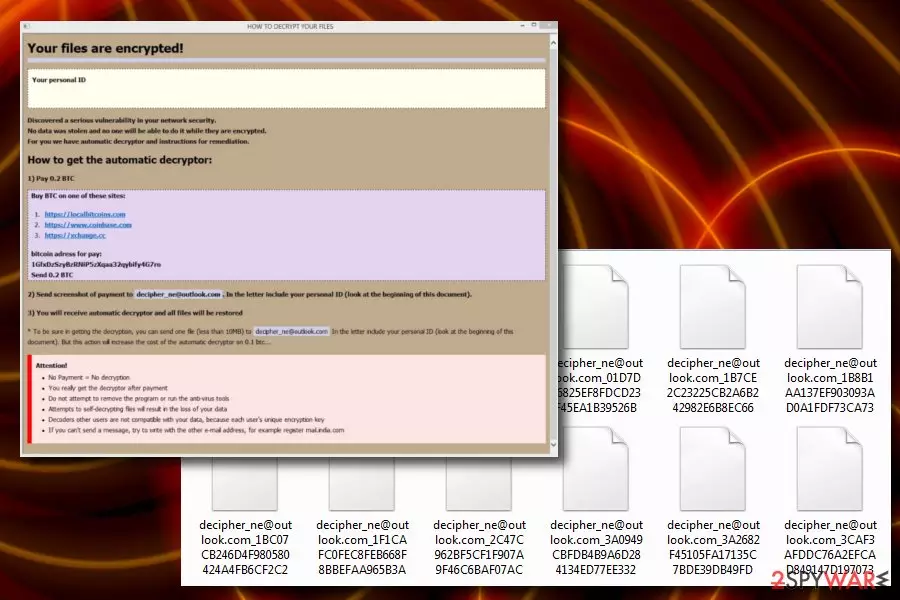
The ransom note of this virus reads:
Your files are encrypted!
Your personal ID:
Discovered a serious vulnerability in your network security.
No data was stolen and no one will be able to do it while they are encrypted.
For you we have automatic decryptor and instructions for remediation.
How to get the automatic decryptor:
1) 0.7 BTCBuy BTC on one of these sites:
https://localbitcoins.com
https://www.coinbase.com
https://xchange.ccbitcoin adress for pay:
Send 0.7 BTC2) Send screenshot of payment to someone_ne@india.com. In the letter include your personal ID(look at the beginning of this document).
3) You will receive automatic decryptor and all files will be restored
* To be sure in getting the decryption, you can send one file(less than 10MB) to bit-tray@tutanota.com In the letter include your personal ID(look at the beginning of this document). But this action will increase the cost of the automatic decryptor on 0.1 btc…
Attention!
• No Payment = No decryption
• You really get the decryptor after payment
• Do not attempt to remove the program or run the anti-virus tools
• Attempts to self-decrypting files will result in the loss of your data
• Decoders other users are not compatible with your data, because each user’s unique encryption key
• If you can’t send a message, try to write with the other e-mail address, for example register mail.tutanota.com

As you can see, the victim is asked to send 0.7 or more Bitcoins to a provided Bitcoin address, make a screenshot of the transaction document and send it to criminals via email. Currently, known email addresses that are associated with the virus are:
- someone_ne@india.com;
- something_ne@india.com;
- decipher_ne@outlook.com;
- unCrypte@outlook.com;
- qar48@tutanota.com;
- xzet@tutanota.com;
- szem@tutanota.com;
- desparo@tuta.io
- xser@tutanota.com
- redbul@tutanota.com
- heineken@tuta.io
The files are renamed accordingly using these email addresses, depending on the version. For example, a file called picture.jpg gets renamed to picture.jpg.someone_ne@india.com or picture.jpg.qar48@tutanota.com. This behavior mimics working ransomware. However, as we already mentioned, files do not get corrupted, unlike in the case of Cerber[5] or Spora viruses.

If this foolish virus has attacked you, better remove CryptConsole or its second version ASAP with anti-malware tools like FortectIntego or SpyHunterCombo Cleaner. There is already a decrypter for this virus available, and you can find its download link below the post.
What is interesting about this virus is that it suggests the victim try the imaginary “decryption service.” It asks to send a file not larger than 10MB to one of the emails mentioned above and include the personal ID, which is written in the HOW TO DECRYPT YOUR FILES ransom note. However, other viruses typically suggest this proof that decryptor exists for free, and CryptConsole ransomware doesn’t.
It says that if the victim wants to restore one file and find out that the decrypter actually works, the initial ransom price increases by 0.1 BTC. No matter what, you shouldn’t care about the price of the ransom because you can recover your files for free. Before you use the decrypter created by a malware researcher M. Gillespie, you should complete the CryptConsole elimination procedure using proper anti-malware tools.
Ransomware might sneak into device not only from a malicious email
Criminals distribute malicious payload using social engineering.[6] They often send thousands of spam emails directed to unsuspecting users. Their primary goal is to make the malicious file look like it is a safe one.
So they create a document named, for example, “Invoice,” “Scan,” “Purchase Order” or similar. Typically, they use .doc, .pdf or .txt file formats (however, other file types can be used as well), and insert a script into them, which has to be opened with Macro function. If the victim proceeds with opening the file, the malicious script downloads malware from the Internet and immediately infects the entire system with it, meaning that all data gets corrupted.
Other ransomware viruses can infect systems by using vulnerabilities in the system, so it is advisable to keep all programs up-to-date and protect the system with decent anti-malware software.

Delete CryptConsole and recover your files
Security experts[7] advise that the best way to remove CryptConsole virus is to perform a system scan with anti-malware software. Such scan checks the system and finds all malicious files associated with the malware. You might also detect some potentially unwanted programs on the system.
It goes without saying that to removing spyware/malware automatically takes less time and detects more infectious files than the manual method. Besides, ransomware is a very complex program, and it is tough to remove it. Therefore, before you run the system scan, read these CryptConsole removal instructions first. Then, you can download the decrypter and learn how to rename your files to previous states.
Did this guide help?
4 comments
sohappy
YAY!!! I RESTORED MY FILES!
THANK YOUUUUU!
Simba78
Yes, I restored my files, too! Cant thank you guys enough! And whoever created the decryption tool!
gowaz
Cant wait to test the decryptor, but need to remove the virus first. Gonna go and read some reviews about these programs.
Wudy
Reimage uninstalled the virus, and then i used the free decryptor. Files are like new, I can open and use them again. Words cant express how thankful I am, guys... Wish u all the best