

Duck Search extension – a browser hijacker that will redirect your internet traffic to questionable sites
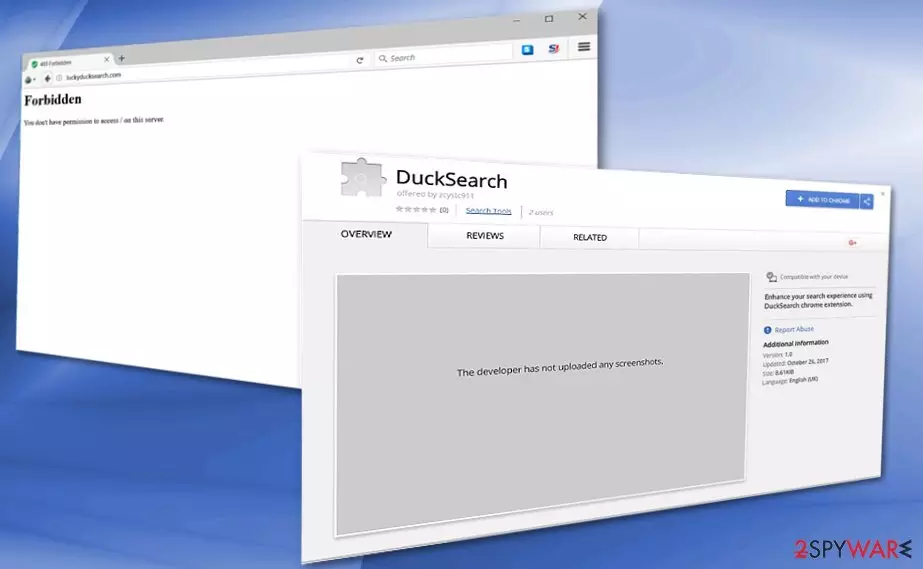
DuckSearch virus functions as a shady browser extension available on Google Chrome Web Store. However, you do not need to have much knowledge about IT and cyber threats to notice the questionable behavior of both the plug-in and the website it promotes – luckyducksearch.com.
In the said store, the plug-in does not have any rating or provides any proper official site. It is supposedly introduced by an individual called zcystc911. If you enable this extension, it will replace your default search engine with the aforementioned website.
However, the latter does not function at all – it does not present any content. Besides, the website does not contain the HTTPS[1] protocol, which implies the reliability of the website. Fortunately, the search engine is not labeled as malicious by VirusTotal[2]. But you still should not use it. This article contains removal and recovery options.
| Name | DuckSearch |
|---|---|
| Type | Browser hijacker |
| Altered browser settings | The default search engine, homepage, new tab |
| Appointed fake search site | luckyducksearch.com |
| Risks | Exposure to questionable or even malicious websites could lead to privacy issues, financial losses, PUP and malware infections |
| Elimination | You can remove this annoying pest by scanning your device with a reliable security engine |
| System health check | Fix any system-related issues by running system diagnostics with the time-tested FortectIntego PC repair tool |
The purpose of this browser plug-in and the search engine sparks speculation about the initial goals. It might serve for hidden crypto-coin mining purposes as Chrome Web and Google Play stores happen to be the popular target for crooks to foist miners.[3].
Finally, the distribution method suggests that both, the pug-in and search engine, belong to the category of PUPs. The extension is promoted in random and highly insecure websites. It could also be downloaded and installed unwillingly through software bundling.
Moreover, you could be diverted to domains bearing quite bothersome threats. If you notice DuckSearch redirect issue activate each time you launch the browser, you will need to clean the browser. For that purpose, you may use SpyHunterCombo Cleaner or MalwarebytesMalwarebytes. Update them before scanning the system.
Either of those security tools should take care of the browser hijacker within minutes. When the removal is complete, you should take care of the overall health of your device. The best way to do that is to perform system diagnostics with reliable optimizers such as the FortectIntego app.
PUPs transmission methods remain the same
This shady extension was initially available on Google Chrome Web Store. However, due to the absence of sufficient information about its author, privacy policy and terms of use, and valuable content on the search engine, the tool was removed from the store. What is more, you should be wary of “DuckSearch hijack“ when visiting poorly protected domains.
If adware settles on your browser, it might redirect you to potentially fraudulent websites which promote this extension. Sufficient anti-virus and malware elimination tools with real-time protection anti-malicious URL block filters will help you evade similar PUP-like extensions. Security tools will also help you complete Duck Search removal.
Remove the extension and get your default settings back
You can remove DuckSearch virus by scanning your infected computer, phone, or tablet with a compatible security tool. We've listed the best options below this article. Afterward, to restore default browser settings, you will have to reset them. The search engine implies the possible relation with the group of LuckySearching hijackers.
If that is the case, we do not recommend removing the article's culprit manually with the below-listed instructions as additional browser hijacker modules could be overlooked. Keep in mind that scanning your device with a proper AV engine will eliminate all PUPs and other suspicious entries.
And last but not least, when DuckSearch removal is done, your computer might still be polluted with tons of tracking cookies and residual virus files. Using powerful PC repair software will take care of that and ensure that your device runs smoothly again.
Uninstall from Windows
Uninstall from Windows 10/8:
- Type Control Panel into the Windows search box and open the result.
- Under Programs, select Uninstall a program.


Uninstall from Windows 7/XP:
- Click on Windows Start > Control Panel (Windows XP users should click on Add/Remove Programs).
- In Control Panel, select Programs > Uninstall a program.


Remove the unwanted program:
- In the Programs and Features window, look for any recently installed suspicious entries, select them, and click Uninstall.
- If User Account Control appears, click Yes to confirm, then complete the removal.


Delete from macOS
Remove the unwanted application:
- From the menu bar, select Go > Applications.
- In the Applications folder, look for any suspicious entries, then drag them to Trash (or right-click and pick Move to Trash).


Delete leftover files and folders:
- Select Go > Go to Folder.
- Enter /Library/Application Support and remove any suspicious folders related to the unwanted program.
- Repeat the same check in the /Library/LaunchAgents and /Library/LaunchDaemons folders, deleting any suspicious entries.

- Finally, empty the Trash to permanently remove the leftovers.

Remove from Microsoft Edge
Delete unwanted extensions from MS Edge:
- Select Menu (three horizontal dots at the top-right of the browser window) and pick Extensions.
- From the list, pick the extension and click on the Gear icon.
- Click Remove.


Clear cookies and other browser data:
- Click on the Menu (three horizontal dots at the top-right of the browser window) and select Settings > Privacy, search, and services..
- Under Clear browsing data, pick Choose what to clear.
- Select Cookies and other site data and Cached images and files. (apart from passwords, although you might want to include Media licenses as well, if applicable) and click on Clear.


Restore new tab and homepage settings:
- Click the menu icon and choose Settings.
- Then find On startup section.
- Click Remove next to any suspicious startup page.
Reset MS Edge if the above steps did not work:
- Press on Ctrl + Shift + Esc to open Task Manager.
- Click on More details arrow at the bottom of the window.
- Select Details tab.
- Now scroll down and locate every entry with Microsoft Edge name in it. Right-click on each of them and select End Task to stop MS Edge from running.


Instructions for Chromium-based Edge
Delete extensions from MS Edge (Chromium):
- Open Edge and click select Settings > Extensions.
- Delete unwanted extensions by clicking Remove.


Clear cache and site data:
- Click on Menu and go to Settings.
- Select Privacy, search and services.
- Under Clear browsing data, pick Choose what to clear.
- Under Time range, pick All time.
- Select Clear now.


Reset Chromium-based MS Edge:
- Click on Menu and select Settings.
- On the left side, pick Reset settings.
- Select Restore settings to their default values.
- Confirm with Reset.
- This will disable extensions and reset startup pages but will not delete bookmarks, saved passwords, or browsing history.


Remove from Mozilla Firefox (FF)
Remove dangerous extensions:
- Open Mozilla Firefox browser and click on the Menu (three horizontal lines at the top-right of the window).
- Select Add-ons.
- In here, select the unwanted extension and click Remove.


Reset the homepage:
- Click three horizontal lines at the top right corner to open the menu.
- Choose Settings.
- Under Home, set your preferred homepage and new tab settings.
Clear cookies and site data:
- Click Menu and pick Settings.
- Go to Privacy & Security section.
- Scroll down to locate Cookies and Site Data.
- Click on Clear Data...
- Select Cookies and Site Data and Temporary cached files and pages, then click Clear.


Reset Mozilla Firefox
If clearing the browser as explained above did not help, reset Mozilla Firefox:
- Open Mozilla Firefox browser and click the Menu.
- Go to Help and then choose Troubleshooting Information.

- Under Give Firefox a tune up section, click on Refresh Firefox...
- Once the pop-up shows up, confirm the action by pressing on Refresh Firefox.



Remove from Google Chrome
Delete malicious extensions from Google Chrome:
- Open Google Chrome, click on the Menu (three vertical dots at the top-right corner) and select More tools > Extensions.
- In the newly opened window, you will see all the installed extensions. Uninstall all suspicious extensions related to the unwanted program by clicking Remove.


Clear cache and web data from Chrome:
- Click on Menu and pick Settings.
- Under Privacy and security, select Clear browsing data.
- Select Browsing history, Cookies and other site data, as well as Cached images and files.
- Click Clear data.


Change your homepage:
- Click menu and choose Settings.
- Look for a suspicious site in the On startup section.
- Click on Open a specific or set of pages and click on three dots to find the Remove option.
Reset Google Chrome:
If the previous methods did not help you, reset Google Chrome to eliminate all the unwanted components:
- Click on Menu and select Settings.
- In the Settings, scroll down and click Advanced.
- Scroll down and locate Reset and clean up section.
- Now click Restore settings to their original defaults.
- Confirm with Reset settings.


Delete from Safari
Remove dangerous extensions:
- Open Safari, click Safari in the menu at the top-left of the screen, and select Preferences.
- Go to the Extensions tab, look for any suspicious entries, and click Uninstall to remove them.


Clear history and website data:
- Click Safari in the menu and pick Clear History.
- Set Clear to all history and confirm with Clear History.


Reset Safari:
- Click Safari in the menu and select Preferences > Advanced.
- Enable Show Develop menu in menu bar.
- From the menu bar, click Develop and select Empty Caches.


Did this guide help?
Be the first to comment