

PUP.Optional.Yontoo virus is the detection indicating the shady program that runs in the background
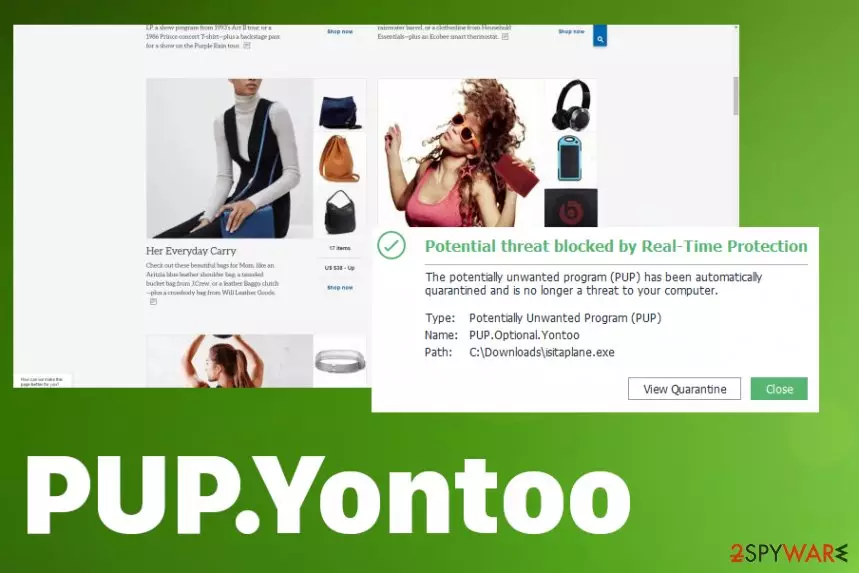
Pua.yontoo is the potentially unwanted program that can install itself as a browser extension and run for a while. It delivers advertising content and redirects users to shady pages. If the advertisements keep popping in front of your computer screen, it might be a sign that a potentially unwanted program in a category of adware managed to interfere with the performance.
PUP.Optional.Yontoo virus has been the one that infected your computer. Thus, its primary mission is to drive you mad with various pop-ups covering online content. This potentially malicious program might also wreck your browser settings which result in redirecting you to suspicious domains.
| Name | PUP.Optional.Yontoo |
|---|---|
| Other names | PUP.Yontoo, PUA.Yontoo |
| Type | Adware/ Potentially unwanted program |
| Distribution | Freeware installations, deceptive sites, and misleading online content leads to these PUP downloads and other infections |
| Elimination | You need proper AV tools for PUP.Optional.Yontoo removal |
| Repair | Rely on FortectIntego, so the damage if the virus can be eliminated |
IT experts have detected that this adware is related to Yontoo Layers Client and Yontoo Pagerage, so remain vigilant since these adware-type programs might target your PC as well. Speaking of the current PUP, it has quite a disgusting feature to muddle your browser settings. This results in PUP.Optional.Yontoo redirects issue.
Thus, you may start seeing Yontoo ads, or you can get mislead to its associated search engine. You may also find yourself in various advertising web pages, or sometimes in highly disturbing pornographic websites. It is often the case that trojans or similar malware hide there. If you do not want to get infected with a virus or two, then you should consider PUP.Optional.Yontoo removal.
Trojans have the ability to pass themselves as legitimate files. Moreover, they often contain menaces – ransomware – within themselves. Once the files get into a computer, they enwrap their content. Then, the consequences of such infiltration are highly severe. That is why you should be extremely careful not to click on any suspicious hyperlinks on those websites that pua.yontoo redirect you to.

Furthermore, if you spot an excessive amount of various banners and commercials, restrain from clicking on them. PUP.Optional.Yontoo ads are completely useless. Moreover, they do not bear any relevant information. This detection can show up as various alerts.
PUA.Yontoo is another detection name associated with this adware/ redirect virus. There is no other way to remove the threat by running the anti-malware tool that could find all the shady tools and remove all of them at once.
These pay-per-click advertisements are only designed to attract as many views as possible. Depending on the number of views and clicks, the developers of this pua.yontoo adware collect quite a decent income. Such activity is highly profitable while users only get irritation and annoyance.
Additionally, it is likely that the adware might generate offers suggesting you to install new applications. Do not fall into this trap and avoid installing any software while PUP.Optional.Yontoo resides on your computer.
Such programs might be completely useless or “enhanced” with malignant elements. All in all, stay alert and try to remove PUP.Optional.Yontoo as soon as possible. You also need to rely on PC repair tools like FortectIntego, so the damage is fixed and cleared of.
Adware slips through the installation options
Scammers developed an effective strategy to spread unwanted applications. The essence of this technique lies in pinning down the PUPs to frequently downloadable programs.
After you download one of them, you might often overlook that “bonus” applications come along. Thus, when the installation process is finished, the add-ons which were automatically pre-marked get installed as well.
Alternatively, we offer another way of installing a new program without adware or other unwanted software. Select “Advanced” installation mode rather than “Recommended”. Afterward, uncheck the pre-marked software. If you follow these steps, you will be able to prevent such hijacks in the future.
Run proper AV tools to remove PUP.Optional.Yontoo virus
It is not difficult to get rid of this potentially unwanted program. The easiest and fastest way to remove PUP.Optional.Yontoo virus is to install an anti-spyware program. It quickly detects the PUP and removes it in a blink of an eye.
Remember to update your AV tool regularly so that it could protect your operating system from unwanted “guests.” There is also a manual PUP.Optional.Yontoo removal option. We recommend you to carefully complete each step of the guidelines. Eliminating all associated files is of high importance.
Uninstall from Windows
Uninstall from Windows 10/8:
- Type Control Panel into the Windows search box and open the result.
- Under Programs, select Uninstall a program.


Uninstall from Windows 7/XP:
- Click on Windows Start > Control Panel (Windows XP users should click on Add/Remove Programs).
- In Control Panel, select Programs > Uninstall a program.


Remove the unwanted program:
- In the Programs and Features window, look for any recently installed suspicious entries, select them, and click Uninstall.
- If User Account Control appears, click Yes to confirm, then complete the removal.


Delete from macOS
Remove the unwanted application:
- From the menu bar, select Go > Applications.
- In the Applications folder, look for any suspicious entries, then drag them to Trash (or right-click and pick Move to Trash).


Delete leftover files and folders:
- Select Go > Go to Folder.
- Enter /Library/Application Support and remove any suspicious folders related to the unwanted program.
- Repeat the same check in the /Library/LaunchAgents and /Library/LaunchDaemons folders, deleting any suspicious entries.

- Finally, empty the Trash to permanently remove the leftovers.

Reset Internet Explorer
Remove dangerous add-ons:
- Open Internet Explorer, click on the Gear icon (IE menu) on the top-right corner of the browser
- Pick Manage Add-ons.
- You will see a Manage Add-ons window. Here, look for suspicious plugins. Click on these entries and select Disable.


Change your homepage if it was altered:
- Open IE and click on the Gear icon.
- Select Internet Options.
- In the General tab, delete the Home page address and replace it by your preferred one (for example, Google.com).
- Click Apply and then select OK.


Delete temporary files:
- Press on the Gear icon and select Internet Options.
- Under Browsing history, click Delete...
- Select relevant fields and press Delete.


Reset Internet Explorer:
- Click on Gear icon > Internet options and select Advanced tab.
- Select Reset.
- In the new window, check Delete personal settings and select Reset.


Remove from Microsoft Edge
Delete unwanted extensions from MS Edge:
- Select Menu (three horizontal dots at the top-right of the browser window) and pick Extensions.
- From the list, pick the extension and click on the Gear icon.
- Click Remove.


Clear cookies and other browser data:
- Click on the Menu (three horizontal dots at the top-right of the browser window) and select Settings > Privacy, search, and services..
- Under Clear browsing data, pick Choose what to clear.
- Select Cookies and other site data and Cached images and files. (apart from passwords, although you might want to include Media licenses as well, if applicable) and click on Clear.


Restore new tab and homepage settings:
- Click the menu icon and choose Settings.
- Then find On startup section.
- Click Remove next to any suspicious startup page.
Reset MS Edge if the above steps did not work:
- Press on Ctrl + Shift + Esc to open Task Manager.
- Click on More details arrow at the bottom of the window.
- Select Details tab.
- Now scroll down and locate every entry with Microsoft Edge name in it. Right-click on each of them and select End Task to stop MS Edge from running.


Instructions for Chromium-based Edge
Delete extensions from MS Edge (Chromium):
- Open Edge and click select Settings > Extensions.
- Delete unwanted extensions by clicking Remove.


Clear cache and site data:
- Click on Menu and go to Settings.
- Select Privacy, search and services.
- Under Clear browsing data, pick Choose what to clear.
- Under Time range, pick All time.
- Select Clear now.


Reset Chromium-based MS Edge:
- Click on Menu and select Settings.
- On the left side, pick Reset settings.
- Select Restore settings to their default values.
- Confirm with Reset.
- This will disable extensions and reset startup pages but will not delete bookmarks, saved passwords, or browsing history.


Remove from Mozilla Firefox (FF)
Remove dangerous extensions:
- Open Mozilla Firefox browser and click on the Menu (three horizontal lines at the top-right of the window).
- Select Add-ons.
- In here, select the unwanted extension and click Remove.


Reset the homepage:
- Click three horizontal lines at the top right corner to open the menu.
- Choose Settings.
- Under Home, set your preferred homepage and new tab settings.
Clear cookies and site data:
- Click Menu and pick Settings.
- Go to Privacy & Security section.
- Scroll down to locate Cookies and Site Data.
- Click on Clear Data...
- Select Cookies and Site Data and Temporary cached files and pages, then click Clear.


Reset Mozilla Firefox
If clearing the browser as explained above did not help, reset Mozilla Firefox:
- Open Mozilla Firefox browser and click the Menu.
- Go to Help and then choose Troubleshooting Information.

- Under Give Firefox a tune up section, click on Refresh Firefox...
- Once the pop-up shows up, confirm the action by pressing on Refresh Firefox.



Remove from Google Chrome
Delete malicious extensions from Google Chrome:
- Open Google Chrome, click on the Menu (three vertical dots at the top-right corner) and select More tools > Extensions.
- In the newly opened window, you will see all the installed extensions. Uninstall all suspicious extensions related to the unwanted program by clicking Remove.


Clear cache and web data from Chrome:
- Click on Menu and pick Settings.
- Under Privacy and security, select Clear browsing data.
- Select Browsing history, Cookies and other site data, as well as Cached images and files.
- Click Clear data.


Change your homepage:
- Click menu and choose Settings.
- Look for a suspicious site in the On startup section.
- Click on Open a specific or set of pages and click on three dots to find the Remove option.
Reset Google Chrome:
If the previous methods did not help you, reset Google Chrome to eliminate all the unwanted components:
- Click on Menu and select Settings.
- In the Settings, scroll down and click Advanced.
- Scroll down and locate Reset and clean up section.
- Now click Restore settings to their original defaults.
- Confirm with Reset settings.


Delete from Safari
Remove dangerous extensions:
- Open Safari, click Safari in the menu at the top-left of the screen, and select Preferences.
- Go to the Extensions tab, look for any suspicious entries, and click Uninstall to remove them.


Clear history and website data:
- Click Safari in the menu and pick Clear History.
- Set Clear to all history and confirm with Clear History.


Reset Safari:
- Click Safari in the menu and select Preferences > Advanced.
- Enable Show Develop menu in menu bar.
- From the menu bar, click Develop and select Empty Caches.


Did this guide help?
2 comments
Ian
Thanks for the tutorial! This one is a pesky one.
Shaylene
You never know how many of PUPs youll collect while you are surfing in legitimate websites...what a drag...