

Main features that define ScenicHomepage Toolbar
After the program’s unexpected appearance on the system, confused users often start flooding web forums and online security counselors inquiring about ScenicHomepage Toolbar virus removal options. In reality, there is no need to look that far because Scenic Homepage is a legitimate browser extension [1] released by a company called Mindspark, so you should be able to delete it from your computer without any special effort. Although the program itself is not malicious and is highly unlikely to damage your computer, its appearance on your system reveals issues related to your browsing habits. If you do not remember having installed this toolbar on your browser yourself, this suggests that you have given the permission unknowingly. This usually happens when users rush through the software installation steps and don’t bother to analyze the complete list of components included in the downloaded software packages [2]. This way, the initial software gets installed along with all the suggested applications [3]. If you often find yourself behaving in such a manner, don’t be surprised to see some new, unfamiliar applications emerging on your computer from time to time. If it so happened that you have unwillingly acquired and now want to remove ScenicHomepage Toolbar from your computer, keep reading this article, and you will find all the answers.
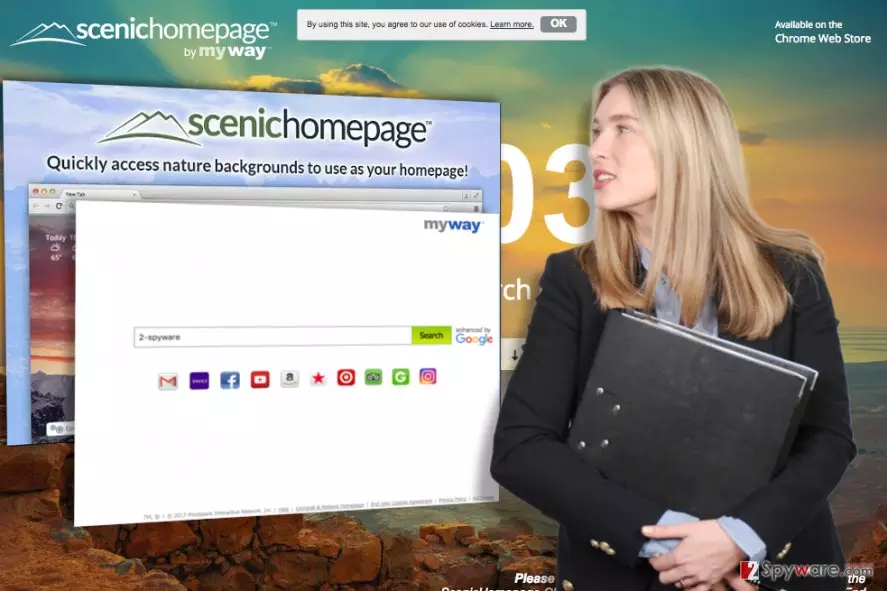
Despite the fact that users themselves are the ones to take most of the responsibility for allowing this toolbar to install on their computers, we can’t say ScenicHomepage Toolbar is completely innocent either. The developers purposefully choose bundling as an additional strategy of spreading this software around, though its download link can already be found on Google Store and the application’s official website. Besides, once the program gets installed on the computer, it does not only pin ScenicHomepage Toolbar on web browsers but also changes the homepage and default search engine by replacing them with hp.myway.com search engine, similarly to what browser hijackers [4] do. This engine is known as a modified web search which mainly focuses on promoting affiliate websites and products [5]. If this is not exactly what your expect from your browser, do not hesitate and proceed straight to the ScenicHomepage Toolbar removal. A sophisticated antivirus software such as FortectIntego may detect it as PUP (potentially unwanted program) and eliminate it from your computer automatically, though it is also possible to delete the program manually.
Recently, the developer of this program contacted us asking us to remove this post from 2-spyware.com website. We believe that we shouldn’t do that as long as programs that we offer for the removal of ScenicHomepage Toolbar can detect it and help users to remove it from the system. As it is mentioned under each of download buttons, we ARE affiliated with these anti-malware programs, and while some of them are free, others can remove a virus only after purchasing them. These mentions fully fulfil each of the requirements of FTC.
Nevertheless, we have recently decided to make a revision of this and other posts that are related to this developer. We claim that all of them are described properly.
How do I prevent this toolbar from returning to my browser?
If you have already eliminated ScenicHomepage Toolbar and simply want to learn more about how to avoid such unexpected encounters, you should remember three things:
- Freeware and shareware rarely travel alone and are commonly bundled with additional programs. ScenicHomepage Toolbar can surely be one of them. So, if you do not want to see this browser helper on your computer again, you should always go through the contents of the downloaded software packages manually and deselect the undesirable components.
- Software bundles appended with potentially unwanted applications are usually distributed on obscure and unpopular websites, so you must choose your download sources carefully.
- Do not leave your computer unprotected. If you actively browse the web and download various software, you must make sure your computer is given proper protection. Obtain a reputable antivirus utility with real-time protection and keep it regularly updated.
Our suggestions on ScenicHomepage Toolbar removal:
While such malware like ScenicHomepage Toolbar virus virtually does not exist, antivirus utilities may find it difficult to detect and remove it. Thus, we recommend taking a look at our expert-prepared ScenicHomepage Toolbar removal suggestions. These simple steps will help remove ScenicHomepage Toolbar from your computer in a few simple steps. Pay attention that below the elimination guide you will also find browser reset instructions which are necessary to eliminate the virus from the computer entirely.
Uninstall from Windows
Uninstall from Windows 10/8:
- Type Control Panel into the Windows search box and open the result.
- Under Programs, select Uninstall a program.


Uninstall from Windows 7/XP:
- Click on Windows Start > Control Panel (Windows XP users should click on Add/Remove Programs).
- In Control Panel, select Programs > Uninstall a program.


Remove the unwanted program:
- In the Programs and Features window, look for any recently installed suspicious entries, select them, and click Uninstall.
- If User Account Control appears, click Yes to confirm, then complete the removal.


Delete from macOS
Remove the unwanted application:
- From the menu bar, select Go > Applications.
- In the Applications folder, look for any suspicious entries, then drag them to Trash (or right-click and pick Move to Trash).


Delete leftover files and folders:
- Select Go > Go to Folder.
- Enter /Library/Application Support and remove any suspicious folders related to the unwanted program.
- Repeat the same check in the /Library/LaunchAgents and /Library/LaunchDaemons folders, deleting any suspicious entries.

- Finally, empty the Trash to permanently remove the leftovers.

Reset Internet Explorer
Remove dangerous add-ons:
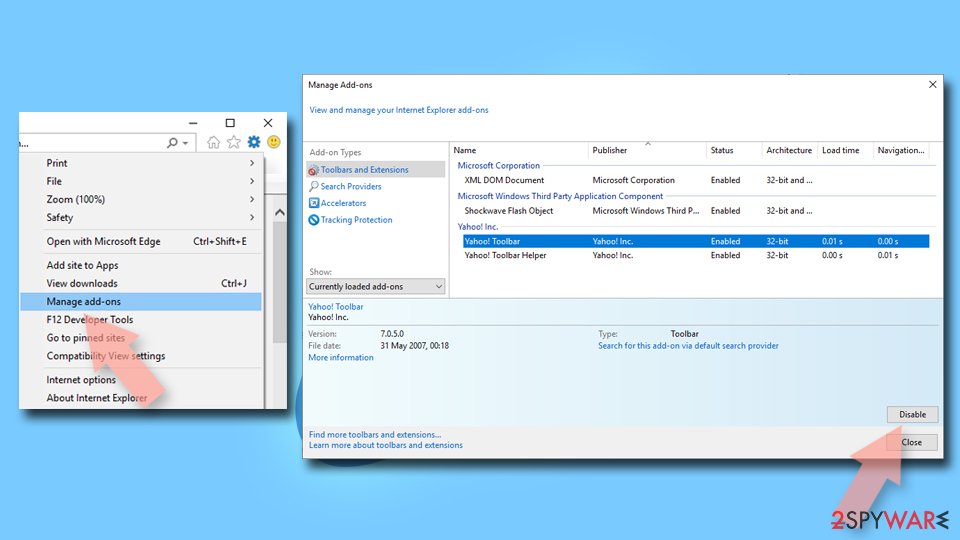
- Open Internet Explorer, click on the Gear icon (IE menu) on the top-right corner of the browser
- Pick Manage Add-ons.
- You will see a Manage Add-ons window. Here, look for suspicious plugins. Click on these entries and select Disable.

Change your homepage if it was altered:
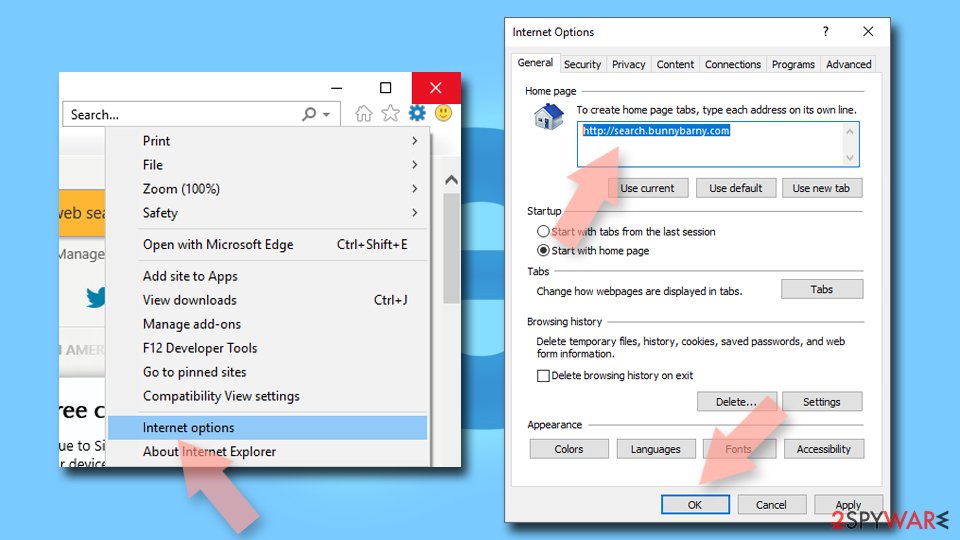
- Open IE and click on the Gear icon.
- Select Internet Options.
- In the General tab, delete the Home page address and replace it by your preferred one (for example, Google.com).
- Click Apply and then select OK.

Delete temporary files:
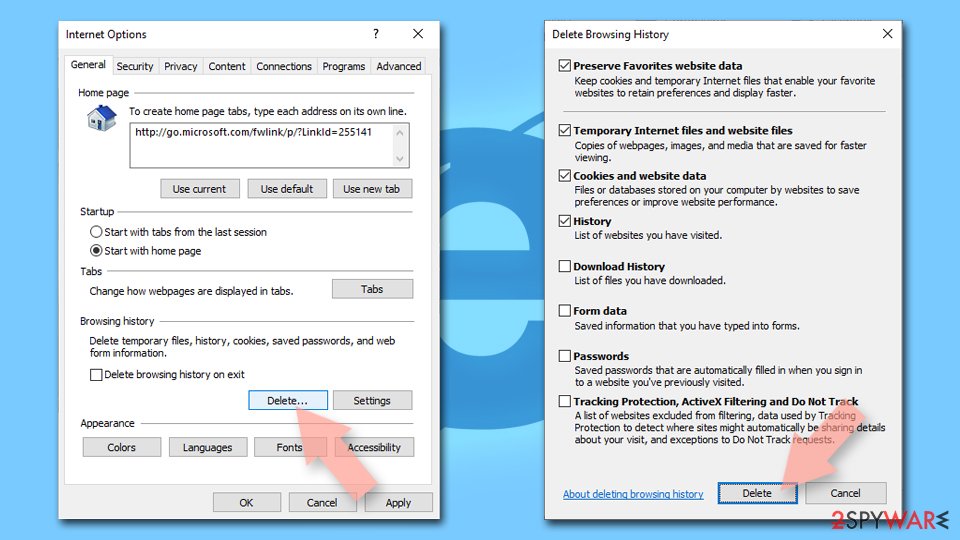
- Press on the Gear icon and select Internet Options.
- Under Browsing history, click Delete...
- Select relevant fields and press Delete.

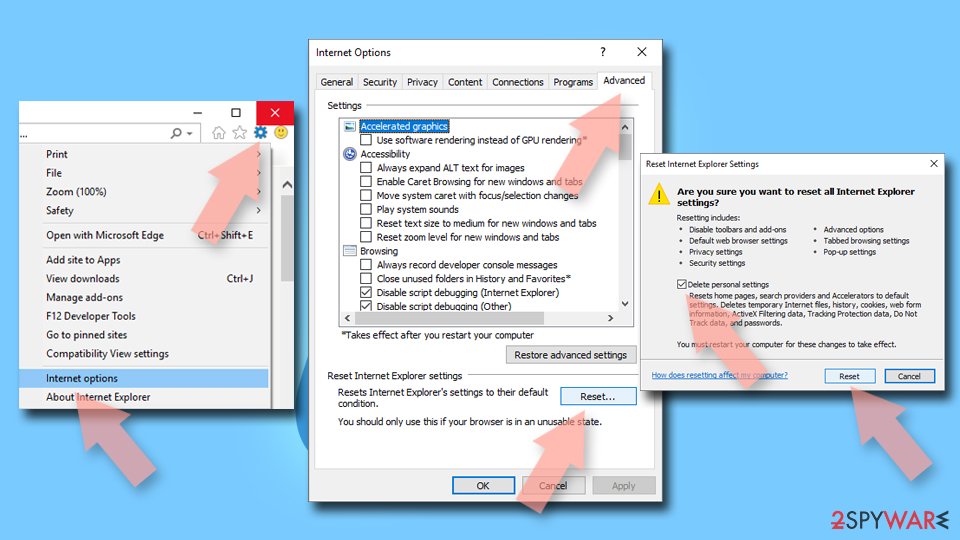
Reset Internet Explorer:
- Click on Gear icon > Internet options and select Advanced tab.
- Select Reset.
- In the new window, check Delete personal settings and select Reset.

Remove from Microsoft Edge
Delete unwanted extensions from MS Edge:
- Select Menu (three horizontal dots at the top-right of the browser window) and pick Extensions.
- From the list, pick the extension and click on the Gear icon.
- Click Remove.


Clear cookies and other browser data:
- Click on the Menu (three horizontal dots at the top-right of the browser window) and select Settings > Privacy, search, and services..
- Under Clear browsing data, pick Choose what to clear.
- Select Cookies and other site data and Cached images and files. (apart from passwords, although you might want to include Media licenses as well, if applicable) and click on Clear.


Restore new tab and homepage settings:
- Click the menu icon and choose Settings.
- Then find On startup section.
- Click Remove next to any suspicious startup page.
Reset MS Edge if the above steps did not work:
- Press on Ctrl + Shift + Esc to open Task Manager.
- Click on More details arrow at the bottom of the window.
- Select Details tab.
- Now scroll down and locate every entry with Microsoft Edge name in it. Right-click on each of them and select End Task to stop MS Edge from running.


Instructions for Chromium-based Edge
Delete extensions from MS Edge (Chromium):
- Open Edge and click select Settings > Extensions.
- Delete unwanted extensions by clicking Remove.


Clear cache and site data:
- Click on Menu and go to Settings.
- Select Privacy, search and services.
- Under Clear browsing data, pick Choose what to clear.
- Under Time range, pick All time.
- Select Clear now.


Reset Chromium-based MS Edge:
- Click on Menu and select Settings.
- On the left side, pick Reset settings.
- Select Restore settings to their default values.
- Confirm with Reset.
- This will disable extensions and reset startup pages but will not delete bookmarks, saved passwords, or browsing history.


Remove from Mozilla Firefox (FF)
Remove dangerous extensions:
- Open Mozilla Firefox browser and click on the Menu (three horizontal lines at the top-right of the window).
- Select Add-ons.
- In here, select the unwanted extension and click Remove.


Reset the homepage:
- Click three horizontal lines at the top right corner to open the menu.
- Choose Settings.
- Under Home, set your preferred homepage and new tab settings.
Clear cookies and site data:
- Click Menu and pick Settings.
- Go to Privacy & Security section.
- Scroll down to locate Cookies and Site Data.
- Click on Clear Data...
- Select Cookies and Site Data and Temporary cached files and pages, then click Clear.


Reset Mozilla Firefox
If clearing the browser as explained above did not help, reset Mozilla Firefox:
- Open Mozilla Firefox browser and click the Menu.
- Go to Help and then choose Troubleshooting Information.

- Under Give Firefox a tune up section, click on Refresh Firefox...
- Once the pop-up shows up, confirm the action by pressing on Refresh Firefox.



Remove from Google Chrome
Delete malicious extensions from Google Chrome:
- Open Google Chrome, click on the Menu (three vertical dots at the top-right corner) and select More tools > Extensions.
- In the newly opened window, you will see all the installed extensions. Uninstall all suspicious extensions related to the unwanted program by clicking Remove.


Clear cache and web data from Chrome:
- Click on Menu and pick Settings.
- Under Privacy and security, select Clear browsing data.
- Select Browsing history, Cookies and other site data, as well as Cached images and files.
- Click Clear data.


Change your homepage:
- Click menu and choose Settings.
- Look for a suspicious site in the On startup section.
- Click on Open a specific or set of pages and click on three dots to find the Remove option.
Reset Google Chrome:
If the previous methods did not help you, reset Google Chrome to eliminate all the unwanted components:
- Click on Menu and select Settings.
- In the Settings, scroll down and click Advanced.
- Scroll down and locate Reset and clean up section.
- Now click Restore settings to their original defaults.
- Confirm with Reset settings.


Delete from Safari
Remove dangerous extensions:
- Open Safari, click Safari in the menu at the top-left of the screen, and select Preferences.
- Go to the Extensions tab, look for any suspicious entries, and click Uninstall to remove them.


Clear history and website data:
- Click Safari in the menu and pick Clear History.
- Set Clear to all history and confirm with Clear History.


Reset Safari:
- Click Safari in the menu and select Preferences > Advanced.
- Enable Show Develop menu in menu bar.
- From the menu bar, click Develop and select Empty Caches.


Did this guide help?
Be the first to comment