

Searchfortplus.com is a dubious application that tracks your online behavior
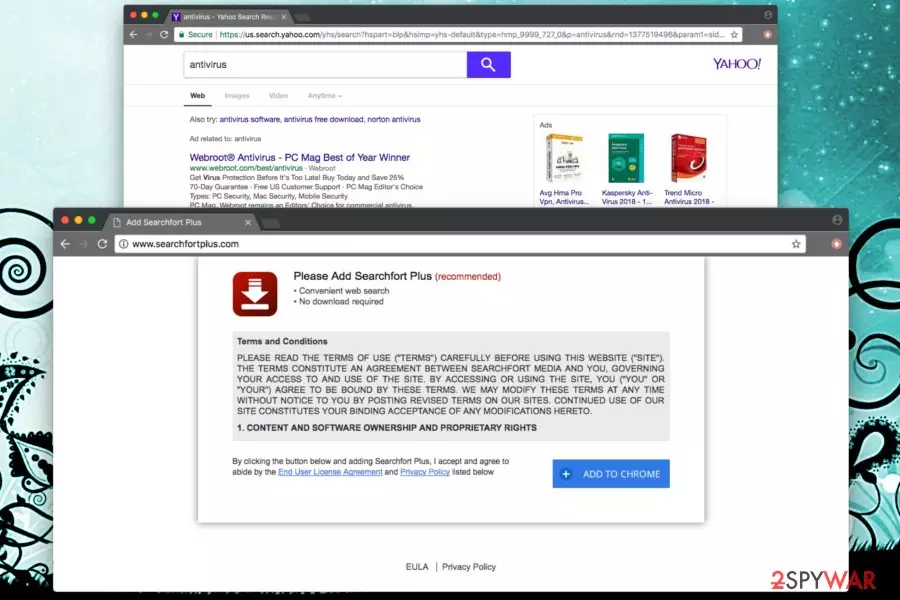
Searchfortplus.com is a browser hijacker that typically enters users machines with bundling, although users can also add Searchfort Plus extension through the website or Google web store. Soon after infiltration, the hijacker modifies browser settings and Windows registry to be able to start its activities.
| SUMMARY | |
| Name | Searchfortplus.com |
|---|---|
| Type | Browser hijacker |
| Official website | hxxp://www.searchfortplus.com/ |
| Browsers affected | Google Chrome, Internet Explorer, Mozilla Firefox, Safari, etc. |
| Distribution | Software bundling, web store, official website |
| Symtoms | Changed browser settings; increased amount of ads, redirects, pop-ups, etc. |
| Elimination | Download and install FortectIntego. Otherwise check the guide for manual deletion |
Developed by Aztec Media (which is also responsible for such browser hijackers as moviesearchcenter.com, 4newtab.com, blpsearch.com and many others), the questionable application is designed having one thought in mind – to generate revenue while exposing users to sponsored content.
To achieve that, Searchfortplus.com floods Google Chrome, Internet Explorer, Mozilla Firefox, etc. with advertisements and displays them whether users want it or not. The only way to eliminate these ads is to remove Searchfortplus.com entirely. You can either download a reputable security tool like FortectIntego or delete the virus manually.
Soon after Searchfort Plus hijack, the significant changes are made to each of the browsers:
- The startup page, new tab, and search engine are set to hxxp://www.searchfortplus.com. These changes allow the suspicious app to prevent users from navigating to certain websites (such as preferred homepage or anti-virus sites);
- Users might be rerouted to unknown domains. Third-party content might be legitimate and sometimes even useful. However, victims can also get redirected to websites of questionable content, such as pornographic, gambling, fake software, etc. Therefore, malware infections and personal data leakage are possible due to PUP’s redirecting tendencies;
- Ads are delivered to users non-stop. These advertisements might conceal the background of legitimate websites. Also, some random words might be turned into hyperlinks;
- Search results are altered to expose users to affiliated sites. This way, Aztec Media receives revenue for each click, even if it is accidental. This scheme is called “pay-per-click.”
- Users can observe additional components added without their consent, such as toolbars, extensions, new bookmarks, etc.
Additionally, just like many other browser hijackers out there, Searchfortplus.com virus gathers a significant amount of non-personally identifiable information (including IP address, browser type, ISP, cookie information,[1] search queries and similar). This data is gathered to monitor users’ behavior online to deliver targeted sponsored ads.
Although Aztec Media does not sell or share any personal information,[2] it is worth mentioning the following from Privacy Policy:
In the event that Aztec Media goes through a business transition, such as a merger, acquisition by another company, or sale of all or a portion of its assets, Personal Information will likely be among the assets transferred in the transaction.
Thus, by accepting the terms and conditions, you agree that the developer can transfer your personal data, in case the position of the company changes. Personal details might end in cybercriminals’ possession and used for illegal purposes, such as identity theft.
You should not delay Searchfortplus.com removal. Do not forget, that the longer you wait, the more likely you are to lose your personal data or obtain malware. Not to mention the annoyance non-stop ads can bring.

The way PUPs are distributed
Security experts[2] concluded that users are unaware how browser hijackers enter their machines. Some people why aren’t that experienced with the computer and the internet don’t even notice its presence. It is possible due to free software developers and PUP authors other use a marketing technique called bundling. This allows developers to add additional components into their installers.
These additional applications are optional. However, users fail to pick “Advanced/Custom” mode and remove all the tick marks that allow installation of add-ons, toolbars,[3] search engines, system optimizers and similar.
Despite free software developers’ recommendations, never pick “Recommended/Quick” settings. It might save time but might also install adware or other PUPs into your machine. Sometimes, these might lead to more severe threats. Thus, saving few minutes is not worth it.
Eliminate Searchfort Plus in just a few minutes
You can remove Searchfortplus.com virus in two ways – manual or automatic. Both methods are effective; however, the latter one is quicker.
Manual Searchfortplus.com removal is only recommended to computer-savvy individuals as tampering with system files without enough experience might lead to computer damage. Thus, if you are knowledgeable enough, check our step-by-step guide below.
For most people, we recommend automatic option. The security software can get rid of Searchfort Plus and all its components by a few clicks. Download one of the reputable anti-virus programs, bring it up to date and perform a full system scan.
Uninstall from Windows
Uninstall from Windows 10/8:
- Type Control Panel into the Windows search box and open the result.
- Under Programs, select Uninstall a program.


Uninstall from Windows 7/XP:
- Click on Windows Start > Control Panel (Windows XP users should click on Add/Remove Programs).
- In Control Panel, select Programs > Uninstall a program.


Remove the unwanted program:
- In the Programs and Features window, look for any recently installed suspicious entries, select them, and click Uninstall.
- If User Account Control appears, click Yes to confirm, then complete the removal.


Delete from macOS
Remove the unwanted application:
- From the menu bar, select Go > Applications.
- In the Applications folder, look for any suspicious entries, then drag them to Trash (or right-click and pick Move to Trash).


Delete leftover files and folders:
- Select Go > Go to Folder.
- Enter /Library/Application Support and remove any suspicious folders related to the unwanted program.
- Repeat the same check in the /Library/LaunchAgents and /Library/LaunchDaemons folders, deleting any suspicious entries.

- Finally, empty the Trash to permanently remove the leftovers.

Reset Internet Explorer
Remove dangerous add-ons:
- Open Internet Explorer, click on the Gear icon (IE menu) on the top-right corner of the browser
- Pick Manage Add-ons.
- You will see a Manage Add-ons window. Here, look for suspicious plugins. Click on these entries and select Disable.


Change your homepage if it was altered:
- Open IE and click on the Gear icon.
- Select Internet Options.
- In the General tab, delete the Home page address and replace it by your preferred one (for example, Google.com).
- Click Apply and then select OK.


Delete temporary files:
- Press on the Gear icon and select Internet Options.
- Under Browsing history, click Delete...
- Select relevant fields and press Delete.


Reset Internet Explorer:
- Click on Gear icon > Internet options and select Advanced tab.
- Select Reset.
- In the new window, check Delete personal settings and select Reset.


Remove from Microsoft Edge
Delete unwanted extensions from MS Edge:
- Select Menu (three horizontal dots at the top-right of the browser window) and pick Extensions.
- From the list, pick the extension and click on the Gear icon.
- Click Remove.


Clear cookies and other browser data:
- Click on the Menu (three horizontal dots at the top-right of the browser window) and select Settings > Privacy, search, and services..
- Under Clear browsing data, pick Choose what to clear.
- Select Cookies and other site data and Cached images and files. (apart from passwords, although you might want to include Media licenses as well, if applicable) and click on Clear.


Restore new tab and homepage settings:
- Click the menu icon and choose Settings.
- Then find On startup section.
- Click Remove next to any suspicious startup page.
Reset MS Edge if the above steps did not work:
- Press on Ctrl + Shift + Esc to open Task Manager.
- Click on More details arrow at the bottom of the window.
- Select Details tab.
- Now scroll down and locate every entry with Microsoft Edge name in it. Right-click on each of them and select End Task to stop MS Edge from running.


Instructions for Chromium-based Edge
Delete extensions from MS Edge (Chromium):
- Open Edge and click select Settings > Extensions.
- Delete unwanted extensions by clicking Remove.


Clear cache and site data:
- Click on Menu and go to Settings.
- Select Privacy, search and services.
- Under Clear browsing data, pick Choose what to clear.
- Under Time range, pick All time.
- Select Clear now.


Reset Chromium-based MS Edge:
- Click on Menu and select Settings.
- On the left side, pick Reset settings.
- Select Restore settings to their default values.
- Confirm with Reset.
- This will disable extensions and reset startup pages but will not delete bookmarks, saved passwords, or browsing history.


Remove from Mozilla Firefox (FF)
Remove dangerous extensions:
- Open Mozilla Firefox browser and click on the Menu (three horizontal lines at the top-right of the window).
- Select Add-ons.
- In here, select the unwanted extension and click Remove.


Reset the homepage:
- Click three horizontal lines at the top right corner to open the menu.
- Choose Settings.
- Under Home, set your preferred homepage and new tab settings.
Clear cookies and site data:
- Click Menu and pick Settings.
- Go to Privacy & Security section.
- Scroll down to locate Cookies and Site Data.
- Click on Clear Data...
- Select Cookies and Site Data and Temporary cached files and pages, then click Clear.


Reset Mozilla Firefox
If clearing the browser as explained above did not help, reset Mozilla Firefox:
- Open Mozilla Firefox browser and click the Menu.
- Go to Help and then choose Troubleshooting Information.

- Under Give Firefox a tune up section, click on Refresh Firefox...
- Once the pop-up shows up, confirm the action by pressing on Refresh Firefox.



Remove from Google Chrome
Delete malicious extensions from Google Chrome:
- Open Google Chrome, click on the Menu (three vertical dots at the top-right corner) and select More tools > Extensions.
- In the newly opened window, you will see all the installed extensions. Uninstall all suspicious extensions related to the unwanted program by clicking Remove.


Clear cache and web data from Chrome:
- Click on Menu and pick Settings.
- Under Privacy and security, select Clear browsing data.
- Select Browsing history, Cookies and other site data, as well as Cached images and files.
- Click Clear data.


Change your homepage:
- Click menu and choose Settings.
- Look for a suspicious site in the On startup section.
- Click on Open a specific or set of pages and click on three dots to find the Remove option.
Reset Google Chrome:
If the previous methods did not help you, reset Google Chrome to eliminate all the unwanted components:
- Click on Menu and select Settings.
- In the Settings, scroll down and click Advanced.
- Scroll down and locate Reset and clean up section.
- Now click Restore settings to their original defaults.
- Confirm with Reset settings.


Delete from Safari
Remove dangerous extensions:
- Open Safari, click Safari in the menu at the top-left of the screen, and select Preferences.
- Go to the Extensions tab, look for any suspicious entries, and click Uninstall to remove them.


Clear history and website data:
- Click Safari in the menu and pick Clear History.
- Set Clear to all history and confirm with Clear History.


Reset Safari:
- Click Safari in the menu and select Preferences > Advanced.
- Enable Show Develop menu in menu bar.
- From the menu bar, click Develop and select Empty Caches.


Did this guide help?
Be the first to comment