

Smartnewtab.com is a program that redirects to dubious sites claiming that the system is infected with E.tre456_worm_osx and similar viruses
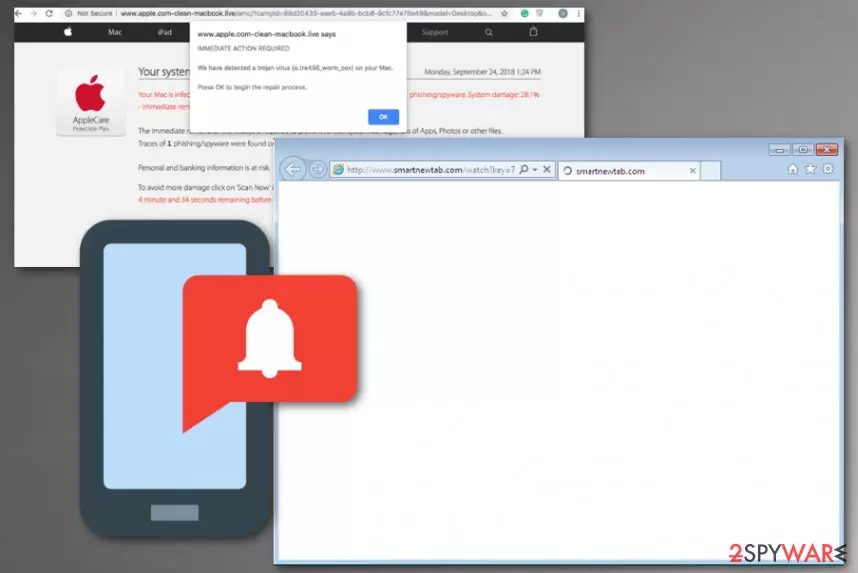
Smart New Tab is adware-type[1] program that delivers intrusive ads claiming that the system is infected with E.tre456_worm_osx, Tapsnake, and similar viruses. However, after seeing such alerts, you can be sure that your computer is affected by adware. All PUPs of this kind are designed to advertise certain products or websites, redirect traffic to dubious websites, and even track their victims to know more about their interests. However, beware that such intrusive activity and background processes can diminish the performance of your PC in general. Besides, these commercial offers and virus notifications can lead you to the installation of useless tools or even viruses. In this case, Smartnewtab.com virus is actively pushing Advanced Mac Cleaner which is more than just a simple PUP lurking around. People have been dealing with this threat since 2014.[2]
| Name | Smart New Tab |
|---|---|
| Type | Adware |
| Category | Potentially unwanted program |
| Symptoms | Redirects users to unsafe websites, delivers intrusive ads, promotes malware |
| viruses reported in ads | Tapsnake, E.tre456_worm_osx, CronDNS, Dubfishicv |
| Main virus promoted | Advanced Mac Cleaner |
| Distribution | Software bundles |
| Elimination | Use FortectIntego for fixing virus damage |
Smart New Tab gets activated after clicking on one of its ads. As a result, it starts redirecting to numerous commercial domains and finishes on a site claiming that the system is infected with malware. Even if the redirect domains contain catchy headlines or intriguing reports, exit them right away as they might end up with unpleasant “bonus” content – other PUPs or even malware.
Furthermore, you should know that similar rogue sites might collect quite a handful of information about your browsing preferences. In other words, the data about recently and frequently visited domains, search entries, IP address, and even email address can be accessed by this Smart New Tab virus.
The primary goal of SmartNewTab activity is to collect as much relevant information as possible. Later on, it is exploited by the advertiser for marketing purposes and even sold to suspicious third parties. The collected data can be used to generate personalized ads, create pay-per-click revenue, or can even be misused for identity theft.[1]
Thus, you can get rid of them, and you need to proceed with Smart New Tab removal as soon as possible. This is crucial because collected information leads to more advertisements and redirects to dubious, possibly malicious websites. This constant background activity makes your device running slow.
The signs indicating that you have an adware-type program like smartnewtab.com on the device include the following unwanted activities:
- numerous ads randomly appear on commonly visited sites;
- various banners are injected into random websites;
- homepage and new tab settings are changed to an unknown domain on every browser;
- websites randomly redirect to commercial sites;
- search results are filled with questionable hyperlinks;
- additional programs, toolbars or extensions appear on the system without your knowledge.
We suggest you remove Smart New Tab virus by using reputable malware-fighting tools or follow our manual removal guide posted at the end of this article. You need to scan your system fully to delete all possible threats and tools that you don't even need. Finally, fix virus damage with the help of FortectIntego as there are numerous different components installed by viruses like this one.
To complete Smart New Tab removal, don't forget to reset your web browsers. Our step-by-step guide will help you do that professionally and will clean your system further by offering to eliminate suspicious browser add-ons, extensions, and plugins.

Ways to distribute PUPs and other cyber infections
Potentially unwanted programs like adware or browser hijackers tend to spread along with free applications. Most likely, you encounter it when installing a new movie streaming player or image editing tool. Due to the common habit of choosing Quick or Default options as installation settings.
Unfortunately, these additional programs concealed during these insecure processes. Thus, dashing through the stages, you left the checkbox of unknown application pre-marked. As a result, you enabled the installation of additional applications. Upon starting the installation guide, make sure to opt for “Advanced” settings. Then, unmark the additional pieces and only then continue installing the wanted software.
Tips on SmartNewTab removal
As many researchers[3] advise, the proper solution for adware is automatic Smartnewtab.com removal. After installing reputable security application and performing the full scan you will get rid of the virus causing serious danger to your system. Do not install recommended software as there is a great danger to end up with malware.
Also, you might check the manual removal guidelines down below to fix your PC without complementary tools. However, note that viruses like this one travel around together with different components that are used to reinstall the virus right after the victim reboots his or her computer. To remove Smartnewtab.com virus and fix its damage, uninstall the PUP via the task manager, reset web browsers, and double check the system by running a full scan with recommended software.
Uninstall from Windows
Uninstall from Windows 10/8:
- Type Control Panel into the Windows search box and open the result.
- Under Programs, select Uninstall a program.


Uninstall from Windows 7/XP:
- Click on Windows Start > Control Panel (Windows XP users should click on Add/Remove Programs).
- In Control Panel, select Programs > Uninstall a program.


Remove the unwanted program:
- In the Programs and Features window, look for any recently installed suspicious entries, select them, and click Uninstall.
- If User Account Control appears, click Yes to confirm, then complete the removal.


Delete from macOS
Remove the unwanted application:
- From the menu bar, select Go > Applications.
- In the Applications folder, look for any suspicious entries, then drag them to Trash (or right-click and pick Move to Trash).


Delete leftover files and folders:
- Select Go > Go to Folder.
- Enter /Library/Application Support and remove any suspicious folders related to the unwanted program.
- Repeat the same check in the /Library/LaunchAgents and /Library/LaunchDaemons folders, deleting any suspicious entries.

- Finally, empty the Trash to permanently remove the leftovers.

Reset Internet Explorer
Remove dangerous add-ons:
- Open Internet Explorer, click on the Gear icon (IE menu) on the top-right corner of the browser
- Pick Manage Add-ons.
- You will see a Manage Add-ons window. Here, look for suspicious plugins. Click on these entries and select Disable.


Change your homepage if it was altered:
- Open IE and click on the Gear icon.
- Select Internet Options.
- In the General tab, delete the Home page address and replace it by your preferred one (for example, Google.com).
- Click Apply and then select OK.


Delete temporary files:
- Press on the Gear icon and select Internet Options.
- Under Browsing history, click Delete...
- Select relevant fields and press Delete.


Reset Internet Explorer:
- Click on Gear icon > Internet options and select Advanced tab.
- Select Reset.
- In the new window, check Delete personal settings and select Reset.


Remove from Microsoft Edge
Delete unwanted extensions from MS Edge:
- Select Menu (three horizontal dots at the top-right of the browser window) and pick Extensions.
- From the list, pick the extension and click on the Gear icon.
- Click Remove.


Clear cookies and other browser data:
- Click on the Menu (three horizontal dots at the top-right of the browser window) and select Settings > Privacy, search, and services..
- Under Clear browsing data, pick Choose what to clear.
- Select Cookies and other site data and Cached images and files. (apart from passwords, although you might want to include Media licenses as well, if applicable) and click on Clear.


Restore new tab and homepage settings:
- Click the menu icon and choose Settings.
- Then find On startup section.
- Click Remove next to any suspicious startup page.
Reset MS Edge if the above steps did not work:
- Press on Ctrl + Shift + Esc to open Task Manager.
- Click on More details arrow at the bottom of the window.
- Select Details tab.
- Now scroll down and locate every entry with Microsoft Edge name in it. Right-click on each of them and select End Task to stop MS Edge from running.


Instructions for Chromium-based Edge
Delete extensions from MS Edge (Chromium):
- Open Edge and click select Settings > Extensions.
- Delete unwanted extensions by clicking Remove.


Clear cache and site data:
- Click on Menu and go to Settings.
- Select Privacy, search and services.
- Under Clear browsing data, pick Choose what to clear.
- Under Time range, pick All time.
- Select Clear now.


Reset Chromium-based MS Edge:
- Click on Menu and select Settings.
- On the left side, pick Reset settings.
- Select Restore settings to their default values.
- Confirm with Reset.
- This will disable extensions and reset startup pages but will not delete bookmarks, saved passwords, or browsing history.


Remove from Mozilla Firefox (FF)
Remove dangerous extensions:
- Open Mozilla Firefox browser and click on the Menu (three horizontal lines at the top-right of the window).
- Select Add-ons.
- In here, select the unwanted extension and click Remove.


Reset the homepage:
- Click three horizontal lines at the top right corner to open the menu.
- Choose Settings.
- Under Home, set your preferred homepage and new tab settings.
Clear cookies and site data:
- Click Menu and pick Settings.
- Go to Privacy & Security section.
- Scroll down to locate Cookies and Site Data.
- Click on Clear Data...
- Select Cookies and Site Data and Temporary cached files and pages, then click Clear.


Reset Mozilla Firefox
If clearing the browser as explained above did not help, reset Mozilla Firefox:
- Open Mozilla Firefox browser and click the Menu.
- Go to Help and then choose Troubleshooting Information.

- Under Give Firefox a tune up section, click on Refresh Firefox...
- Once the pop-up shows up, confirm the action by pressing on Refresh Firefox.



Remove from Google Chrome
Delete malicious extensions from Google Chrome:
- Open Google Chrome, click on the Menu (three vertical dots at the top-right corner) and select More tools > Extensions.
- In the newly opened window, you will see all the installed extensions. Uninstall all suspicious extensions related to the unwanted program by clicking Remove.


Clear cache and web data from Chrome:
- Click on Menu and pick Settings.
- Under Privacy and security, select Clear browsing data.
- Select Browsing history, Cookies and other site data, as well as Cached images and files.
- Click Clear data.


Change your homepage:
- Click menu and choose Settings.
- Look for a suspicious site in the On startup section.
- Click on Open a specific or set of pages and click on three dots to find the Remove option.
Reset Google Chrome:
If the previous methods did not help you, reset Google Chrome to eliminate all the unwanted components:
- Click on Menu and select Settings.
- In the Settings, scroll down and click Advanced.
- Scroll down and locate Reset and clean up section.
- Now click Restore settings to their original defaults.
- Confirm with Reset settings.


Delete from Safari
Remove dangerous extensions:
- Open Safari, click Safari in the menu at the top-left of the screen, and select Preferences.
- Go to the Extensions tab, look for any suspicious entries, and click Uninstall to remove them.


Clear history and website data:
- Click Safari in the menu and pick Clear History.
- Set Clear to all history and confirm with Clear History.


Reset Safari:
- Click Safari in the menu and select Preferences > Advanced.
- Enable Show Develop menu in menu bar.
- From the menu bar, click Develop and select Empty Caches.


Did this guide help?
2 comments
fayerr
I occasionally spotted it in movie streaming websites.
dragonSword
These "tab" browsing tools are not suspicious at all.