

Information about Trusted Surf virus
Computer users who tend to install programs carelessly might come up with a Trusted Surf virus on their computers. This program hijacks Internet browsers and changes the homepage to Trustedsurf.com, which supposedly provides reliable web search engine. Unfortunately, this search engine is definitely untrustworthy, and you should not use it. Practically, it does not provide relevant search results, because its main function is to redirect users to particular web pages. Therefore, if you do not want to end up on possibly dangerous web pages, avoid using this search engine.
We assume that you want to get a more detailed explanation. So here’s how Trusted Surf browser hijacker works. Once it gets inside the computer system, it sets up its executive file as a startup program so that it would run immediately after you start your computer. It also adds Trusted Surf browser extension to each web browser to track what websites does the user visit, what links does he/she click on, and also other personally non-identifiable information such as computer’s geolocation and IP address. Officially, Trusted Surf virus might claim that it uses this information to its site and provide better services for you, however, we doubt that you will like the way it improves “the site.” Trusted Surf browser hijacker might use information it collects about you to display targeted ads and provide sponsored search outcomes, but that does not mean such content will be useful for you. 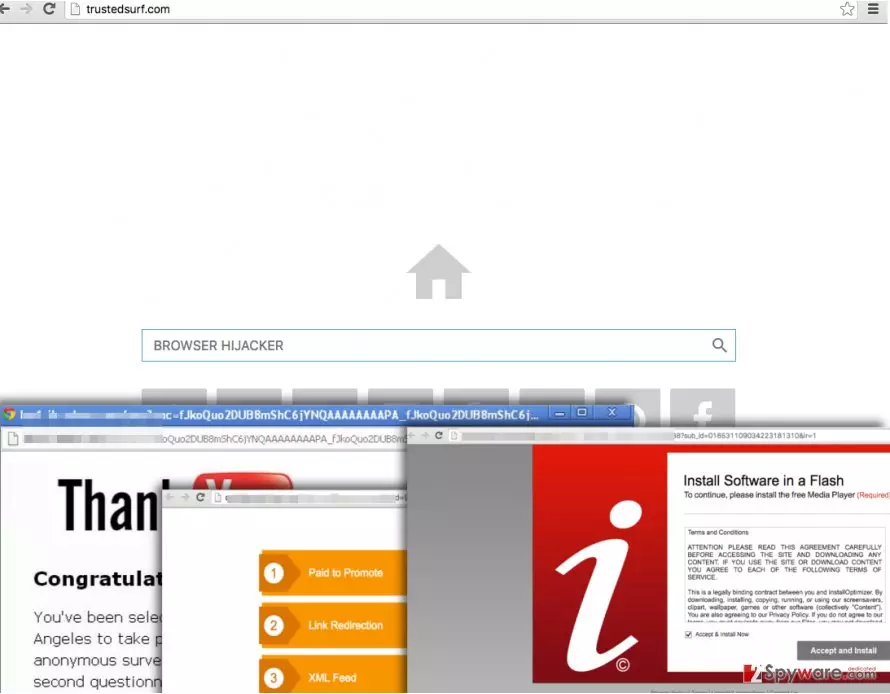
In fact, we have noticed that the search engine by Trusted Surf delivers corrupted results that contain deceptive third-party links. In other words, after clicking on such results you will be redirected to random third-party websites that have nothing to do with your search query. Trusted Surf redirects are meant to drive traffic to partners’ websites and boost their popularity, however, consider whether you want to receive misleading search results and function as a tool used to generate pay-per-click revenue for the developers of Trusted Surf hijacker. Besides, these redirects can force you to visit highly dangerous websites that promote spyware or even malware. If you would rather avoid visiting such web sources, you should remove Trusted Surf PUP from your computer with an anti-spyware software like FortectIntego.
How does Trusted Surf hijack computers?
Speaking of Trusted Surf’s distribution method, we have to say that it spreads the same way as the majority of PUPs do and that it can be installed only if the computer user lacks basic knowledge on how to install software properly. What we want to say is that you can easily avoid installing Trusted Surf and similar PUPs just by following a few simple steps:
- If you did not know this yet, PUPs spread together with free programs and so it is a must to monitor the installation process properly whenever you install a new program.
- The majority of computer users tend to ignore important legal documents such as Privacy Policy and Terms of Use, which are provided in the software’s setup menu. Remember that you should never check the “I acknowledge that I have read and agreed to the terms and conditions” checkbox if you have not actually read these documents.
- Software installers usually provide an opportunity to choose your preferred installation settings – use this opportunity. Instead of Default or Standard settings (which are commonly pre-selected for you), opt for Custom or Advanced mode. Then you will see a list of optional downloads offered for you – refuse to install them!
- Proceed with the installation as usual.
If this dubious browser hijacker has already infiltrated your computer system, we recommend you to uninstall it. You can find Trusted Surf removal tutorial on page 2.
Trusted Surf removal instructions
If you are not willing to experience continuous redirects, receive annoying pop-up ads and suffer other consequences of Trusted Surf virus infiltration, you should remove Trusted Surf from your computer without a delay. Although it is possible to uninstall this potentially unwanted software manually, we do not recommend you to do so. If you are an unskilled computer user, you might not recognize files related to Trusted Surf browser hijacker and leave some of them on your system, which can cause problems for you later. You also risk to delete important system files accidentally; if you do not want that to happen, consider removing Trusted Surf redirect virus automatically. For that, you can use one of these programs:
Uninstall from Windows
Uninstall from Windows 10/8:
- Type Control Panel into the Windows search box and open the result.
- Under Programs, select Uninstall a program.


Uninstall from Windows 7/XP:
- Click on Windows Start > Control Panel (Windows XP users should click on Add/Remove Programs).
- In Control Panel, select Programs > Uninstall a program.


Remove the unwanted program:
- In the Programs and Features window, look for any recently installed suspicious entries, select them, and click Uninstall.
- If User Account Control appears, click Yes to confirm, then complete the removal.


Delete from macOS
Remove the unwanted application:
- From the menu bar, select Go > Applications.
- In the Applications folder, look for any suspicious entries, then drag them to Trash (or right-click and pick Move to Trash).


Delete leftover files and folders:
- Select Go > Go to Folder.
- Enter /Library/Application Support and remove any suspicious folders related to the unwanted program.
- Repeat the same check in the /Library/LaunchAgents and /Library/LaunchDaemons folders, deleting any suspicious entries.

- Finally, empty the Trash to permanently remove the leftovers.

Remove from Microsoft Edge
Delete unwanted extensions from MS Edge:
- Select Menu (three horizontal dots at the top-right of the browser window) and pick Extensions.
- From the list, pick the extension and click on the Gear icon.
- Click Remove.


Clear cookies and other browser data:
- Click on the Menu (three horizontal dots at the top-right of the browser window) and select Settings > Privacy, search, and services..
- Under Clear browsing data, pick Choose what to clear.
- Select Cookies and other site data and Cached images and files. (apart from passwords, although you might want to include Media licenses as well, if applicable) and click on Clear.


Restore new tab and homepage settings:
- Click the menu icon and choose Settings.
- Then find On startup section.
- Click Remove next to any suspicious startup page.
Reset MS Edge if the above steps did not work:
- Press on Ctrl + Shift + Esc to open Task Manager.
- Click on More details arrow at the bottom of the window.
- Select Details tab.
- Now scroll down and locate every entry with Microsoft Edge name in it. Right-click on each of them and select End Task to stop MS Edge from running.


Instructions for Chromium-based Edge
Delete extensions from MS Edge (Chromium):
- Open Edge and click select Settings > Extensions.
- Delete unwanted extensions by clicking Remove.


Clear cache and site data:
- Click on Menu and go to Settings.
- Select Privacy, search and services.
- Under Clear browsing data, pick Choose what to clear.
- Under Time range, pick All time.
- Select Clear now.


Reset Chromium-based MS Edge:
- Click on Menu and select Settings.
- On the left side, pick Reset settings.
- Select Restore settings to their default values.
- Confirm with Reset.
- This will disable extensions and reset startup pages but will not delete bookmarks, saved passwords, or browsing history.


Remove from Mozilla Firefox (FF)
Remove dangerous extensions:
- Open Mozilla Firefox browser and click on the Menu (three horizontal lines at the top-right of the window).
- Select Add-ons.
- In here, select the unwanted extension and click Remove.


Reset the homepage:
- Click three horizontal lines at the top right corner to open the menu.
- Choose Settings.
- Under Home, set your preferred homepage and new tab settings.
Clear cookies and site data:
- Click Menu and pick Settings.
- Go to Privacy & Security section.
- Scroll down to locate Cookies and Site Data.
- Click on Clear Data...
- Select Cookies and Site Data and Temporary cached files and pages, then click Clear.


Reset Mozilla Firefox
If clearing the browser as explained above did not help, reset Mozilla Firefox:
- Open Mozilla Firefox browser and click the Menu.
- Go to Help and then choose Troubleshooting Information.

- Under Give Firefox a tune up section, click on Refresh Firefox...
- Once the pop-up shows up, confirm the action by pressing on Refresh Firefox.



Remove from Google Chrome
Delete malicious extensions from Google Chrome:
- Open Google Chrome, click on the Menu (three vertical dots at the top-right corner) and select More tools > Extensions.
- In the newly opened window, you will see all the installed extensions. Uninstall all suspicious extensions related to the unwanted program by clicking Remove.


Clear cache and web data from Chrome:
- Click on Menu and pick Settings.
- Under Privacy and security, select Clear browsing data.
- Select Browsing history, Cookies and other site data, as well as Cached images and files.
- Click Clear data.


Change your homepage:
- Click menu and choose Settings.
- Look for a suspicious site in the On startup section.
- Click on Open a specific or set of pages and click on three dots to find the Remove option.
Reset Google Chrome:
If the previous methods did not help you, reset Google Chrome to eliminate all the unwanted components:
- Click on Menu and select Settings.
- In the Settings, scroll down and click Advanced.
- Scroll down and locate Reset and clean up section.
- Now click Restore settings to their original defaults.
- Confirm with Reset settings.


Delete from Safari
Remove dangerous extensions:
- Open Safari, click Safari in the menu at the top-left of the screen, and select Preferences.
- Go to the Extensions tab, look for any suspicious entries, and click Uninstall to remove them.


Clear history and website data:
- Click Safari in the menu and pick Clear History.
- Set Clear to all history and confirm with Clear History.


Reset Safari:
- Click Safari in the menu and select Preferences > Advanced.
- Enable Show Develop menu in menu bar.
- From the menu bar, click Develop and select Empty Caches.


Did this guide help?
4 comments
Azarrenko
Thanks! Great guide :)
ralph
puts ads on the websites I visit! changed my homepage!!! I dont like it!!!! Trusted surf is a virus!!!
coachella16
Trusted Surf sux!
lemans
trustedsurf just cannot be trusted. do not use it...