

News-cokaze.cc is a fake website made by scammers: what you should know

News-cokaze.cc is a harmful website that aims to deceive users into subscribing to push notifications, which would allow ads to be displayed directly on their screens. Individuals may inadvertently stumble upon this website by clicking on a malicious link elsewhere, and they will be presented with a misleading message that urges them to press the “Allow” button for a false reason.
Once deceived, victims will soon realize that their desktops are being flooded with relentless News-cokaze.cc ads that can appear at any time, regardless of the websites they are visiting or programs they are using. The most concerning part is that the links and ads displayed in the push notification window are often malicious, including phishing campaigns, notifications about virus infections, fake prizes, and other dangerous content.
We strongly advise against engaging with any links or other content promoted by this malicious website. Instead, follow the instructions below to eliminate this activity entirely and safeguard your computer and personal security.
| Name | News-cokaze.cc |
| Type | Push notifications, ads, pop-ups, scam |
| Distribution | Intrusive pop-ups can start showing up at some point after the “Allow” button is pressed within the notification prompt |
| Symptoms | Pop-up notifications are shown on a desktop at random times |
| Risks | The ads shown within push notifications might include misleading messages and links to malicious websites. If clicked, you might end up infecting your system with malware, disclosing your personal information, or losing money |
| Removal | Access browser settings to stop intrusive push notifications. After that, make sure that your system is not infected with adware or malware – scan it with SpyHunterCombo Cleaner |
| Repair & tips | You should remove caches and other web data after eliminating adware to prevent data tracking with the FortectIntego maintenance utility. You can also repair damaged system files using it |
How to protect yourself from risky websites
Whether you're using Google Chrome, Mozilla Firefox, MS Edge, or any other browser, there are several ways to navigate the internet, including clicking on links, accessing bookmarks, or typing in the URL directly. While entering the URL might be the most secure method, search engines, and hyperlinks can be misleading, leaving users unaware of what they might encounter next. This is how most people stumble upon News-cokaze.cc.
Dubious websites are often used to distribute malicious links. Cybercriminals frequently use peer-to-peer networks, software crack sites, or illegal streaming platforms for various purposes, as these sites often lack basic security measures. In some cases, the criminals might even create the sites themselves.
Users might click on links that appear to be for watching a video or downloading a program, only to be quickly redirected to an unexpected site such as Pogothere.xyz, Realgadssolutions.com, or News-fahahu.cc. Once there, users could be asked to subscribe to fake services, download harmful software, or provide personal information.
In some cases, the redirect could even occur without clicking on any links, as malicious scripts could be embedded on the page. To prevent these scripts from running, it's best to use ad-blockers and advanced security solutions. However, the most effective protection is to avoid visiting high-risk websites altogether.
Scam message examples
It is clear that most users do not willingly subscribe to receive fraudulent content. However, News-cokaze.cc uses various social engineering tactics to deceive and trap unsuspecting users into falling for their scams.
Once the redirect takes place, users are often unsure of what has happened, as they are prompted to click the “Allow” button without much explanation. The message could be phrased in different ways, such as :
Click Allow to verify that you are not a robot.
Your file is ready for download. Press Allow to proceed.
If you are over 18, click Allow.
Just one more step! Click 'Allow' to continue.
Those who are misled into believing that the request is legitimate and following the instructions are typically sent to another malicious website without receiving the promised content. Since nothing appears to happen at the moment, many users simply move on with their daily routines, only to later discover that their computer screens are bombarded with News-cokaze.cc ads. Fortunately, getting rid of these ads is quite straightforward.

Push notification removal
To put an end to the bothersome pop-up ads, accessing the settings section of your web browser is necessary. While push notifications are not inherently harmful, the links they contain can be malicious depending on their source. As a result, anti-malware software is unable to detect and delete them on your behalf, making you to take the necessary steps to remove them manually.
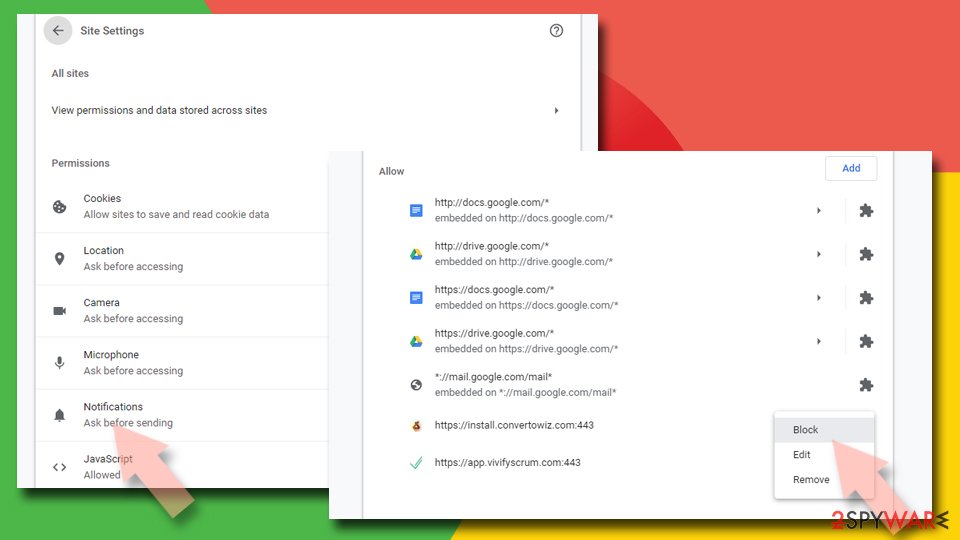
Google Chrome (desktop)
- Open the Google Chrome browser and go to Menu > Settings.
- Scroll down and click on Advanced.
- Locate the Privacy and security section and pick Site Settings > Notifications.
- Look at the Allow section and look for a suspicious URL.
- Click the three vertical dots next to it and pick Block. This should remove unwanted notifications from Google Chrome.

Google Chrome (Android)
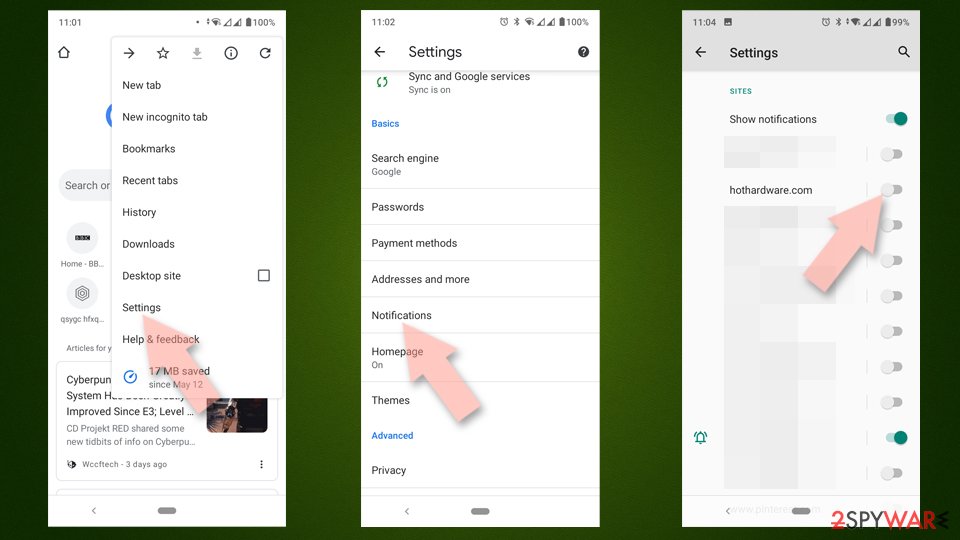
- Open Google Chrome and tap on Settings (three vertical dots).
- Select Notifications.
- Scroll down to the Sites section.
- Locate the unwanted URL and toggle the button to the left (Off setting).

Mozilla Firefox
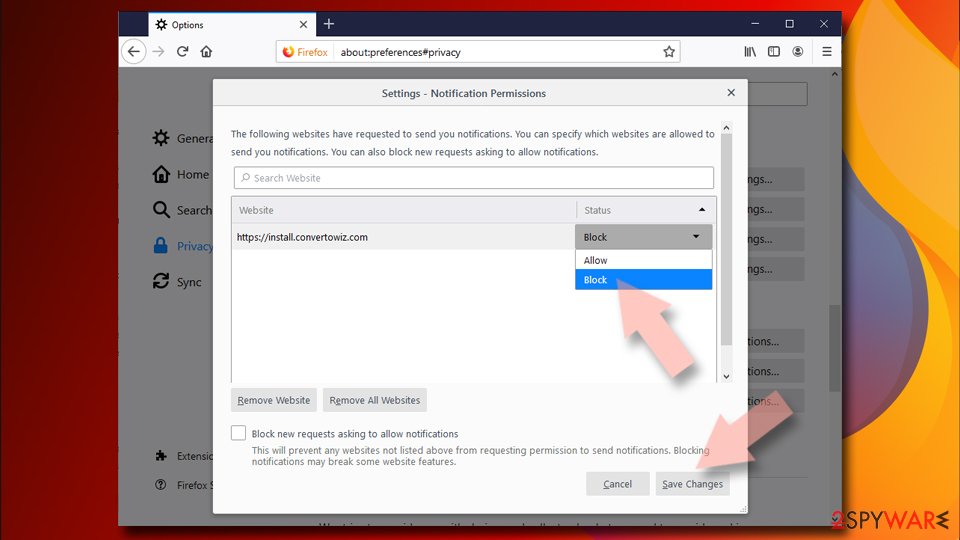
- Open Mozilla Firefox and go to Menu > Options.
- Click on Privacy & Security section.
- Under Permissions, you should be able to see Notifications. Click the Settings button next to it.
- In the Settings – Notification Permissions window, click on the drop-down menu by the URL in question.
- Select Block and then click on Save Changes. This should remove unwanted notifications from Mozilla Firefox.

MS Edge (Chromium)
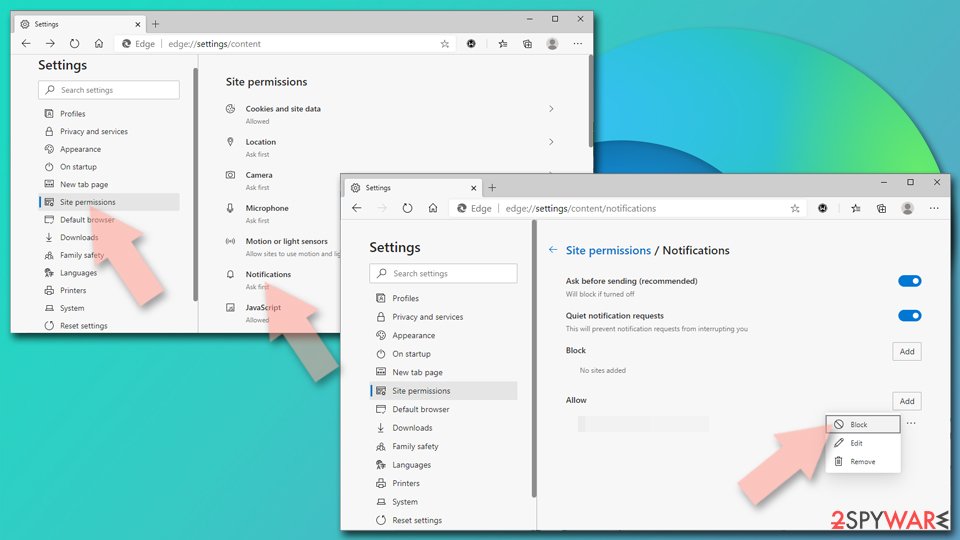
- Open Microsoft Edge, and go to Settings.
- Select Site permissions.
- Go to Notifications on the right.
- Under Allow, you will find the unwanted entry.
- Click on More actions and select Block.

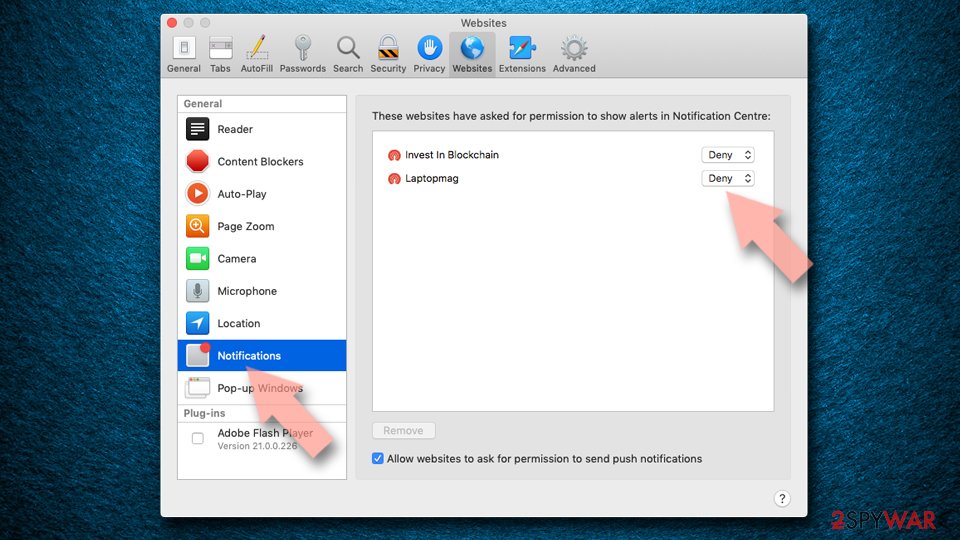
Safari
- Click on Safari > Preferences…
- Go to the Websites tab and, under General, select Notifications.
- Select the web address in question, click the drop-down menu and select Deny.

Internet Explorer
- Open Internet Explorer, and click on the Gear icon at the top-right of the window.
- Select Internet options and go to the Privacy tab.
- In the Pop-up Blocker section, click on Settings.
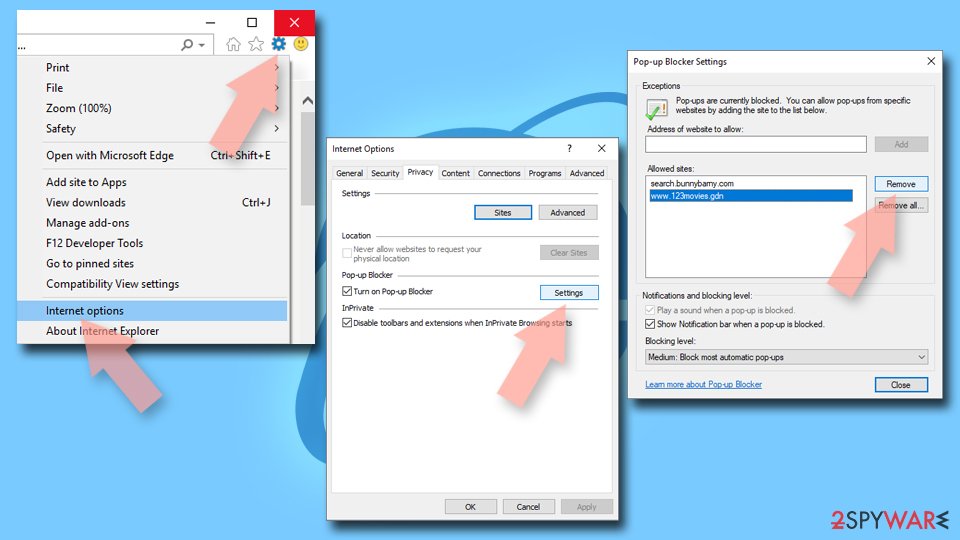
- Locate the web address in question under Allowed sites and pick Remove.

Take care of adware issues
Once you've successfully tackled the pesky push notifications, it's also crucial to inspect your system for adware. This type of potentially unwanted software is frequently distributed through bundling or similar methods, causing unwitting users to install it.
As a result, individuals may be redirected to unsafe websites while browsing the internet and exposed to an increased amount of advertisements. While some adware is easily removable as it masquerades as an extension, several types of malware can embed themselves into your system, making it nearly impossible for the average user to eradicate without specialized software.
This is why we strongly suggest running a thorough system scan with anti-malware software, such as SpyHunterCombo Cleaner or MalwarebytesMalwarebytes. It can verify whether any malicious programs have infiltrated your device, ensuring your safety once more. Additionally, clearing browser caches is crucial, as trackers may persist even after eliminating PUPs. Utilizing FortectIntego may be the quickest way to address this issue, but if you prefer a manual approach, follow the instructions provided below.
Uninstall from Windows
Uninstall from Windows 10/8:
- Type Control Panel into the Windows search box and open the result.
- Under Programs, select Uninstall a program.


Uninstall from Windows 7/XP:
- Click on Windows Start > Control Panel (Windows XP users should click on Add/Remove Programs).
- In Control Panel, select Programs > Uninstall a program.


Remove the unwanted program:
- In the Programs and Features window, look for any recently installed suspicious entries, select them, and click Uninstall.
- If User Account Control appears, click Yes to confirm, then complete the removal.


Delete from macOS
Remove the unwanted application:
- From the menu bar, select Go > Applications.
- In the Applications folder, look for any suspicious entries, then drag them to Trash (or right-click and pick Move to Trash).


Delete leftover files and folders:
- Select Go > Go to Folder.
- Enter /Library/Application Support and remove any suspicious folders related to the unwanted program.
- Repeat the same check in the /Library/LaunchAgents and /Library/LaunchDaemons folders, deleting any suspicious entries.

- Finally, empty the Trash to permanently remove the leftovers.

Remove from Microsoft Edge
Delete unwanted extensions from MS Edge:
- Select Menu (three horizontal dots at the top-right of the browser window) and pick Extensions.
- From the list, pick the extension and click on the Gear icon.
- Click Remove.


Clear cookies and other browser data:
- Click on the Menu (three horizontal dots at the top-right of the browser window) and select Settings > Privacy, search, and services..
- Under Clear browsing data, pick Choose what to clear.
- Select Cookies and other site data and Cached images and files. (apart from passwords, although you might want to include Media licenses as well, if applicable) and click on Clear.


Restore new tab and homepage settings:
- Click the menu icon and choose Settings.
- Then find On startup section.
- Click Remove next to any suspicious startup page.
Reset MS Edge if the above steps did not work:
- Press on Ctrl + Shift + Esc to open Task Manager.
- Click on More details arrow at the bottom of the window.
- Select Details tab.
- Now scroll down and locate every entry with Microsoft Edge name in it. Right-click on each of them and select End Task to stop MS Edge from running.


Instructions for Chromium-based Edge
Delete extensions from MS Edge (Chromium):
- Open Edge and click select Settings > Extensions.
- Delete unwanted extensions by clicking Remove.


Clear cache and site data:
- Click on Menu and go to Settings.
- Select Privacy, search and services.
- Under Clear browsing data, pick Choose what to clear.
- Under Time range, pick All time.
- Select Clear now.


Reset Chromium-based MS Edge:
- Click on Menu and select Settings.
- On the left side, pick Reset settings.
- Select Restore settings to their default values.
- Confirm with Reset.
- This will disable extensions and reset startup pages but will not delete bookmarks, saved passwords, or browsing history.


Remove from Mozilla Firefox (FF)
Remove dangerous extensions:
- Open Mozilla Firefox browser and click on the Menu (three horizontal lines at the top-right of the window).
- Select Add-ons.
- In here, select the unwanted extension and click Remove.


Reset the homepage:
- Click three horizontal lines at the top right corner to open the menu.
- Choose Settings.
- Under Home, set your preferred homepage and new tab settings.
Clear cookies and site data:
- Click Menu and pick Settings.
- Go to Privacy & Security section.
- Scroll down to locate Cookies and Site Data.
- Click on Clear Data...
- Select Cookies and Site Data and Temporary cached files and pages, then click Clear.


Reset Mozilla Firefox
If clearing the browser as explained above did not help, reset Mozilla Firefox:
- Open Mozilla Firefox browser and click the Menu.
- Go to Help and then choose Troubleshooting Information.

- Under Give Firefox a tune up section, click on Refresh Firefox...
- Once the pop-up shows up, confirm the action by pressing on Refresh Firefox.



Remove from Google Chrome
Delete malicious extensions from Google Chrome:
- Open Google Chrome, click on the Menu (three vertical dots at the top-right corner) and select More tools > Extensions.
- In the newly opened window, you will see all the installed extensions. Uninstall all suspicious extensions related to the unwanted program by clicking Remove.


Clear cache and web data from Chrome:
- Click on Menu and pick Settings.
- Under Privacy and security, select Clear browsing data.
- Select Browsing history, Cookies and other site data, as well as Cached images and files.
- Click Clear data.


Change your homepage:
- Click menu and choose Settings.
- Look for a suspicious site in the On startup section.
- Click on Open a specific or set of pages and click on three dots to find the Remove option.
Reset Google Chrome:
If the previous methods did not help you, reset Google Chrome to eliminate all the unwanted components:
- Click on Menu and select Settings.
- In the Settings, scroll down and click Advanced.
- Scroll down and locate Reset and clean up section.
- Now click Restore settings to their original defaults.
- Confirm with Reset settings.


Delete from Safari
Remove dangerous extensions:
- Open Safari, click Safari in the menu at the top-left of the screen, and select Preferences.
- Go to the Extensions tab, look for any suspicious entries, and click Uninstall to remove them.


Clear history and website data:
- Click Safari in the menu and pick Clear History.
- Set Clear to all history and confirm with Clear History.


Reset Safari:
- Click Safari in the menu and select Preferences > Advanced.
- Enable Show Develop menu in menu bar.
- From the menu bar, click Develop and select Empty Caches.


Did this guide help?
Be the first to comment