

Mac Tweaker – a rogue system optimizer that might leave you disappointed
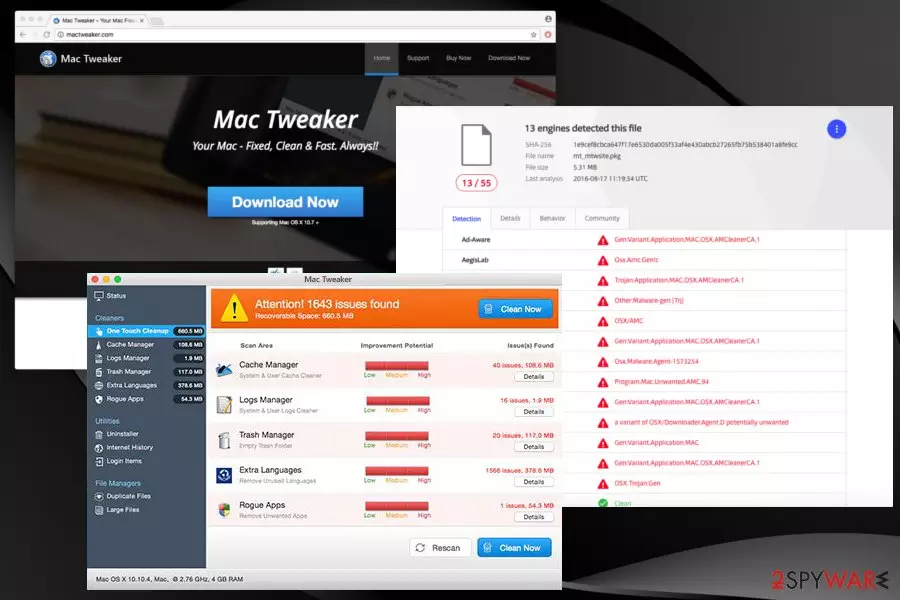
Mac Tweaker is advertised as an optimization tool that can clean and optimize Mac OS X system 10.7 & above. Similarly to MacKeeper, Mac Optimizer, Mac Mechanic and many others, this questionable application infiltrates users’ machines without permission. Thus, it falls into potentially unwanted program[1] category.
| SUMMARY | |
| Name | Mac Tweaker |
|---|---|
| Type | Potentially unwanted program |
| OS affected | Mac OS X 10.7 and above |
| Main dangers | Wasted money on full license, important file deletion, personal information disclosure |
| Distribution | Bundling, online advertisements or official website – hxxp://mactweaker.com/ |
| Elimination | Download and install FortectIntego. Manual method also available |
As soon as the unwanted app infests your system, it performs a computer scan. You should not be surprised that, according to Mac Tweaker, your system is affected by many issues that need to be addressed. As soon as you proceed and click “Fix” however, you are prompted to buy a full version of the program.
A licensed version is subscription based and costs $39.95 every six months. You are also offered additional software that costs another $19.95. The service is expensive, especially when you combine it with questionable functionality.
If you proceed with the purchase, you are asked to provide personal details, including name, email, phone and bank information. Please read the following from developer’s EULA:
7.2. You acknowledge that Mac Tweaker collects certain information regarding the users of the Software, including certain personally identifiable information. You hereby consent to Mac Tweaker for collection and use of such information, and agree that Mac Tweaker's collection and use of such information will be governed by Mac Tweaker's Privacy Policy
We highly advise refraining from this offer as the personal information might be used for questionable purposes (typically marketing); however, you can never know when your data might be misused, especially when payments are handled by 3rd parties, too. Thus, do not trust this program – remove Mac Tweaker immediately.
The main problem with fake optimization tools is that all of them have a similar function: they mostly enter users machines through software bundling or advertisements, perform the scan, find hundreds of “issues” and demand payment for the alleged fix. The whole scheme is incredibly shady. Therefore, some people might call it Mac Tweaker virus (although it is not).
If you want proper tools to protect your computer, select reputable security software, like FortectIntego. Not only can it help you with Mac Tweaker removal but can also detect other PUPs or even malware. Furthermore, junk files,[2] trash, logs and other issues can be eliminated manually – for free.

Ways rogue software invades users’ machines
The suspicious application can be distributed in two ways – downloaded and installed intentionally or installed together with other free software. As the PUP performs scan instantaneously after installation, confused and scared users might proceed with the full license purchase.
Therefore, do not let questionable applications enter your Mac OS that easily – be attentive while installing freeware. The most important thing is not to rush the installation while clicking “Next” button without looking. By doing so, you might skip essential steps. Thus, read installation instructions carefully and always opt for Advanced or Custom installation mode. Make sure you deselect any pre-selected tick marks by add-ons, toolbars, optimization tools, etc.
Uninstall Mac Tweaker from your Mac and save your money
Security experts[3] noted that fake optimization tools are not useful for your computer and should be avoided in the first place. However, if you noticed that your system is being scanned out of nowhere, remove Mac Tweaker at once.
You can remove Mac Tweaker manually by using our guide below this article. Do not forget that you have to eliminate all related files in the libraries. Also, we do not advise picking this method if you are not that computer-savvy individual.
You can also opt for automatic Mac Tweaker virus removal – it will only take a few minutes. Please pick one of the programs mentioned below, install and run a full system scan. If you recently installed free software and obtained Mac Tweaker, it is highly likely that you have other PUPs installed on your system, like a browser hijacker or an adware program. Security software will detect all of these unwanted programs and eliminate them for good.
Uninstall from Windows
Uninstall from Windows 10/8:
- Type Control Panel into the Windows search box and open the result.
- Under Programs, select Uninstall a program.


Uninstall from Windows 7/XP:
- Click on Windows Start > Control Panel (Windows XP users should click on Add/Remove Programs).
- In Control Panel, select Programs > Uninstall a program.


Remove the unwanted program:
- In the Programs and Features window, look for any recently installed suspicious entries, select them, and click Uninstall.
- If User Account Control appears, click Yes to confirm, then complete the removal.


Delete from macOS
Remove the unwanted application:
- From the menu bar, select Go > Applications.
- In the Applications folder, look for any suspicious entries, then drag them to Trash (or right-click and pick Move to Trash).


Delete leftover files and folders:
- Select Go > Go to Folder.
- Enter /Library/Application Support and remove any suspicious folders related to the unwanted program.
- Repeat the same check in the /Library/LaunchAgents and /Library/LaunchDaemons folders, deleting any suspicious entries.

- Finally, empty the Trash to permanently remove the leftovers.

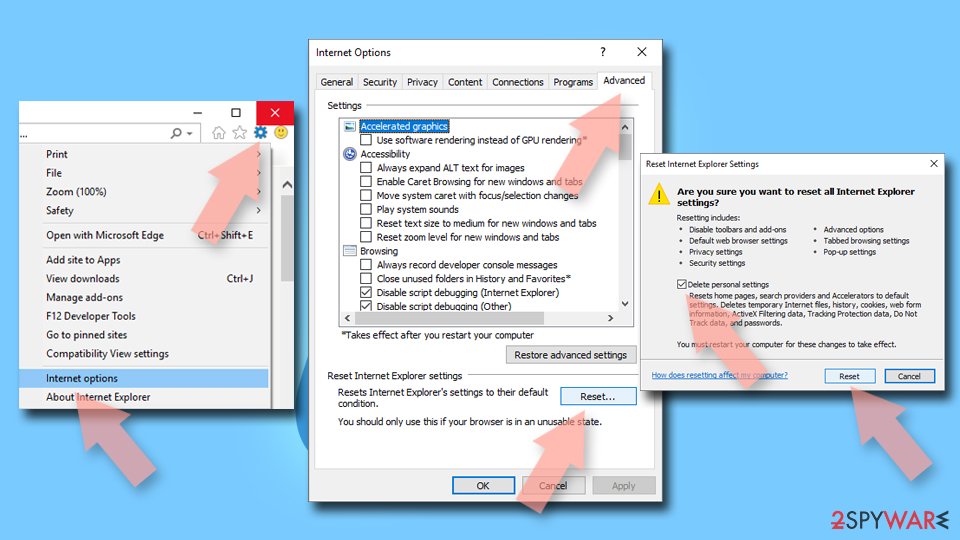
Reset Internet Explorer
Remove dangerous add-ons:
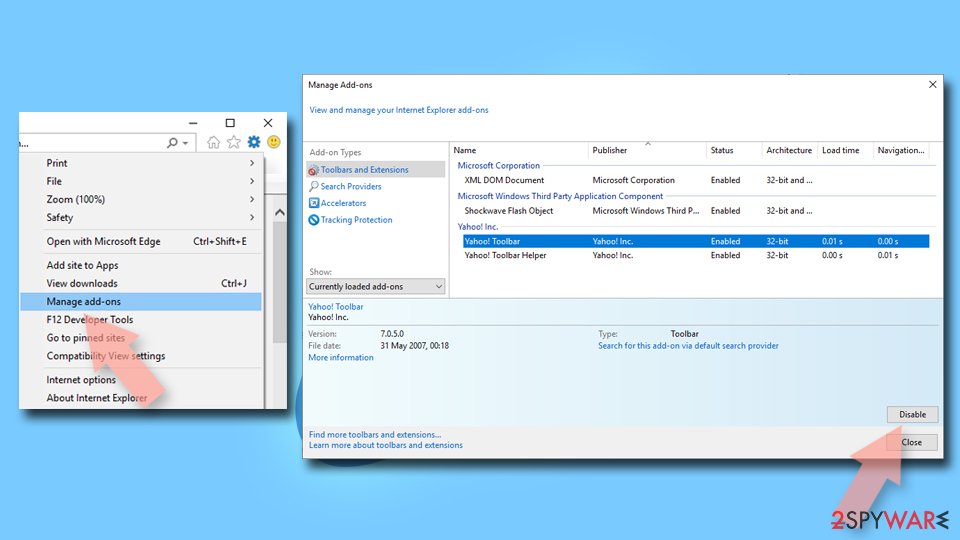
- Open Internet Explorer, click on the Gear icon (IE menu) on the top-right corner of the browser
- Pick Manage Add-ons.
- You will see a Manage Add-ons window. Here, look for suspicious plugins. Click on these entries and select Disable.

Change your homepage if it was altered:
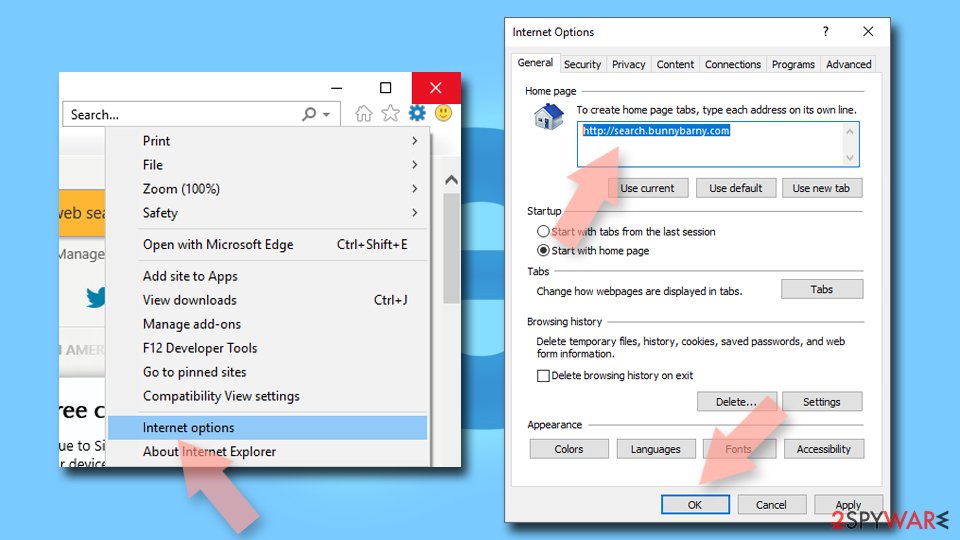
- Open IE and click on the Gear icon.
- Select Internet Options.
- In the General tab, delete the Home page address and replace it by your preferred one (for example, Google.com).
- Click Apply and then select OK.

Delete temporary files:
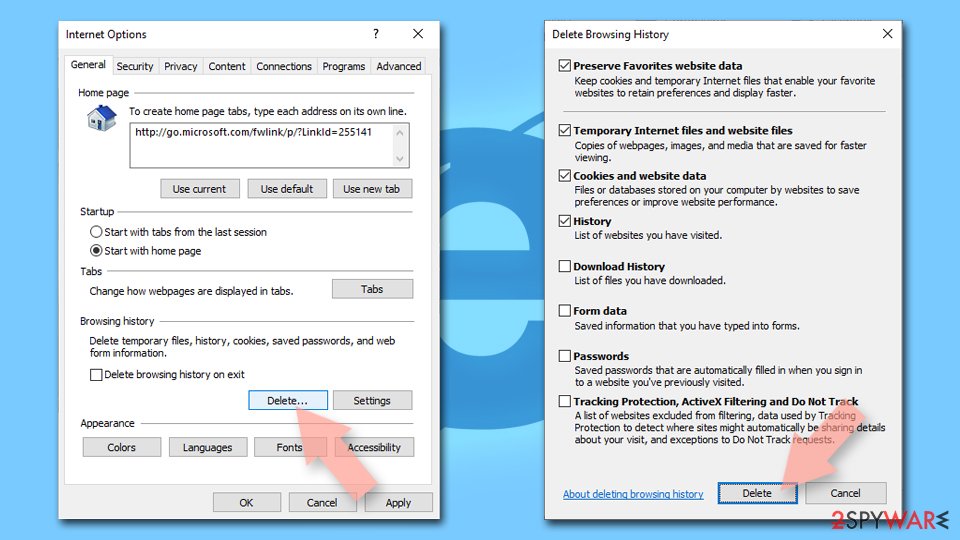
- Press on the Gear icon and select Internet Options.
- Under Browsing history, click Delete...
- Select relevant fields and press Delete.

Reset Internet Explorer:
- Click on Gear icon > Internet options and select Advanced tab.
- Select Reset.
- In the new window, check Delete personal settings and select Reset.

Remove from Microsoft Edge
Delete unwanted extensions from MS Edge:
- Select Menu (three horizontal dots at the top-right of the browser window) and pick Extensions.
- From the list, pick the extension and click on the Gear icon.
- Click Remove.


Clear cookies and other browser data:
- Click on the Menu (three horizontal dots at the top-right of the browser window) and select Settings > Privacy, search, and services..
- Under Clear browsing data, pick Choose what to clear.
- Select Cookies and other site data and Cached images and files. (apart from passwords, although you might want to include Media licenses as well, if applicable) and click on Clear.


Restore new tab and homepage settings:
- Click the menu icon and choose Settings.
- Then find On startup section.
- Click Remove next to any suspicious startup page.
Reset MS Edge if the above steps did not work:
- Press on Ctrl + Shift + Esc to open Task Manager.
- Click on More details arrow at the bottom of the window.
- Select Details tab.
- Now scroll down and locate every entry with Microsoft Edge name in it. Right-click on each of them and select End Task to stop MS Edge from running.


Instructions for Chromium-based Edge
Delete extensions from MS Edge (Chromium):
- Open Edge and click select Settings > Extensions.
- Delete unwanted extensions by clicking Remove.


Clear cache and site data:
- Click on Menu and go to Settings.
- Select Privacy, search and services.
- Under Clear browsing data, pick Choose what to clear.
- Under Time range, pick All time.
- Select Clear now.


Reset Chromium-based MS Edge:
- Click on Menu and select Settings.
- On the left side, pick Reset settings.
- Select Restore settings to their default values.
- Confirm with Reset.
- This will disable extensions and reset startup pages but will not delete bookmarks, saved passwords, or browsing history.


Remove from Mozilla Firefox (FF)
Remove dangerous extensions:
- Open Mozilla Firefox browser and click on the Menu (three horizontal lines at the top-right of the window).
- Select Add-ons.
- In here, select the unwanted extension and click Remove.


Reset the homepage:
- Click three horizontal lines at the top right corner to open the menu.
- Choose Settings.
- Under Home, set your preferred homepage and new tab settings.
Clear cookies and site data:
- Click Menu and pick Settings.
- Go to Privacy & Security section.
- Scroll down to locate Cookies and Site Data.
- Click on Clear Data...
- Select Cookies and Site Data and Temporary cached files and pages, then click Clear.


Reset Mozilla Firefox
If clearing the browser as explained above did not help, reset Mozilla Firefox:
- Open Mozilla Firefox browser and click the Menu.
- Go to Help and then choose Troubleshooting Information.

- Under Give Firefox a tune up section, click on Refresh Firefox...
- Once the pop-up shows up, confirm the action by pressing on Refresh Firefox.



Remove from Google Chrome
Delete malicious extensions from Google Chrome:
- Open Google Chrome, click on the Menu (three vertical dots at the top-right corner) and select More tools > Extensions.
- In the newly opened window, you will see all the installed extensions. Uninstall all suspicious extensions related to the unwanted program by clicking Remove.


Clear cache and web data from Chrome:
- Click on Menu and pick Settings.
- Under Privacy and security, select Clear browsing data.
- Select Browsing history, Cookies and other site data, as well as Cached images and files.
- Click Clear data.


Change your homepage:
- Click menu and choose Settings.
- Look for a suspicious site in the On startup section.
- Click on Open a specific or set of pages and click on three dots to find the Remove option.
Reset Google Chrome:
If the previous methods did not help you, reset Google Chrome to eliminate all the unwanted components:
- Click on Menu and select Settings.
- In the Settings, scroll down and click Advanced.
- Scroll down and locate Reset and clean up section.
- Now click Restore settings to their original defaults.
- Confirm with Reset settings.


Delete from Safari
Remove dangerous extensions:
- Open Safari, click Safari in the menu at the top-left of the screen, and select Preferences.
- Go to the Extensions tab, look for any suspicious entries, and click Uninstall to remove them.


Clear history and website data:
- Click Safari in the menu and pick Clear History.
- Set Clear to all history and confirm with Clear History.


Reset Safari:
- Click Safari in the menu and select Preferences > Advanced.
- Enable Show Develop menu in menu bar.
- From the menu bar, click Develop and select Empty Caches.


Did this guide help?
Be the first to comment