

Pointmarketvalue.top is a fake website created to scam users
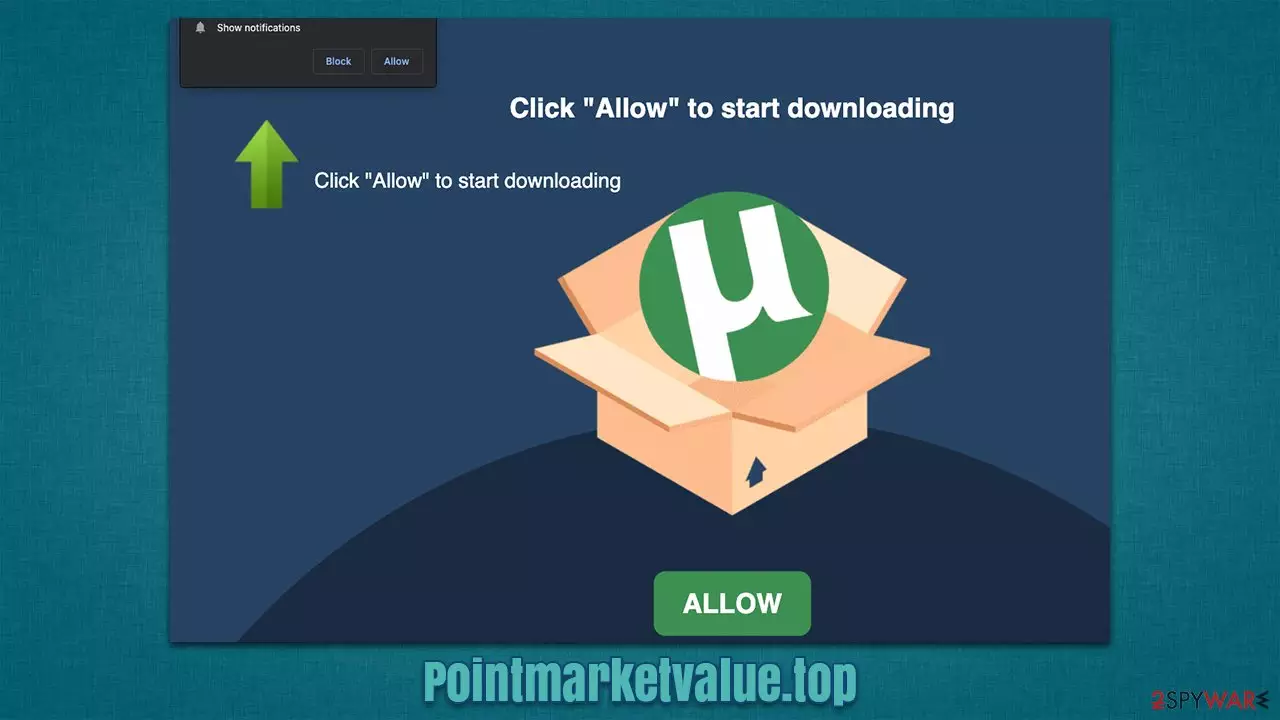
Push notifications have been puzzling some internet users for a while now, as the only encounter they had with them was an unpleasant one. In fact, most victims of push notification scams that are promoted by Pointmarketvalue.top and similar websites don't even suspect a thing when they first see them.
The pop-ups might start showing up at random times, regardless of what you are currently doing – streaming a video, browsing your favorite social media, or even playing a video game. All it takes is for Google Chrome, Mozilla Firefox, MS Edge, or any other used browser to be operational at the time (even in the background).
Besides the suspicious timing of this phenomenon, Pointmarketvalue.top ads would also cover all other programs and windows running at the time. On Windows systems, push notifications are shown at the bottom-right corner of the screen, while on Mac, they would pop up at the top-right. Mobile devices can also be affected by this issue, and the push notifications would be shown even if the phone or tablet is not being used at the time due to the nature of Android/iOS operation.
Unfortunately, the contents of these push notifications are of poor quality and can commonly be deceptive or even malicious. For example, users might be offered to redeem a prize they have somehow won in a fake giveaway, only to later ask them to provide their personal details such as email, name, or even credit card details.
People might also be exposed to scare tactics, where they are told that their computer has been infected or files have been removed and that the only way to remediate the situation is by calling alleged tech support. In reality, the tech support is fake, and scams surrounding this scheme make users lose millions of dollars every year.
The reason these ads are so deceptive is that Pointmarketvalue.top scam authors do not care about the quality of the ads, as long as users are exposed to them is what matters most. Often, insecure advertising networks are used, which explains why the ads are so untrustworthy.
| Name | Pointmarketvalue.top |
| Type | Push notifications, ads, pop-ups, scam |
| Infiltration | The unwanted activity starts sometime later after the “Allow” button is pressed via the notification prompt |
| Symptoms | Push notifications show on the desktop at random time intervals. They show fraudulent content and links to potentially dangerous websites |
| Risks | Redirects to malicious websites can result in unwanted site notifications, personal information disclosure to unknown parties (cybercriminals), monetary losses, installation of other potentially unwanted programs/malware |
| Removal | To get rid of notifications, you should access your web browser settings – check the below paragraphs for more information. You should also scan your system with SpyHunterCombo Cleaner to check for adware |
| Further checks | It is important to clean your browsers after removing potentially unwanted programs from your system – use FortectIntego to do it automatically or refer to the manual guide |
How scam operates
While the internet is a much safer space than it used to be a couple of decades ago, thanks to various regulations and security implementations by tech giants and security experts, it does not mean that malicious websites do not exist. In fact, there are plenty of them around the world wide web, and removing them effectively would be impossible due to the sheer number of websites (almost two billion).
Pointmarketvalue.top is just one of many push notification scam websites that have been created by crooks over the years. Just recently, we discussed Space-of-datings.top, GoodCaptchaStyle.top, and Verysilenitm.work scam sites that specialize in the precisely same thing – to make users subscribe to notifications without releasing what they have actually done. In order to succeed, crooks use all sorts of tricks and misleading messages that are meant to convince visitors that pressing the “Allow” button within the prompt is the best idea.
Upon the website entry, users might be shown one of the following messages (and their variations):
- Loading. Please tap ALLOW button to continue
- If you are 18+, tap Allow
- Click “Allow” if you are not a robot
- Click “Allow” to win a prize and get it in our shop!
- Can't play this video! Browser may block video autoplay… Click “Allow” to play the video, etc.

The messages imply that the functionality of the “Allow” button is not what it actually is – it is a mere excuse to make people click it. For example, many users are well aware of the captcha system that is used by many websites to verify that the visitor is actually human; here, crooks are trying to mislead them by presenting push notification prompt as a verification that is so prominent around the web.
These social engineering[1] tricks are used by many websites, and, once you've seen a few of them, you would immediately recognize the others. In fact, most of these websites are made by using a template that is very easy to create.
Once users accept the push notifications, only later are they shown the Pointmarketvalue.top pop-ups. However, since at the time nothing really happens, they don't seem to connect the dots, and hence don't know where these ads are coming from. Luckily, their removal is not difficult at all, and security risks are minimal as long as the ads are not clicked.
Removal of Pointmarketvalue.top ads
Push notifications, while might be connected to a virus infection indirectly, are not malicious by themselves. The feature is built-in and used by all browsers for many years now. It is the contents of these push notifications that can be particularly insecure. If a website that initiates these pop-ups is malicious, the result is obvious – users will see deceptive and even malicious ads directly on their desktops.
Proceed with the following instructions if you want to get rid of the annoying pop-ups once and for all. Also, you can use this guide in the future for any other website.
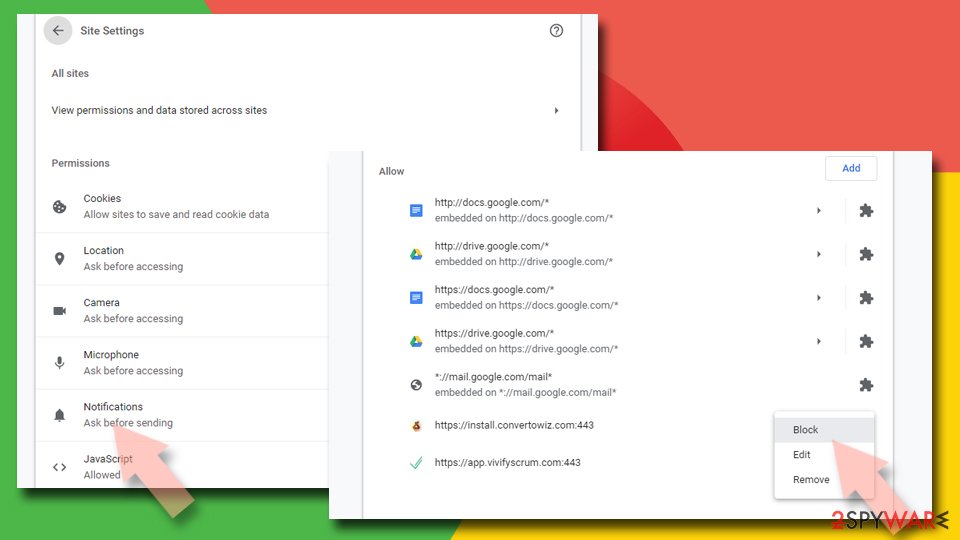
Google Chrome (desktop):
- Open Google Chrome browser and go to Menu > Settings.
- Scroll down and click on Advanced.
- Locate Privacy and security section and pick Site Settings > Notifications.
- Look at the Allow section and look for a suspicious URL.
- Click the three vertical dots next to it and pick Block. This should remove unwanted notifications from Google Chrome.

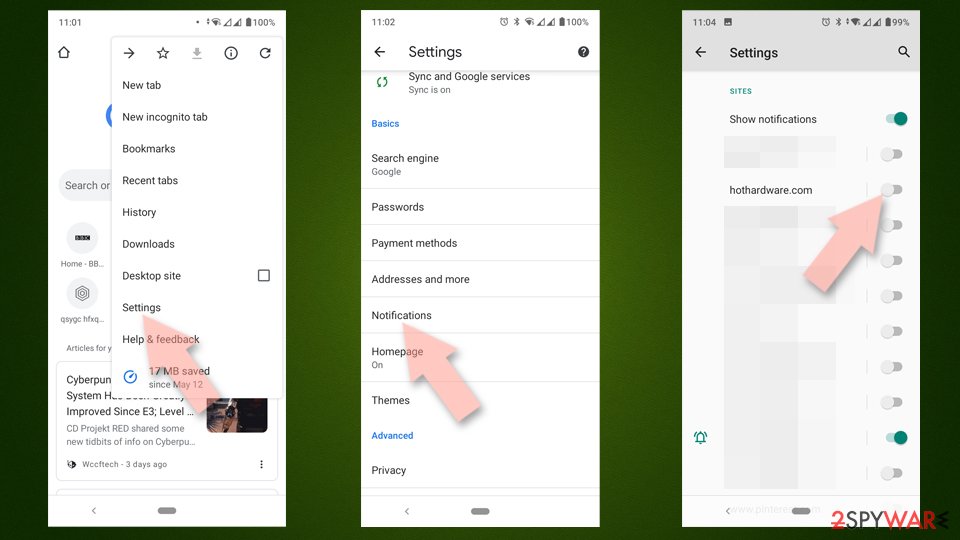
Google Chrome (Android):
- Open Google Chrome and tap on Settings (three vertical dots).
- Select Notifications.
- Scroll down to the Sites section.
- Locate the unwanted URL and toggle the button to the left (Off setting).

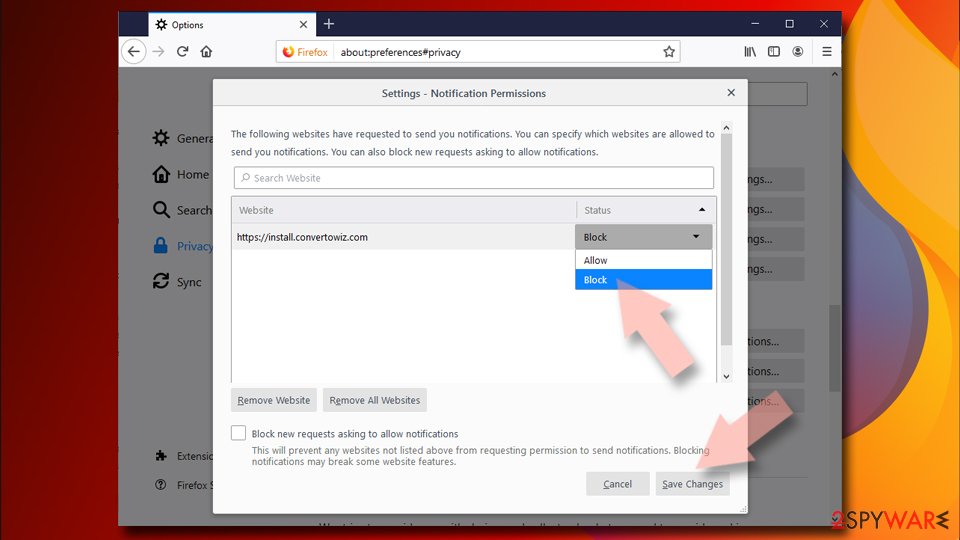
Mozilla Firefox:
- Open Mozilla Firefox and go to Menu > Options.
- Click on Privacy & Security section.
- Under Permissions, you should be able to see Notifications. Click the Settings button next to it.
- In the Settings – Notification Permissions window, click on the drop-down menu by the URL in question.
- Select Block and then click on Save Changes. This should remove unwanted notifications from Mozilla Firefox.

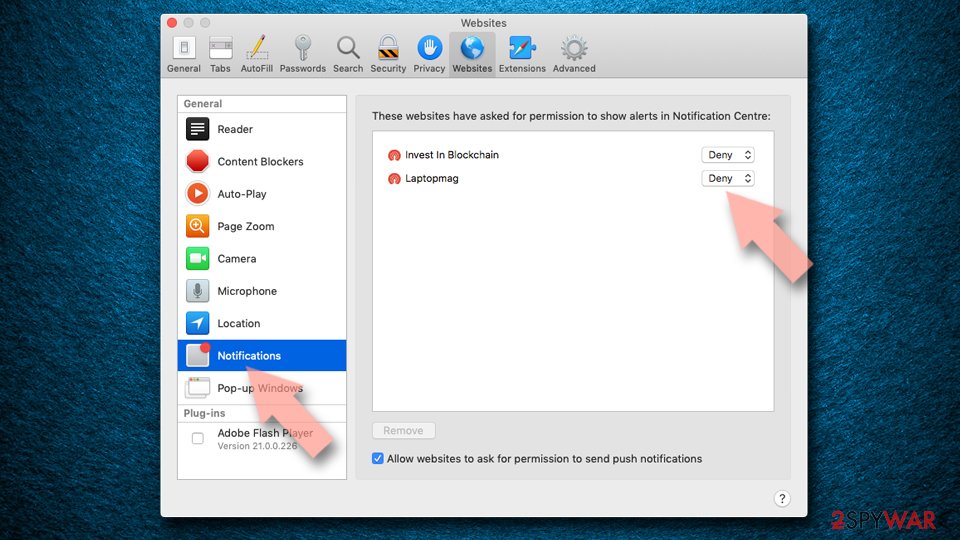
Safari:
- Click on Safari > Preferences…
- Go to the Websites tab and, under General, select Notifications.
- Select the web address in question, click the drop-down menu and select Deny.

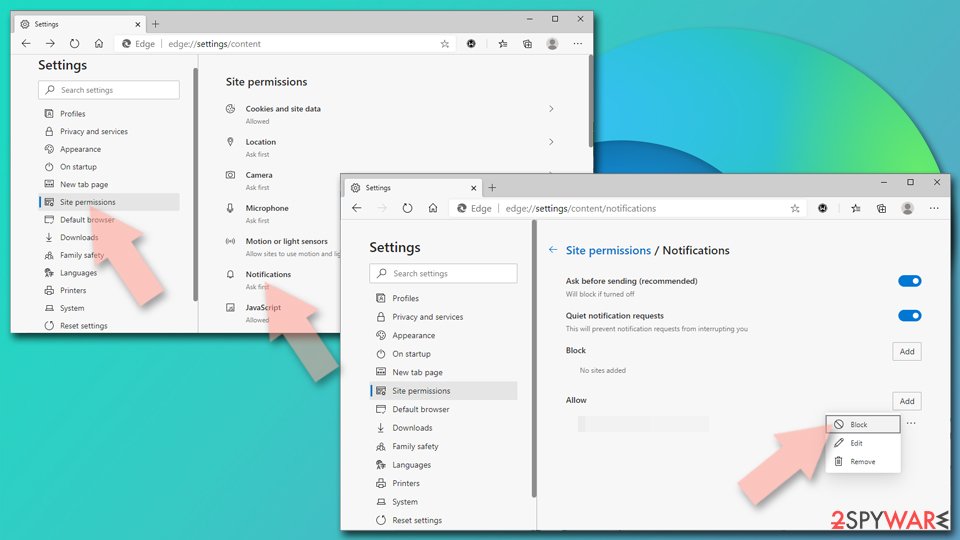
MS Edge (Chromium):
- Open Microsoft Edge, and go to Settings.
- Select Site permissions.
- Go to Notifications on the right.
- Under Allow, you will find the unwanted entry.
- Click on More actions and select Block.

Check your device for adware
While it is true that you might have stumbled upon Pointmarketvalue.top by accident (usually happens after clicking a link on a malicious website), persistent redirects to it or similar scam pages is a common sign of adware infection. This potentially unwanted software is usually distributed via software bundles,[2] which makes less aware users install it unintentionally.
During the installation of new software, you should always pay attention to the installation steps and read the instructions carefully: pre-ticked checkboxes, fine print, misplaced buttons, misleading wording, and similar techniques are used to make users install applications that never wanted in the first place. Also, always pick Advanced settings when possible.
Once installed, adware might engage in all sorts of dubious behavior, including:
- Change browser settings
- Show ads that do not originate from visited websites
- Place cookies and use other tracking technologies for data tracking
- Redirect to malicious websites and show fake messages
- Insert sponsored links at the top of search results
- Show apps that would make users install other potentially unwanted or malicious software, etc.
You can refer to the instructions at the bottom section of the post in order to find out how to remove programs installed on the system or remove browser extensions that might be causing these unwanted issues. However, we strongly recommend using the automatic removal method of potentially unwanted apps and malware – using SpyHunterCombo Cleaner or MalwarebytesMalwarebytes anti-malware software.
While security software can remove all aggressive types of adware and all types of malware, browser hijackers[3] and other minor infections might not be detected at all. Thus, for best results, a combination of manual and automatic methods is something we recommend to all our readers.
After you remove potentially unwanted applications, FortectIntego can repair the damage done to your computer and remove all the leftover files and caches that might cause various performance issues.
Uninstall from Windows
Uninstall from Windows 10/8:
- Type Control Panel into the Windows search box and open the result.
- Under Programs, select Uninstall a program.


Uninstall from Windows 7/XP:
- Click on Windows Start > Control Panel (Windows XP users should click on Add/Remove Programs).
- In Control Panel, select Programs > Uninstall a program.


Remove the unwanted program:
- In the Programs and Features window, look for any recently installed suspicious entries, select them, and click Uninstall.
- If User Account Control appears, click Yes to confirm, then complete the removal.


Delete from macOS
Remove the unwanted application:
- From the menu bar, select Go > Applications.
- In the Applications folder, look for any suspicious entries, then drag them to Trash (or right-click and pick Move to Trash).


Delete leftover files and folders:
- Select Go > Go to Folder.
- Enter /Library/Application Support and remove any suspicious folders related to the unwanted program.
- Repeat the same check in the /Library/LaunchAgents and /Library/LaunchDaemons folders, deleting any suspicious entries.

- Finally, empty the Trash to permanently remove the leftovers.

Remove from Microsoft Edge
Delete unwanted extensions from MS Edge:
- Select Menu (three horizontal dots at the top-right of the browser window) and pick Extensions.
- From the list, pick the extension and click on the Gear icon.
- Click Remove.


Clear cookies and other browser data:
- Click on the Menu (three horizontal dots at the top-right of the browser window) and select Settings > Privacy, search, and services..
- Under Clear browsing data, pick Choose what to clear.
- Select Cookies and other site data and Cached images and files. (apart from passwords, although you might want to include Media licenses as well, if applicable) and click on Clear.


Restore new tab and homepage settings:
- Click the menu icon and choose Settings.
- Then find On startup section.
- Click Remove next to any suspicious startup page.
Reset MS Edge if the above steps did not work:
- Press on Ctrl + Shift + Esc to open Task Manager.
- Click on More details arrow at the bottom of the window.
- Select Details tab.
- Now scroll down and locate every entry with Microsoft Edge name in it. Right-click on each of them and select End Task to stop MS Edge from running.


Instructions for Chromium-based Edge
Delete extensions from MS Edge (Chromium):
- Open Edge and click select Settings > Extensions.
- Delete unwanted extensions by clicking Remove.


Clear cache and site data:
- Click on Menu and go to Settings.
- Select Privacy, search and services.
- Under Clear browsing data, pick Choose what to clear.
- Under Time range, pick All time.
- Select Clear now.


Reset Chromium-based MS Edge:
- Click on Menu and select Settings.
- On the left side, pick Reset settings.
- Select Restore settings to their default values.
- Confirm with Reset.
- This will disable extensions and reset startup pages but will not delete bookmarks, saved passwords, or browsing history.


Remove from Mozilla Firefox (FF)
Remove dangerous extensions:
- Open Mozilla Firefox browser and click on the Menu (three horizontal lines at the top-right of the window).
- Select Add-ons.
- In here, select the unwanted extension and click Remove.


Reset the homepage:
- Click three horizontal lines at the top right corner to open the menu.
- Choose Settings.
- Under Home, set your preferred homepage and new tab settings.
Clear cookies and site data:
- Click Menu and pick Settings.
- Go to Privacy & Security section.
- Scroll down to locate Cookies and Site Data.
- Click on Clear Data...
- Select Cookies and Site Data and Temporary cached files and pages, then click Clear.


Reset Mozilla Firefox
If clearing the browser as explained above did not help, reset Mozilla Firefox:
- Open Mozilla Firefox browser and click the Menu.
- Go to Help and then choose Troubleshooting Information.

- Under Give Firefox a tune up section, click on Refresh Firefox...
- Once the pop-up shows up, confirm the action by pressing on Refresh Firefox.



Remove from Google Chrome
Delete malicious extensions from Google Chrome:
- Open Google Chrome, click on the Menu (three vertical dots at the top-right corner) and select More tools > Extensions.
- In the newly opened window, you will see all the installed extensions. Uninstall all suspicious extensions related to the unwanted program by clicking Remove.


Clear cache and web data from Chrome:
- Click on Menu and pick Settings.
- Under Privacy and security, select Clear browsing data.
- Select Browsing history, Cookies and other site data, as well as Cached images and files.
- Click Clear data.


Change your homepage:
- Click menu and choose Settings.
- Look for a suspicious site in the On startup section.
- Click on Open a specific or set of pages and click on three dots to find the Remove option.
Reset Google Chrome:
If the previous methods did not help you, reset Google Chrome to eliminate all the unwanted components:
- Click on Menu and select Settings.
- In the Settings, scroll down and click Advanced.
- Scroll down and locate Reset and clean up section.
- Now click Restore settings to their original defaults.
- Confirm with Reset settings.


Delete from Safari
Remove dangerous extensions:
- Open Safari, click Safari in the menu at the top-left of the screen, and select Preferences.
- Go to the Extensions tab, look for any suspicious entries, and click Uninstall to remove them.


Clear history and website data:
- Click Safari in the menu and pick Clear History.
- Set Clear to all history and confirm with Clear History.


Reset Safari:
- Click Safari in the menu and select Preferences > Advanced.
- Enable Show Develop menu in menu bar.
- From the menu bar, click Develop and select Empty Caches.


Did this guide help?
Be the first to comment