

My Forms Finder – a questionable browser extension that offers free online forms

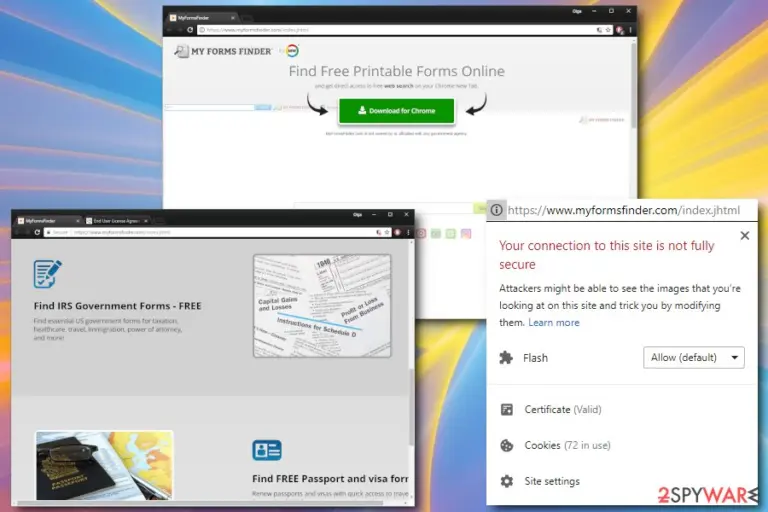
My Forms Finder is available as a toolbal which is compatible with Google Chrome, Internet Explorer, Mozilla Firefox and other browsers. It was created by Mindspark Interactive Network[1] and is considered to be a potentially unwanted program, as it typically enters machines via software bundling. The app is promoted as the extension which allows users access governmental forms without bigger troubles. It is identical to GetFormsOnline.
| SUMMARY | |
| Name | My Forms Finder |
| Type | Potentially unwanted program/browser hijacker |
| Developer | Mindspark Interactive Network |
| Distribution | Official website, software bundling |
| Symptoms | Increased amount of adverts, altered homepage and search engine, modified search results, etc. |
| Elimination | Download and install FortectIntego; manual elimination instructions available below |
Initially, though these extensions may seem to be highly practical, some users are annoyed by the fact that they have to go through the trouble to uninstall this toolbar. Furthermore, even if you find MyFormsFinder useful, hardly any of you will enjoy having their default search engine replaced with ask.com, hp.myway.com or search.mysearch.com.
Another negative aspect of the toolbar is its tendency to collect information about your browsing habits and ignore “do not track signals.” It also tends to share collected data with business partners:
- Authorized service providers;
- Advertisers and Ad Networks;
- Business partners;
- Other IAC businesses;
- Share with a friend/product specific features;
- Other Situations;
There are some risks that might arise from using such search engine. Sponsored search results are not always trustworthy, and the author of the search engine is not liable for what third-parties share on their websites.
Some search engines filter search results, and it is safer to use these. According to My Forms Finder's Privacy Policy, the publisher of this tool:
may integrate, be integrated into, bundled, or be provided in connection with third-party services, feeds and/or content […] does not endorse nor is responsible or liable for any content, advertising, products, or other materials on or available from such sites or resources.
In short, you should be careful when exploring third-party websites[2]. There is a risk to get misled to an insecure web page. Stay safe on the Internet, and if you feel that this search engine is not the right tool for you, simple remove My Forms Finder using instructions provided below the article.
Always pick Advanced installation mode when installing freeware
This browser add-on can be downloaded from its official website. Since Mindspark has a developed network, it may be also promoted as optional download program along with free applications. Thus, it is necessary to pay attention to the installation wizards in order to avoid unwanted applications.
Make sure you check the reputation of the website that provides the download link; read reviews and users' comments. Furthermore, investigate the Terms and Conditions and Privacy Policy documents – you can find many informative statements about the functions and responsibilities of the software.
After all, select safe installation settings. It means that you have to skip the ''Default'' and ''Standard'' installation settings and rather choose ''Custom'' or ''Advanced''. These options allow you to manage the installation process and detect unwanted tools, and it means you will be able to drop off the additional applications if there are any attached.

My Forms Finder removal tutorial
However, if you have already installed this browser add-on without realizing it, you can uninstall the toolbar using two methods. We have prepared MyFormsFinder removal instructions and provided them below the article. Follow them carefully to delete this browser extension from the system.
If you find these instructions troublesome, you can rely on the automatic method. Security tools will remove My Forms Finder within a couple of minutes. Note that this method does not restore the previous search tool; you will have to do so manually. All users, regardless whether you are a resident of Germany[3] or Netherlands, should be cautious of this tool as well.
Recently, the developer of this program contacted us asking us to remove this post from 2-spyware.com website. We believe that we shouldn't do that as long as programs that we offer for the removal of My Forms Finder can detect it and help users to remove it from the system. As it is mentioned under each of download buttons, we ARE affiliated with these anti-malware programs, and while some of them are free, others can remove a virus only after purchasing them. These mentions fully fulfill each of the requirements of FTC.
Nevertheless, we have recently decided to make a revision of this and other posts that are related to this developer. We claim that all of them are described properly.
Uninstall from Windows
Uninstall from Windows 10/8:
- Type Control Panel into the Windows search box and open the result.
- Under Programs, select Uninstall a program.


Uninstall from Windows 7/XP:
- Click on Windows Start > Control Panel (Windows XP users should click on Add/Remove Programs).
- In Control Panel, select Programs > Uninstall a program.


Remove the unwanted program:
- In the Programs and Features window, look for any recently installed suspicious entries, select them, and click Uninstall.
- If User Account Control appears, click Yes to confirm, then complete the removal.


Delete from macOS
Remove the unwanted application:
- From the menu bar, select Go > Applications.
- In the Applications folder, look for any suspicious entries, then drag them to Trash (or right-click and pick Move to Trash).


Delete leftover files and folders:
- Select Go > Go to Folder.
- Enter /Library/Application Support and remove any suspicious folders related to the unwanted program.
- Repeat the same check in the /Library/LaunchAgents and /Library/LaunchDaemons folders, deleting any suspicious entries.

- Finally, empty the Trash to permanently remove the leftovers.

Reset Internet Explorer
Remove dangerous add-ons:
- Open Internet Explorer, click on the Gear icon (IE menu) on the top-right corner of the browser
- Pick Manage Add-ons.
- You will see a Manage Add-ons window. Here, look for suspicious plugins. Click on these entries and select Disable.


Change your homepage if it was altered:
- Open IE and click on the Gear icon.
- Select Internet Options.
- In the General tab, delete the Home page address and replace it by your preferred one (for example, Google.com).
- Click Apply and then select OK.


Delete temporary files:
- Press on the Gear icon and select Internet Options.
- Under Browsing history, click Delete...
- Select relevant fields and press Delete.


Reset Internet Explorer:
- Click on Gear icon > Internet options and select Advanced tab.
- Select Reset.
- In the new window, check Delete personal settings and select Reset.


Remove from Microsoft Edge
Delete unwanted extensions from MS Edge:
- Select Menu (three horizontal dots at the top-right of the browser window) and pick Extensions.
- From the list, pick the extension and click on the Gear icon.
- Click Remove.


Clear cookies and other browser data:
- Click on the Menu (three horizontal dots at the top-right of the browser window) and select Settings > Privacy, search, and services..
- Under Clear browsing data, pick Choose what to clear.
- Select Cookies and other site data and Cached images and files. (apart from passwords, although you might want to include Media licenses as well, if applicable) and click on Clear.


Restore new tab and homepage settings:
- Click the menu icon and choose Settings.
- Then find On startup section.
- Click Remove next to any suspicious startup page.
Reset MS Edge if the above steps did not work:
- Press on Ctrl + Shift + Esc to open Task Manager.
- Click on More details arrow at the bottom of the window.
- Select Details tab.
- Now scroll down and locate every entry with Microsoft Edge name in it. Right-click on each of them and select End Task to stop MS Edge from running.


Instructions for Chromium-based Edge
Delete extensions from MS Edge (Chromium):
- Open Edge and click select Settings > Extensions.
- Delete unwanted extensions by clicking Remove.


Clear cache and site data:
- Click on Menu and go to Settings.
- Select Privacy, search and services.
- Under Clear browsing data, pick Choose what to clear.
- Under Time range, pick All time.
- Select Clear now.


Reset Chromium-based MS Edge:
- Click on Menu and select Settings.
- On the left side, pick Reset settings.
- Select Restore settings to their default values.
- Confirm with Reset.
- This will disable extensions and reset startup pages but will not delete bookmarks, saved passwords, or browsing history.


Remove from Mozilla Firefox (FF)
Remove dangerous extensions:
- Open Mozilla Firefox browser and click on the Menu (three horizontal lines at the top-right of the window).
- Select Add-ons.
- In here, select the unwanted extension and click Remove.


Reset the homepage:
- Click three horizontal lines at the top right corner to open the menu.
- Choose Settings.
- Under Home, set your preferred homepage and new tab settings.
Clear cookies and site data:
- Click Menu and pick Settings.
- Go to Privacy & Security section.
- Scroll down to locate Cookies and Site Data.
- Click on Clear Data...
- Select Cookies and Site Data and Temporary cached files and pages, then click Clear.


Reset Mozilla Firefox
If clearing the browser as explained above did not help, reset Mozilla Firefox:
- Open Mozilla Firefox browser and click the Menu.
- Go to Help and then choose Troubleshooting Information.

- Under Give Firefox a tune up section, click on Refresh Firefox...
- Once the pop-up shows up, confirm the action by pressing on Refresh Firefox.



Remove from Google Chrome
Delete malicious extensions from Google Chrome:
- Open Google Chrome, click on the Menu (three vertical dots at the top-right corner) and select More tools > Extensions.
- In the newly opened window, you will see all the installed extensions. Uninstall all suspicious extensions related to the unwanted program by clicking Remove.


Clear cache and web data from Chrome:
- Click on Menu and pick Settings.
- Under Privacy and security, select Clear browsing data.
- Select Browsing history, Cookies and other site data, as well as Cached images and files.
- Click Clear data.


Change your homepage:
- Click menu and choose Settings.
- Look for a suspicious site in the On startup section.
- Click on Open a specific or set of pages and click on three dots to find the Remove option.
Reset Google Chrome:
If the previous methods did not help you, reset Google Chrome to eliminate all the unwanted components:
- Click on Menu and select Settings.
- In the Settings, scroll down and click Advanced.
- Scroll down and locate Reset and clean up section.
- Now click Restore settings to their original defaults.
- Confirm with Reset settings.


Delete from Safari
Remove dangerous extensions:
- Open Safari, click Safari in the menu at the top-left of the screen, and select Preferences.
- Go to the Extensions tab, look for any suspicious entries, and click Uninstall to remove them.


Clear history and website data:
- Click Safari in the menu and pick Clear History.
- Set Clear to all history and confirm with Clear History.


Reset Safari:
- Click Safari in the menu and select Preferences > Advanced.
- Enable Show Develop menu in menu bar.
- From the menu bar, click Develop and select Empty Caches.


Did this guide help?
3 comments
CkInfluence7
I installed this computer parasite because it promised it will help me to find forms to fill out in order to apply for the green card lottery. Sadly, I did not get any help from this app. So disappointing!
ronaldoffan11
Same here. It installed various browser extensions that caused many negative effects for my computer browser!!!
By the way, has anyone tried SpyHunter? Should I download it? Is it really a good program? I feel like I cant trust anything on the web these days. I would like to hear some individual responses about this anti-spyware. Thanks
Shane-bi
I also had this problem on my computer, but I did not install this app by myself. I have installed a PDF creator because I needed to merge several PDF files, and, of course, I chose traditional default option... As a result, this computer parasite has hijacked my system! I tried to uninstall My Forms Finder using the guidelines, but it looks like it didnt work out for me. So I decided to try SpyHunter. It is a superb anti-spyware. My Forms Finder is already gone!