

PDFSearchz – a potentially unwanted application that hijacks your searches
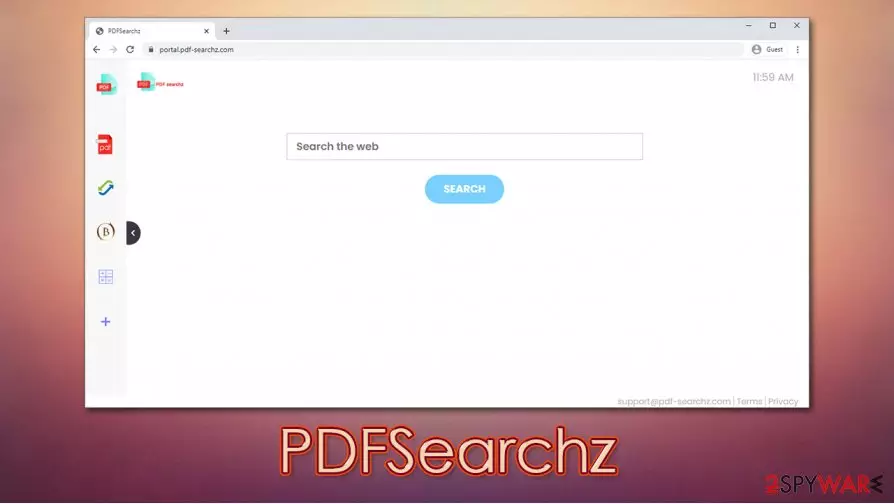
PDFSearchz is yet another creation of potentially unwanted program developers. Since it mainly spreads via software bundles and other deceptive channels, many users find the extension on Google Chrome, Mozilla Firefox, Safari, or MS Edge, seemingly out of nowhere. Once installed, it would perform several browser changes, including modification to the homepage and new tab address (it is set to portal.pdf-searchz.com). After the hijack, the PUP would redirect all searches to Yahoo, insert intrusive ads, and track user activity for marketing purposes.
| Name | PDFSearchz |
|---|---|
| Type | Browser hijacker, potentially unwanted program |
| IP address | 104.27.169.69 |
| Distribution | Software bundles, deceptive ads, fake update prompts |
| Symptoms | An extension or application is installed on the system; homepage and new tab address are set to portal.pdf-searchz.com; search results redirect to search.yahoo.com; a customized search engine is appended to the homepage; search results are filled with sponsored links and ads |
| Risks | Installation of other potentially unwanted programs, privacy risks due to information gathering practices, financial losses |
| Removal | You can uninstall potentially unwanted programs by following the manual guide below or by scanning the computer with powerful anti-malware |
| Optional steps | Computer infections can cause significant damage to system files or disrupt normal settings. To revert these changes and remediate the OS, perform a full system scan with FortectIntego repair software |
PDFSearchz hijacker belongs to a broader group of PUPs that are most commonly rebranded and distributed as a new product. Previously-released apps include HDSportSearchs, MovieSearches, FunSearchToday, and many others. These apps are almost virtually identical, as the only difference is the icon used to promote them. Otherwise, the functionality remains the same – to hijack user browsers and deliver sponsored content, earning profits in the process.
And, since PDFSearchz most commonly gains access to users' computers in deceptive methods such as software bundling, the developers include several attributes to make people keep it installed for as long as possible. For that, the hijacker inserts seemingly useful features, such as a cryptocurrency converter or a calculator. However, don't let these features deceive you – there is very little use of them.
Since the so-called PDFSearchz virus engages in the browser modifications, users always find the portal.pdf-searchz.com as their homepage, new tab, and search engine address. When used, users will quickly notice that Google is redirecting to Yahoo, and that search results look nothing like they are used to.
Despite Yahoo being a legitimate and trusted search engine, the browser hijacker inserts sponsored links to unknown websites. Since they are placed at the top of search results, users are likely to click on them, generating profits for the developers though the pay-per-click[1] scheme. The only way to stop this behavior is to remove PDFSearchz from their web browsers or computers.

Another deceptive trait of a browser hijacker is that it is set to spy on users' online behavior. With the help of cookies, web beacons, and similar technologies, the developers of the app are capable of spying on users' searches, visited websites, clicked links, IP address, ISP provider, and much more. This behavior is described on portal.pdf-searchz.com's Privacy Policy page:[2]
Non-Personal Information may be automatically transmitted by the user's device. When using our Service, we assign your device with a log file, a cookie (session or persistent), web beacons or other related technologies, to collect Non-Personal Information with respect to your activity in connection with our Service.
While in most cases the PDFSearchz hijack is related to an extension that is likely to be clipped to the web browser, it might be difficult to eliminate, as previous members of the hijacker family used to apply “Managed by your organization” feature. This would prevent users from uninstalling the extension easily.
However, there are ways to bypass this when attempting PDFSearchz removal. In most cases, users should be able to delete the extension in a regular way. If not successful, you should try to clean the web browser as instructed in the guidelines below. It is also recommended to scan the machine with anti-malware tools and then attempt repair Windows damage with FortectIntego.
PUPs spread through software bundles – use correct installation settings of freeware
Most users are aware that malicious programs exist somewhere on the internet and by now know that downloading suspicious executables can be dangerous. However, potentially unwanted applications are being spread around regularly, and what users describe as “stealthy installation” is not that mysterious after all. This is because PUP authors and distributors employ software bundle packages to install apps behind less cautions users' backs.
While bundles can be encountered on most third-party sites,[3] freeware apps are where the issue lies. The main goal of distributing “free” software is showing visitors ads or making them install applications that never intended in the first place (there is no such a thing as completely free software unless it is open source). To slip in PUPs, developers employ pre-ticked boxes, fine print text, misleading button placements, and other tricks that would make users not notice the optional components within the installer.

Therefore, it is vital to be vigilant when installing new apps on the system. You should never rush through steps, read the installation instructions carefully, and, most importantly, always choose the Advanced or Custom settings rather than Recommended ones. If the latter is chosen, you automatically agree to install apps you know nothing about. Also, a robust security application can warn you about PUPs, so you should keep an updated anti-malware on your system at all times.
PDFSearchz removal options
As mentioned above, you will most commonly encounter a browser hijacker as an extension that is appended to your web browser. Thus, to remove PDFSearchz hijack from your system, you need to locate and eliminate the unwanted add-on. This way, you will get rid of the changed browser settings and redirects to sponsored sites. To find out how to clean your web browser and delete extensions, you can check the instructions provided below. In case the browser hijack is not related to the extension, you can also look for programs installed on your Windows or Mac system.
If you struggle with PDFSearchz removal for some reason, you can try to reset your web browser and scan the machine with a powerful anti-malware tool, such as SpyHunterCombo Cleaner or MalwarebytesMalwarebytes. This way, you could also find and delete other potentially unwanted applications and malware that could be completely invisible otherwise.
Uninstall from Windows
Uninstall from Windows 10/8:
- Type Control Panel into the Windows search box and open the result.
- Under Programs, select Uninstall a program.


Uninstall from Windows 7/XP:
- Click on Windows Start > Control Panel (Windows XP users should click on Add/Remove Programs).
- In Control Panel, select Programs > Uninstall a program.


Remove the unwanted program:
- In the Programs and Features window, look for any recently installed suspicious entries, select them, and click Uninstall.
- If User Account Control appears, click Yes to confirm, then complete the removal.


Delete from macOS
Remove the unwanted application:
- From the menu bar, select Go > Applications.
- In the Applications folder, look for any suspicious entries, then drag them to Trash (or right-click and pick Move to Trash).


Delete leftover files and folders:
- Select Go > Go to Folder.
- Enter /Library/Application Support and remove any suspicious folders related to the unwanted program.
- Repeat the same check in the /Library/LaunchAgents and /Library/LaunchDaemons folders, deleting any suspicious entries.

- Finally, empty the Trash to permanently remove the leftovers.

Reset Internet Explorer
Remove dangerous add-ons:
- Open Internet Explorer, click on the Gear icon (IE menu) on the top-right corner of the browser
- Pick Manage Add-ons.
- You will see a Manage Add-ons window. Here, look for suspicious plugins. Click on these entries and select Disable.


Change your homepage if it was altered:
- Open IE and click on the Gear icon.
- Select Internet Options.
- In the General tab, delete the Home page address and replace it by your preferred one (for example, Google.com).
- Click Apply and then select OK.


Delete temporary files:
- Press on the Gear icon and select Internet Options.
- Under Browsing history, click Delete...
- Select relevant fields and press Delete.


Reset Internet Explorer:
- Click on Gear icon > Internet options and select Advanced tab.
- Select Reset.
- In the new window, check Delete personal settings and select Reset.


Remove from Microsoft Edge
Delete unwanted extensions from MS Edge:
- Select Menu (three horizontal dots at the top-right of the browser window) and pick Extensions.
- From the list, pick the extension and click on the Gear icon.
- Click Remove.


Clear cookies and other browser data:
- Click on the Menu (three horizontal dots at the top-right of the browser window) and select Settings > Privacy, search, and services..
- Under Clear browsing data, pick Choose what to clear.
- Select Cookies and other site data and Cached images and files. (apart from passwords, although you might want to include Media licenses as well, if applicable) and click on Clear.


Restore new tab and homepage settings:
- Click the menu icon and choose Settings.
- Then find On startup section.
- Click Remove next to any suspicious startup page.
Reset MS Edge if the above steps did not work:
- Press on Ctrl + Shift + Esc to open Task Manager.
- Click on More details arrow at the bottom of the window.
- Select Details tab.
- Now scroll down and locate every entry with Microsoft Edge name in it. Right-click on each of them and select End Task to stop MS Edge from running.


Instructions for Chromium-based Edge
Delete extensions from MS Edge (Chromium):
- Open Edge and click select Settings > Extensions.
- Delete unwanted extensions by clicking Remove.


Clear cache and site data:
- Click on Menu and go to Settings.
- Select Privacy, search and services.
- Under Clear browsing data, pick Choose what to clear.
- Under Time range, pick All time.
- Select Clear now.


Reset Chromium-based MS Edge:
- Click on Menu and select Settings.
- On the left side, pick Reset settings.
- Select Restore settings to their default values.
- Confirm with Reset.
- This will disable extensions and reset startup pages but will not delete bookmarks, saved passwords, or browsing history.


Remove from Mozilla Firefox (FF)
Remove dangerous extensions:
- Open Mozilla Firefox browser and click on the Menu (three horizontal lines at the top-right of the window).
- Select Add-ons.
- In here, select the unwanted extension and click Remove.


Reset the homepage:
- Click three horizontal lines at the top right corner to open the menu.
- Choose Settings.
- Under Home, set your preferred homepage and new tab settings.
Clear cookies and site data:
- Click Menu and pick Settings.
- Go to Privacy & Security section.
- Scroll down to locate Cookies and Site Data.
- Click on Clear Data...
- Select Cookies and Site Data and Temporary cached files and pages, then click Clear.


Reset Mozilla Firefox
If clearing the browser as explained above did not help, reset Mozilla Firefox:
- Open Mozilla Firefox browser and click the Menu.
- Go to Help and then choose Troubleshooting Information.

- Under Give Firefox a tune up section, click on Refresh Firefox...
- Once the pop-up shows up, confirm the action by pressing on Refresh Firefox.



Remove from Google Chrome
Delete malicious extensions from Google Chrome:
- Open Google Chrome, click on the Menu (three vertical dots at the top-right corner) and select More tools > Extensions.
- In the newly opened window, you will see all the installed extensions. Uninstall all suspicious extensions related to the unwanted program by clicking Remove.


Clear cache and web data from Chrome:
- Click on Menu and pick Settings.
- Under Privacy and security, select Clear browsing data.
- Select Browsing history, Cookies and other site data, as well as Cached images and files.
- Click Clear data.


Change your homepage:
- Click menu and choose Settings.
- Look for a suspicious site in the On startup section.
- Click on Open a specific or set of pages and click on three dots to find the Remove option.
Reset Google Chrome:
If the previous methods did not help you, reset Google Chrome to eliminate all the unwanted components:
- Click on Menu and select Settings.
- In the Settings, scroll down and click Advanced.
- Scroll down and locate Reset and clean up section.
- Now click Restore settings to their original defaults.
- Confirm with Reset settings.


Delete from Safari
Remove dangerous extensions:
- Open Safari, click Safari in the menu at the top-left of the screen, and select Preferences.
- Go to the Extensions tab, look for any suspicious entries, and click Uninstall to remove them.


Clear history and website data:
- Click Safari in the menu and pick Clear History.
- Set Clear to all history and confirm with Clear History.


Reset Safari:
- Click Safari in the menu and select Preferences > Advanced.
- Enable Show Develop menu in menu bar.
- From the menu bar, click Develop and select Empty Caches.


Did this guide help?
Be the first to comment