

WireNavigate is a malicious Mac application that changes your browser preferences and feeds intrusive ads
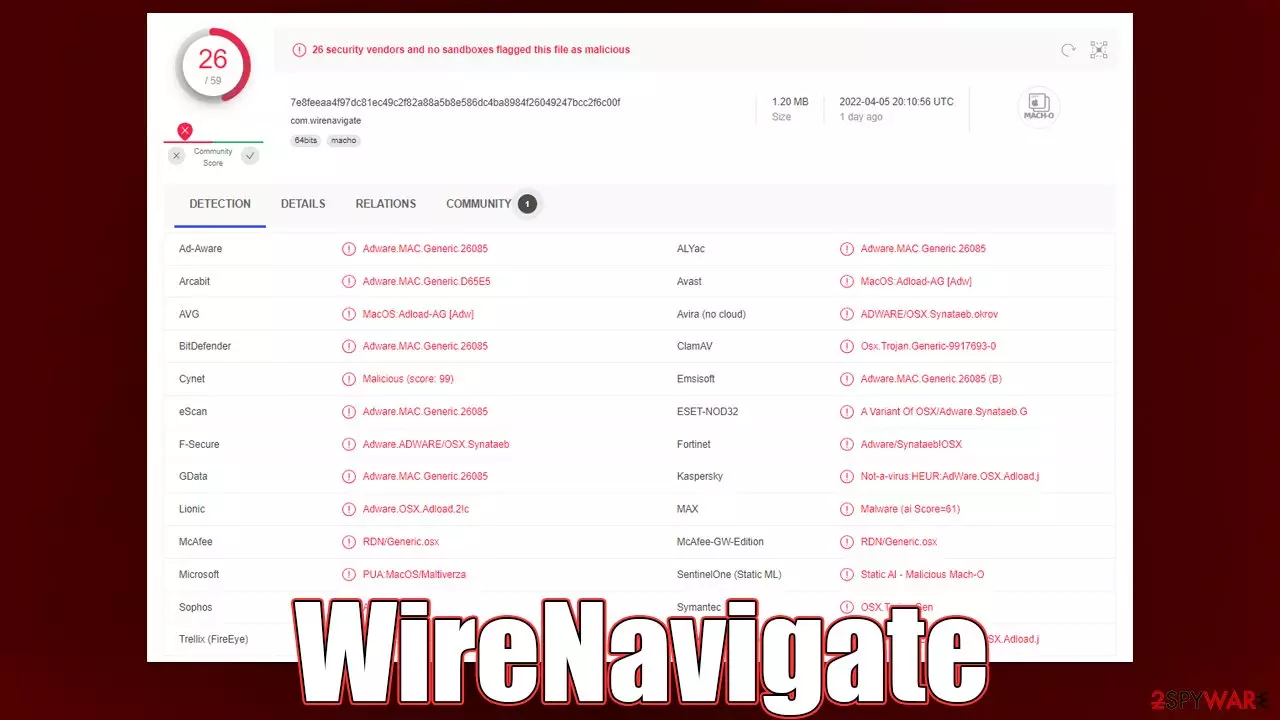
WireNavigate is yet another version of the widespread malware strain targeting Mac systems known as Adload. The malicious app is not installed intentionally, but users are frequently tricked into doing so when visiting insecure websites or downloading cracked applications. Fake Flash Player updates[1] are among the most common reasons for malware infections on macOS.
Once installed, WireNavigate appends its own browser extension onto Safari, Chrome, or another used web browser, which becomes impossible to eliminate in a regular way. It can gather personal information, such as credit card details or passwords, for as long as it is active. Thus, it is recommended not to enter any sensitive data before it's fully removed.
The virus also alters the default browser settings, sometimes appending a different homepage and the search provider (Yahoo or Safe Finder are most commonly used, although this might vary). As a result, generated results are no longer the same, as sponsored links and ads replace the top ones. Clicking these is not recommended, as you might be directed to malicious websites, resulting in malware infections of personal information disclosure.
WireNavigate Mac virus might be a pain to eliminate manually due to its simple yet effective persistence methods. Below we provide detailed instructions on how to get rid of the virus and ensure that the device would operate smoothly post-infection.
| name | WireNavigate |
|---|---|
| Type | Mac virus, adware, browser hijacker |
| Family | Adload |
| Distribution | Flash Player installers or bundled along illegal software downloaded from torrent and similar sites |
| Symptoms | An extension installed on the browser with elevated permissions, along with an application of the same name; new profiles and login items set up on the account; malicious ads shown during web browsing activities; search and browsing settings altered to Safe Finder or another search provider |
| Risks | Installation of other PUAs or malware without permission, personal information theft, monetary losses |
| Removal | To remove malware easily, employ SpyHunterCombo Cleaner security software. Manual steps are also provided below |
| Other tips | Clean your browsers accordingly once the virus is eliminated – you can use FortectIntego to speed up this process |
Previous versions
Adload is truly an expansive malware family, with hundreds upon hundreds of versions. First released in late 2017,[2] the strain has been using simple distribution and operation principles; this proved to be extremely successful and malware had since then been associated with other strains, including Shlayer Trojan or CrescentCore. This is why it is important to make sure that WireNavigate removal and all the other infections are removed as soon as possible.
Members of this malware family always use a distinct naming pattern, combining words such as “Service,” “Guide,” “System,” and similar. Great examples of such practices are GuideService, OnlinePlatform, ProfessionalHelper, and similar. All these malicious apps use a distinctive magnifying glass icon, most recently seen on the gray background.

Removal steps
Regardless of how the virus is installed, users always have to type in their Apple ID before installing the application. Thus, they give their permission to do so, and thanks to several tricks VirtualGuest uses, it manages to root itself well within the system. To be more precise, AppleScript is commonly used to make changes to the infected systems, and new Login Items, Profiles, Plist files, and other items are created automatically.
Because of this, the easiest way to remove the infection is by employing powerful anti-malware software, such as SpyHunterCombo Cleaner or MalwarebytesMalwarebytes. A third-party anti-malware can also provide significantly higher protection when employed along with Mac's built-in defenses, so it creates a much safer environment on the device.
We also provide manual instructions below if you decide to go that route. In fact, combining both methods would probably yield the best results; if you believe that manual steps are too complicated, simply leave that job for the security software. Nonetheless, we do recommend cleaning web browsers regardless of which approach you are to take.
Remove the app and get rid of its files
Before you begin, you should make sure that malware's processes are no longer running; then, find and remove the main application by moving it to Trash.
- Open Applications folder
- Select Utilities
- Double-click Activity Monitor
- Here, look for suspicious processes related to adware and use the Force Quit command to shut them down
- Go back to the Applications folder
- Find UpgradedPlatform in the list and move it to Trash.
If the previous step was unsuccessful, it could be because of Login items and Profiles created by the WireNavigate virus. Remove them as follows:
- Go to Preferences and pick Accounts
- Click Login items and delete everything suspicious
- Next, pick System Preferences > Users & Groups
- Find Profiles and remove unwanted profiles from the list.
The PLIST files are small config files, also known as “Properly list.” They hold various user settings and hold information about certain applications. In order to remove the virus, you have to find the related PLIST files and remove them.
- Select Go > Go to Folder.
- Enter /Library/Application Support and click Go or press Enter.
- In the Application Support folder, look for any dubious entries and then delete them.
- Now enter /Library/LaunchAgents and /Library/LaunchDaemons folders the same way and terminate all the related .plist files.


Take care of the browser
Typically, Adload versions install a browser extension with elevated permissions by dropping malicious files on the system. If you managed to delete them successfully, as explained in the previous section, you should be able to eliminate the extension without too much trouble.
Safari
- Click Safari > Preferences…
- In the new window, pick Extensions.
- Select the unwanted extension and select Uninstall.


Google Chrome
- Open Google Chrome, click on the Menu (three vertical dots at the top-right corner) and select More tools > Extensions.
- In the newly opened window, you will see all the installed extensions. Uninstall all the suspicious plugins that might be related to the unwanted program by clicking Remove.


Your next step is to ensure that your browser caches are cleaned. Adware and malware often insert trackers into web browsers, which are then stored locally – cookies[3] are perfect examples of such. They can remain on the device for years if not removed. Therefore, you should always clean your browsers regularly, especially after the removal of adware.
The easiest way to do so is by employing FortectIntego maintenance utility. If you rather do it manually, proceed with the following steps:
Safari
- Click Safari > Clear History…
- From the drop-down menu under Clear, pick all history.
- Confirm with Clear History.


Google Chrome
- Click on Menu and pick Settings.
- Under Privacy and security, select Clear browsing data.
- Select Browsing history, Cookies and other site data, as well as Cached images and files.
- Click Clear data.


If you were unable to eradicate malware components within your web browser, you could simply reset it as we explain below. Your bookmarks and other preferences will not get lost as long as you remember your account details. Proceed with the following to reset your browser:
Safari
- Click Safari > Preferences…
- Go to Advanced tab.
- Tick the Show Develop menu in menu bar.
- From the menu bar, click Develop, and then select Empty Caches.


Google Chrome
- Click on Menu and select Settings.
- In the Settings, scroll down and click Advanced.
- Scroll down and locate Reset and clean up section.
- Now click Restore settings to their original defaults.
- Confirm with Reset settings.


If you are using MS Edge or Mozilla Firefox, check out the instructions below.
Remove from Microsoft Edge
Delete unwanted extensions from MS Edge:
- Select Menu (three horizontal dots at the top-right of the browser window) and pick Extensions.
- From the list, pick the extension and click on the Gear icon.
- Click Remove.


Clear cookies and other browser data:
- Click on the Menu (three horizontal dots at the top-right of the browser window) and select Settings > Privacy, search, and services..
- Under Clear browsing data, pick Choose what to clear.
- Select Cookies and other site data and Cached images and files. (apart from passwords, although you might want to include Media licenses as well, if applicable) and click on Clear.


Restore new tab and homepage settings:
- Click the menu icon and choose Settings.
- Then find On startup section.
- Click Remove next to any suspicious startup page.
Reset MS Edge if the above steps did not work:
- Press on Ctrl + Shift + Esc to open Task Manager.
- Click on More details arrow at the bottom of the window.
- Select Details tab.
- Now scroll down and locate every entry with Microsoft Edge name in it. Right-click on each of them and select End Task to stop MS Edge from running.


Instructions for Chromium-based Edge
Delete extensions from MS Edge (Chromium):
- Open Edge and click select Settings > Extensions.
- Delete unwanted extensions by clicking Remove.


Clear cache and site data:
- Click on Menu and go to Settings.
- Select Privacy, search and services.
- Under Clear browsing data, pick Choose what to clear.
- Under Time range, pick All time.
- Select Clear now.


Reset Chromium-based MS Edge:
- Click on Menu and select Settings.
- On the left side, pick Reset settings.
- Select Restore settings to their default values.
- Confirm with Reset.
- This will disable extensions and reset startup pages but will not delete bookmarks, saved passwords, or browsing history.


Remove from Mozilla Firefox (FF)
Remove dangerous extensions:
- Open Mozilla Firefox browser and click on the Menu (three horizontal lines at the top-right of the window).
- Select Add-ons.
- In here, select the unwanted extension and click Remove.


Reset the homepage:
- Click three horizontal lines at the top right corner to open the menu.
- Choose Settings.
- Under Home, set your preferred homepage and new tab settings.
Clear cookies and site data:
- Click Menu and pick Settings.
- Go to Privacy & Security section.
- Scroll down to locate Cookies and Site Data.
- Click on Clear Data...
- Select Cookies and Site Data and Temporary cached files and pages, then click Clear.


Reset Mozilla Firefox
If clearing the browser as explained above did not help, reset Mozilla Firefox:
- Open Mozilla Firefox browser and click the Menu.
- Go to Help and then choose Troubleshooting Information.

- Under Give Firefox a tune up section, click on Refresh Firefox...
- Once the pop-up shows up, confirm the action by pressing on Refresh Firefox.



Did this guide help?
Be the first to comment