
Program file
chrome_elf.dll: part of Google Chrome, another Chromium browser, or something you never installed?
chrome_elf.dll is the Chrome Early Loading Framework, the first library chrome.exe loads when Google Chrome starts. A copy in Chrome's version folder is normal. Every browser built on Chromium carries its own copy, so the file also shows up with browsers that free software installers bring along, and a copy there needs a closer look at the browser itself.
Prefer to check it yourself? The manual checks follow.
A chrome_elf.dll in a version folder under Google\Chrome\Application, describing itself as Google Chrome and signed by Google LLC, is the genuine file. It is not a process of its own: chrome.exe loads it first, before any other library, and every Chrome window and tab process loads it again. Two version folders during an update are normal too.
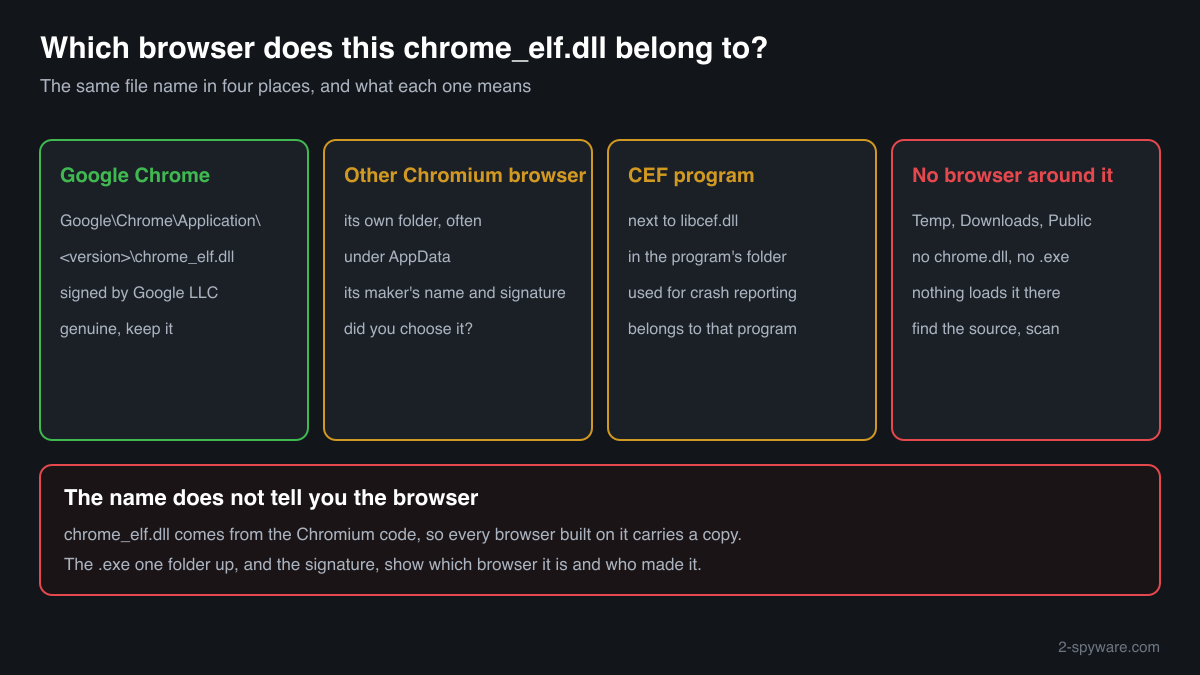
The name says nothing about which browser it belongs to. The same file comes with every Chromium-based browser, including unwanted ones that arrive bundled with free downloads, and a copy alone in Temp, Downloads or an odd AppData folder belongs to no browser at all.
- Publisher
- Google LLC for Chrome (Google Inc. in older builds); other Chromium browsers put their own company name in the file
- Description in the file
- Google Chrome, or the name of the browser that ships it, such as Chromium
- Belongs to
- Google Chrome and every browser built from the Chromium code, and programs built on the Chromium Embedded Framework, which use it for crash reporting
- Genuine folder
- C:\Program Files\Google\Chrome\Application\<version>\, or the same path under %LOCALAPPDATA%\Google\Chrome for a per-user install. Never in C:\Windows
- Size
- Small: about 120 KB to 1 MB across the Google copies collected in a public DLL catalogue, growing with newer versions
- Signed by
- Google LLC for Chrome; another browser's copy should carry its own maker's signature
- Runs as a process
- No. It is a library loaded into chrome.exe, or into the .exe of the browser that ships it
- Found with
- chrome.dll and the other files of the same version folder, with chrome.exe or another browser's .exe one folder up
What chrome_elf.dll does
Chromium's own documentation describes chrome_elf.dll as the Chrome Early Loading Framework: a way to run code very early during process start-up, before other imported DLLs such as kernel32. Chrome's entry point on Windows is the DllMain of chrome_elf.dll, and the build places it as the first import of chrome.exe. Running first lets the browser patch system functions that map libraries into the process, which gives it control over which outside DLLs can load into it.
The file also starts the crash reporter early, which is why programs built on the Chromium Embedded Framework ship chrome_elf.dll next to libcef.dll. Because all of this comes from open-source code, any browser built on Chromium carries a chrome_elf.dll of its own. The file is therefore no proof that Google Chrome is installed: the question is which browser's folder it sits in, and whether you chose that browser.
About .dll files. A .dll file is a library: it cannot run on its own and is loaded into a program's process. It does not appear in Task Manager under its own name; Process Explorer shows which process loaded it.
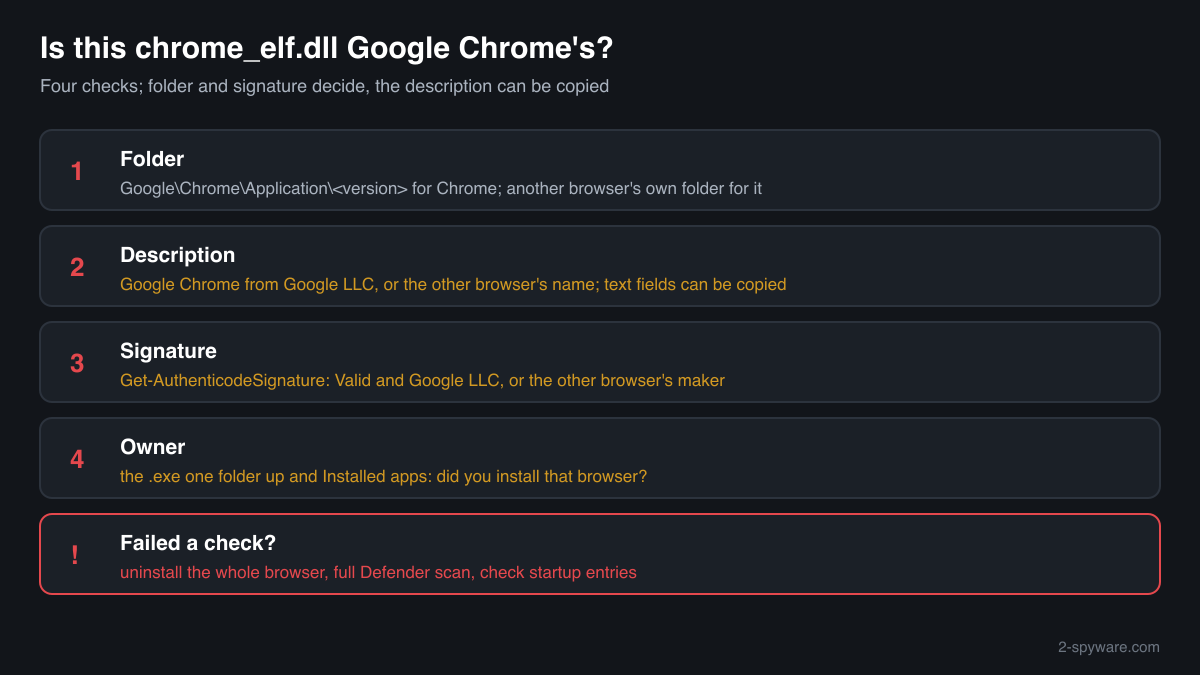
How to check a copy of chrome_elf.dll
Four questions decide it: where the file is, which browser's files surround it, who signed it, and whether you installed that browser yourself. A library never shows in Task Manager under its own name, so use these checks.
- List every copy and where it sits. Copies under Google\Chrome\Application\<version> are Chrome's. Copies in another browser's folder belong to that browser. Look closer at copies in Temp, Downloads, Public or an AppData folder with a name you do not recognise.
Get-ChildItem -Path C:\ -Filter chrome_elf.dll -Recurse -ErrorAction SilentlyContinue | Select-Object FullName, Length, LastWriteTime - Read the version resource. Chrome's copy reports Google LLC (or Google Inc.) as the company and Google Chrome as the description, with the Chrome version as file version. Another browser's copy names that browser. Empty fields deserve a closer look, but text fields can be copied, so they never clear a file alone.
(Get-Item "C:\path\to\chrome_elf.dll").VersionInfo | Format-List CompanyName, FileDescription, FileVersion - Check the digital signature. Status Valid with a Google LLC signer means an unmodified Chrome build. A Chromium-based browser from a known maker is signed by that maker. NotSigned or HashMismatch means the file is not as its maker shipped it.
Get-AuthenticodeSignature "C:\path\to\chrome_elf.dll" | Format-List Status, SignerCertificate - Find the browser it belongs to. Go one folder up from the version folder and look at the .exe there. Then open Settings, Apps, Installed apps and look for that browser. A browser you do not remember installing, especially one that appeared together with a free program, is the real finding, not the DLL.
- Compare the size and checksum. Use the file check on this page. Google's builds in the catalogue range from about 120 KB to 1 MB. A match identifies a known copy; no match is not proof of a fake, because Chrome builds a new chrome_elf.dll for every version. The signature check above is the deciding one.
A valid signature clears that one file. It does not tell you whether you wanted the browser it came with, and a browser you never chose can change your search engine, start page and notifications with genuine, signed files.
Check your chrome_elf.dll
Choose the chrome_elf.dll you are unsure about. Its SHA-256 and SHA-1 checksums are calculated in your browser and compared with the 170 versions of the file known from a public DLL catalogue.
The file stays on your computer. Nothing is uploaded: the checksum is computed locally.
Do you need chrome_elf.dll?
Keep every copy inside the browsers and programs you use: without it the browser does not start. A copy that belongs to a browser you never chose goes away with that browser, so remove the browser, not the DLL.
- Leave Chrome's copy alone. A copy in Google\Chrome\Application belongs to Chrome. Deleting it only stops Chrome from starting; the browser's own installer is the way to replace one that is damaged or flagged.
- Uninstall a Chromium-based browser you did not choose. Open Settings, Apps, Installed apps, find the browser and uninstall it. If it has no uninstaller and sits under AppData, close it in Task Manager first, then delete its whole folder, not only chrome_elf.dll.
- Remove the program it came with. Sort Installed apps by install date. Unwanted browsers usually arrive with a free tool, converter or game installed on the same day. Uninstall what you do not recognise from that day.
- Run a Microsoft Defender full scan. Open Windows Security, Virus and threat protection, Scan options, Full scan. Quarantine what it finds and look at Protection history afterwards for anything in Downloads, Temp or AppData.
- Check what starts with Windows. Open Task Manager, Startup apps, and Task Scheduler. Disable entries that start a browser or an updater from AppData that you do not recognise, after the browser itself is gone.
- Clean up the browser you keep. In the browser you use, check the default search engine, the start page, the extensions and the sites allowed to send notifications. Unwanted browsers and the installers that bring them often change these as well.
Warning signs
| What you see | What it means |
|---|---|
| chrome_elf.dll in a folder of a browser you never installed | A Chromium-based browser came with other software. Uninstall that browser. |
| chrome_elf.dll alone in Temp, Downloads or Public, with no browser files next to it | No browser loads it there. Find out where it came from and scan. |
| The signature check shows NotSigned or HashMismatch | The file is not as its maker shipped it. |
| A copy that says Google Chrome but sits outside Google\Chrome\Application | The text fields were copied. Check the signature and the .exe it belongs to. |
| Your search engine or start page changed when a new browser appeared | Typical of unwanted browsers bundled with free downloads. |
| Two version folders in Chrome's Application folder, each with chrome_elf.dll | Normal during an update. Chrome removes the old folder itself. |
Known versions of chrome_elf.dll
A public DLL catalogue lists 170 versions of chrome_elf.dll, from 0.0.0.0 to 88.0.4285.3, by Google LLC. Its copies are uploaded by users and not verified, so a checksum match identifies the version, while the digital signature tells you whether the file is genuine. Even a genuine file clears only the file, not the folder: attackers ship genuine libraries next to a program they abuse, so where the copy sits still decides whether it is safe.
Every version with its checksums, and how to fix chrome_elf.dll errors on uGetFix
Questions people ask
Is chrome_elf.dll a virus?
No, Google's chrome_elf.dll is a harmless part of Chrome, signed by Google LLC and kept in Chrome's version folder. The name also appears in every other browser built on Chromium, including unwanted ones that free software installers add. A copy in Chrome's folder with Google's signature is the genuine file. A copy anywhere else needs the checks on this page.
Why is there a chrome_elf.dll in AppData?
Chrome installed for one user lives under %LOCALAPPDATA%\Google\Chrome, so a copy there can be genuine. Other Chromium-based browsers also install per user under AppData without asking for administrator rights, which is how unwanted ones get in. Look at the folder name and the .exe one level up to see which browser it is.
Why do I have chrome_elf.dll if I do not use Chrome?
Because the file is part of Chromium, not only of Chrome. Any browser built on it carries a copy, and programs built on the Chromium Embedded Framework ship it next to libcef.dll for crash reporting. Find the folder it is in: the program there is the owner, and you decide whether you want that program.
How can I tell Google's chrome_elf.dll from another browser's?
Check three things. The folder: Google\Chrome\Application\<version> is where Chrome keeps it. The signature: Get-AuthenticodeSignature should show Valid and Google LLC. The neighbours: chrome.exe one folder up. A copy that says Google Chrome but sits in another folder, or carries no signature, is not Chrome's file as Google shipped it.
Can I delete chrome_elf.dll?
You can, but the browser it belongs to stops starting, because chrome_elf.dll is the first library it loads. Deleting it from Chrome gains nothing. If it belongs to a browser you did not choose, uninstall that whole browser in Settings, Apps, Installed apps and run a Microsoft Defender full scan, rather than deleting only the DLL.
Why does chrome_elf.dll load before everything else?
So that the browser can watch and control which libraries get mapped into it from the very start, and so that its crash reporter is ready before anything can fail. Chromium's build places chrome_elf.dll as the first import of chrome.exe for that reason. Outside software that pushes its own DLLs into the browser meets this file first.
Sources
- Chromium source: Chrome Early Loading Framework (ELF) README
- Chromium Embedded Framework issue 1995: Migrate from breakpad to crashpad
- Microsoft Learn: Get-AuthenticodeSignature
Version data read on Oct 18, 2026.
Questions and experiences
Ask about this page: members and our editors answer. Reading is open; writing needs a free account.
…